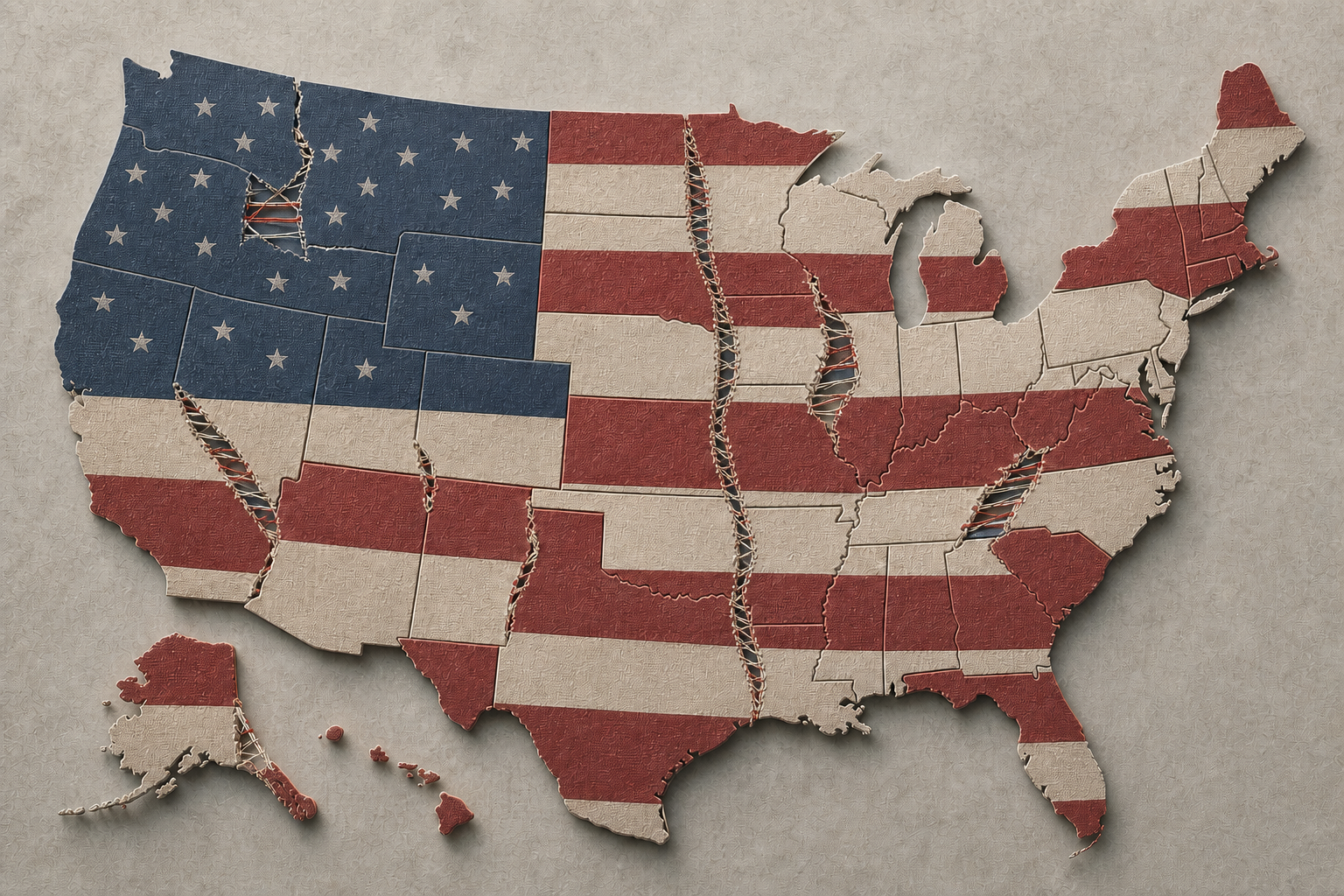
Your Outrage Isn't Just Heard by Campaigns — It's Harvested, and Both Parties Built the Machine
Every "BREAKING: we're finished, DONATE NOW" text treats an ordinary Tuesday as the end of the world — because fear and anger are the two feelings that reliably open a wallet. Behind those messages sits an industry: fundraising platforms, PAC operators, and consultants whose paychecks go up when you believe the other side is about to destroy the country. Some of it crossed into outright traps — pre-checked boxes that charged donors again and again until their banks flagged fraud. Republicans and Democrats both run this machine. Here's how it works, and how to stop feeding it.
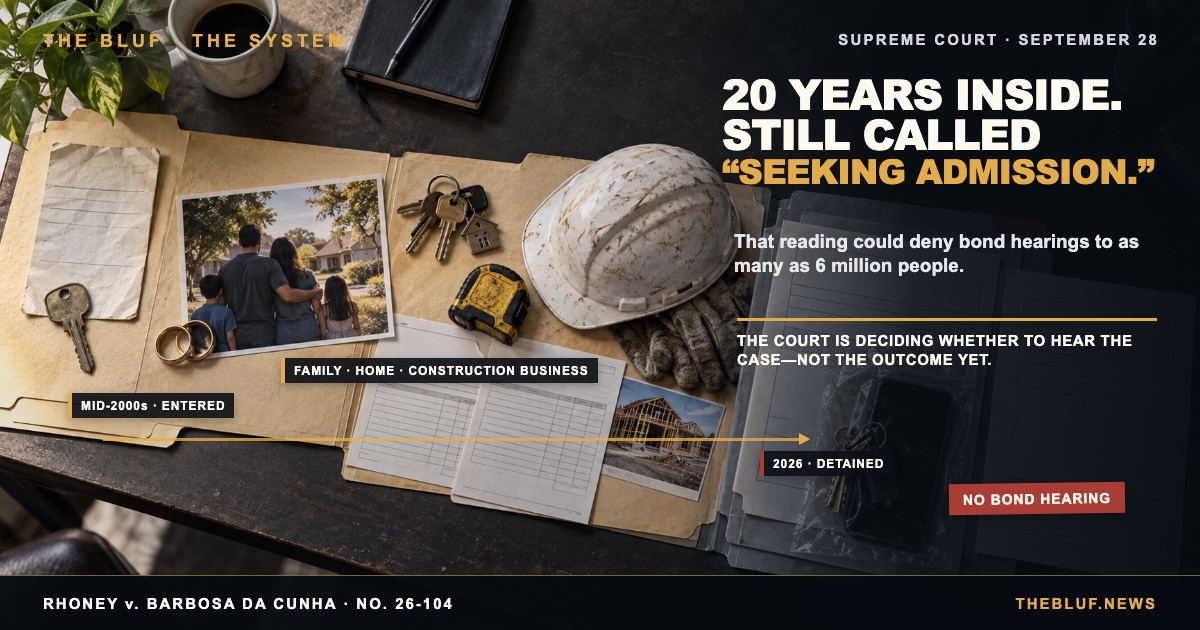
The Supreme Court Decides This Week Whether to Hear a Case That Could Let ICE Detain Millions Without a Bond Hearing
Ricardo Barbosa da Cunha lived in Massachusetts for two decades, married, had two kids, and ran a small construction business -- then immigration agents arrested him and said he wasn't entitled to a bond hearing, ever, under a new reading of a 30-year-old law. Nine of 11 federal appeals courts say that reading is wrong. On September 28, the Supreme Court decides whether to even hear the government's appeal of his case -- a decision that could reach as many as 6 million people.
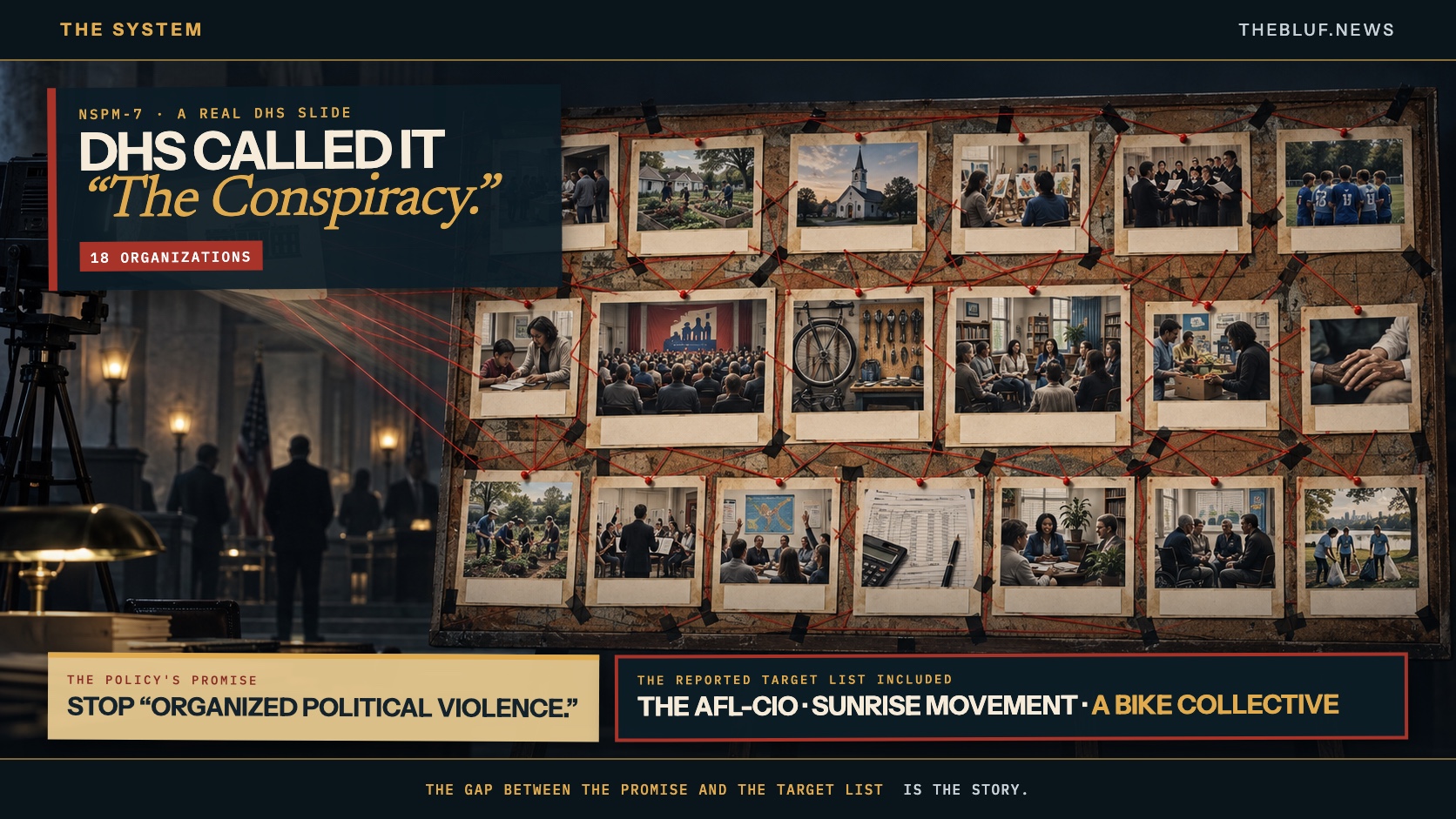
This Order Was Sold as Stopping Political Violence. Here's How It Got Weaponized Instead.
Last September, Trump signed an order to stop "organized political violence." Since then, the government has used it to spy on America's largest union, investigate nonprofits' bank records, and help a state brand a Muslim civil rights group "terrorists" — while the one time it's produced an actual terrorism conviction, the "threat" it caught was a small group that had already shot at a police officer. That gap between what this policy was sold as and who it's actually hit is the story.
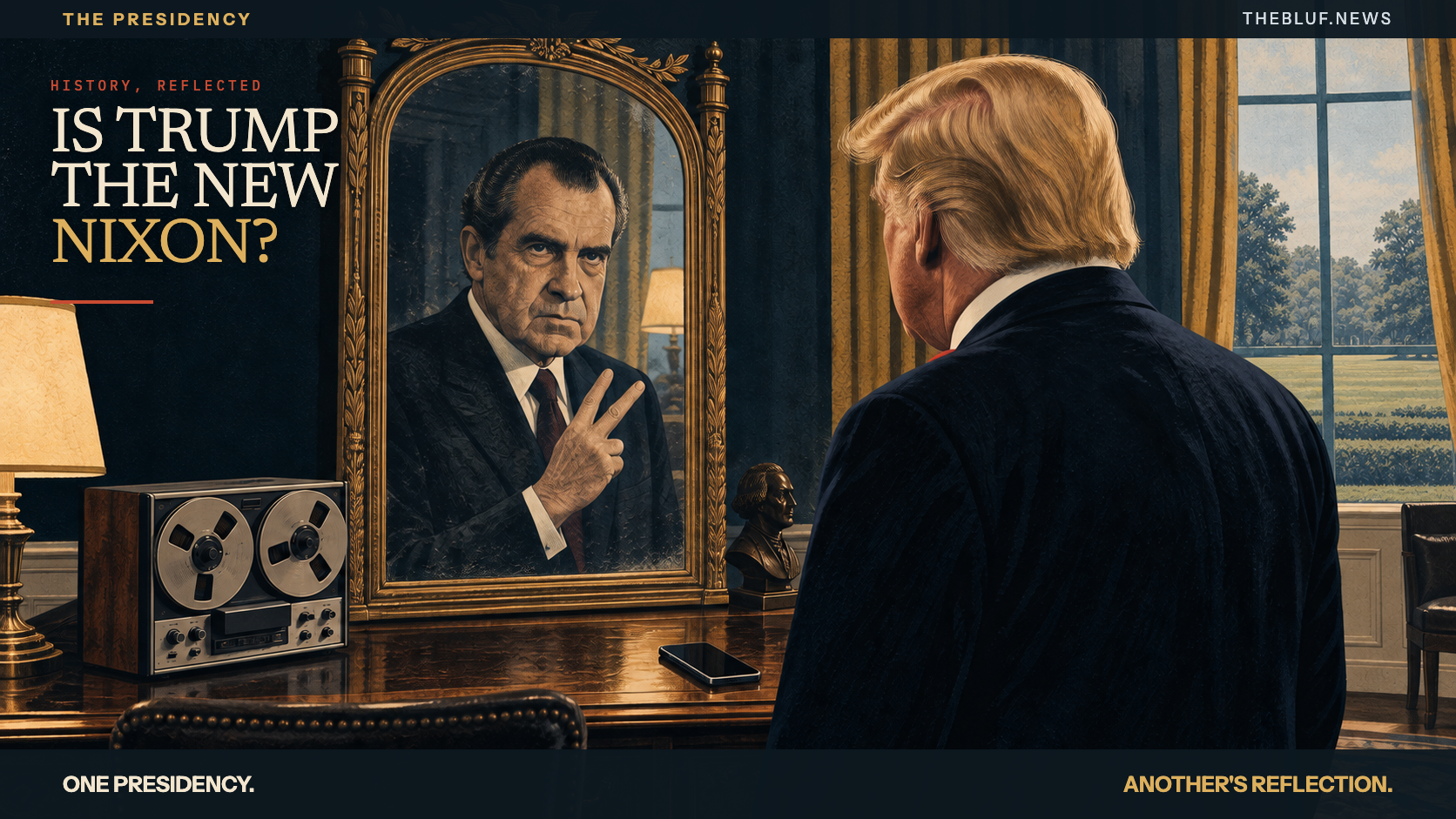
Is Trump the New Nixon?
The comparisons that hold up are real. So are the ones that don't. The interesting part isn't which -- it's why the outcome changed. Nixon's own party told him to his face it was over. Trump's party never has -- and the reasons why are structural, not moral.
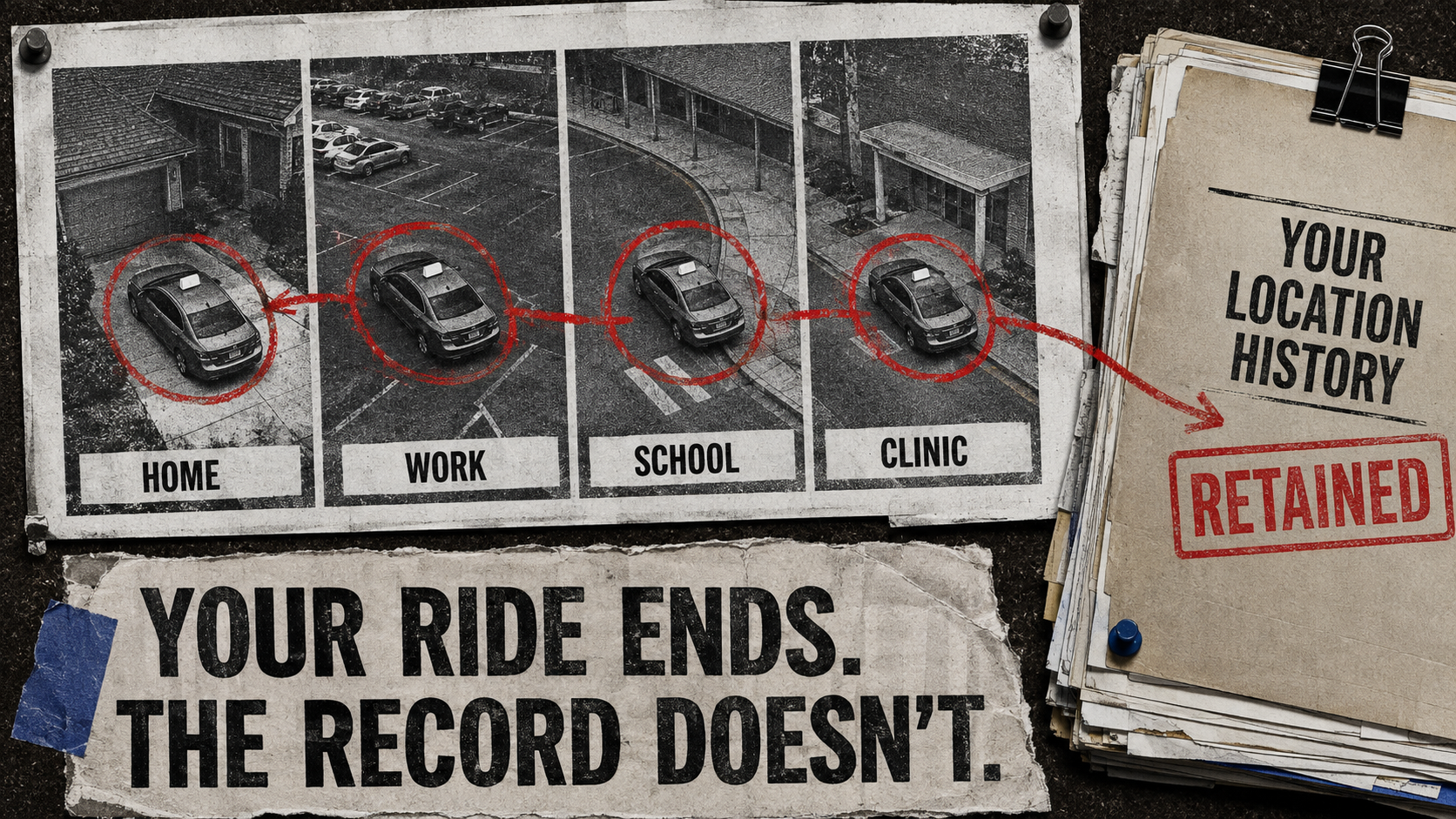
Uber Built Secret Tools to Track Cops and Rivals. Now It's the Only One of the Four Telling You How Long It Keeps Your Data.
For years, Uber ran secret software that identified undercover police and served them a fake app so they could never catch a ride. A separate Uber tool tracked Lyft's own drivers. A third remotely wiped company laptops the second police raided a foreign office. All three were built to control what outsiders could see. Uber says the tool for tracking regulators is retired — it pledged in March 2017 to stop using it against law enforcement — but no independent audit has confirmed that nine years later. What's clearly still alive is the underlying instinct: deciding unilaterally what customers get to know about their own data. Read the four leading apps' current privacy policies side by side and only one of them — Uber's — tells you in writing how many years it keeps your location and trip history.
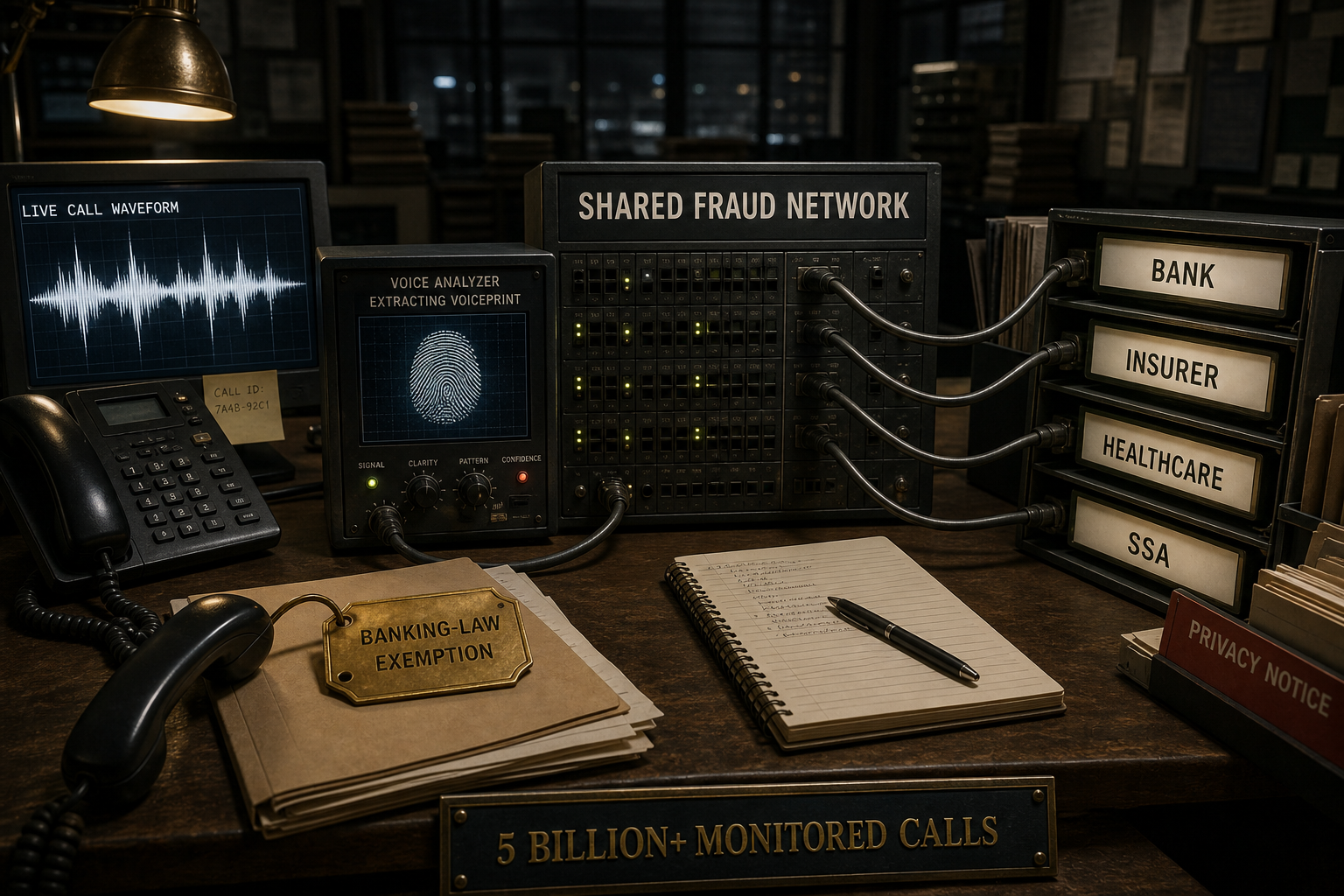
One Company Analyzes Your Voice for Your Bank, Your Insurer, and the SSA. A Federal Court Just Sided With It.
Pindrop's voice-analysis technology already sits inside call centers at seven of the top ten U.S. banks, insurers, and healthcare providers, and, since April 2025, inside the Social Security Administration's own fraud-screening system — where it flagged two likely-fraudulent claims out of more than 110,000 while slowing retirement claims processing 25%. It's not siloed company by company, either: Pindrop pools fraud intelligence across every client that uses it, in a shared network built from more than 5 billion monitored calls. Two lawsuits argued the company was collecting biometric voiceprints without the consent Illinois and California law require. On May 12, 2026, a federal appeals court ended one of them for good: for its bank-authentication work, the Third Circuit ruled, Pindrop counts as a "financial institution" under a federal banking-law carve-out — exempt from Illinois's biometric privacy law, the strongest one in the country, including that law's own 3-year data-destruction clock. The federal law that exemption leans on, unlike BIPA, gives an individual caller no way to sue over it at all — enforcement is regulators-only. A second suit, over Bank of the West's use of the same technology, ended after the named plaintiff's individual claims were dismissed with prejudice.
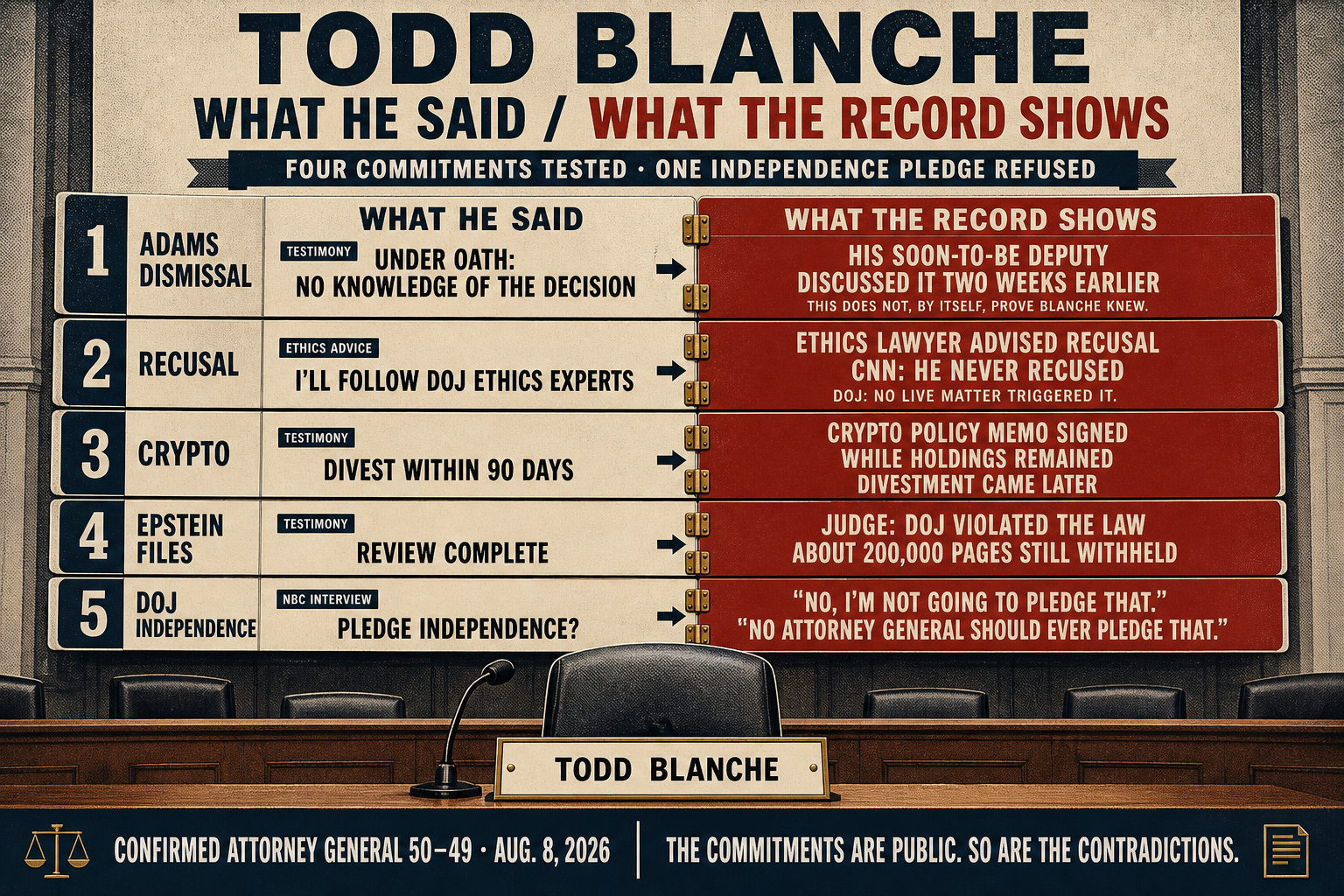
Todd Blanche Told the Senate Under Oath He Knew Nothing About the Adams Dismissal. His Soon-to-Be Deputy Was Already Discussing It.
Attorney General Todd Blanche has made the same shape of commitment five times since joining DOJ in 2025, and contradicted it five times. He testified under oath he had no knowledge of the decision to dismiss corruption charges against NYC Mayor Eric Adams -- unsealed documents show the acting deputy AG discussed it with prosecutors two weeks earlier, and every Senate Judiciary Democrat has asked DOJ's Inspector General to investigate. He pledged to recuse from Trump-related matters if DOJ's ethics lawyer advised it -- the ethics lawyer did, in writing, and CNN reports he never recused. He signed an ethics pledge to divest his crypto holdings within 90 days -- he signed a memo killing crypto enforcement while still holding up to $485,000 in crypto, and didn't divest for two more months. He told Congress DOJ's Epstein-files review was complete and unredacted beyond legal necessity -- a federal judge found DOJ in violation of the transparency law, with roughly 200,000 pages still withheld. And this week, asked to pledge that DOJ would act independently of the White House, he simply declined: "No attorney general should ever pledge that." He was confirmed as Attorney General nine days ago, 50-49 -- his closest margin yet.
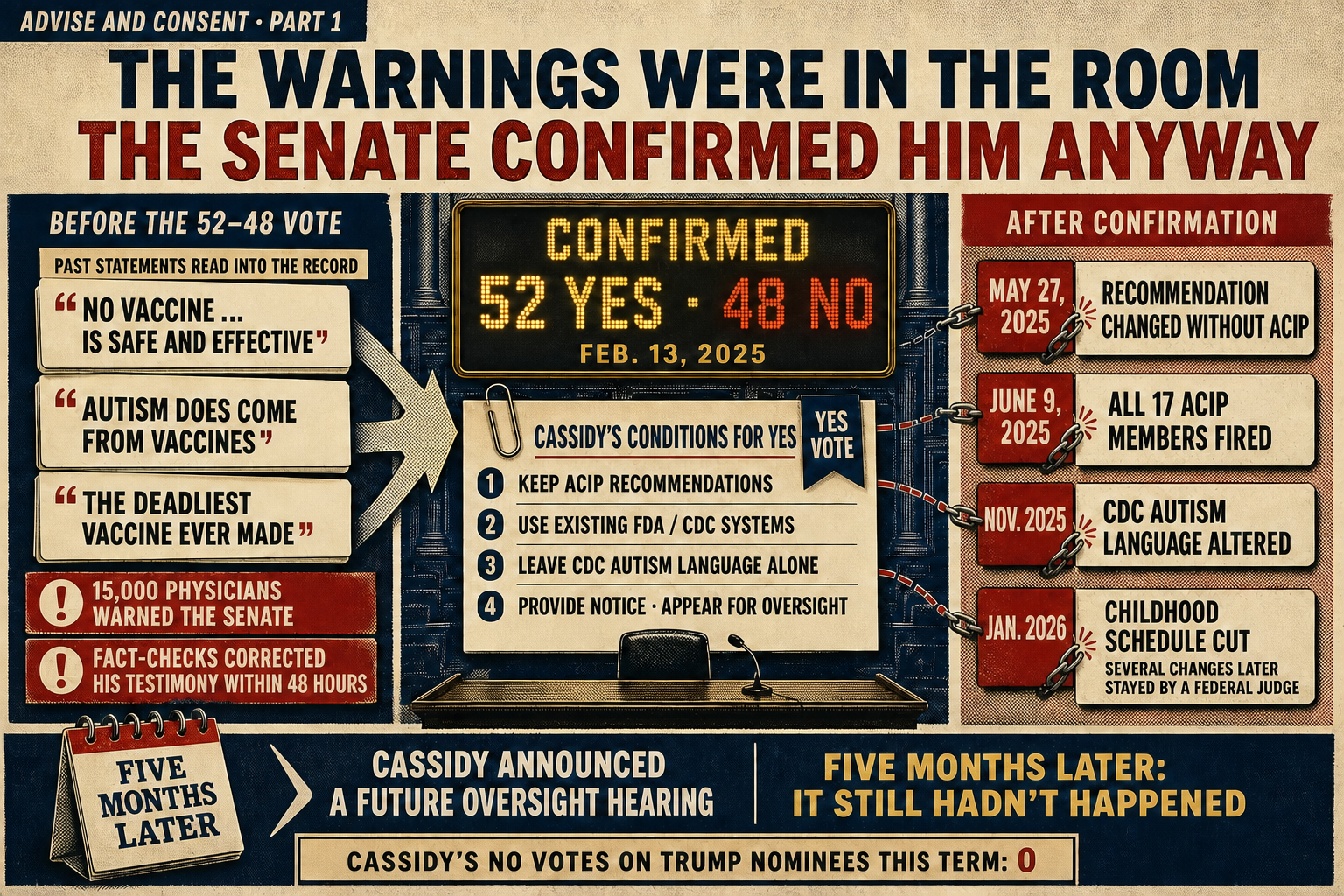
RFK Jr.'s Own Words Were Read Back to Him at His Hearing. The Senate Confirmed Him Anyway.
Robert F. Kennedy Jr.'s past statements on vaccines were read back to him, on the record, during his own January 2025 confirmation hearing -- and fact-checkers were correcting his sworn testimony within 48 hours, not months later. Sen. Bill Cassidy, the key swing vote, says he got specific written commitments in exchange for his yes: don't touch the vaccine advisory committee, work within existing systems, leave the CDC's autism language alone. Kennedy has since fired all 17 members of that committee, bypassed it to change vaccine recommendations, and ordered the CDC's autism language altered -- each with a clean date. Cassidy's own follow-through has been mostly words: a delay request that was ignored, a promised oversight hearing that, five months later, still hasn't happened. And in his entire Senate term, Cassidy has never once voted no on a Trump nominee -- not this one, not any other.
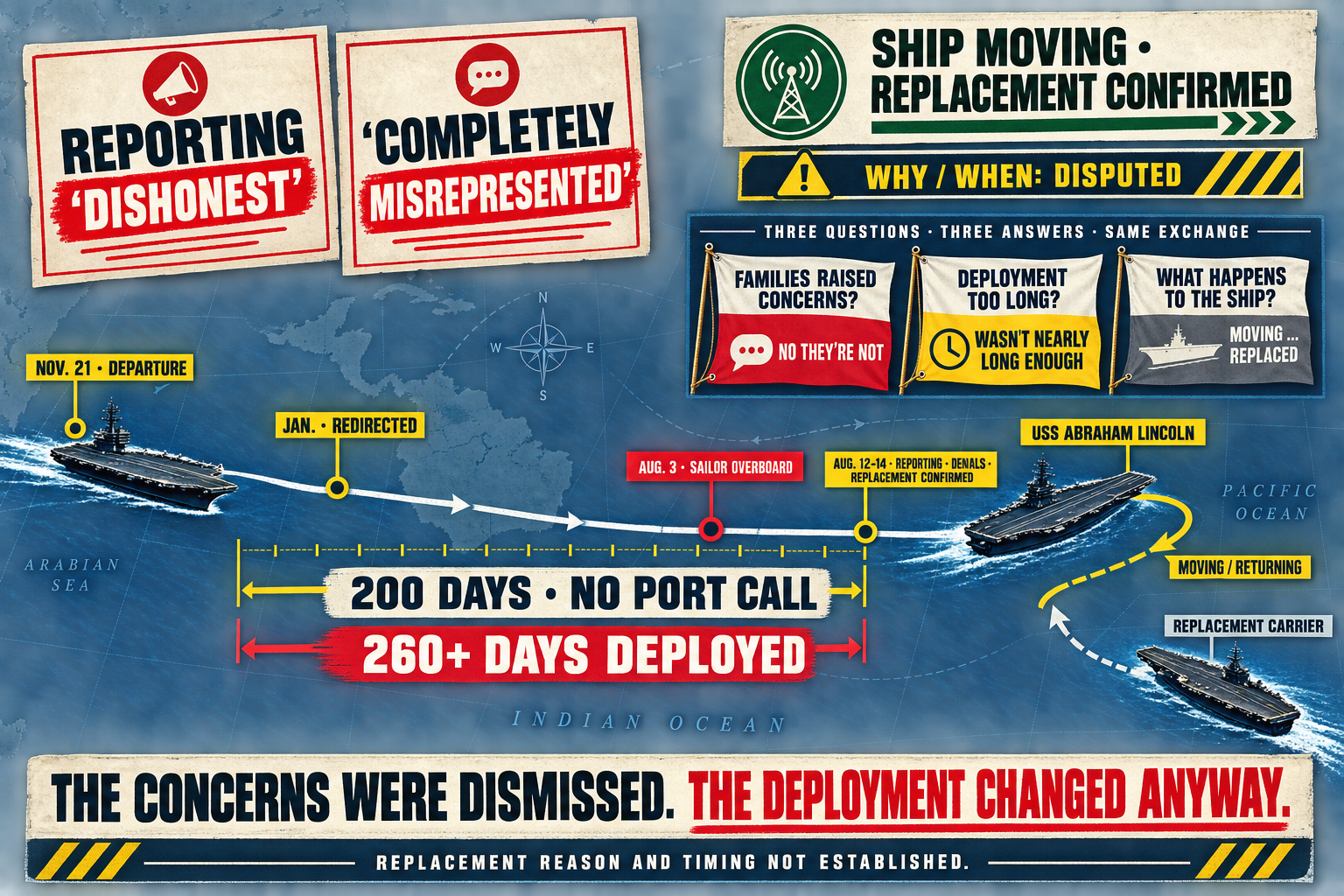
Officials Called the Reporting on USS Lincoln's Sailors “Dishonest.” The Ship Is Being Replaced Anyway.
A sailor went overboard from the USS Abraham Lincoln on August 3rd. The Navy called it a mental health episode. By mid-August the carrier had gone 200 days without a single port call -- a modern-day record -- inside a total deployment past 260 days, and lawmakers were demanding answers. The Pentagon's response wasn't just denial. The Acting Secretary of the Navy accused the media of painting "our warriors as victims" and called the concerns "dishonest," the same week he'd personally heard those concerns from military spouses at a town hall. The Defense Secretary called the reporting "completely misrepresented." Asked directly whether families had raised concerns, the President said "No they're not," then, asked separately whether the deployment had gone on too long, said it "wasn't nearly long enough" -- and in the same appearance with reporters, confirmed: "That ship is moving right now or very shortly, and it's being replaced with another very similar ship." A retired two-star general called it what it is: "Now they're actually spewing lies."
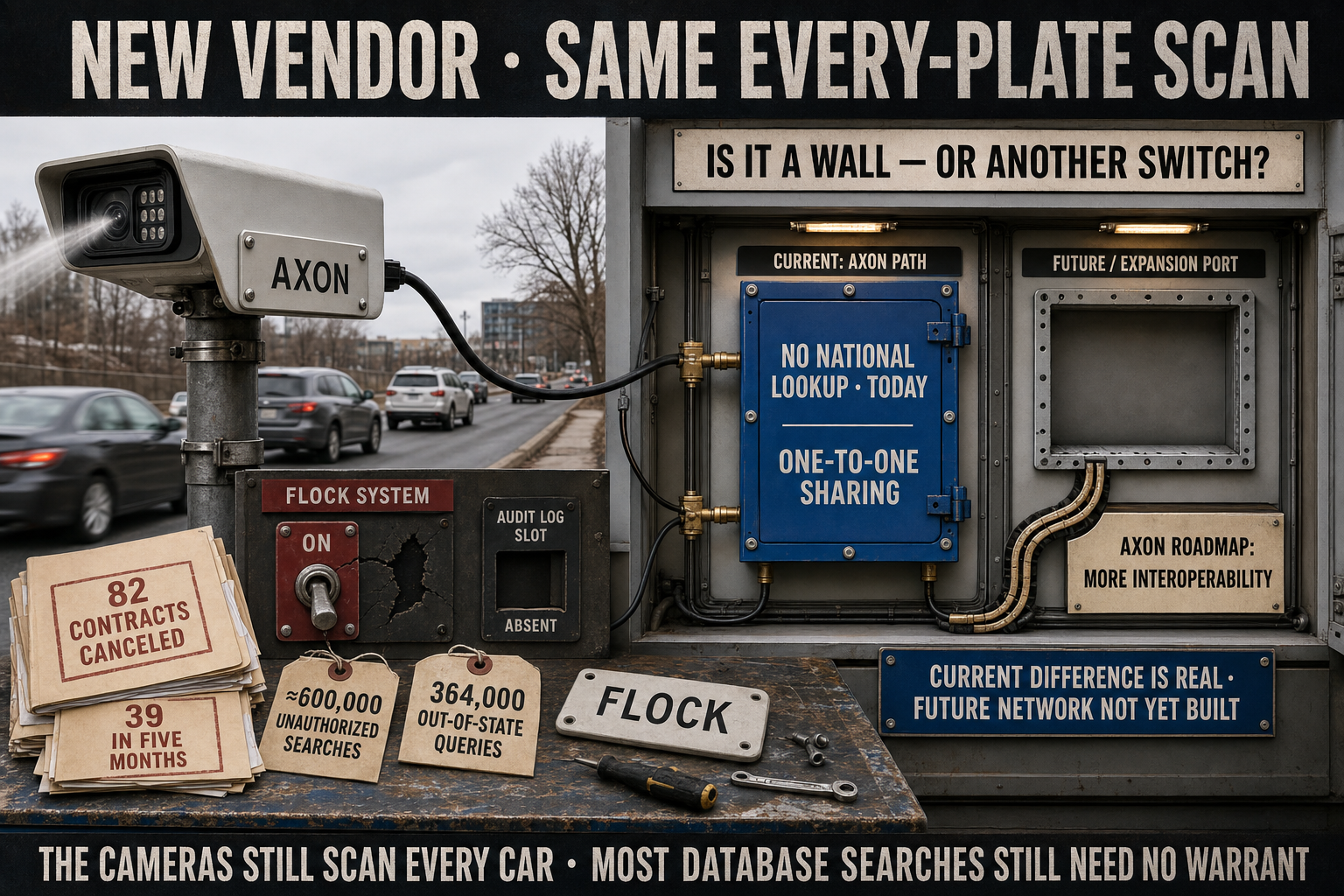
Cities Are Ditching Flock for Axon. Nothing Stops Axon From Becoming Flock.
Thirty-nine Flock Safety contracts were canceled in just the first five months of 2026 alone -- after Mountain View and Ventura County discovered Flock's own "nationwide" sharing setting had been quietly active, feeding roughly 600,000 unauthorized searches to agencies that never signed a data agreement. Most of those cities are hiring Axon to do the identical job. Axon's contracts genuinely lack Flock's national lookup network -- that part is real. But so far that's a competitive selling point, not a locked-in architecture: Flock proved it can build hard technical guardrails when it wants to (encrypted storage, true data deletion); the one setting that caused two scandals was left as a switch instead of a wall. Axon has already announced plans to build the same kind of interoperable network, and its own leadership overrode its ethics board on a different surveillance product four years ago.
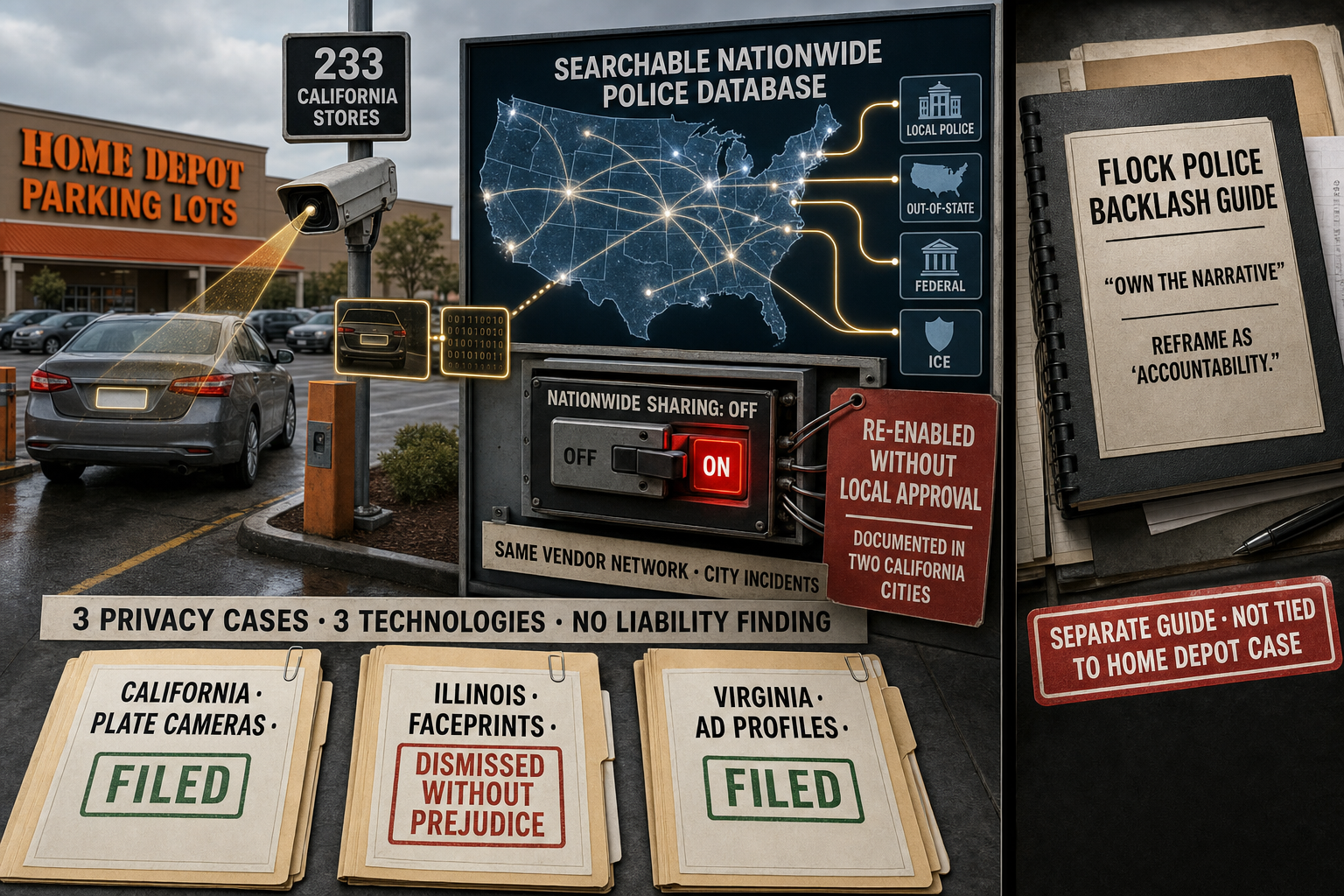
Home Depot Is Being Sued Three Times This Year Over How It Watches You. Its Camera Vendor Has a Playbook for Backlash Like It.
Home Depot faces three separate privacy lawsuits in 2026 across three states. The most serious: a California class action says its Flock Safety license-plate cameras at 233 stores feed a searchable, nationwide police database, with a policy that doesn't meaningfully restrict sharing with ICE or out-of-state agencies. That's not hypothetical -- the same complaint documents two real cases where cities that explicitly disabled nationwide Flock access got it secretly turned back on anyway. Separately -- and not shown to be connected to Home Depot's case specifically -- a leaked Flock coaching guide obtained by 404 Media shows the company has a practiced playbook for handling this kind of backlash generally: don't deny it's mass surveillance, reframe the debate around "accountability," and get to officials before the public can organize against it.
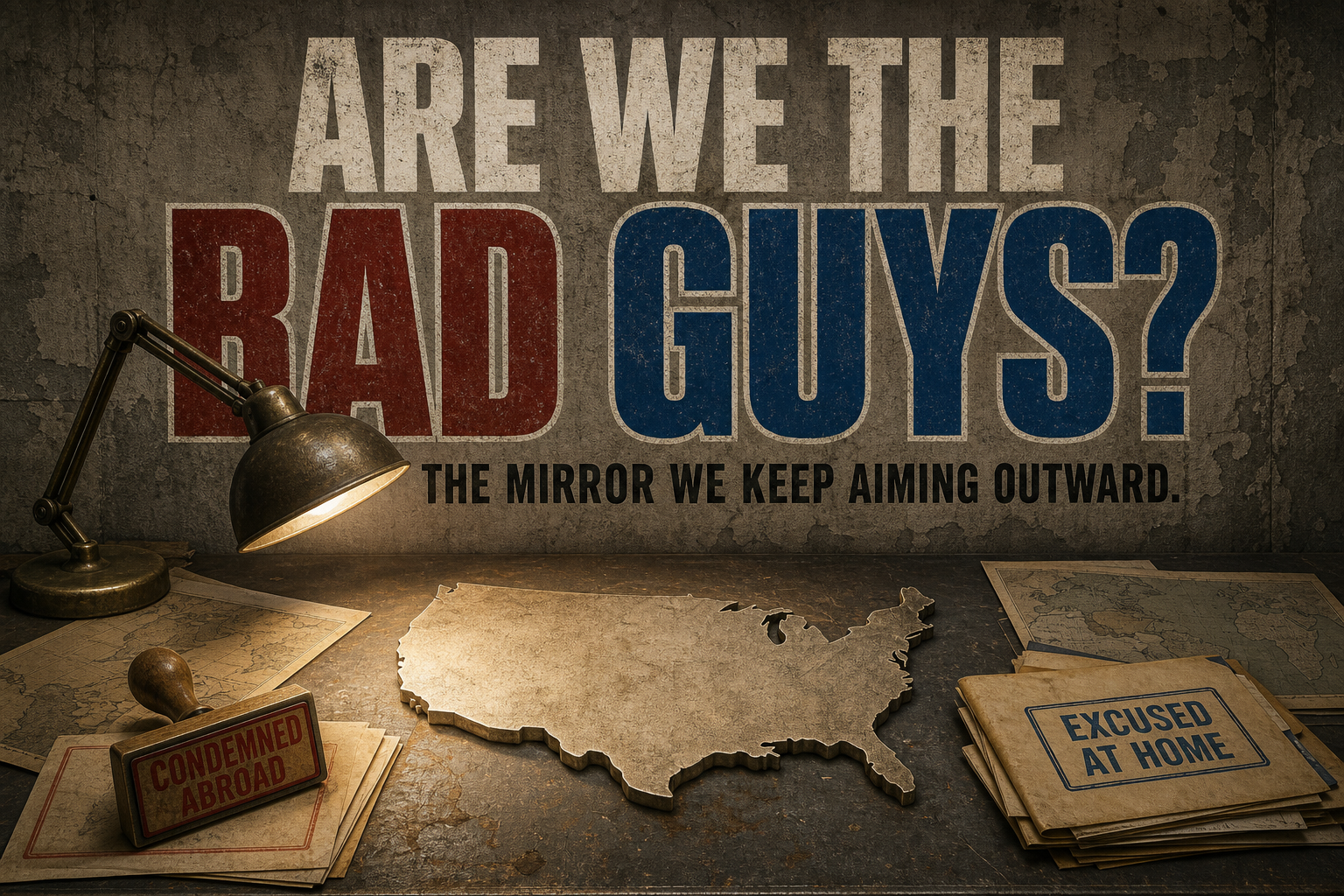
Are We the Bad Guys? — The Question Mark Is the Point.
This series applies America's stated standards to America. Not American failures by other countries' standards — America's own, written into its own reports, signed by its own officials. Every episode tests a specific charge against the government's own written record, the strongest available defense, and the plainest reading of the facts. The title ends with a question mark. That's not a rhetorical hedge. That's the whole method.
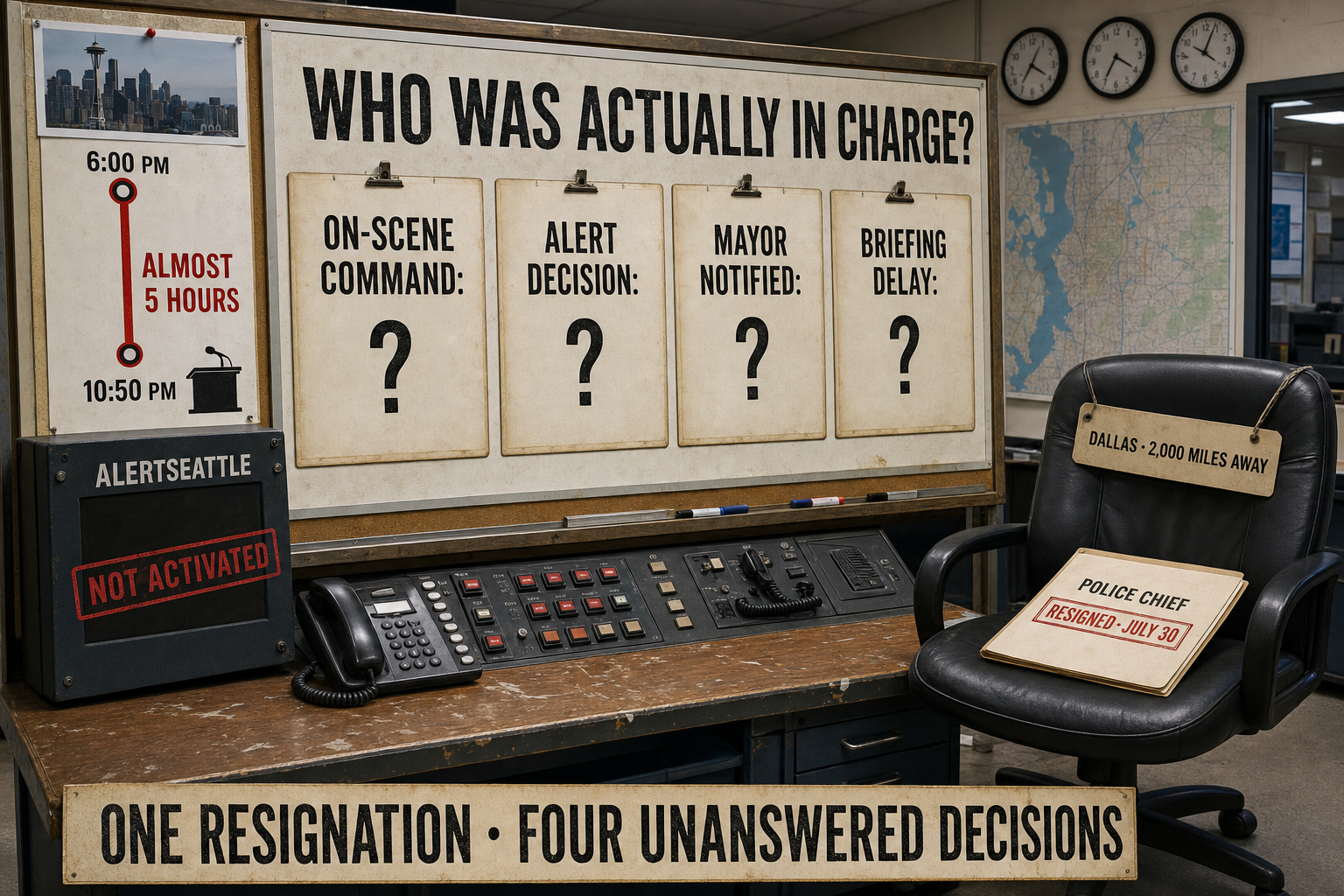
Seattle's Police Chief Resigned Over the Festival-Shooting Response. He Was in Dallas — So Who Was Actually Running It?
Seattle Police Chief Shon Barnes resigned under pressure on July 30 over the city's response to the Bite of Seattle festival shooting — a mass shooting that killed three and wounded four more, then left the public with almost no official information for nearly five hours. But Barnes was in Dallas when it happened. The emergency alert that was never sent isn't run by the police chief. Two assistant chiefs were on the ground in Seattle. And the mayor herself was issuing public statements — some of them wrong — within hours. Every question about who was actually in charge that night, who chose to keep the city silent, and when the mayor was told runs into the same wall: the city hasn't said. The one accountability question that got a clean answer is the one aimed at the man who wasn't in the room.
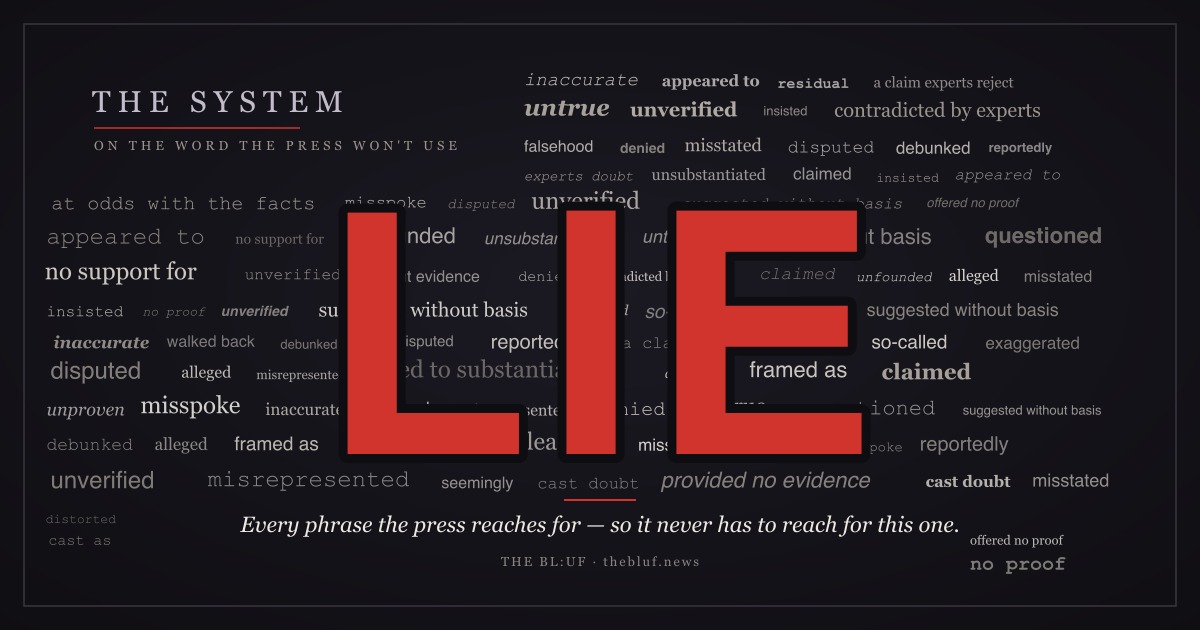
“Lie” Is the One Word Newsrooms Won’t Put on the Powerful — and the Reason Mostly Isn’t Cowardice.
English has a precise word for knowingly saying what isn't true: a lie. Watch how rarely it lands on a president or a prosecutor, even when the claim falls apart on contact — “without evidence,” “baseless,” “unsubstantiated” instead. That restraint is mostly not cowardice; it's a stack of real reasons, legal and linguistic and institutional. But the blank where the word should be is itself the story — because it sits exactly where accountability is supposed to be, and the powerful have learned to live inside it.
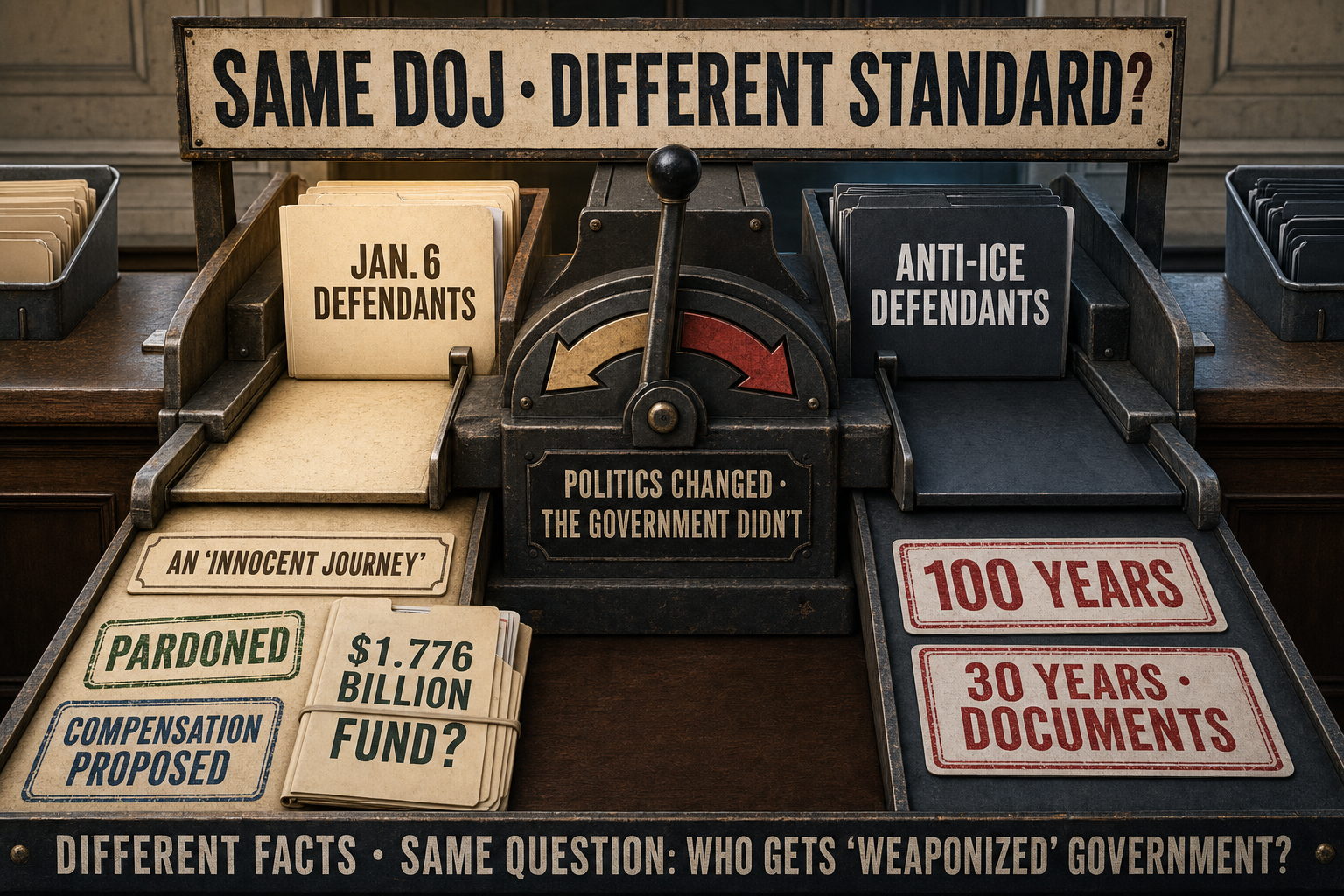
Trump Says January 6 Was an "Innocent Journey" Deserving Compensation. His Own DOJ Just Gave Anti-ICE Protesters Up to 100 Years.
At a Camp David cabinet meeting Friday, Trump called the January 6 prosecutions "an innocent journey" and said he wants defendants compensated from a $1.776 billion fund his own DOJ told the Senate is dead. Weeks earlier, that same DOJ handed decades-to-life sentences — one for 100 years, one for 30 years for handling documents — to protesters convicted under his new Antifa-terrorism order for a structurally similar attack on a federal facility. No January 6 defendant is serving any sentence at all.
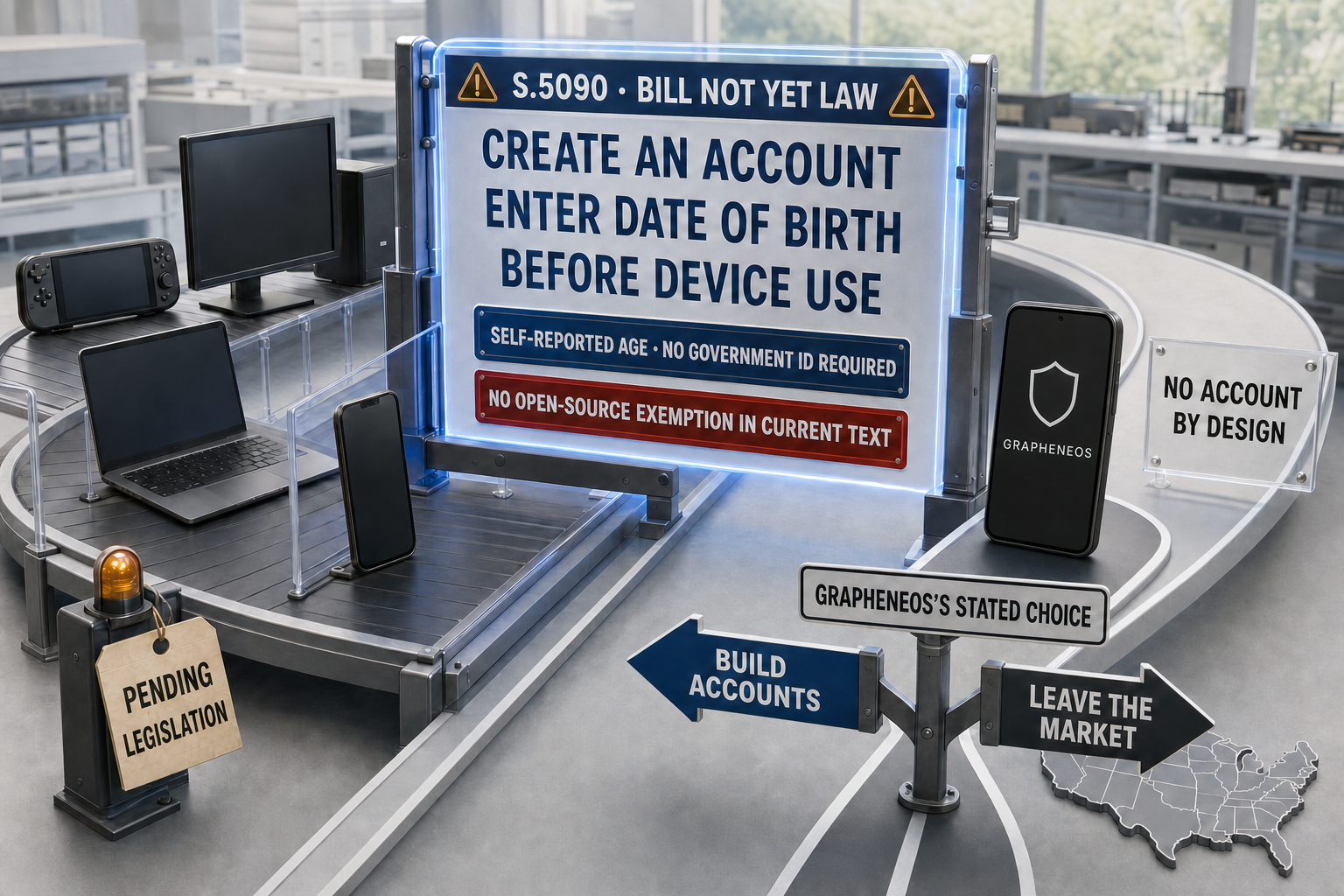
A Bipartisan Bill to Protect Kids Online Would Also Outlaw GrapheneOS's Account-less Design
A federal bill sitting in the Senate Commerce Committee -- introduced by two Democrats and two Republicans -- would require every operating system on every general-purpose computer to gate use behind an account and a declared age. Its text carries no exemption for open-source, nonprofit, or small developers. GrapheneOS, the account-less privacy OS BL:UF profiled after a traveler's duress-wipe feature got him federally charged, has already told the identical state-level requirement it would rather leave a market than build the account system this bill demands.

FIFA Scrapped the $20 Billion World Cup Sale. Its Own COO Broke Ranks — and UEFA Says It's Lost Confidence in Infantino.
FIFA killed its own $20 billion World Cup stake-sale plan on July 31, one day after 143 national associations across three confederations came out against it. That didn't end the crisis: FIFA's own Chief Operating Officer publicly broke with Infantino the same day, a senior adviser resigned calling it "a bad deal for football," and UEFA says it has lost confidence in his leadership -- with Infantino reportedly told, privately, to resign or face a formal vote to remove him. He has not stepped down.
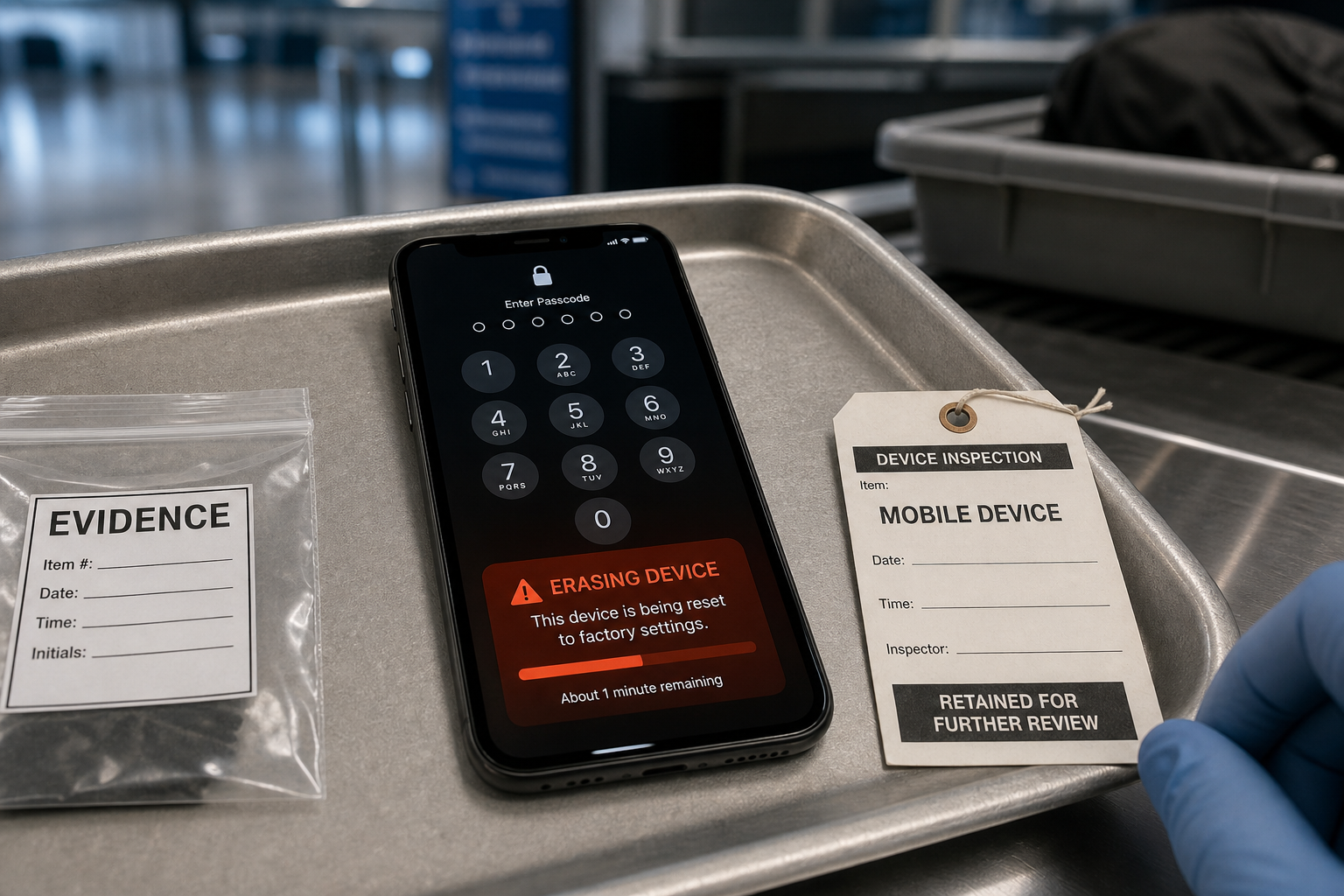
He Gave Border Agents a Passcode. It Wiped His Phone Instead of Unlocking It. Now He's Facing Federal Charges.
CBP stopped Samuel Tunick at the Atlanta airport in January 2025, saying they suspected child exploitation material on his phone. He gave them a passcode; instead of unlocking the device, GrapheneOS's built-in duress feature wiped it permanently. Federal prosecutors indicted him in November 2025 for destroying property to prevent its seizure — the first known US case charging someone specifically over a phone's duress-wipe feature. His lawyers say the child-exploitation justification doesn't hold up and that the real target was his connection to the "Stop Cop City" activist movement. Neither claim has been ruled on yet.
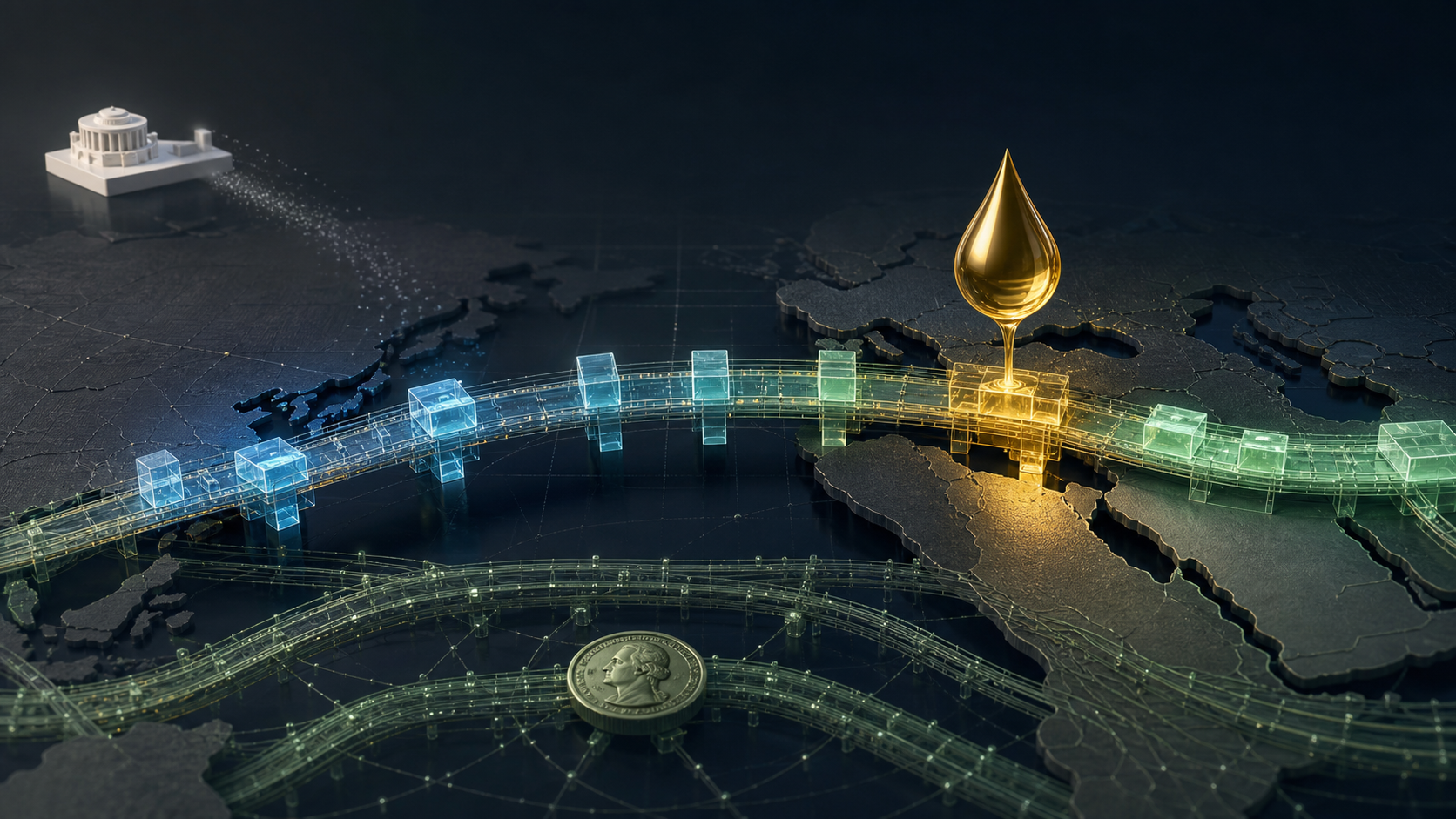
China Built a Payment System That Skips the Dollar. Saudi Arabia Joined It. The Bank Running It Just Walked Away.
Project mBridge lets central banks pay each other directly in their own digital currencies, with no dollar and no SWIFT in the middle. It's run by China, Hong Kong, Thailand, and the UAE — and, since 2024, Saudi Arabia, whose oil sales have priced almost entirely in dollars since 1974. The Bank for International Settlements built the technology, then walked away from the project in October 2024, about a week after Vladimir Putin publicly proposed a comparable BRICS payment concept as a tool to dodge Western sanctions. The bank says it simply graduated out of a project that had matured, not a political exit. Cumulative transactions have grown from $22 million in 2022 to roughly $69 billion (470 billion yuan) by mid-2026 — real activity, but still small next to the trillions that move through dollar-based systems every day.
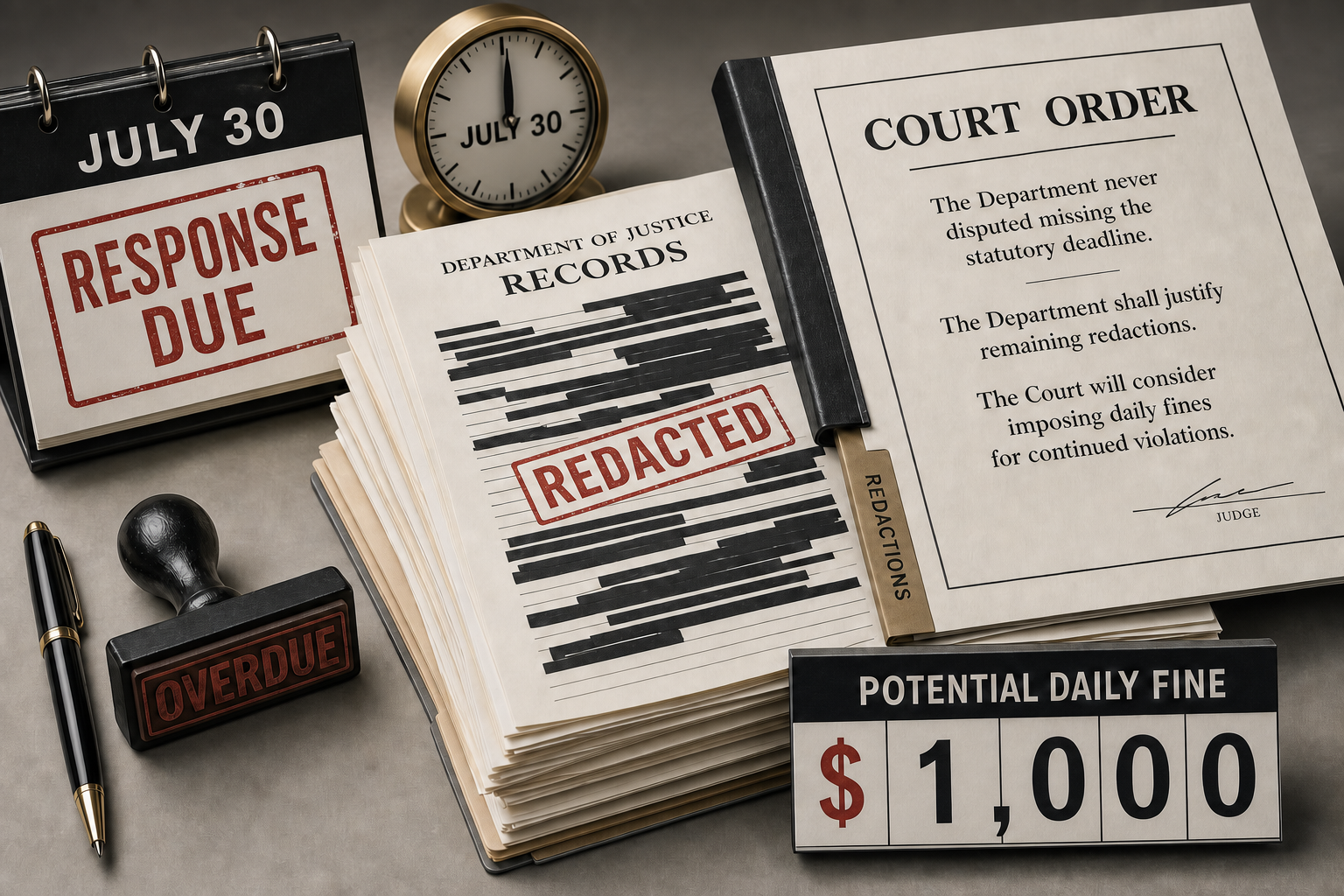
A Federal Judge Says the DOJ Never Disputed Missing Its Epstein Files Deadline. Now the Question Is What Happens Next.
Congress passed the Epstein Files Transparency Act with near-unanimous support in November 2025, giving DOJ 30 days to release its unclassified Epstein-investigation records. DOJ missed the deadline, made redactions a court has since called excessive, and withheld documents the law required. Journalist Katie Phang sued Acting Attorney General Todd Blanche over it, and in June 2026 the judge ruled that Blanche never actually disputed any of that in his own filings. A new order requires DOJ to justify its remaining redactions by July 30, 2026, and the judge is separately weighing a $1,000-a-day fine against Blanche. DOJ's strongest defense — that some redactions protect victims' identities, which the law explicitly allows — is real; its weaker arguments about paperwork and foreign-language documents are not grounded in anything the law permits.
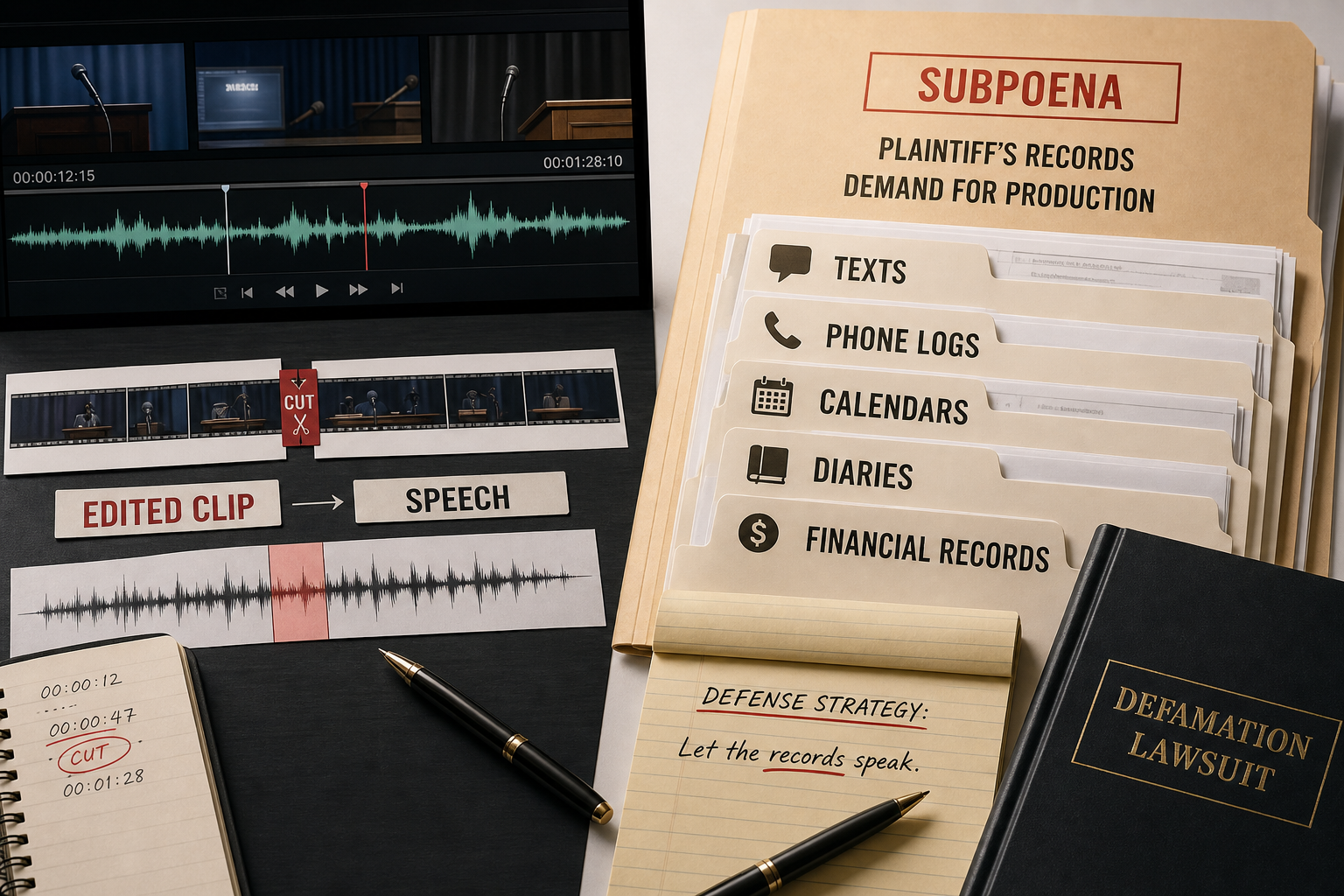
Trump Is Suing the BBC for $10 Billion Over an Edited Speech. The BBC's Defense Strategy: Subpoena His Own Texts.
A BBC Panorama documentary spliced parts of Trump's January 6, 2021 speech together into what looked like one line telling the crowd to march on the Capitol and "fight like hell." The BBC apologized; two of its top executives resigned. Trump then sued for $10 billion. Now, to defend the case, BBC's lawyers are demanding Trump hand over his own personal texts, phone logs, calendars, and diaries from the day of the riot, plus financial details on roughly 400 companies in his family's revocable trust — a federal judge already ordered the financial records turned over. Trump's team is fighting the rest, citing executive privilege, a claim that's legally contested since privilege normally covers official government deliberations, not personal business records.
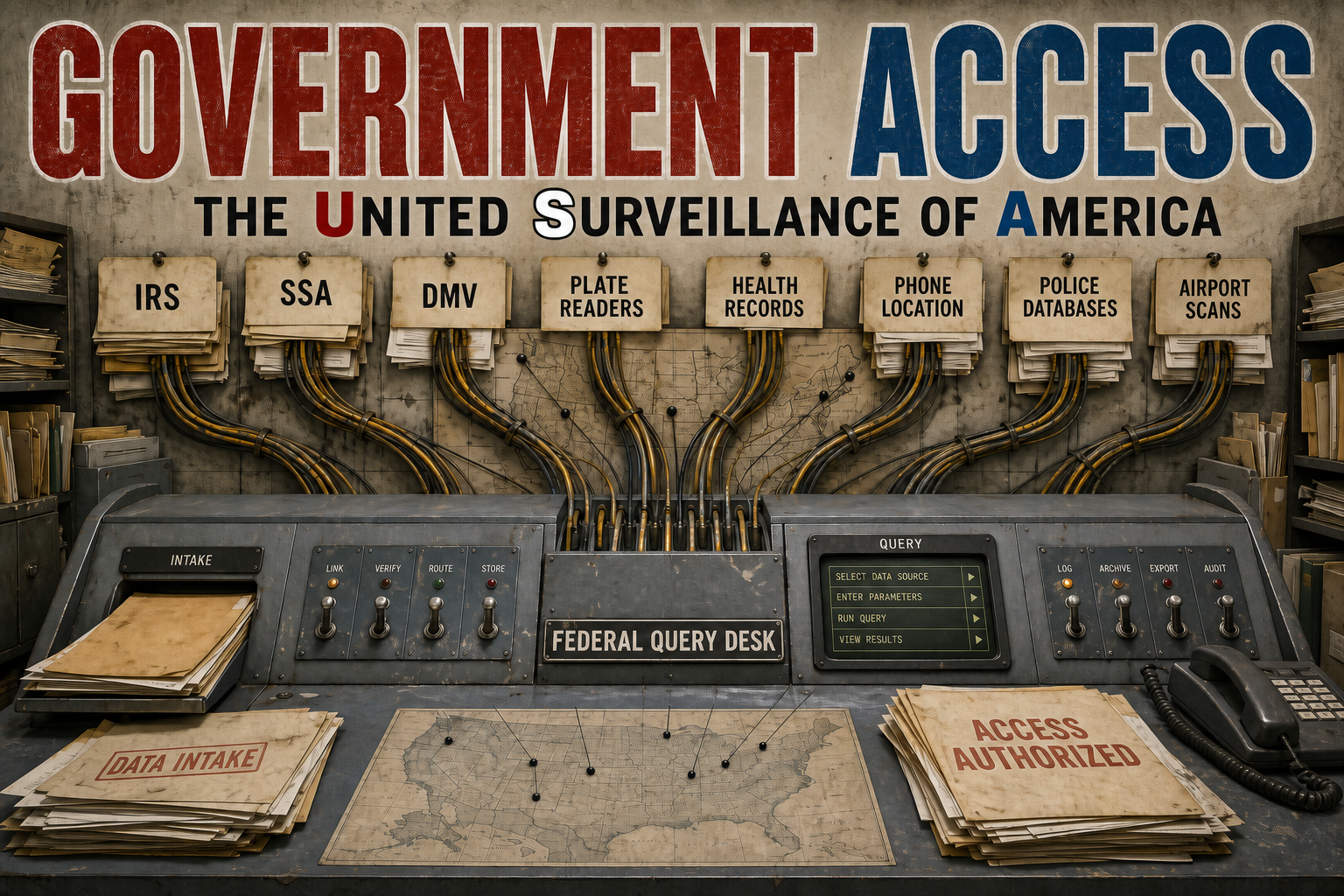
A Federal Agency That Regulates Lawnmowers Is Now Demanding Your ER Records. Its Own Press Release Leaves Out the Part Where Hospitals Were Told It's Mandatory.
The Consumer Product Safety Commission — the agency that recalls dangerous toys and coffeemakers — is quietly pushing at least 100 hospitals to hand over identifiable emergency-room records for every patient, not just consumer-product injuries: names, addresses, diagnoses. A private Kansas contractor, Konza Health, is running the pipeline under a contract worth up to $15.9 million. Internal correspondence calls hospital participation "mandatory." Federal law requires public notice and a comment period before any agency collects information from 10 or more entities — CPSC hasn't done it, and its own spokesperson admits that. And when CPSC finally announced the program publicly, its press release never mentioned Konza by name, never mentioned that hospitals were told sharing was mandatory, and never mentioned the legally required public notice it hasn't filed.
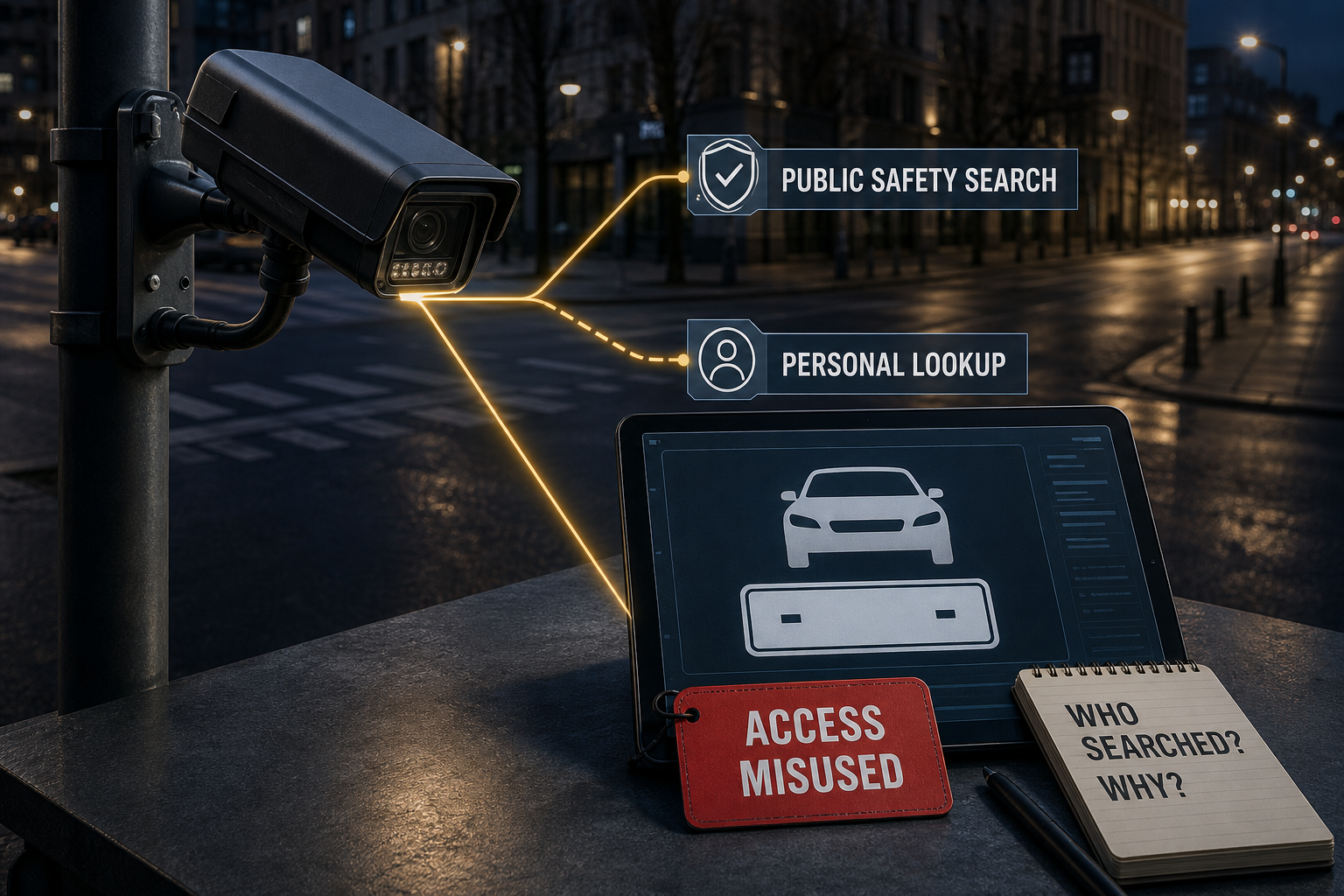
Police Used License-Plate Cameras to Stalk Their Exes. One of the Officers Who Investigated the First Case Was Caught Doing the Same Thing.
Milwaukee police officer Josue Ayala used the department's Flock license-plate-reader system to look up his romantic partner's location 124 times and her ex's location 55 times. He resigned and pleaded guilty. One of the two detectives assigned to investigate him, Tehrangi Chapman, was later charged with the same kind of misuse — tracking two people himself and secretly planting a GPS tracker on one of their cars. Georgia's state investigators have arrested five more officers this month for the same pattern; two more were fired in South Carolina. An Institute for Justice count puts documented cases like this at two dozen and climbing. And in Norfolk, Virginia — Flock's own backyard for one of the most consequential pending court fights over whether any of this requires a warrant in the first place — the city just voted to add more cameras, not fewer.

Every Privacy Law in America Exempts the Government. That's Exactly Where Your Data Is Moving Fastest.
Three separate government surveillance stories broke this month — a police drone leak, license-plate cameras used to stalk exes, a consumer-safety agency demanding hospital ER records — and they're the same story: agencies are sharing and buying data across walls that used to separate them, almost always without a public vote. The part almost no coverage gets to: every one of America's 20 state privacy laws, and the federal proposals that died before becoming law, explicitly exempts government from the rules that bind companies. Add in the terms-of-service agreements nobody reads — a 2008 study put the reading time at roughly 244 hours a year, popularized since as "76 work days" — and the honest answer is that citizens have a little real recourse against companies and functionally none against the government programs documented here.
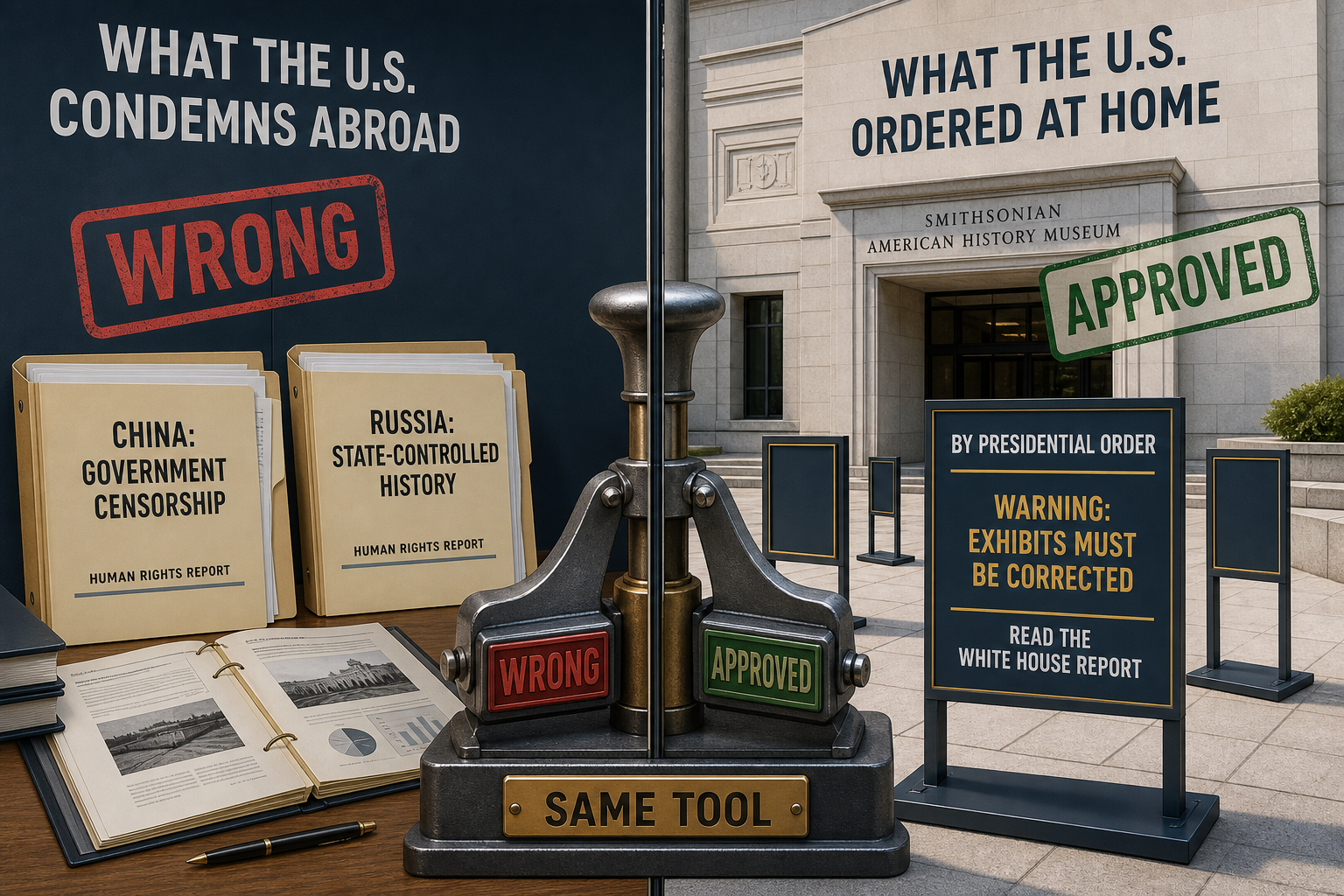
America Told China and Russia This Was Wrong. Then the White House Ordered the Smithsonian to Rewrite Its Own Exhibits.
The United States condemns China and Russia, by name, in its own human-rights reporting, for using government power to force museums, academics, and cultural institutions to tell a state-approved version of history instead of an honest one. On July 24, 2026, President Trump signed an executive order doing a version of the same thing to the Smithsonian's National Museum of American History — ordering federal signage that tells visitors the museum's exhibits are wrong, a second exhibit correcting it, and directing four federal officials to use the museum's own funding as leverage to make it comply. The tool is the same. The consequences, so far, are not: nobody has been arrested. That gap is the honest center of this story.
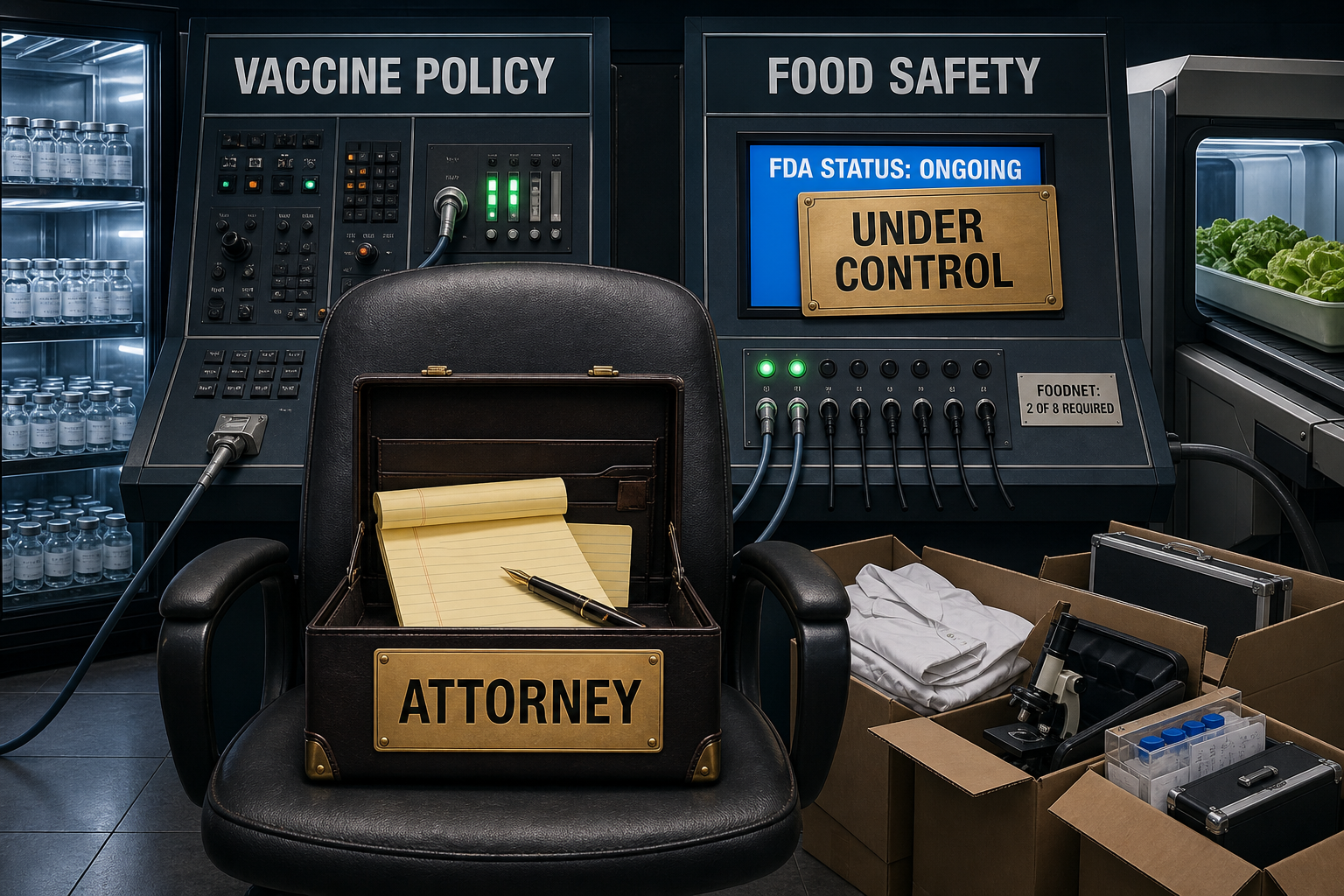
RFK Jr. Said the Outbreak Was ‘Under Control.’ His Own FDA Had Already Said the Opposite.
The man in charge of America's vaccine and food-safety infrastructure fired the CDC's vaccine advisory panel, cut food-safety surveillance, had his signature vaccine-schedule policy blocked by a federal court, and is now on the record calling an active outbreak "under control" — days after his own agency's evidence fell apart and a foreign government publicly disputed his account.
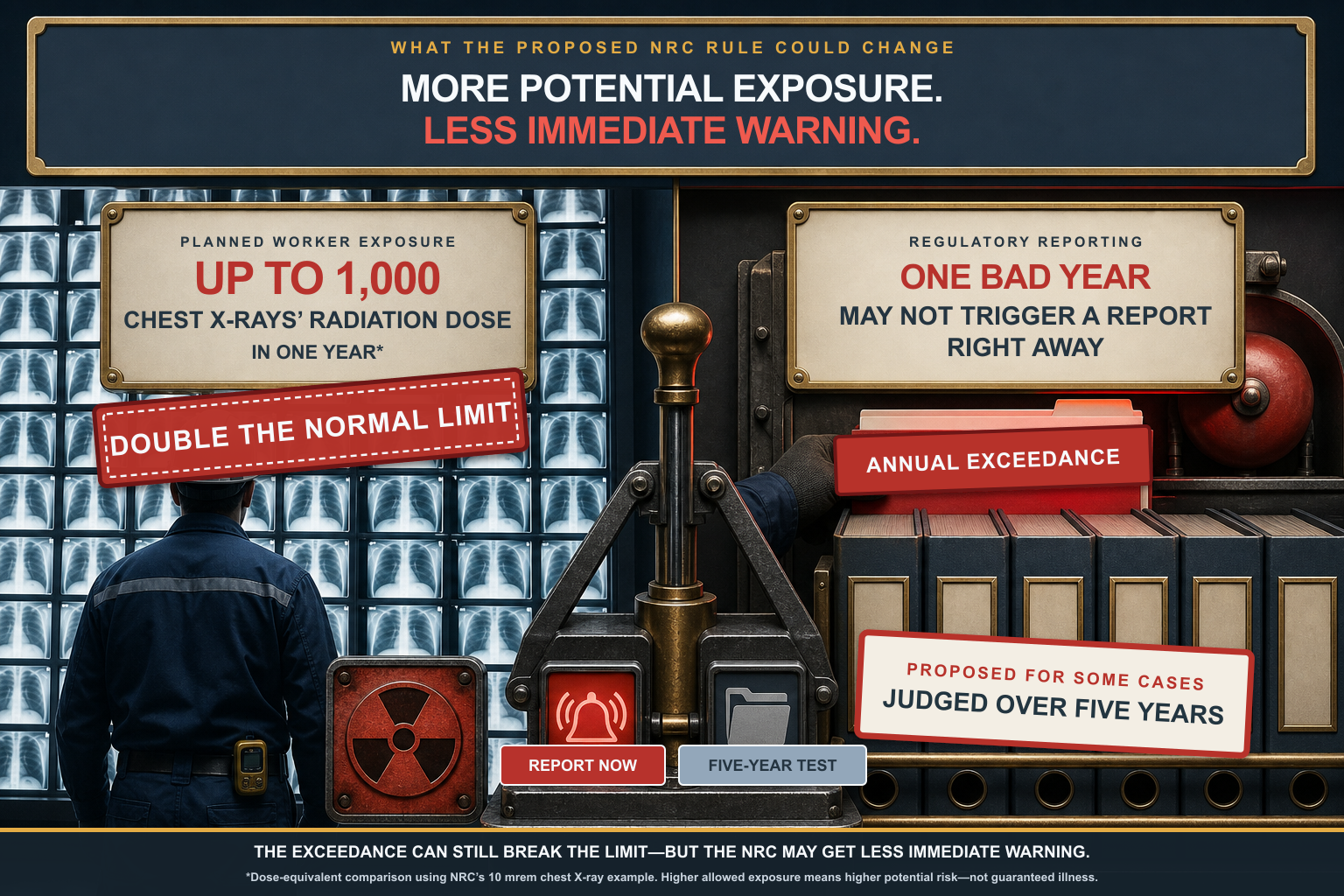
To Build Nuclear Fast Enough for AI, the NRC Wants to Kill the 50-Year Rule That's Kept Radiation Exposure Low
For 50 years, US nuclear facilities have had to follow a rule called ALARA — keep radiation exposure "as low as reasonably achievable," on top of hard legal dose limits. The Nuclear Regulatory Commission wants to kill it, as part of a broader rule change the agency's own analysis estimates saves industry about $9.5 million a year overall. The reason traces directly to one thing: an executive order telling the NRC to help quadruple US nuclear capacity by 2050 to feed surging electricity demand from AI data centers. Officials say the hard dose limits themselves aren't changing. Having read the actual 164-page proposal, that's true in the narrowest sense — the headline numbers stay on the books — but the document changes how three of those limits actually work in practice: how much a worker can receive in a single year, how high a public dose limit can go with NRC sign-off, and whether an overexposure even has to be reported.
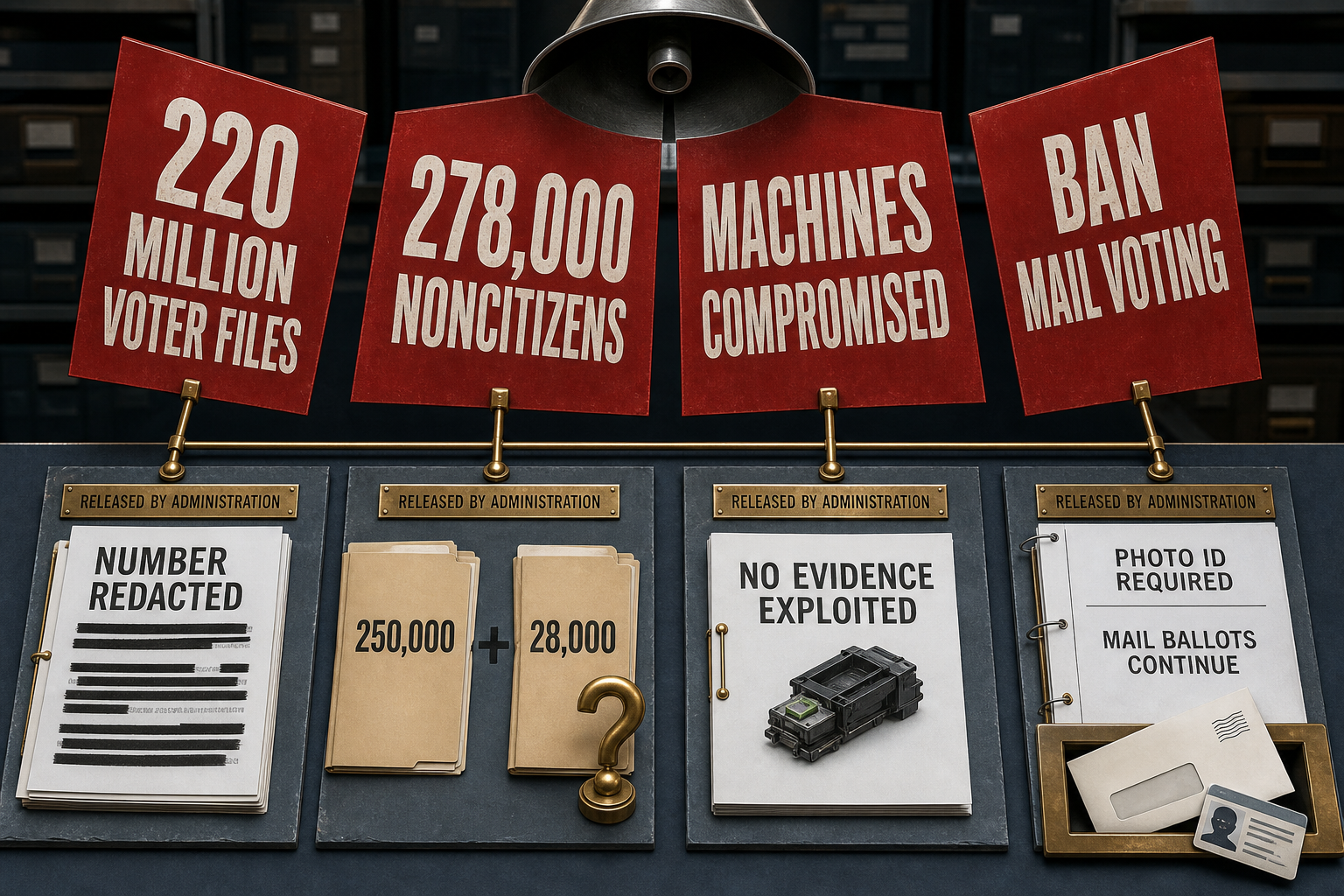
Trump Released the Evidence for an Election Crisis. It Doesn’t Prove One.
The biggest number is redacted. Two separate counts became 278,000. Machine vulnerabilities were never shown to have been exploited. And the bill he demanded does not ban mail voting.
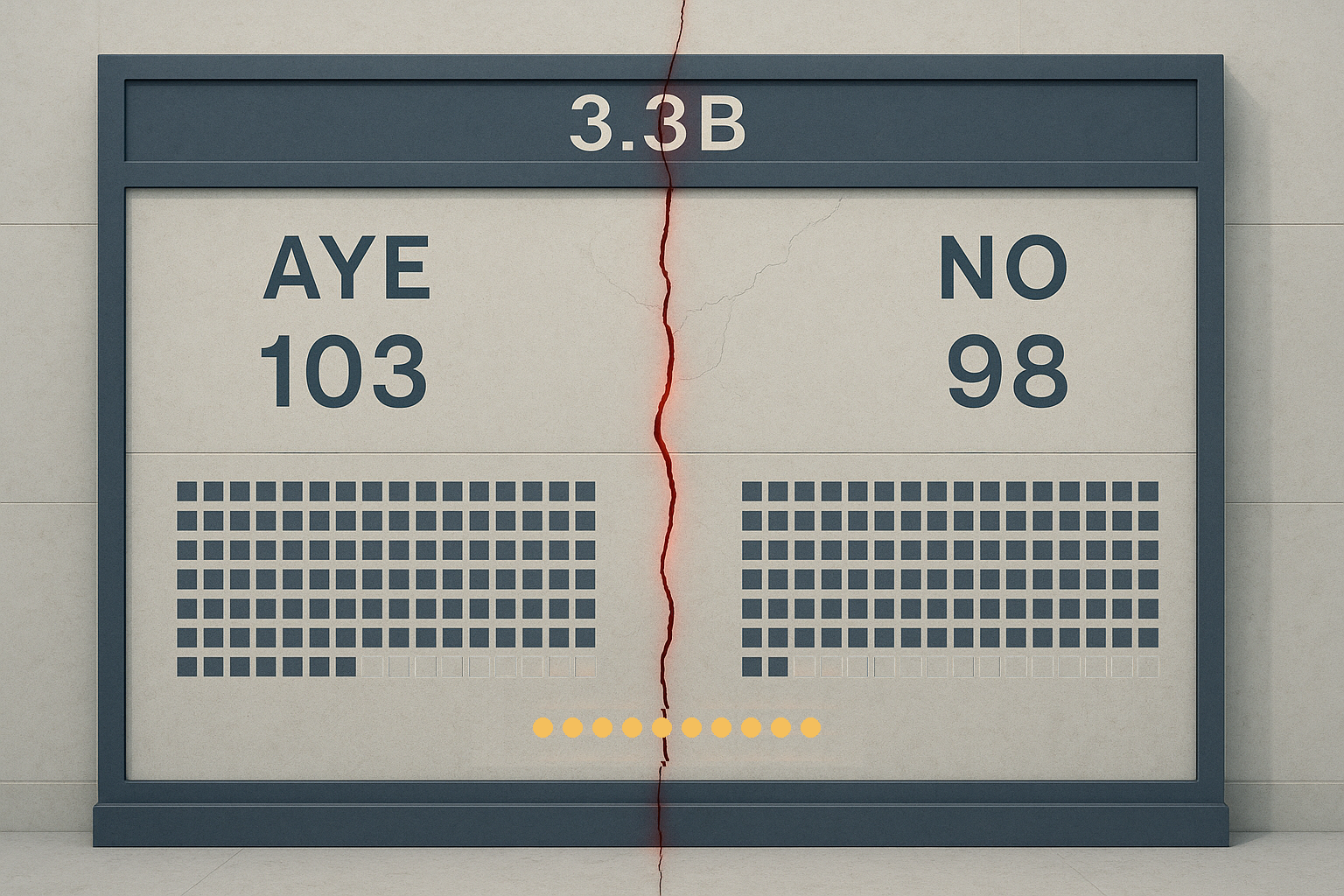
Pelosi Voted to Cut Israel Aid. Jeffries Voted to Keep It. The Old Democratic Consensus Is Gone.
The amendment failed overwhelmingly. Inside the Democratic caucus, it won 103–98 — splitting the party's leadership and turning what was once a fringe position into a majority vote.

No Treaty Binds America to Israel. A System Does — and It's Only Cracking on One Side of the Aisle.
There's no mutual-defense treaty, and the exceptional part was never the money — it's the UN veto no senator's primary ever turned on. Six reasons hold the relationship up, and no single one is the answer. What decides it is a price: challenging the default costs a politician, keeping it costs someone else. Democrats have doubled their votes against it in seventeen months. Not one Republican has moved.

The Slavery Exhibit Is Back. The History Is Thinner.
The government did not erase slavery from the President's House entirely. It replaced a memorial built around nine enslaved people with an account that gives George Washington more room and slavery less detail.

The Pentagon Is Ordering Annual Testosterone Tests. The Medical Guidelines Say Not to Screen Everyone.
The screening is mandatory for male troops 30 and older; treatment is not. The unanswered question is why the military is testing an entire population when the leading clinical guideline recommends testing people with symptoms.

Vance Says the Ten Commandments Don't Force Religion. That Isn't the Only Constitutional Question.
Joe Rogan asked whether mandatory Christian scripture belongs in public classrooms. The vice president answered a different question: whether a poster can make a child believe.
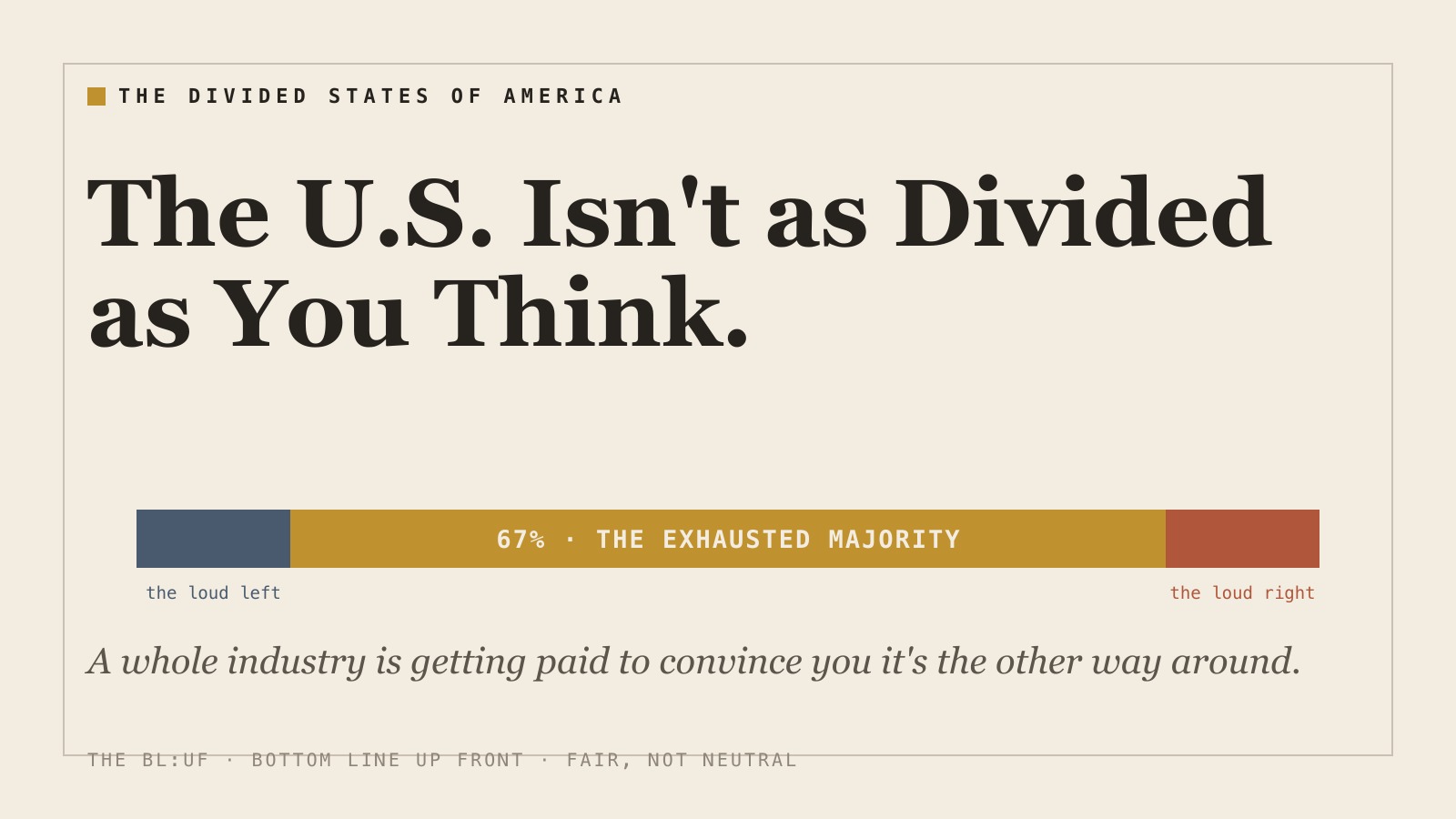
The U.S. Isn't as Divided as You Think — and a Whole Industry Is Getting Paid to Convince You It Is
Americans wildly overestimate how much the other side hates them. That gap is not an accident. A machinery — engagement algorithms, outrage media, campaign fundraising, and foreign influence operations — earns money, ratings, votes, and clicks every time we treat our neighbors as the enemy. This series finds the machinery, names who profits, and maps the common ground the fight is hiding. **The pain is real. A lot of the villains are manufactured.**
Your Feed Makes You Angrier at the Other Side Than Anyone in Your Actual Life Does — Because Outrage Is What It Was Built to Sell
The division you feel scrolling isn't mainly a plot to brainwash you. It's a side effect of a business decision. Social platforms rank posts by what keeps you watching, and a mountain of evidence — including the companies' own leaked research — shows attacking the other side travels farther than almost anything else online. So the machine turns the anger up, because your attention is the product it sells to advertisers. The good news, also proven: turn the animosity dial down and people actually cool off. **The pain is real. The dial is real. And it was set to "angry" for money, not malice.**
Your Anger Is the Product: How Partisan Media Gets Paid to Keep You Furious
The news that makes you angriest at the other side is often the news designed to. Across cable, talk radio, and the partisan web — on the left and the right — the business runs on fear and outrage, because outrage holds an audience, and an audience is what gets sold. Researchers who counted it found outrage in 100% of the cable-opinion episodes they studied. This is how the machine works, who cashes the check, and how to turn the volume down without tuning out.
The Reason Your Representative Is More Extreme Than Your Neighbors: the Map Was Drawn So the Only Election That Matters Is a Primary You Probably Skipped
Most Americans are moderate and exhausted, but the people they send to Congress keep getting more extreme. That's not a mystery — it's the machinery. Safe districts, low-turnout primaries, and a winner-take-all two-party system quietly pay politicians to please their angriest voters and ignore everyone in the middle. In 2024, about **7% of voters — the ones who showed up for the primaries that actually decided the race — effectively chose 87% of the U.S. House.** Both parties built this map, both benefit, and there are real fixes on the table — though they work better in theory than the loudest reformers admit.
Some of the Anger Is Manufactured: How Foreign and Domestic Operators Get Paid to Amplify America's Fights
A lot of American division is real. But some of the ugliest fights online were deliberately lit — and fanned — by people who don't care who wins. Russia's troll farm once staged an anti-Muslim rally *and* the counter-protest against it, at the same Houston corner, on the same afternoon, for about $200. Teenagers in a small town in North Macedonia pumped out fake pro-Trump and anti-Clinton stories purely for the ad clicks. Modern engagement-farms reached 140 million Americans a month on Facebook by posting whatever enraged us most. The goal was never a policy. The goal was the fight itself — a distracted, divided America is weaker, and outrage pays. **One honest caveat runs through this whole piece: researchers still argue how much these operations actually changed anyone's mind, versus just amplifying anger that was already there. We'll show you both sides of that debate.**
Most Americans Are Losing Ground in the Same Economy — While the Culture War Keeps Them Fighting Each Other Instead of the Cause
The economic pain is real, and it does not care what party you belong to. Wages stalled while the work got more productive. Barely half of kids now out-earn their parents, down from nearly all of them two generations ago. Hundreds of thousands of Americans a year die of drugs, drink, and suicide. That part is measured fact, and this piece lays it out cold. Then it takes on a harder, contested claim — that the culture war often aims that anger sideways, at other people just as squeezed, instead of at what's squeezing everyone. We mark clearly where that's fact and where it's interpretation, and give the strongest argument *against* it a fair hearing. The pain is real. Whether the enemy you've been handed is the right one is the fight worth having.
You Agree With the Other Side More Than You Think — and the Research Shows What Actually Calms the Fight
The belief that America is split into two armies that hate each other is itself something being sold to you. The evidence: partisans wildly overestimate how extreme the other side is, and the more news you consume, the worse your guess gets. About two-thirds of us are a tired, flexible middle — and on the things that hit your wallet, big majorities of Republicans and Democrats already agree. Researchers have even tested what cools the anger down. Some of it works. This is the hope bookend, and it's earned, not wished for.

The FBI Director Tied a Career Agent's Job to Purging Colleagues Who Investigated Trump — the Agent Says, on the Record.
Kash Patel has removed senior agents in Atlanta, New York, New Orleans, and Miami — all tied to prior investigations of Donald Trump. The FBI's own agents' association calls it "a campaign of erratic and arbitrary retribution." A fired former acting FBI director says on the record that Patel tied his job security to helping carry it out.

The Defense Secretary Invited His Mentor to Preach Inside the Pentagon. Here's Who That Mentor Is.
Pastor Doug Wilson wants the 19th Amendment repealed — he told NPR so, and said the reason is that it's "a good idea." In February, Defense Secretary Pete Hegseth had him preach inside the Pentagon, on the Defense Department's own TV network, and thanked him on stage for his mentorship. The Pentagon says Hegseth doesn't share Wilson's view on women voting.
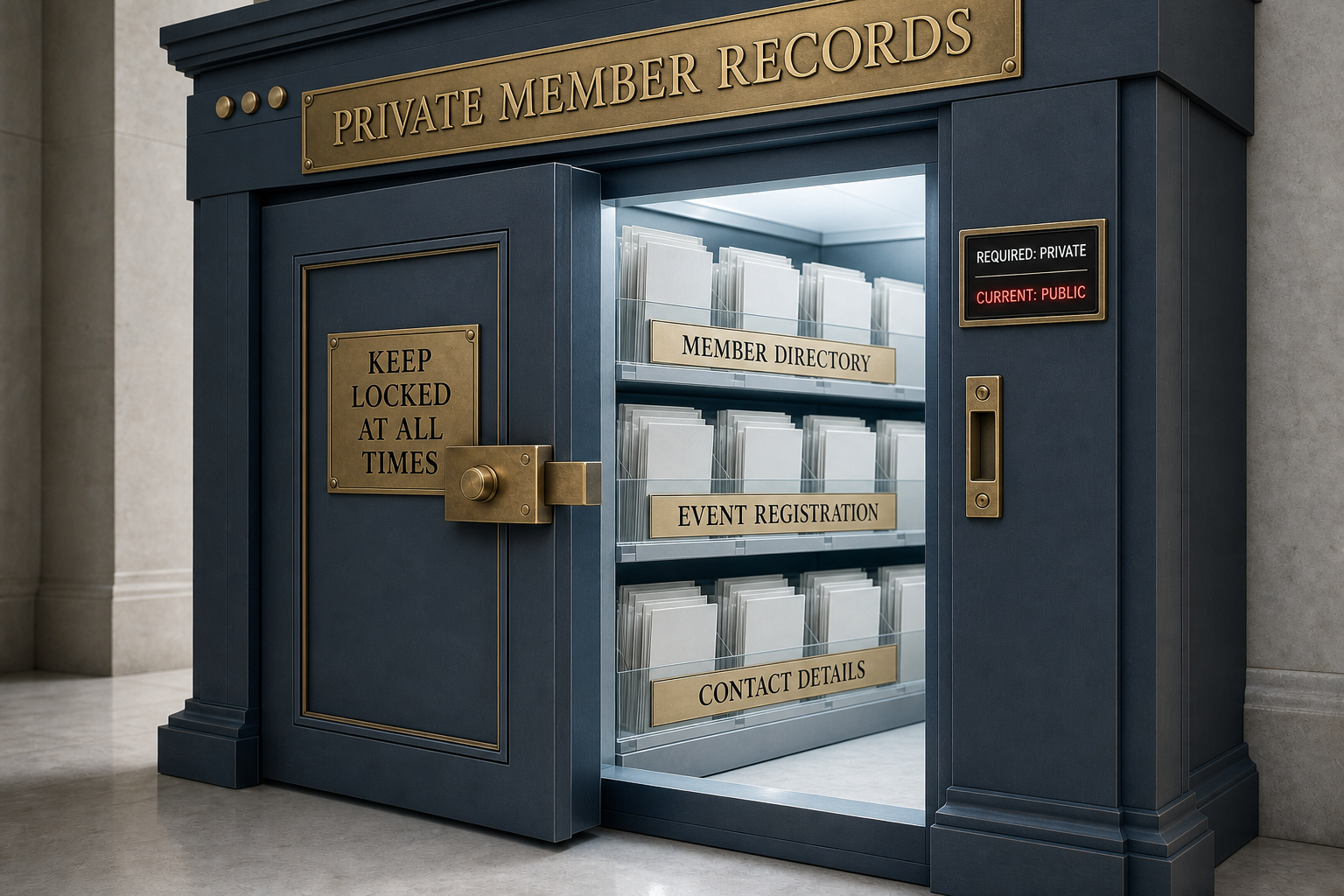
A Website Bug Exposed Peter Thiel's Secret Society. The Real Scandal Isn't the Secret — It's How Rarely We Catch One.
A misconfigured website — not a hack — leaked member and attendee data from Dialog, a private networking society Peter Thiel co-founded in 2006. The viral claim that Jeffrey Epstein was invited is false: two other people forwarded him their own invitations, and a different, fully-identified 'Jeff Epstein' appears on a leaked list. What's actually documented: a badly-secured but otherwise unremarkable version of something powerful people have always done in private. The real story isn't that this happens. It's that we almost never get to see it when it does.
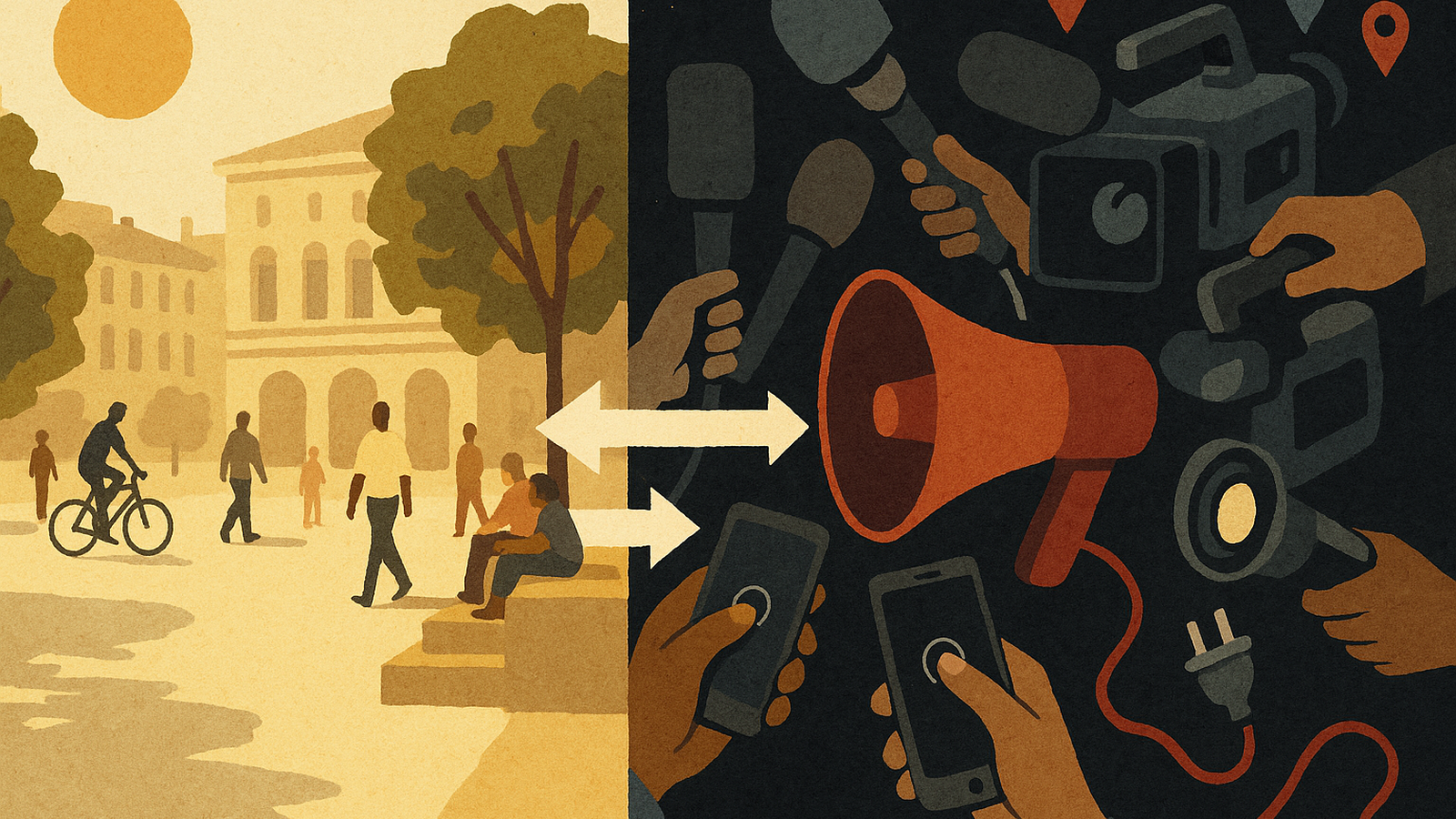
A Former Prime Minister Said Something Racist. We Don’t Have to Do His Publicity.
Mariano Rajoy supplied one ugly sentence. Politicians, newspapers and millions of social-media users supplied everything it needed to become an international event.
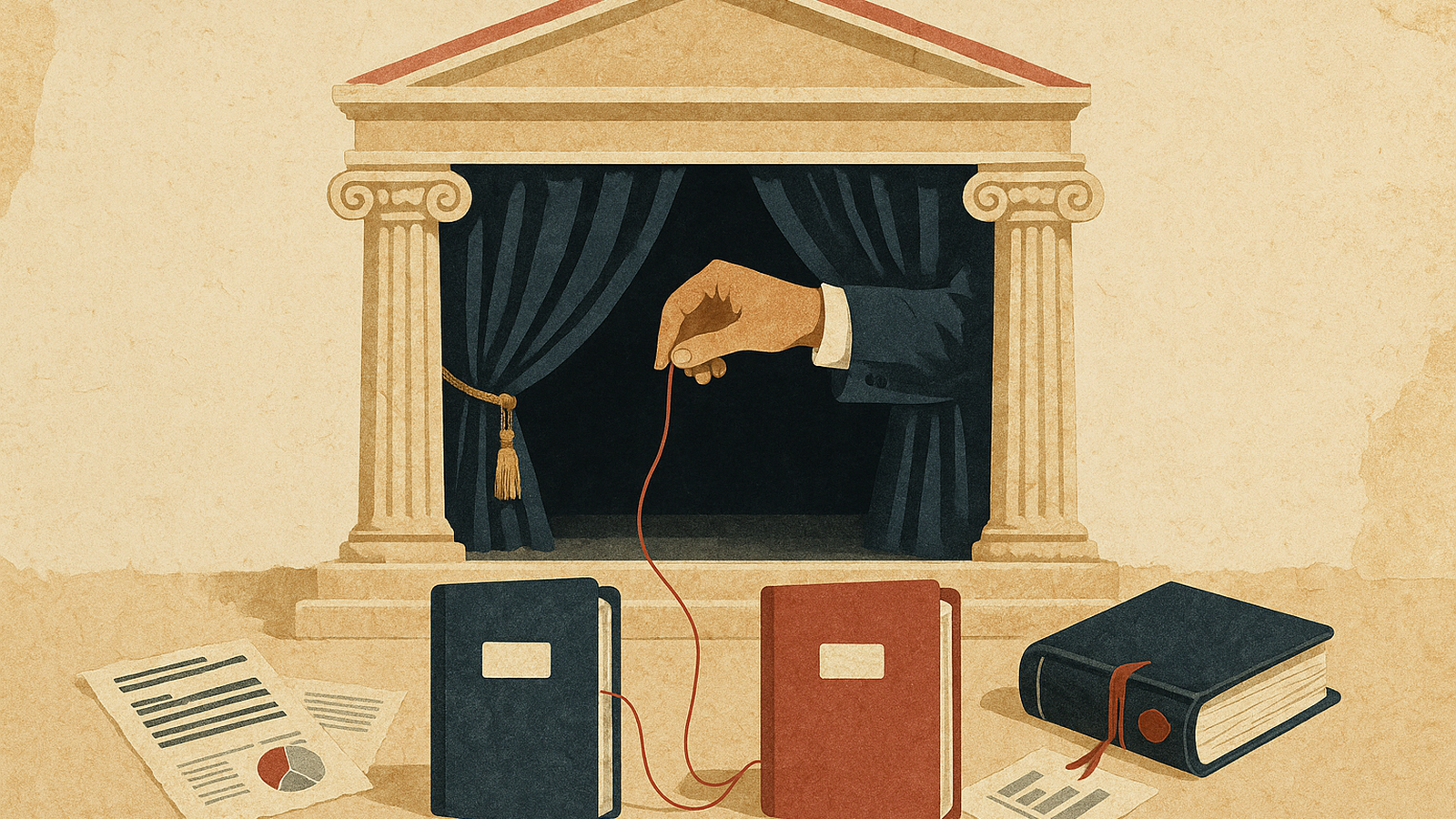
Trump Sued His Own Government. A Judge Says the Case Was Built to Make a Private Deal Look Legitimate.
The lawsuit produced tax protections for the president and a proposed $1.776 billion fund for his allies. A federal judge has now barred the parties from treating the arrangement as a legitimate settlement and referred lawyers for possible discipline.
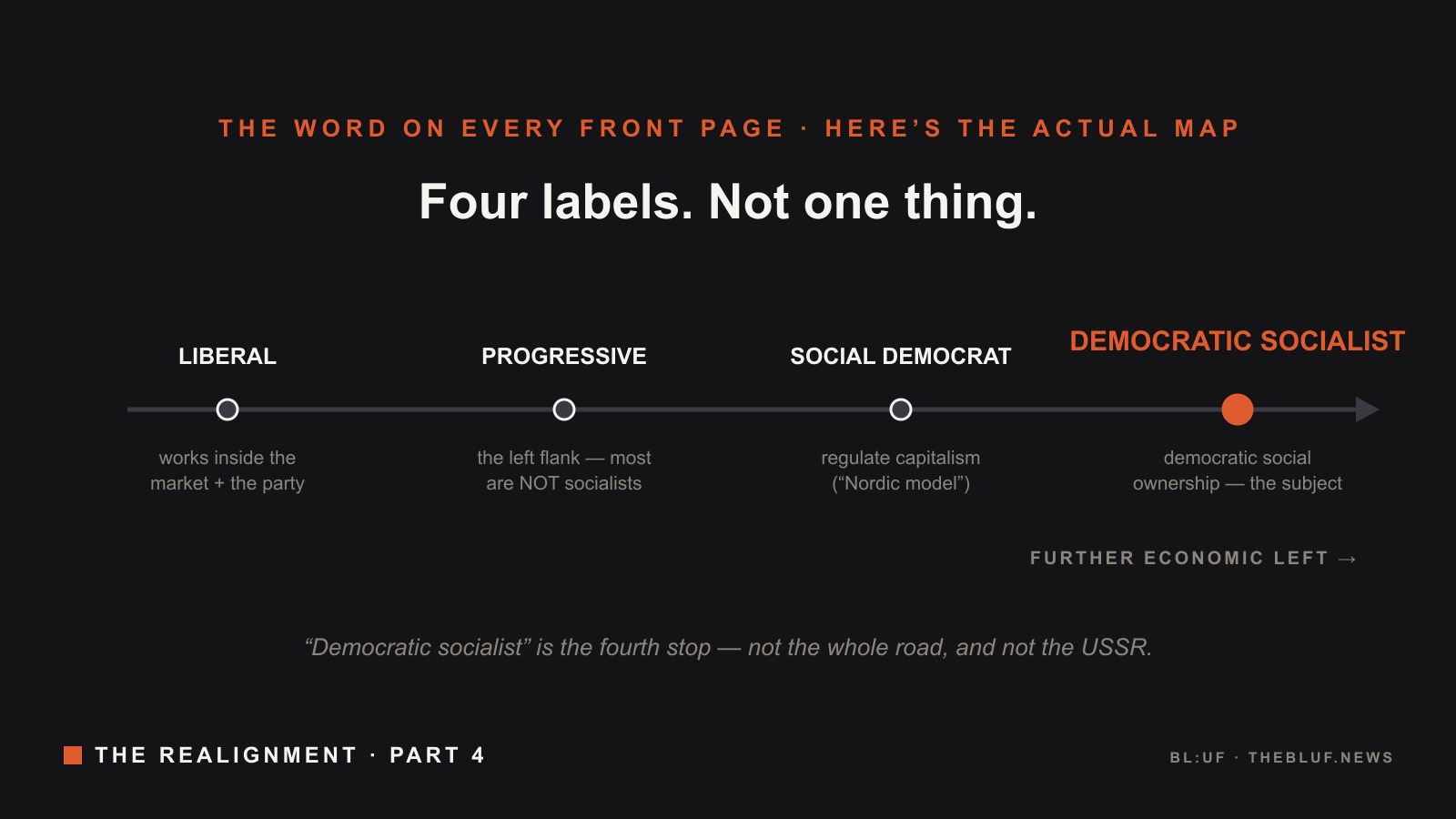
A Democratic Socialist Runs New York Now. Here's What That Word Actually Means — and Who's Under the Banner.
Zohran Mamdani — a democratic socialist — is the mayor of New York City, and the label is suddenly everywhere, used to mean everything from Bernie Sanders to Soviet communism. It's neither by accident. Here's what the word actually means, who's really under the banner, what they want, and where each side says the other distorts it.
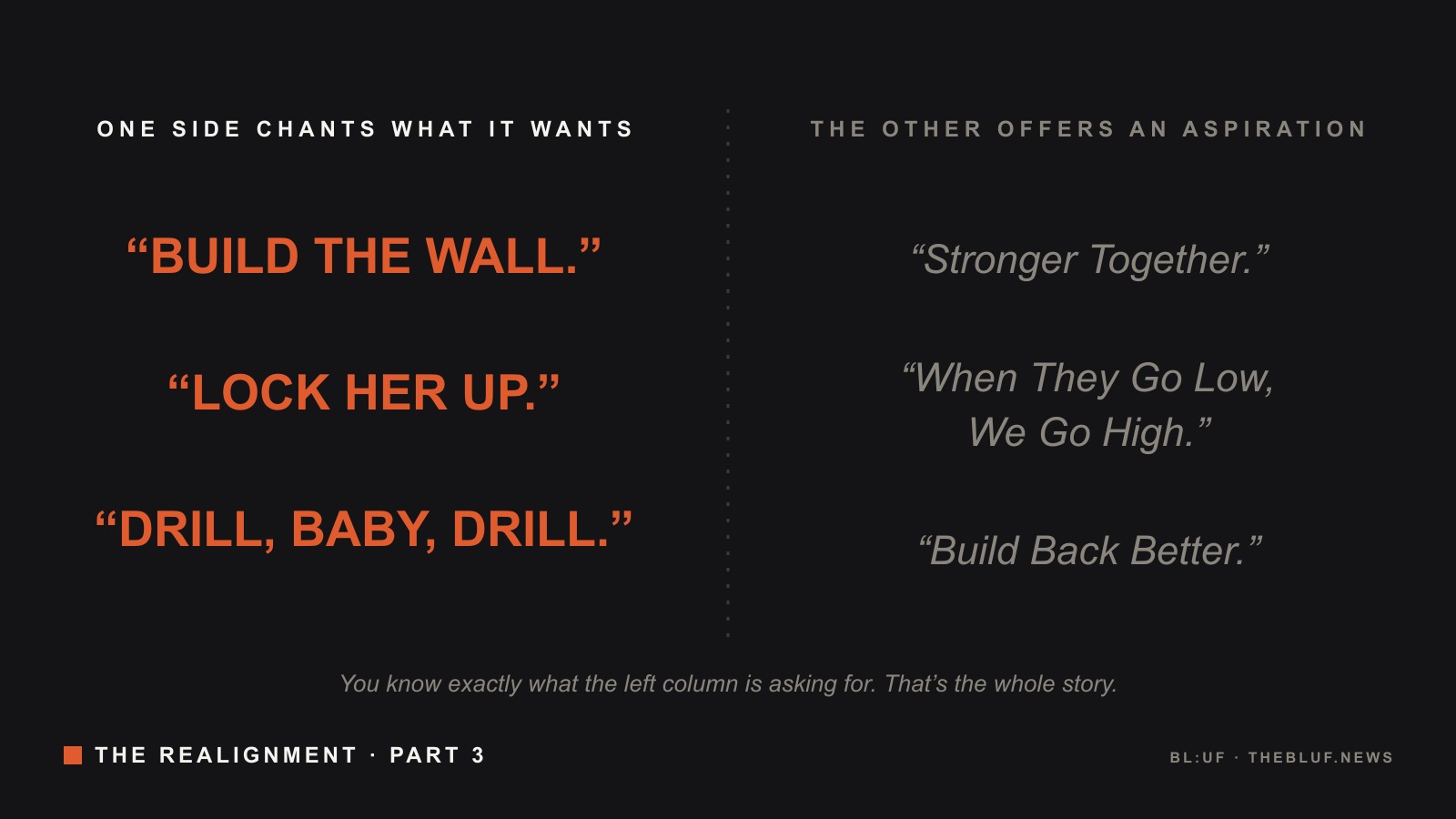
One Party Talks in Verbs. The Other in Adjectives.
Why do some slogans lodge in your head while others slide right off? It comes down to a documented difference in how the two parties tend to talk — concrete and repeated versus abstract and listed. It shapes what voters remember, says nothing about who is right, and costs both sides.
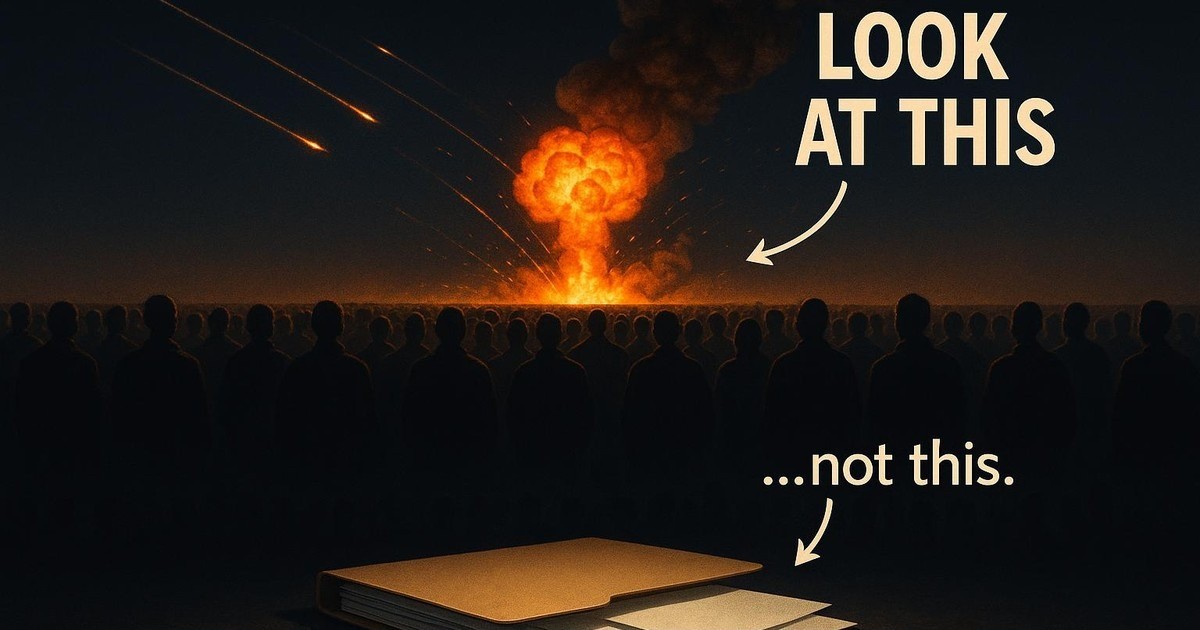
He Ordered Strikes on Iran the Same Day He Called It “Japan.”
On July 8, the President reignited the Iran war from the NATO stage — and in the same appearance called Iran the “Islamic Republic of Japan,” mistook Zelensky for Putin, and described a missile attack his own military says never happened. Six days earlier, his Justice Department defied a federal court order to release Epstein files. Two documented things, side by side. We'll show you when each happened. Why — if there's a why — is yours to weigh.

America Runs on a Contribution It Refuses to Invoice. Now It's Un-Invoicing the Record, Too.
Black Americans are roughly one in seven people in this country, a third of its home health aides and postal clerks, nearly a third of its enlisted women, the authors of the music genre America streams more than any other — and the largest single financial asset in the pre-Civil War American economy. That contribution has always come with the credit and the payment quietly withheld: a $50 buyout for a song that built a genre, a $500 check for a hit that made someone else a fortune, farmland taken by the millions of acres, riot claims filed and denied. This piece calls that pattern the un-invoicing — extraction with the receipt voided. For most of American history it ran headless, no memo, just a thousand separate hands reaching for the same thing. In the last eighteen months, for the first time, it has a signature: a named executive order, a dated letter, a 500-plus-item government spreadsheet — and, as of five days ago, a federal court that just let the un-invoicing continue.
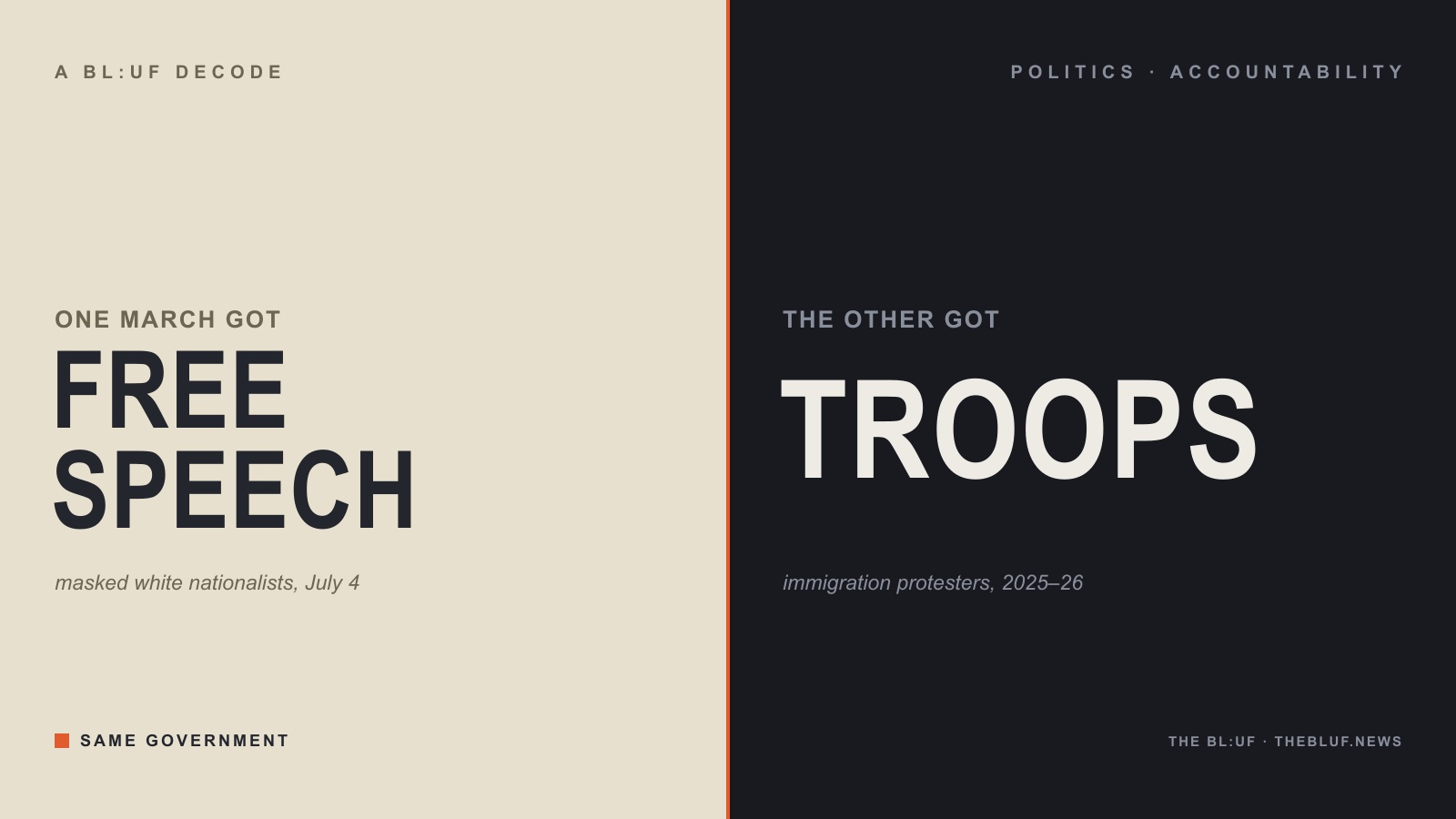
One March Got "Free Speech." The Other Got Troops.
On July 4, masked white nationalists marched past the U.S. Capitol, and a sitting Cabinet secretary called it "free speech" in a "messy democracy." Over the past year, the same administration met immigration protesters — including peaceful ones and bystanders — with troops a federal judge ruled were deployed illegally, mass subpoenas for critics' data, facial-recognition surveillance, and the label "insurrectionists." The conduct at those events wasn't identical. But the government's own words and posture flipped depending on who was marching, and for what.
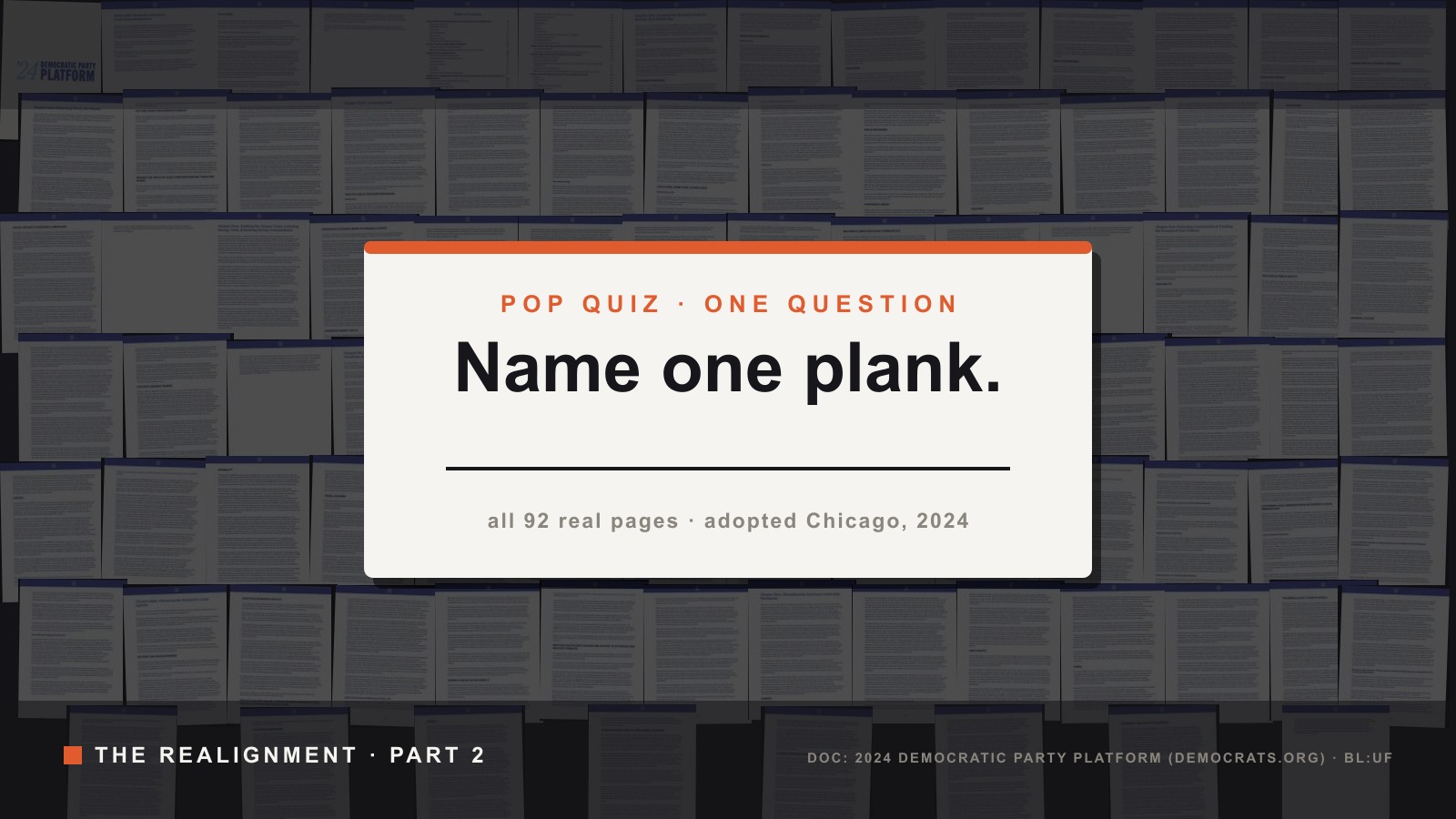
The Democrats Have a Platform. Almost No One Can Name a Plank.
The Democratic Party has a 92-page platform — so why can't the people who vote for it name a single thing it stands for? Not because the party believes in nothing, but because the platform is orphaned, no one is left to say it, and out of power it can't deliver.
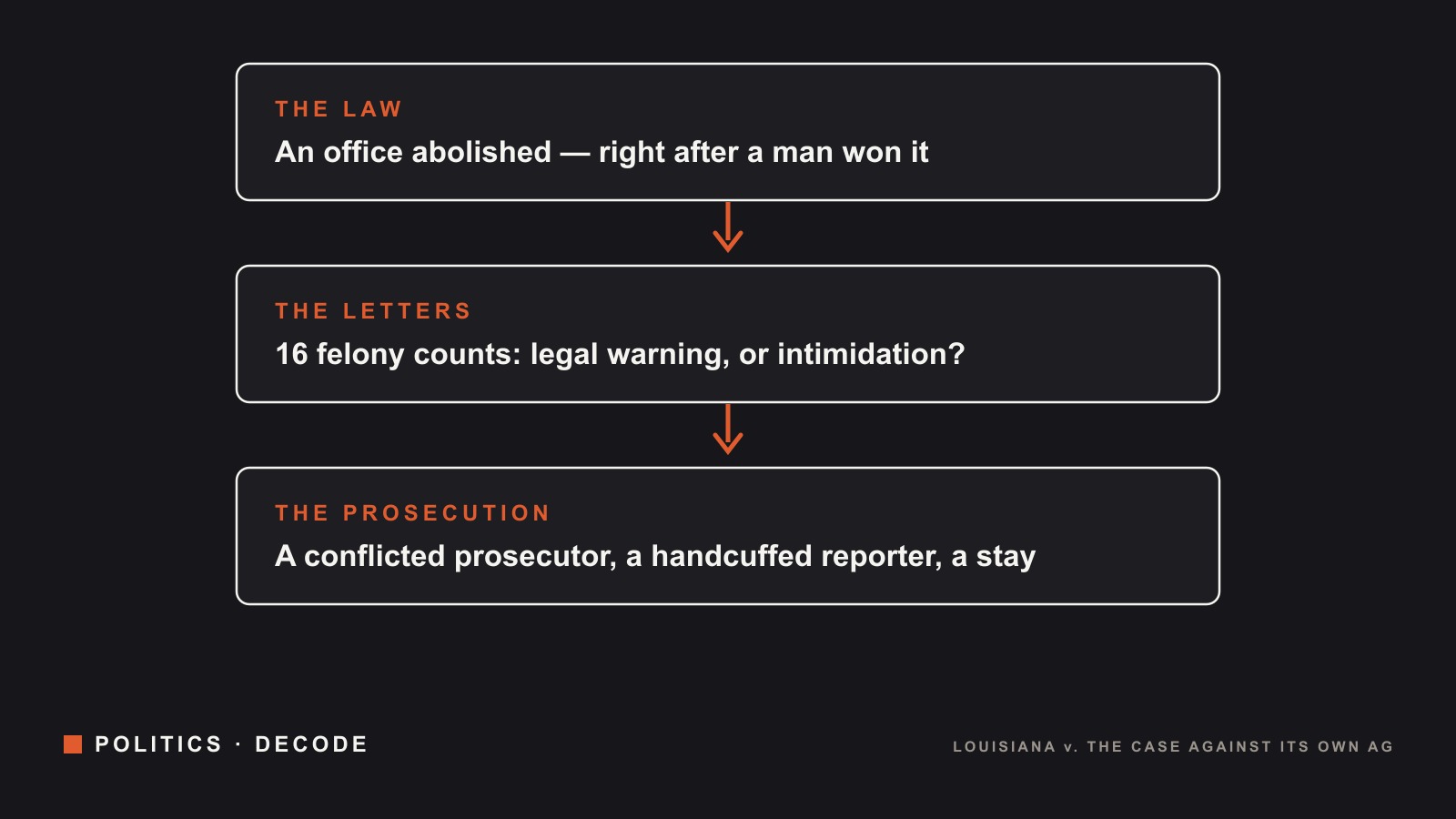
Louisiana Indicted Its Attorney General. Its Top Court Froze the Case in a Day. Both Moves Have Documented Problems.
AG Liz Murrill was indicted on 16 felony counts over letters warning New Orleans officials their jobs were at risk — then the state supreme court froze the case in under a day, citing a conflicted special prosecutor, a closed courtroom, and a handcuffed journalist. The dissents call it preferential treatment. Underneath it all: the state abolished an office right after an exonerated man won it. Three fights, one decode.
The Supreme Court Just Said Birthright Citizenship Stays. Here's the 14th Amendment Behind It — and the Claim About It That's Simply Wrong.
Today the Supreme Court ruled, six to three, that a move to end birthright citizenship can't be squared with the 14th Amendment. If you've heard that scrapping the 14th would "make Black Americans slaves again," that part is wrong — that was the 13th. Here's where this law actually came from, what it does, and what today's ruling did and didn't settle.
Half of Americans Have Had a Family Member Locked Up. Most of Us Don't See How Cruel It Is Until It's Someone We Love.
The abuses inside America's jails aren't secret — they're in court orders, federal investigations, and settlements going back decades. We mostly look away until the system reaches our own family. Here is what's on the other side of that door — and the pattern in who finally gets heard.

Criticizing Israel Isn’t Antisemitism. Real Antisemitism Sometimes Hides Right Next to It. Here’s the Documented Line — and Why a CNN Panel Just Exploded Over It.
A CNN panel blew up this weekend over a question tangling both left and right: where does criticism of Israel end and antisemitism begin? They’re different things — criticizing a government, including Israel’s, is ordinary politics; antisemitism is hostility or conspiracy aimed at Jews as Jews. The confusion gets exploited two opposite ways, and those failures aren’t mirror images. Here’s the line, the documented stakes, and the tests that tell them apart.
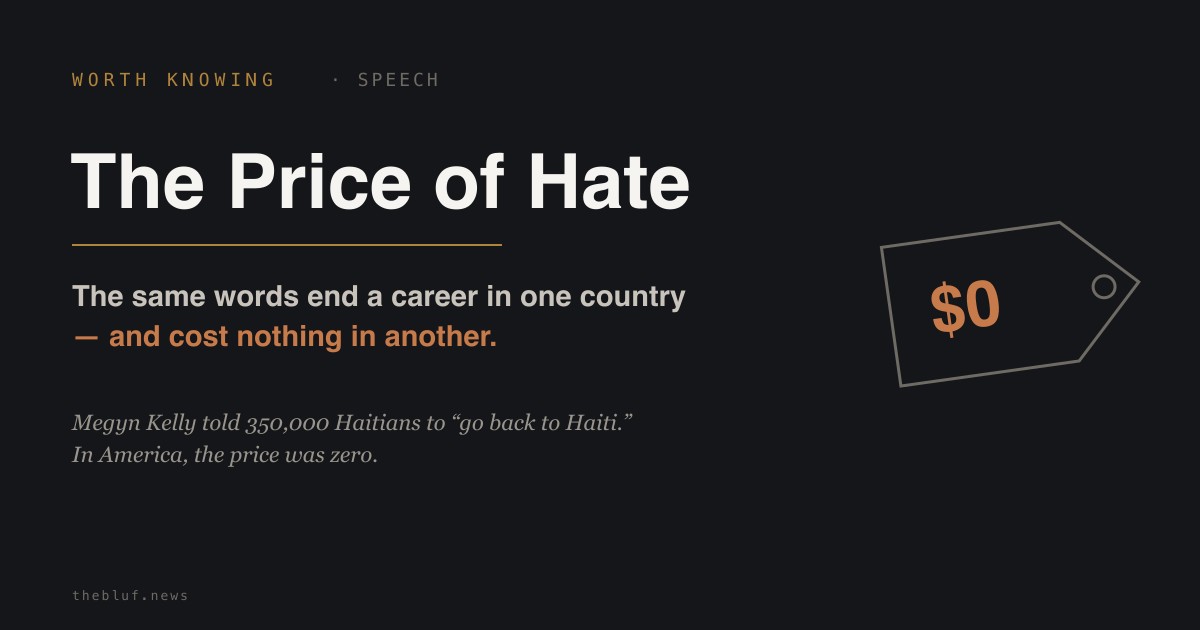
Megyn Kelly Told 350,000 Haitians to “Go Back to Haiti.” It Cost Her Nothing. Whether Hate Has a Price Depends on Who You Aim It At — and Which Country You’re In.
After the Supreme Court cleared the way to end legal status for ~350,000 Haitians, Megyn Kelly told them on a top show to “go back to f—ing Haiti” — and faced no penalty. Two rules explain the silence: in America, whether hate carries a cost turns on who it targets and whether the machinery to make it expensive was ever built for that group; and the same words are protected speech here but a regulated offence across most of the democratic world. Here’s how both work — and what you can do about either.
Texas Will Require 5 Million Kids to Study the Bible. You Can Opt Out — but Your Child Can Still Be Tested on It.
Texas voted to put Bible stories into the required reading curriculum for 5.5 million public-school students. Parents can opt a child out of the lessons — but the state admits the child can still be tested on it, including on the standardized STAAR exams. For the ~1 in 3 Texas families who aren’t Christian, that leaves no real way out.
The Democratic Base Had Nowhere to Go. It Stopped Falling in Line.
For thirty years the Democratic left had nowhere else to go, so the party banked its loyalty and governed toward the middle. That bargain just broke — not because the base left (it can't), but because it found another way to make the party listen: beating its own incumbents in their primaries. Mamdani is the headline, not the whole story. Here's the machine underneath it.