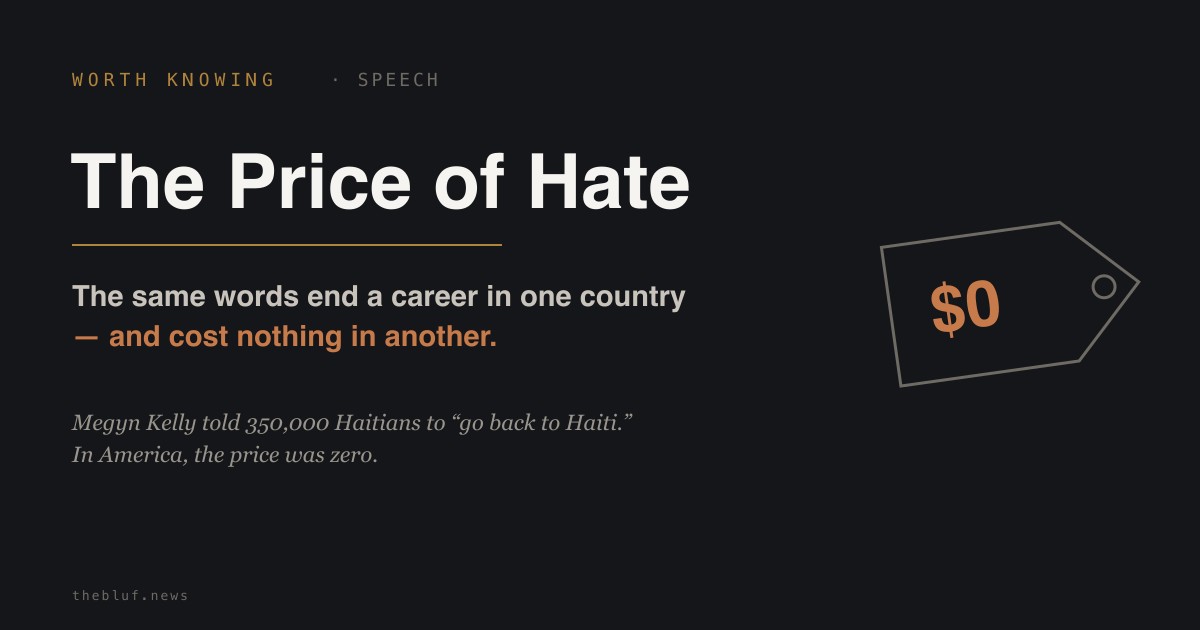
After the Supreme Court cleared the way to end legal status for some 350,000 Haitians, Megyn Kelly told them — on one of the biggest shows in the country — to "go back to f—ing Haiti." No government could punish that; the First Amendment protects it, by design. No employer or advertiser did either. Two quiet rules explain the silence. One: in America, whether hate carries a cost depends less on how ugly it is than on who it targets — and whether the machinery that makes hate expensive was ever built for that group. Two: the same words are protected speech here and a regulatory offence in Britain, Canada, or Germany. Here's how both work — and what, realistically, you can do about either.
The rant
On June 25, 2026, the Supreme Court ruled 6–3 that courts can't block the administration from ending Temporary Protected Status for roughly 350,000 Haitians (and about 6,000 Syrians) — and rejected the argument that the move was racially discriminatory. These are people who had lived and worked in the US legally for years, many for more than a decade — with jobs, leases, US-citizen kids — and the country they'd be returned to is one the State Department warns Americans not to travel to at all. The next day, on The Megyn Kelly Show (SiriusXM), Kelly's response was: "Go home! Get out! We know our country is better than yours… You being here only dilutes it for us, those who built it and live it… And half of you people — more than half of you — won't assimilate." She capped it: "Go back to f—ing Haiti!" She also repeated a claim that Springfield, Ohio police and city officials had publicly refuted back in 2024 — that Haitian immigrants were eating residents' pets. The fallout? A few commentators called it vile. No advertiser left, no suspension, no real apology.
Rule one — in America, the price of hate depends on the target
Run the thought experiment. Aim that monologue at almost any group with an organized civil-rights defense behind it and it ends a career by lunch: advertisers bolt, the network issues a statement, an apology gets drafted. Aimed at Haitians, it's a Tuesday.
The reason isn't that some group is over-protected. It's that the protection is unevenly built. What makes hate cost something is infrastructure — advocacy that documents it and pressures sponsors, civil-rights enforcement that gives it legal teeth, advertisers who fear the association. That infrastructure is robust for some targets (watch how fast the response moves when slurs are aimed at Black Americans, or how quickly a company distances itself after an antisemitic outburst) and barely exists for others. Haitians have no comparable lobby. The power lives in the system that got built — not in any group that "controls" anything.
And one thing supercharges the gap: political alignment. Right now, anti-immigrant contempt isn't transgressive — it's endorsed, by a Supreme Court ruling, an administration, and a mass audience all pointed the same way. Hatred of a group that's both organized and in political favor gets punished; hatred of a group that's neither gets applause. This isn't a left-right rule — swap the speaker's politics and the target's standing and the same math holds. The variables are organized power and political favor, not ideology.
So what's the lesson? Be careful, because there are two honest ones, pointing opposite ways. One: build that civil-rights machinery for everyone, so no group is left as fair game. The other: dismantle the reflex of career-ending punishment for all of it alike, and let even ugly speech answer only to argument. The first treats consequences as accountability; the second treats them as a mob. This piece documents the gap — which way to close it is a real fight, and not one we settle here.
One more honest caveat: "hate" is a contested label, not a settled one. Kelly's is an easy case — a slur plus a debunked hoax. The hard cases are the ones where someone else decides what counts, and the same rules that catch a slur have been turned on feminists, street preachers, and comedians. That danger is exactly what the next section runs into.
Rule two — it's not just unpunished here. It's legal.
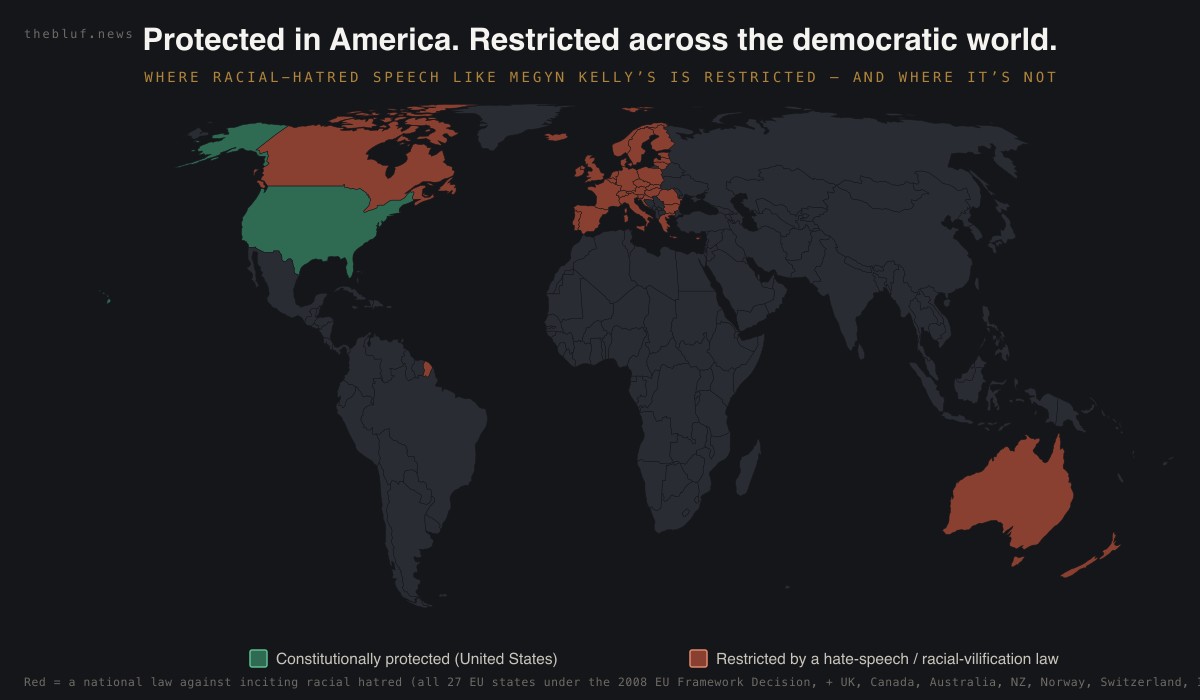
In the US, Kelly's words are squarely protected. The First Amendment shields hate speech from government penalty, and there's no broadcast-content referee for satellite radio or podcasts — the FCC doesn't police them. The only enforcement is the uneven market from Rule One.
Cross an ocean and the same sentence changes legal character. A UK-licensed broadcaster airing it could face Ofcom — whose code bars "abusive or derogatory treatment" of ethnic groups and material likely to stir up hatred — and the UK's Public Order Act makes "stirring up racial hatred" a criminal offence. Canada (Criminal Code §319; the CRTC) and Germany (§130, Volksverhetzung — incitement of the people) reach it too — and so, in some form, does most of the democratic world. All 27 EU states are required to make public incitement to hatred on racial or ethnic grounds a criminal offence under a 2008 EU framework decision, and Australia, New Zealand, Norway, Switzerland, and Iceland have their own versions. The US isn't strict or lenient on a spectrum — it's the outlier, the rare democracy that protects this speech outright. (A law on the books isn't the same as a prosecution — several of these are rarely enforced — but the legal line exists nearly everywhere except here.)
The honest tension
Neither model is free — and the point is not to pretend the two costs are the same kind of thing. America's bet is that government can't be trusted to define "hate," so it protects nearly all speech; that's why the dissident and the bigot shelter under the same amendment. Europe's bet is that the state can draw the line — which curbs the bile but hands officials a tool that has been turned on legitimate speech (the double edge we mapped in our piece on criticism of Israel and antisemitism: a rule against hate is only as fair as whoever's holding it). Here's the honest asymmetry: the American model's cost is concrete and present — 350,000 people told to get out, no penalty for the telling — while the European model's cost is a risk, the tool waiting to be misused. They're different kinds of cost. Where you land says as much about which risk you fear as about the facts.
The bottom line
Whether hate carries a price in America comes down to two questions that have nothing to do with how cruel it is: who you aimed it at, and where you were standing. Kelly's words are simply what the American bet looks like when the target is a group with no lobby and no political cover. The line between hard speech and hate is worth holding — but a line only protects people if someone is willing to hold it for the ones nobody's organized to defend.
If it offended you — here's what you can actually do
The honest answer splits in two, and the split is the piece.
- For the speech itself, there's no US referee — by design. The FCC doesn't touch satellite radio or podcasts, and the First Amendment protects the words; the same shield covers the dissident and the bigot. There's no government complaint to file, and that's a feature, not an oversight.
- What you do have here is persuasion, not penalty. Advertisers and the platform set their own lines — you can tell them where you stand, on any side. And the decision underneath the rant — ending TPS for 350,000 people — sits with Congress and the administration: find your representative at congress.gov/members/find-your-member and weigh in, whatever your view.
- If you or someone you know is a TPS holder affected by the ruling: free or low-cost legal help is at CLINIC (cliniclegal.org) and the Immigrant Legal Resource Center (ilrc.org).
- Where there is a referee: in the UK (Ofcom — ofcom.org.uk/make-a-complaint), Canada, and much of the EU, on-air hate can be formally complained about — for better and worse, that's the state drawing the line.
The point isn't that you're powerless. It's that in America the levers are the market and the ballot — never a regulator. Which is exactly the bet this piece is about.
Related: our decode of where criticism of Israel ends and antisemitism begins — on the same hard problem underneath this one: a rule against hate is only ever as fair as whoever gets to enforce it.
Receipts: Kelly quotes — Daily Beast / Atlanta Black Star / The Hill / theGrio / Mediaite. SCOTUS — Mullin v. Doe (No. 25-1083), 6–3, June 25 2026 (held the TPS termination unreviewable + rejected the discrimination claim). Springfield hoax refuted by city/police, 2024. US — First Amendment + FCC scope (no satellite/podcast content rule). UK — Ofcom Broadcasting Code §3 + Public Order Act 1986 Part III. Canada — Criminal Code §319 + CRTC. Germany — §130 StGB. EU-wide — Framework Decision 2008/913/JHA (all 27 states). Australia — Racial Discrimination Act §18C + ACMA. New Zealand — Human Rights Act §61/§131. Also Norway §185, Switzerland Art. 261bis, Iceland §233a. Spotted an error? editor@thebluf.news