What's documented
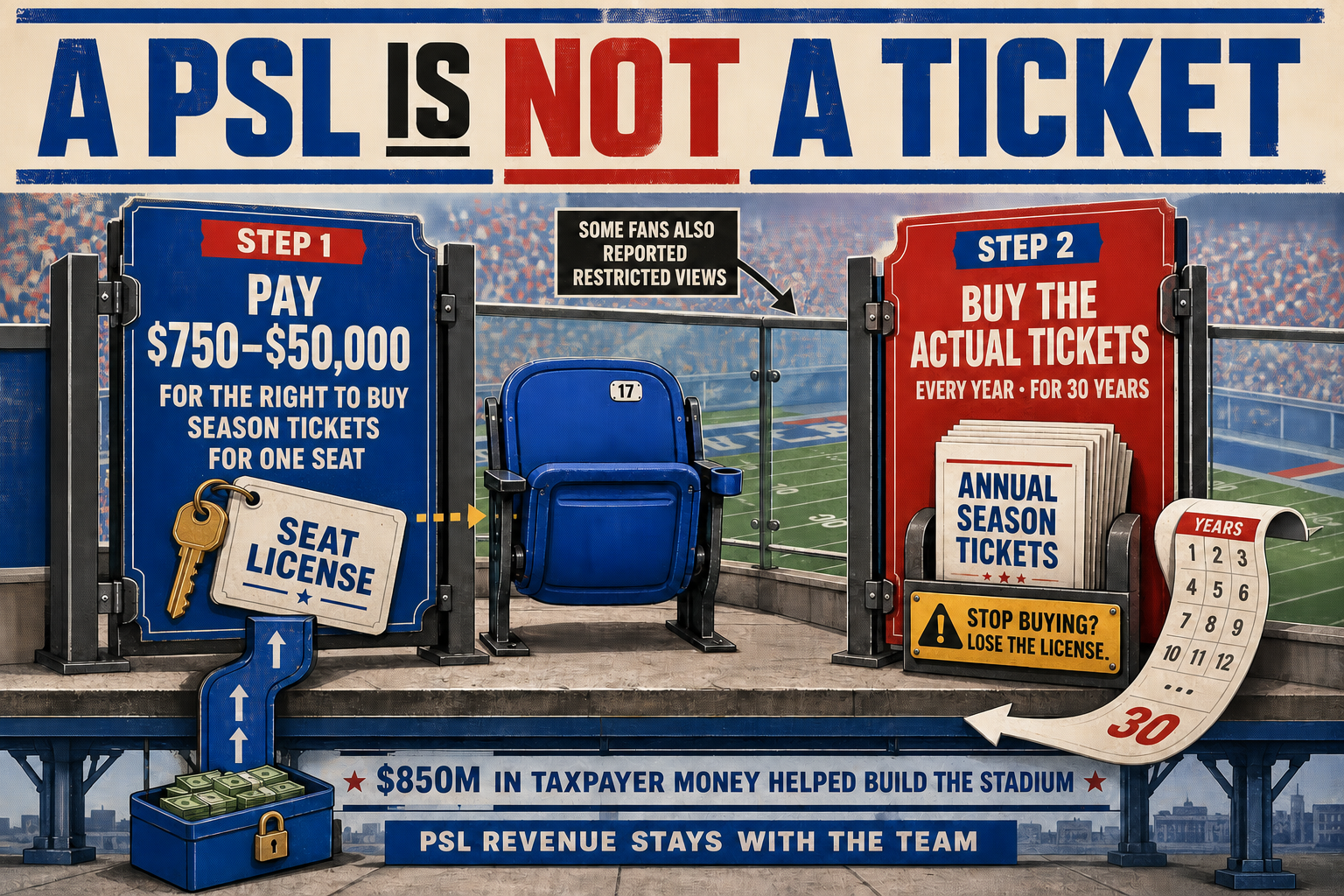
A Personal Seat License is not a ticket. It's a one-time, non-refundable fee that buys the right to purchase season tickets for a specific seat — and it comes with an obligation to keep buying those tickets every year, or forfeit the license. The PSL price never counts toward the ticket price. It's charged once at the start, and season tickets are charged on top of it, every single year, for as long as you hold the license. At Highmark Stadium, that's the length of the Bills' new 30-year lease.
Prices ranged $750 to $50,000 per seat depending on location. All 54,628 licenses sold out, raising just over $259 million — an average around $4,700 to $4,800 per seat across the 60,000-seat building.
Season ticket prices went up on top of that. Angelica James, a season ticketholder, told CNN she'd paid $4,300 per seat for club seating in the old stadium and was quoted $8,610 per seat for the new one. She and her husband downgraded to general admission with $6,000 PSLs instead. "It's not just the Bills," she told CNN. "It's everyone in the world is trying to make money." Fans also pay a 6% surcharge on top of the existing 8.75% sales tax on purchases inside the stadium, a term of the county's stadium deal. The Bills now rank as the NFL's most expensive team to watch live, with family game-day cost estimates topping $2,100.
Where PSLs came from, and why they spread
Personal seat licenses were invented in 1993 by Charlotte marketing agent Max Muhleman for the Carolina Panthers, an expansion team with no stadium built and no public money committed. The NFL's $140 million expansion fee, plus giving up half the team's TV revenue for three years, left the Panthers needing a financing source that wasn't a loan or a tax bond. PSL sales raised more than $92 million from 49,294 licenses — short of the team's own 50,000-license goal — priced $600 to $5,400 each, averaging $2,200, to build what became Ericsson Stadium.
The reason PSLs spread to a majority of NFL teams comes down to how the league splits money. The NFL has long required teams to share a cut of ticket revenue with the rest of the league — historically in the 30–40% range. PSL revenue is exempt from that formula entirely: a team keeps 100% of what it raises from seat licenses. Economists who study PSL markets have found a documented incentive beyond the one-time cash: teams that use them often price season tickets below what the market would bear, because a cheaper advertised ticket makes the PSL — the revenue stream nobody else gets a cut of — worth more. Revenue sharing predates PSLs by decades, going back to the NFL-AFL merger era. PSLs weren't built as a workaround from day one, but the tax-free-to-the-league status is why the mechanism caught on once owners understood what they were sitting on.
Before PSLs existed, two different problems — how a stadium got built, and how a fan got a seat in it — were both solved without one. Through the 1970s and into the '80s, the public covered roughly 90% of stadium construction costs on average, financed through tax-exempt municipal bonds. Congress tried to shut that down in the Tax Reform Act of 1986, but the law required a bond to fail two separate tests — a 10% private-use test and a 10% private-payment test — before losing its tax-exempt status, and teams that avoided tripping both at once kept the public-bond financing flowing anyway. Seat scarcity had an even simpler answer: a waiting list. No fee, no license — you put your name down, waited your turn, and paid face value when a seat opened up.
That second mechanism isn't history. The Green Bay Packers still use it today, with no PSL at all. Their season ticket waiting list runs over 130,000 names deep, with waits that can stretch 30 to 60 years — long enough that Wisconsin families routinely add a newborn's name the day the birth certificate comes through, and a spot passes to a spouse or child if the person on the list dies first. It's proof the scarcity problem PSLs claim to solve was always solvable without charging anyone $50,000 for the right to then pay full price — Green Bay just never chose to.
The seats don't all see the field
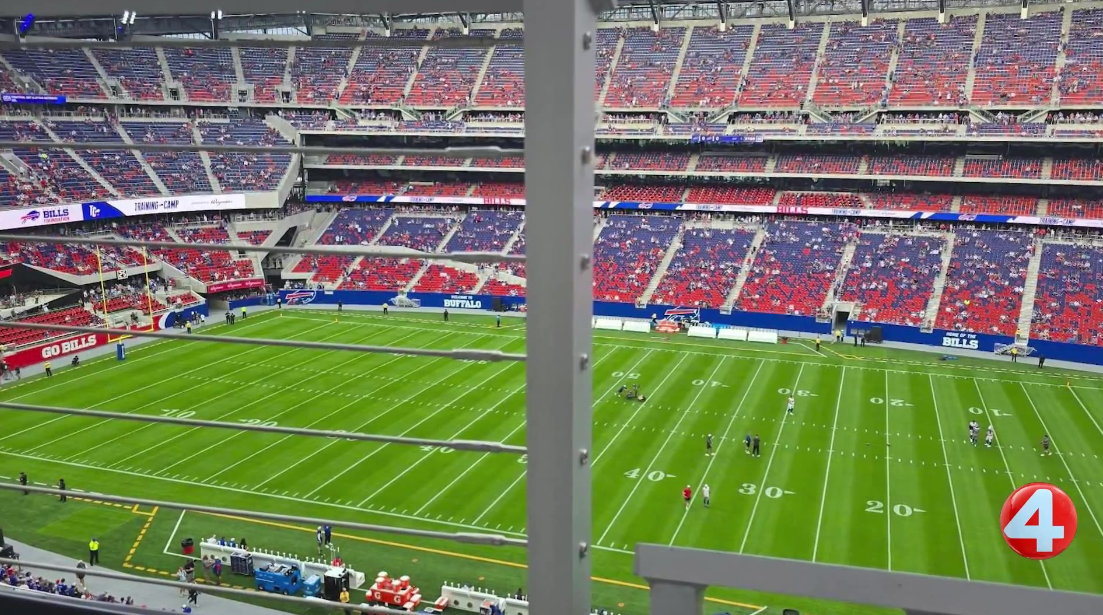 Credit: WIVB/News 4 Buffalo, from the August 8, 2026 open practice
Fans posted photos this summer showing parts of the field blocked by railings, glass barriers, and overhangs — for seats they had already paid PSL money to lock in for three decades. Bills beat reporter Alex Brasky's thread became one of the most-cited examples, amplified by outlets including Underdog NFL. Season ticket holder Derrick Piatkowski posted what Bills staff showed him during the sales pitch next to what he actually got, writing that staff had told him the obstruction "wouldn't be an issue."
Bills COO Pete Guelli's response: "So far, we've heard from less than one percent of our PSL holders about anything sightline related," and "any building you would walk into, there would be some obstructed seating." Separately, roughly 600 fans reportedly have views that are fully obstructed — a figure close to Guelli's own one-percent framing, since it's a similar share of the building, though the two numbers measure different things: his is a complaint rate, the 600 is a count of seats independently identified as blocked. As of this writing, fans are described as "threatening" a class-action suit over restricted views — no case has actually been filed.
The public paid for the building; the PSL money stayed private
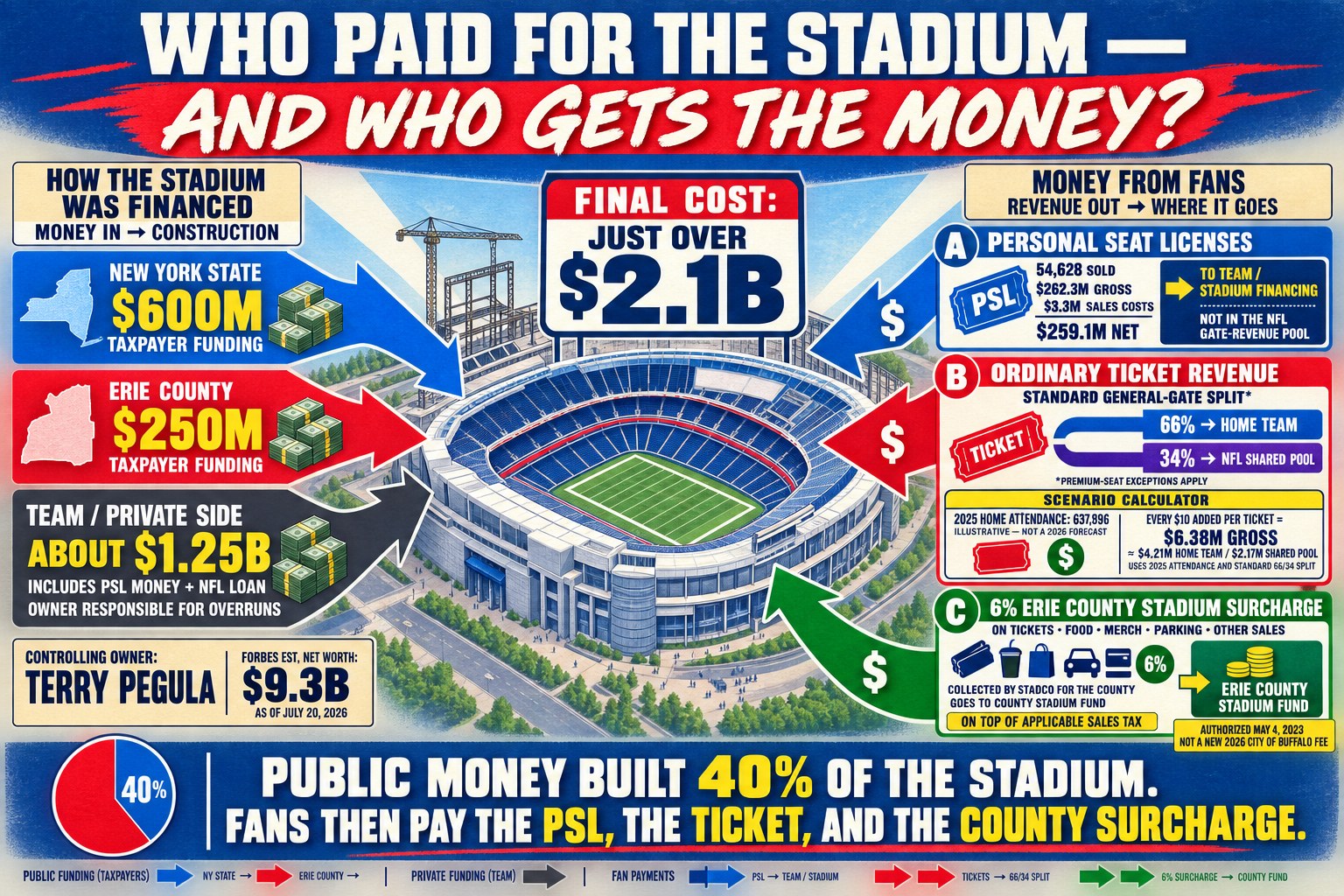
Highmark's total cost was $2.1–2.2 billion. Taxpayers covered $850 million of it — $600 million from New York State and $250 million from Erie County — plus another $100 million in state maintenance money over 15 years on top of that. The $850 million is roughly 39–40% of the final project cost, not the 60% figure tied to the stadium's original, smaller $1.4 billion budget estimate; it's still the second-largest public subsidy an NFL stadium has received, behind only Nashville's $1.2 billion Titans deal. Bills owner Terry Pegula's net worth is $9.3 billion, per Forbes' real-time tracker as of mid-August 2026 — a fact critics of the deal point to when arguing the public support wasn't necessary. Sports economist Victor Matheson, who has studied stadium financing for two decades, called the deal "one of the worst" he's seen for taxpayers when it was struck in 2022 — that assessment predates this year's fan backlash, but it's the same financing structure now generating it: public money built the stadium; the PSL system, exempt from league revenue sharing, is what generates money the Bills don't have to share with anyone. State and county officials who backed the 2022 deal argued it would keep the Bills in Buffalo for the length of the 30-year lease and anchor regional economic activity around the stadium — the standard case made for most publicly financed stadiums, whether or not the economics ultimately bear it out.
No state law specifically regulates personal seat licenses. The only fallback for a fan who feels misled about what they were buying is the same general unfair-and-deceptive-practices law that covers any consumer transaction — and that law has never been tested against a PSL sale.
What can I do
Right now, if you bought a Bills PSL and feel misled: file with the New York Attorney General's Consumer Frauds Bureau. There's no PSL-specific statute — this is general unfair-and-deceptive-practices law, the same law that covers any business that misrepresented what you were buying. One complaint doesn't guarantee anything. But that bureau logs every complaint against the same business into one file, and a pattern of matching complaints is what turns "one fan's bad experience" into "an investigation." It only works if it's on the record, and it isn't unless you file it.
Before it's too late in the next five cities — here's exactly where each deal stands, and separately, where PSLs stand, so you're not hunting for either:
- Kansas City (Chiefs, Wyandotte County, Kansas) — stadium funding still genuinely live; PSLs not yet formalized. Kansas is covering 60% ($1.8 billion) of the $3 billion project through STAR bonds; the Chiefs cover the remaining $1.2 billion. The Unified Government Commission held a public hearing on the STAR bond district in February 2026, and the project doesn't open until 2031 — there's years of oversight ahead. Track meetings and submit public comment through the Unified Government's CivicClerk portal. Sports-business reporters describe a PSL program as close to inevitable, but no pricing or structure has been announced — this is the one city where weighing in could still shape how PSLs get built, not just whether they exist.
- Hammond, Indiana (Bears) — funding partly live; PSLs expected but unannounced. Indiana's $1 billion-plus state package already passed in February 2026. What's still being fought over locally: the food-and-beverage tax, Hammond's admissions tax, and a hotel tax hike that fund it — and Porter and Lake counties are visibly split on those. Reach Hammond's Common Council or Lake County Council while that's still being decided. No PSL announcement yet, though reporting expects one given recent stadiums in LA, Las Vegas, Atlanta, the Bay Area, and Minneapolis all leaned on PSL sales.
- Brook Park, Ohio (Browns) — funding mostly settled; PSLs already confirmed and priced. The $600 million in state money is already approved and signed. What's still moving through the process is local: Brook Park City Council held a special session on the pre-development agreement in April 2026, and further zoning and implementation votes are ahead. Brook Park City Council's page has the agendas. PSLs are not speculative here: the Browns have told season ticket holders directly that a PSL will be required for every seat, existing PSL holders get a credit toward the new one, and a fan survey has floated pricing from $500 to nearly $194,000 for the top field-level seats — not final, but real numbers already in front of real fans.
- Washington, D.C. (Commanders) — funding closed; PSLs confirmed, structured differently than anywhere else. The D.C. Council gave final approval to the $3.7 billion deal in September 2025, 11-2. The big vote is over; groundbreaking is already underway. The PSL twist: the District's own EventsDC is selling the PSL rights to the Commanders for up to $975 million — meaning the city government, not just the team, is a direct party to the seat-license sale. That works out to roughly $15,000/seat if spread across the whole stadium; exact pricing by section isn't set yet.
- Nashville (Titans) — both closed. That $1.2 billion public-funding deal — the one that now holds the record Buffalo's held before it — was approved in 2023, and the PSL sale is already largely done, not something still ahead: the priciest tier ($20,000 to $75,000 a seat) sold out by mid-2024, ahead of schedule, and sales are in their third and final phase. Based on public reporting, there's no open process left to weigh in on for either the money or the seats.
The Receipts
- Here's How Much a PSL Costs Right Now at the New Buffalo Bills Stadium — on PSL pricing and structure
- Latest Buffalo Bills PSL numbers — Spectrum Local News, on the final $259M/54,628-license total
- The Buffalo Bills' new stadium has some seats with obstructed views. What's worse are the ticket prices — CNN Business (syndicated), on Angelica James, the 600-fan obstructed-view figure, and family game-day costs
- Why Are Buffalo Bills Fans Threatening Legal Action Over the New Stadium? — on Pete Guelli's exact comments
- Fans will pay an extra 6 percent on purchases inside new Buffalo Bills stadium — WKBW, on the surcharge
- The Buffalo Bills got tons of taxpayer money for a stadium with a lot of pretty lame problems — Reason, on the public-funding breakdown
- Ribbon cut on new $2.2B Highmark Stadium, taxpayers helped fund $850M of it — CNY Central
- Terrence Pegula — Forbes real-time net worth tracker, $9.3B as of mid-August 2026
- 2023 Erie County stadium lease (executed) — primary source for the 6% surcharge, authorized May 4, 2023
- The New Buffalo Bills Stadium Is One of the Worst Deals for Taxpayers — economist Victor Matheson's original 2022 analysis
- Titans to get $760M in city bonds as part of record stadium funding — ESPN, confirming Nashville's $1.2B now holds the public-subsidy record Buffalo held before it
- The Creator of Personal Seat Licenses Hates Them As Much As You Do — Vice, on Max Muhleman and the actual 1993 Carolina Panthers sale figures
- SEAT LICENSE REVENUE IN THE NATIONAL FOOTBALL LEAGUE: SHAREABLE OR NOT? — Seton Hall Journal of Sports and Entertainment Law, on the revenue-sharing exemption
- PSL Information — PSL Source, on how PSL and season-ticket pricing work as separate charges
- Chiefs' New Kansas Stadium Project Includes Record $1.8B Public Money — the Beacon: Kansas City, on the Wyandotte County STAR bond split
- KCK Chiefs stadium: Residents sound off ahead of Unified Government STAR bond vote — KCTV5
- Chicago Bears' board of directors votes to push stadium to Hammond, Indiana — NPR Illinois, on the Indiana funding package and local tax fight
- Browns offering existing seat-license holders credit for PSLs at new stadium in Brook Park — News 5 Cleveland, on the Browns' confirmed PSL program and pricing survey
- Commanders to buy personal seat license rights at new stadium for up to $975M — WJLA, on EventsDC's role in the PSL sale
- Titans projected to sell $270M in personal seat licenses at new $2.1B stadium — the Center Square, on Nashville's PSL sales and pricing tiers
- Some Bills fans find obstructed views in new Highmark Stadium — on the WIVB/News 4 Buffalo photo used above, from the Aug. 8, 2026 open practice
- Alex Brasky on X — the widely-cited original obstructed-view thread
- Derrick Piatkowski on X — what Bills staff showed him vs. the actual seat