
What's actually being argued
For nearly 30 years, only two groups of unauthorized immigrants could be held in detention with no chance at a bond hearing: people just caught at the border, and people arrested inside the country who had certain criminal convictions. Everyone else got to see an immigration judge, who could order release on bond while their case played out.
In the summer of 2025, then-acting Immigration and Customs Enforcement (ICE) Director Todd Lyons sent his staff a memo reinterpreting that rule. His position: anyone who ever entered the country illegally -- even decades ago -- counts as someone "seeking admission" at the border, not someone already living in the interior. Under that reading, ICE can detain them with no bond hearing at all, for as long as removal proceedings take. There's no date by which that has to end.
The government calls this "mandatory detention." Immigrant-rights lawyers call it something closer to indefinite detention with no judicial check -- and courts have mostly agreed with them.
Decode the law: what the statute actually says
The provision at the center of all this is a 1996 law, Section 235(b)(2)(A) of the Immigration and Nationality Act. Stripped of legal phrasing, it says: if an "applicant for admission" isn't clearly allowed into the country, that person "shall be detained" for removal proceedings. It doesn't mention bond, and it doesn't say how long detention can last.
The fight is entirely about that one phrase: "applicant for admission." The same 1996 law defines it broadly -- as anyone "present in the United States who has not been admitted." Read literally, that could include someone who crossed the border without being stopped and has lived here, undetected, for 20 years. That literal reading is the government's argument.
Most courts that have looked at it say that's not what Congress meant. Their reasoning: the law was written to describe people actively trying to get into the country -- at a border checkpoint, mid-attempt -- not people who succeeded years ago and built a life here. That's the distinction behind Judge Bianco's stadium analogy: a fan already sitting in the seventh inning isn't still "seeking admission" to the game, even if he snuck in without a ticket at the start.
Nobody disputes what the words on the page say. The disagreement is about what Congress meant by them in 1996, and whether that meaning stretches to cover people the government wants it to cover now.
Why almost every appeals court disagrees
All 11 regional federal appeals courts have now ruled on this. Nine sided against the government's reading; only the Fifth and Eighth Circuits sided with it. More than 500 federal judges have ruled against the administration in roughly 20,000 individual mandatory-detention cases over the past year, according to court records cited by the Marshall Project.
The judges who rejected the government's position leaned on Congress's own language: the 1996 law drew a real distinction between people "seeking admission" at the border and people already inside the country as "applicants for admission." Second Circuit Judge Joseph F. Bianco -- a Trump appointee -- used a sports analogy in the ruling that covers Barbosa da Cunha's case: someone caught in their seat during the seventh inning, having snuck into the stadium at the start of the game, isn't still "seeking admission" to the game. Fourth Circuit Judge Nicole G. Berner, a Biden appointee, wrote for a 2-1 majority that the government's reading requires believing Congress authorized "the single largest mass detention of human beings in our nation's history" 30 years ago without ever funding it or saying so directly.
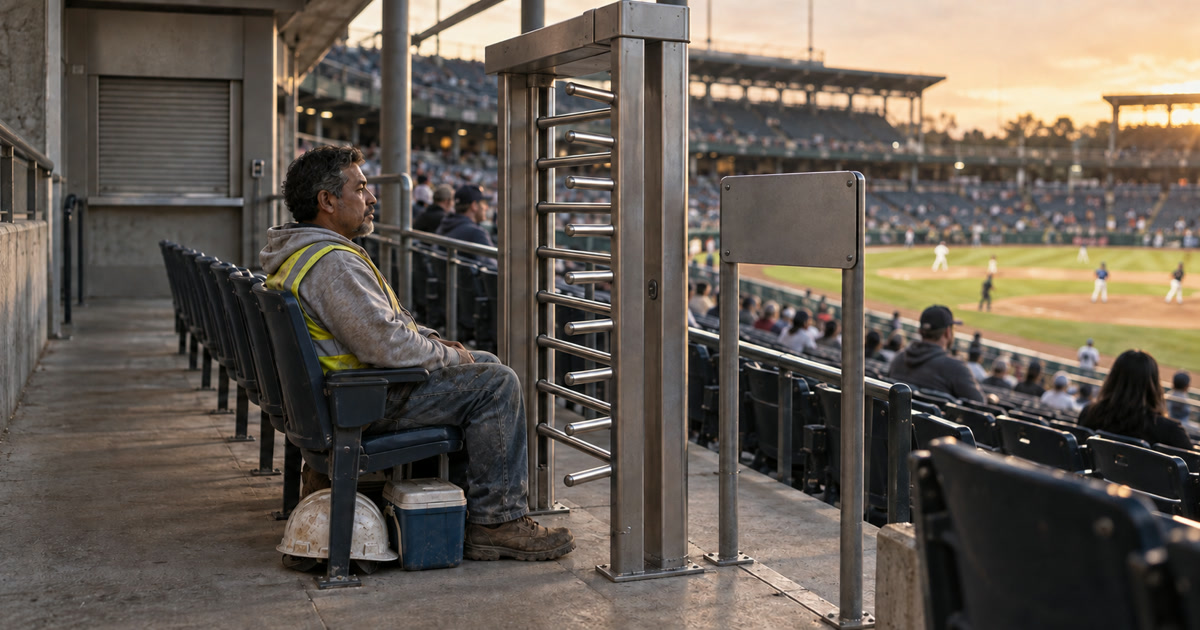 Judge Bianco's analogy: a fan already sitting in his seat during the seventh inning isn't still "seeking admission" to the game -- even if he snuck in without a ticket at the start.
The Fifth and Eighth Circuits reached the opposite conclusion: that "seeking admission" and "applicant for admission" mean the same thing, so the same no-bond-hearing rule applies to both groups. Judges in those circuits also noted that five previous administrations -- including Trump's first term -- chose not to enforce this reading, but that doesn't mean the law never allowed it.
The case now in front of the Supreme Court
The government's appeal is Rhoney v. Barbosa da Cunha, No. 26-104 -- Philip L. Rhoney, acting director of ICE's Buffalo field office, versus the man ICE detained. It comes up from the Second Circuit's April 28, 2026 ruling (No. 25-3141), which went against the government.
Barbosa da Cunha crossed the border without permission in the mid-2000s, settled in Massachusetts, applied for asylum, and waited -- his application sat untouched for a decade, which immigration-court backlogs made unremarkable. He had no criminal record. Federal agents arrested him a year ago. An immigration judge denied him bond under the new policy; he filed a habeas corpus petition -- a lawsuit that asks a court to rule that someone's detention is unlawful -- and won at the Second Circuit.
The government petitioned the Supreme Court on July 23, 2026. Briefing closed with the government's reply on September 4. The Court distributed the case for its September 28, 2026 conference -- the first conference of the new term. That conference decides only whether the Court will hear the case at all, not how it would rule. If the justices grant review, a decision likely wouldn't come until sometime in the 2026-2027 term.
Barbosa da Cunha's case isn't the only mandatory-detention petition up for that same conference. A second case, Putra/Raycraft v. Lopez-Campos, No. 25-1415, out of the Sixth Circuit, raises the same statutory question -- and the Solicitor General has told the Court that Lopez-Campos, not Barbosa da Cunha, is the "better vehicle" for deciding it. The justices could grant either case, both, or hold one while acting on the other.
What both sides say
Suchita Mathur, senior litigation attorney for the American Immigration Council, called the policy "really shocking": "There is no other context in which the government can detain people inside the country endlessly, for no reason." My Khanh Ngo of the American Civil Liberties Union (ACLU) said the policy is now hitting "a really diverse group of people," including people married to U.S. citizens and people who've applied for asylum.
The Department of Homeland Security (DHS) has defended the policy on the record. A spokesperson told the Marshall Project the department is "confident in its legal position regarding mandatory detention" and that "the law is on our side." DHS has also pointed to a self-deportation option -- $2,600 and a free flight -- saying "being in detention is a choice." Jessica Vaughan of the pro-enforcement Center for Immigration Studies said ICE officers in the field pushed for the policy because they were frustrated watching judges release detainees on bond, undercutting enforcement numbers they'd been told to hit.
The scale
About 70% of people in ICE detention in July had no criminal record, according to the Deportation Data Project, a research group based at the University of California, Berkeley (UC Berkeley) and the University of California, Los Angeles (UCLA) law schools. More than 660,000 immigrants have been detained since Trump returned to office. Judge Berner's opinion estimated that as many as 6 million people currently in the country could fall under the government's reading of mandatory detention if it's upheld.
Why this matters now
This isn't a settled question waiting on a formality. It's a live circuit split, on a real detained person's case, in front of the Supreme Court in the next few days, with a plausible outcome in either direction — one appeals judge on the losing side of this fight was appointed by Trump himself. Whatever the Court decides, or declines to decide, on September 28 will shape whether the next phase of the country's deportation effort runs through immigration judges at all, or doesn't.
Sources
- The Marshall Project: "ICE Says It Can Detain Immigrants as Long as It Wants. Will the Supreme Court Agree?"
- Supreme Court docket, No. 26-104, Rhoney v. Barbosa da Cunha
- Bloomberg Law: "Migrant Detention Cases Close in on Expected Supreme Court Bid"
- American Immigration Council: "Detention under INA § 235(b): The Statutory Scheme and Strategies for Release"