What's actually getting built
"Stratos" is the name of the data center. "Wonder Valley" is O'Leary's name for the whole development, which is planned in two phases — Hansel Valley and Locomotive Springs — spread across roughly 40,000 acres, about 62 square miles, of unincorporated Box Elder County in Utah's west desert. That's nearly three times the land area of Manhattan.
The plan: six data center clusters, solar arrays, and what the architecture firm Gensler's master plan calls a "mixed-use innovation district." It's designed to run on 9 gigawatts at full build — more than double Utah's entire current electricity use, according to reporting on the project. It's meant to be powered entirely by natural gas piped in from the Ruby Pipeline, which already crosses northern Utah, rather than pulling from the state's electric grid. Backers say that's a deliberate choice so the project doesn't compete with residents for power. No specific corporate tenant — no Microsoft, Meta, or OpenAI — has been publicly named; it's being built as speculative capacity, not for one contracted buyer.
Supporters point to about 4,000 temporary construction jobs, roughly 2,000 permanent jobs after that, and new property tax revenue for a rural county of roughly 60,000 people. Opponents point to nearly everything else about how it happened.
How a private data center became a "military project"
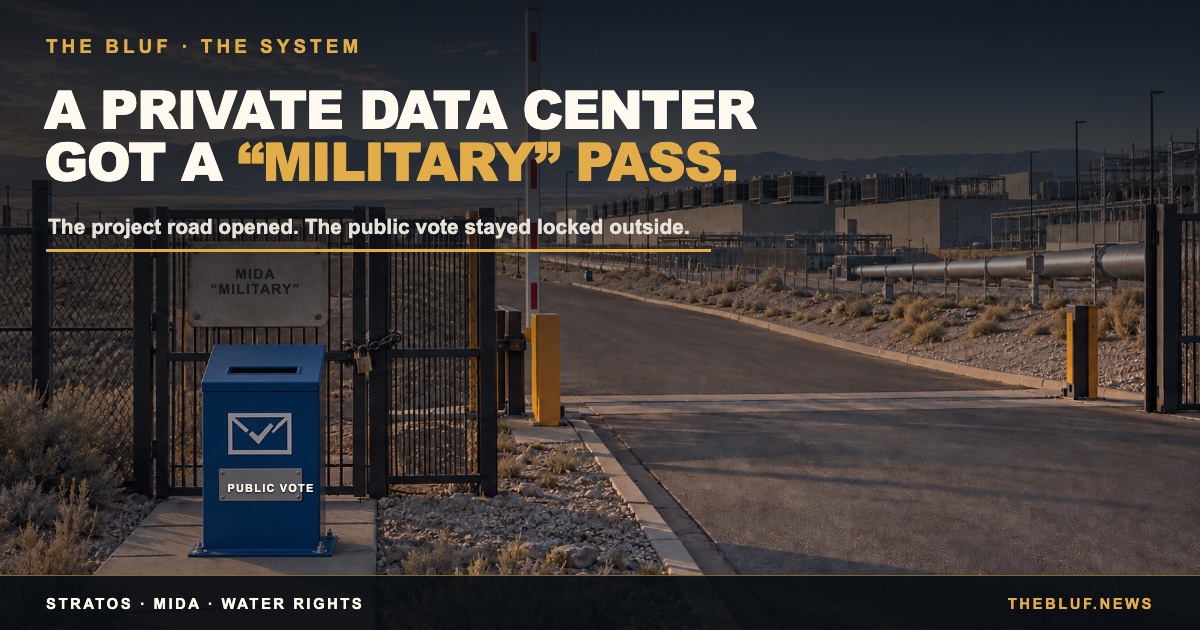
In January 2026, Utah's Governor's Office of Economic Development referred the Stratos project to the Military Installation Development Authority — MIDA, a state body created to manage land and development around actual military bases — on the theory that a data center's "energy resilience" counts as strengthening national security. MIDA now describes the campus as supporting "military readiness" and says it will generate revenue for Hill Air Force Base and the Utah National Guard.
MIDA isn't an elected body. Its board is appointed, and it holds land-use and taxation authority that would normally sit with an elected county commission. Routing Stratos through MIDA moved a private commercial project into a process built for a different purpose entirely — one with fewer of the public-input requirements an ordinary county rezoning would carry.
On April 24 and May 4, 2026, the MIDA board and the Box Elder County Commission approved the "Stratos Project Area" through an interlocal agreement and two resolutions. The county attorney later classified those approvals as "administrative actions" rather than new laws — a distinction that matters because only new laws can be put to a public referendum in Utah.
Residents noticed. A group called BEAR — Box Elder Accountability Referendum — filed two referendum petitions asking to let county voters decide. The county attorney denied both, citing that same administrative-action classification. BEAR has since appealed that denial to Utah's 1st District Court. That appeal is still pending; nobody has ruled on the merits of whether the project should exist, only on whether voters get to weigh in at all.
Who benefits — and who had a hand in the approval
The developer is O'Leary Digital, Kevin O'Leary's company, working with an Alpine-based partner called West GenCo. In an interview with Fox 13's investigative team, O'Leary described the financing model as leaning on hyperscalers — Amazon, Meta, Microsoft, the companies that actually run cloud computing — leasing space in the finished data center rather than owning it themselves: "basically funding with a long-term lease," in his words. No specific tenant has been publicly named. The land itself belongs to Bar H Ranch, a private landowner that stands to profit from the deal and is also the entity that filed — then withdrew, then said it would refile — the water rights application at the center of the fight below.
Some of the people who approved the project had their own financial ties to it. Box Elder County Commissioner Boyd Bingham, who voted yes on May 4, sits on the board of Western AgCredit, an agricultural lender that holds an active lien on 10 of the Bar H Ranch parcels inside the project footprint. He didn't disclose that before the vote. Bingham says he didn't know about the lien until a watchdog group, Utah Civic Compact, raised it in June; Utah Civic Compact has asked the Utah Attorney General's office to investigate. The AG's office won't confirm or deny whether it has opened a review, saying it doesn't comment on ongoing or potential investigations.
Separately, Senate President J. Stuart Adams chairs the MIDA board that approved the project on April 24. Seven days later, his political action committee took in $135,000 in a single day — the five largest donations the PAC has ever reported in its six-year history — from donors connected to other MIDA-overseen developments (ski resort projects at Deer Valley and Jordanelle, not Stratos specifically). Reporting on this is careful to note there's no direct evidence tying those particular donations to the Stratos approval. But Adams has separately been reported to have received large sums over time from companies and lobbyists with business before MIDA generally, and a civil rights lawsuit now pending against MIDA and Box Elder County argues that pattern violated his fiduciary duty. That's a real, documented financial entanglement between MIDA's chair and MIDA-connected money — not proof of a payoff for this specific vote, and it's worth being precise about that difference.
One more allegation didn't hold up as well: critics pointed out that Utah House Speaker Mike Schultz owns more than 25,000 acres a few miles from the site. Schultz says that cuts against him, not for him — "nobody wants a data center built down the road from them," in his words — and says he was "blindsided" by the project rather than consulted on it.
All three paid a real political price. Two Box Elder commissioners who voted yes, Lee Perry and Boyd Bingham, lost their Republican primaries afterward — reporting ties both losses to voter anger over the data center vote itself, not to any personal conflict. Adams lost his primary too, in a race widely tied to his association with the project. Whatever their individual reasons for voting yes, none of them survived the backlash.
The water fight, and a law that changed mid-fight
The project sits next to a lake in genuine crisis. As of June 2026, the Great Salt Lake stood at 4,191 feet — three feet above the record low it hit in November 2022 — after a winter snowpack that came in at less than half the normal average. The lake has lost 63% of its volume and more than half its surface area since Utah was settled, and the newly exposed lakebed is kicking up dust laced with arsenic and heavy metals along the Wasatch Front.
Stratos's developers say the project's closed-loop cooling system will need no more than about 1,800 acre-feet of water a year at full scale — engineer-speak for roughly 590 million gallons, a modest amount for a project this size. The water rights application actually filed with the state — the one nearly 4,000 Utahns protested, later withdrawn — sought 1,900 acre-feet, in line with what they say they need. A separate, larger number is also in play: developers say roughly 13,000 acre-feet of water rights are already attached to the property overall, split between the site itself and additional rights under contract near Snowville. That figure was never formally submitted to the state for approval — it's the larger pool the project is drawing from, not the application under dispute. The real gap is in what a project like this actually ends up using: independent estimates range from roughly 3,000 acre-feet a year under a genuine closed-loop system to well over 100,000 acre-feet a year if conventional wet cooling towers get used instead. The company hasn't disclosed or contracted a final cooling design, so which number applies isn't something the public can currently check.
The specific water source matters too. The application draws from Salt Wells Spring Stream, which feeds directly into the Great Salt Lake system. Two miles from the project site sits the Locomotive Springs Wildlife Management Area, a state-managed wetland that has already lost 80% of its spring flow to groundwater pumping in the area — a live example, not a hypothetical, of what heavy withdrawal does to this specific watershed.
Nearly 4,000 Utahns each paid a $15 filing fee to formally protest the water rights application — an unusually large response by the standards of Utah's water rights office. It worked, in the short term: the applicant, Bar H Ranch, withdrew the request in May, saying it planned to refile with more supporting detail.
Here's the part that connects both fights: while that water battle was underway, the Utah legislature passed House Bill 60, effective May 6, 2026, narrowing what the state engineer is allowed to weigh when deciding whether to deny a water rights application. The law cut the "public welfare" test down mostly to questions of pollution and scarcity, and removed a "more beneficial use" ground that previously let the state consider broader public-interest arguments. Reporting ties the timing of the bill directly to the Stratos fight. The practical effect: when Bar H Ranch refiles — which it says it intends to do — the next round of public protest may carry less legal weight than the one that just forced a withdrawal. Utah Rivers Council's director has publicly criticized the change. Friends of the Great Salt Lake's general counsel takes a different view, saying the law doesn't hinder that group's specific ability to protest on the lake's behalf — a real disagreement among the people actually fighting this, not a settled fact either way.
Even Utah's governor says the process was broken
This isn't just activists and neighbors saying the system got gamed. In August 2026, Governor Spencer Cox — who did not start out opposed to the project — told reporters MIDA has had "mission creep" beyond its original purpose and said the Stratos approval process, "especially" the MIDA process, was "not good." He's now pushing for "major reform" to MIDA's authority when the legislature reconvenes in January 2027.
That's a notable admission from the state's own chief executive: the mechanism that approved this project, in the view of the person who oversees it, wasn't working the way it was supposed to.
What's still open
Several fights are unresolved as of this writing. BEAR's appeal over the blocked referendum is pending in Utah's 1st District Court. Utah Civic Compact has asked the Attorney General to investigate Bingham's undisclosed lien, and the AG's office hasn't said whether it has opened a review. A civil rights lawsuit against MIDA and Box Elder County over Adams' PAC contributions is pending. Bar H Ranch has said it will refile its water rights application, this time under the narrower HB 60 standard. And Governor Cox has said to expect a push for MIDA reform when lawmakers return in January 2027 — though what that reform will actually look like hasn't been written yet.
What can I do
If you live in Utah, both fights still have real, active points where public input matters. Utah's Division of Water Rights accepts formal protests on any pending water rights application — the same $15-filing mechanism nearly 4,000 people already used once — and a refiled Bar H Ranch application would reopen that window. BEAR's court case and any legislative reform effort in the January 2027 session are both things a state lawmaker's office can tell you how to weigh in on directly.
The Receipts
- Utah just approved a data center twice the size of Manhattan | TechRadar
- Utah Data Center From Kevin O'Leary Sparks Controversy | Rolling Stone
- First images of Stratos Hyperscale Data Center in Utah revealed | Dezeen
- MIDA Board, Box Elder Commission approve Stratos Project Area | Utah Business
- 5 things to know about MIDA | Utah News Dispatch
- What is MIDA? | ABC4
- Box Elder County residents won't get to vote on referendum | Utah News Dispatch
- BEAR appeals referendum denial | HJ News
- Will Utah's Great Salt Lake hit another record low in 2026? | Salt Lake Tribune
- Will O'Leary's data center actually consume billions of gallons of water? | Substack
- More than 2,300 protest filings challenge water application | Fox 13
- Water rights request withdrawn after thousands protest | Salt Lake Tribune
- New water rights law gives less weight to pushback citing broad impact | Utah News Dispatch
- Utah law narrows data center water protests | Western Water
- Cox says MIDA needs 'major reform' | Utah News Dispatch
- The Real Money Behind STRATOS | Utah Money Watch
- Box Elder commissioner responds to conflict of interest allegations | KSL
- Utah House speaker owns 25K acres near data center site | KSL
- Stuart Adams' PAC received $135,000 from MIDA-connected donors | Utah Politics News
- J. Stuart Adams has received huge sums from companies with MIDA business | Salt Lake Tribune
- New lawsuit filed against MIDA, Box Elder County Commission | ABC4
- Utah Democrat campaign to oust county officials over data center | Deseret News
- O'Leary talks new poll, paying for Box Elder County data center | Fox 13 Investigates