1. WHAT'S HAPPENING
Since late 2023, ActBlue — the payment platform that processes the large majority of Democratic small-dollar political donations, similar to how WinRed handles Republican ones — has been under investigation or in active litigation on six fronts at once:
- Texas Attorney General Ken Paxton made a criminal referral to the DOJ in October 2024, asking federal prosecutors to consider charges over what his office calls a pattern of illegal straw donations run through the platform. Two years and a change of administration later, no charging decision has followed. (Texas AG press release; The Center Square)
- Three U.S. House committees (Judiciary, Oversight and Government Reform, and House Administration), all Republican-controlled, have jointly issued a series of staff reports — "Fraud on ActBlue," now in a third installment — alleging the platform knew about extensive fraud, including foreign contributions, and weakened its own safeguards anyway. (House Judiciary Committee Republicans; Part III report, Sept 2026)
- Texas Attorney General Ken Paxton sued ActBlue in Tarrant County state court under the Texas Deceptive Trade Practices Act, alleging the platform marketed itself as fraud-secure while allowing gift-card and prepaid-debit-card donations that could hide foreign or otherwise ineligible donors. (Texas AG press release; Washington Post, Apr 20 2026)
- ActBlue counter-sued Paxton in federal court in Boston, arguing his suit is political retaliation for the platform's role funding Democratic state Rep. James Talarico's Senate campaign against Paxton, and violates its First Amendment rights. On June 11, 2026, U.S. District Judge Richard Stearns granted ActBlue a preliminary injunction, ruling the Texas suit "was filed in retaliation for (and in an attempt to suppress) ActBlue's efforts to fund Talarico's campaign." Paxton has appealed to the First Circuit, arguing the Massachusetts court improperly interfered with the Texas case; the appeal is pending. (Courthouse News; UPI)
- Missouri Attorney General Catherine Hanaway opened a parallel investigation in September 2026 under the state's Merchandising Practices Act, ordering ActBlue to turn over records by October 8, 2026. (Missouri AG's office)
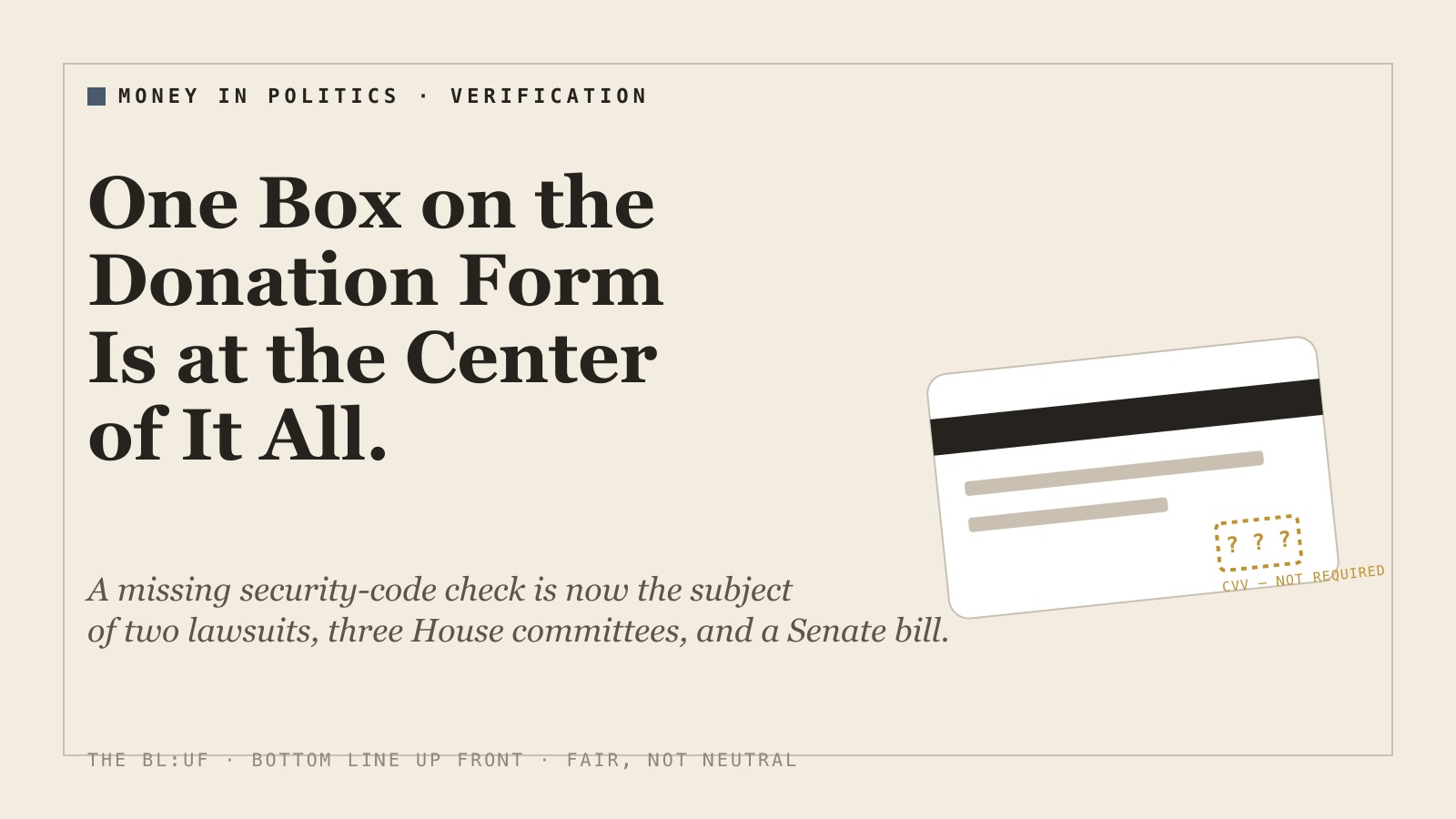
- Sen. Marco Rubio wrote to the Federal Election Commission demanding an investigation and has reintroduced legislation (the CVV Act) that would require credit-card verification codes for donations to any political committee — not just ActBlue. The FEC's response acknowledged the value of card verification without itself finding wrongdoing. (Rubio's office)
None of this has produced a criminal charge against ActBlue, or any ruling finding it broke the law. The one court decision so far actually went ActBlue's way — the preliminary injunction against Paxton above, now on appeal. What follows is what's actually documented on each side.
2. WHAT THE HOUSE REPORTS SAY THE RECORD SHOWS
The committees' claims rest on internal ActBlue documents and depositions obtained by subpoena:
- The committee's report says a training guide for new fraud-review staff instructed them to "look for reasons to accept contributions" rather than flag suspicious ones.
- According to the committee's report, ActBlue's own fraud-detection systems flagged 237 donations in a single 30-day window (Sept–Oct 2024) that came from foreign internet protocol (IP) addresses paired with domestic prepaid cards — a pattern investigators say is a known fraud signature.
- The committee report says ActBlue loosened its fraud-review triggers twice in 2024 (April and September) even after adding a card-verification (CVV) requirement in January 2024. For the April 2024 change alone, the report says ActBlue's own internal assessment estimated it let through 14 to 28 additional fraudulent contributions per month; the report does not give an equivalent estimate for the September change.
- In a November 27, 2023 letter to committee Chairman Bryan Steil, ActBlue said it did not require card-verification (CVV) codes; the requirement began weeks later, in January 2024, without a public announcement. The report characterizes the timing as an attempt to avoid drawing scrutiny to ActBlue's broader fraud policies.
- Seven senior staff resigned between February and September 2025, including General Counsel Darrin Hurwitz. Separately, the report says ActBlue's last remaining compliance lawyer — a different employee — was placed on leave, without email or system access, after raising retaliation concerns.
- Across depositions and one open hearing, the committees say ten ActBlue witnesses have invoked their Fifth Amendment right against self-incrimination — and this isn't limited to junior compliance staff. ActBlue's own CEO, Regina Wallace-Jones, invoked the Fifth more than 20 times at a public House Administration Committee hearing on June 10, 2026. Co-founder Matt DeBergalis did the same in a closed-door deposition on August 20, 2026 — a session reportedly over in under 30 minutes. Board member Kimberly Peeler-Allen followed on September 1, 2026. An initial group of five witnesses invoked the Fifth at least 146 times combined, per an April 2026 committee release; the other five, including Peeler-Allen, were reported through September 2026, but no updated combined invocation count across all ten has been published. (Fox News; Washington Post; Roll Call) Invoking the Fifth Amendment is a constitutional right and is not evidence of wrongdoing — courts have repeatedly held that no adverse inference of guilt may be drawn from it. What makes this notable isn't the legal act itself; it's that it reached the very top of the organization, not just operational staff.
These are documented events (the training-guide language, the detection numbers, the resignations, the Fifth Amendment invocations) reported by the committees from records and testimony they obtained under subpoena. What they add up to — whether they show deliberate fraud, sloppy compliance, or something else — is the part still in dispute.
3. WHAT ACTBLUE DISPUTES
ActBlue denies wrongdoing and says the investigations are a partisan effort to damage the platform ahead of the 2026 midterms, not a good-faith inquiry. In its own statement, the organization says it's being "targeted by MAGA Republicans because of who we are and what we stand for, not because of any unlawful conduct," and that Republicans want to "undermine one of democracy's most powerful tools because they are desperate to hold onto power." (ActBlue, Apr 28 2026)
ActBlue also disputes that it obstructed the investigation, saying it has voluntarily produced non-privileged records and withheld only material it says is protected by attorney-client privilege.
CEO Wallace-Jones gave her own reasoning in a Washington Post op-ed published the same day she testified: she said House Republicans planned to question her about communications protected by attorney-client privilege, and that invoking the Fifth was "the only reasonable response to a proceeding that from the beginning has been about harassing a political opponent's fundraising platform, not genuine oversight." (Washington Post op-ed)
Its strongest counter-evidence: ActBlue commissioned a third-party forensic analysis of its full 2023 contribution data, presented through its law firm WilmerHale. It found that 99.99% of contribution dollars came from donors who supplied a U.S. address or a passport number in a valid format. ActBlue says this undercuts the committees' central claim that the platform is a magnet for foreign money. (ActBlue, Sept 16 2026)
The limit on that defense, stated plainly: the analysis checked whether an address or passport number was present and correctly formatted — it did not verify whether those addresses or passport numbers were real or belonged to the person making the donation. A stolen or fabricated identity with a valid-looking U.S. address would pass this test. That gap is exactly what the CVV/prepaid-card concern is about, and ActBlue's own analysis doesn't close it.
4. WHY CVV VERIFICATION IS THE CRUX OF THIS
A CVV (card verification value) is the 3- or 4-digit security code on the back of a credit or debit card. Requiring it at checkout is standard across nearly all e-commerce and is one of the most basic tools for confirming that whoever is entering a card number actually has the physical card in hand — it's much harder to guess or steal than a card number alone, and prepaid or gift cards are frequently used specifically because they're harder to trace to a real, eligible donor.
WinRed, the Republican-side equivalent platform, has required CVV entry for longer than ActBlue did — ActBlue did not add the requirement until January 2024. (Judge Stearns' injunction ruling separately noted that Paxton had not pursued similar complaints about WinRed's own practices — worth keeping in mind when weighing how even-handed this enforcement push actually is.) Even after ActBlue added CVV, investigators say the platform's other fraud-review settings were loosened enough to offset some of that gain. This is the specific, checkable mechanism at the center of the dispute, as distinct from the more sweeping "cover-up" framing on one side or "partisan witch hunt" framing on the other.
5. THE REAL STAKES: A NEW WAY TO ATTACK A POLITICAL FUNDRAISING PLATFORM
Strip away who's right about the fraud numbers, and this case is testing something bigger: can a state attorney general use consumer-protection law to go after a national political fundraising platform, when campaign finance itself is supposed to be the Federal Election Commission's exclusive turf?
Normally, a state has no standing to police federal campaign fundraising — that's FECA's (the Federal Election Campaign Act's) job, enforced by the FEC alone. Paxton's lawsuit doesn't try to enforce campaign-finance law directly; it uses the Texas Deceptive Trade Practices Act — an ordinary consumer-protection statute, the same kind of law used against a company for a misleading warranty or a fake sale — to argue ActBlue lied to donors about its own security practices. That's the workaround: sue over the marketing claim, not the donation, and state law suddenly reaches something federal law was supposed to preempt.
A similar legal theory has already succeeded once, in a different case — and, in an irony worth sitting with, it exists because WinRed tried to shut it down and lost. In 2021, four state attorneys general (Connecticut, Maryland, Minnesota, New York) investigated both WinRed and ActBlue over the pre-checked-box practice (see our earlier piece on this). WinRed sued those states, arguing FECA preempted their authority to investigate at all. A federal court disagreed — and the ruling held up: WinRed, Inc. v. Ellison, 581 F. Supp. 3d 1152 (D. Minn. 2022), affirmed by the Eighth Circuit (No. 22-1238, Feb. 7, 2023). The courts found that while FECA's legislative history describes it as occupying the field "with respect to elections to Federal office," that doesn't reach or preempt a state's ordinary consumer-protection regulation of deceptive business practices — a state can still go after a platform's marketing claims, even a platform built entirely to fund federal candidates.
That's the same legal theory Paxton is now using against ActBlue — a theory one court accepted once, in a dispute over a different platform's different conduct, that a Texas court or the First Circuit could still weigh differently in Paxton's own case. It cuts both ways by design — nothing in the doctrine itself is partisan. A Democratic state attorney general could try the identical consumer-protection theory against WinRed tomorrow. What's actually happening right now is that Republican-controlled institutions — three House committees, two state AGs, a years-old DOJ criminal referral, a Senate bill — are the ones testing it, aimed at the side's dominant platform, arriving right as that platform posted record 2026 midterm fundraising ($568M Q1, $586M Q2). ActBlue's argument that the timing is itself significant is fair and stated here, not ignored. None of that makes the separately-documented findings — the training-guide language, the detection numbers, the leadership-level Fifth Amendment invocations — untrue. Both things are true at once: the findings are real, and so is the fact that this specific enforcement tool is currently pointed in one direction only.
The Rubio CVV Act is the one durable, non-partisan lever in this whole story. Unlike the lawsuits, it wouldn't single out ActBlue — it would require card-verification codes for donations to any political committee, WinRed included. If it passes, the underlying security gap this whole fight is nominally about gets closed for everyone, regardless of who wins the Paxton case.
6. IF YOU'VE DONATED THROUGH ACTBLUE
There's no indication individual donors did anything wrong or are personally at legal risk. If you're concerned your card or identity was used without your knowledge:
- Check your bank or card statement for ActBlue charges you don't recognize — this is exactly how the 2020 WinRed pre-checked-box overcharges were first caught (see our earlier piece on this).
- Consumer-protection rules give you the right to dispute any charge you didn't authorize with your card issuer, regardless of which platform processed it.
- ActBlue's own donor-history lookup and your card issuer's fraud line are the two fastest paths to a resolution — neither requires waiting on Congress or the courts.