What the paperwork says, in order
The Sewing Box, a tailoring shop in Pensacola, Florida, made the Blue Angels' ceremonial flight suits for 43 years -- Navy records trace the relationship to the 1970s. Every award was sole-source: the Navy contracted directly with the shop, without opening the work to other bidders, because its own paperwork said no one else could do the job.
In 2018, the Navy's sole-source justification for an $81,600 award said the Sewing Box owned the flight suit design and that the Blue Angels couldn't send the pattern to another vendor. It also cited the shop's location -- close enough to Naval Air Station Pensacola to handle the squadron's fittings and its demanding show schedule.
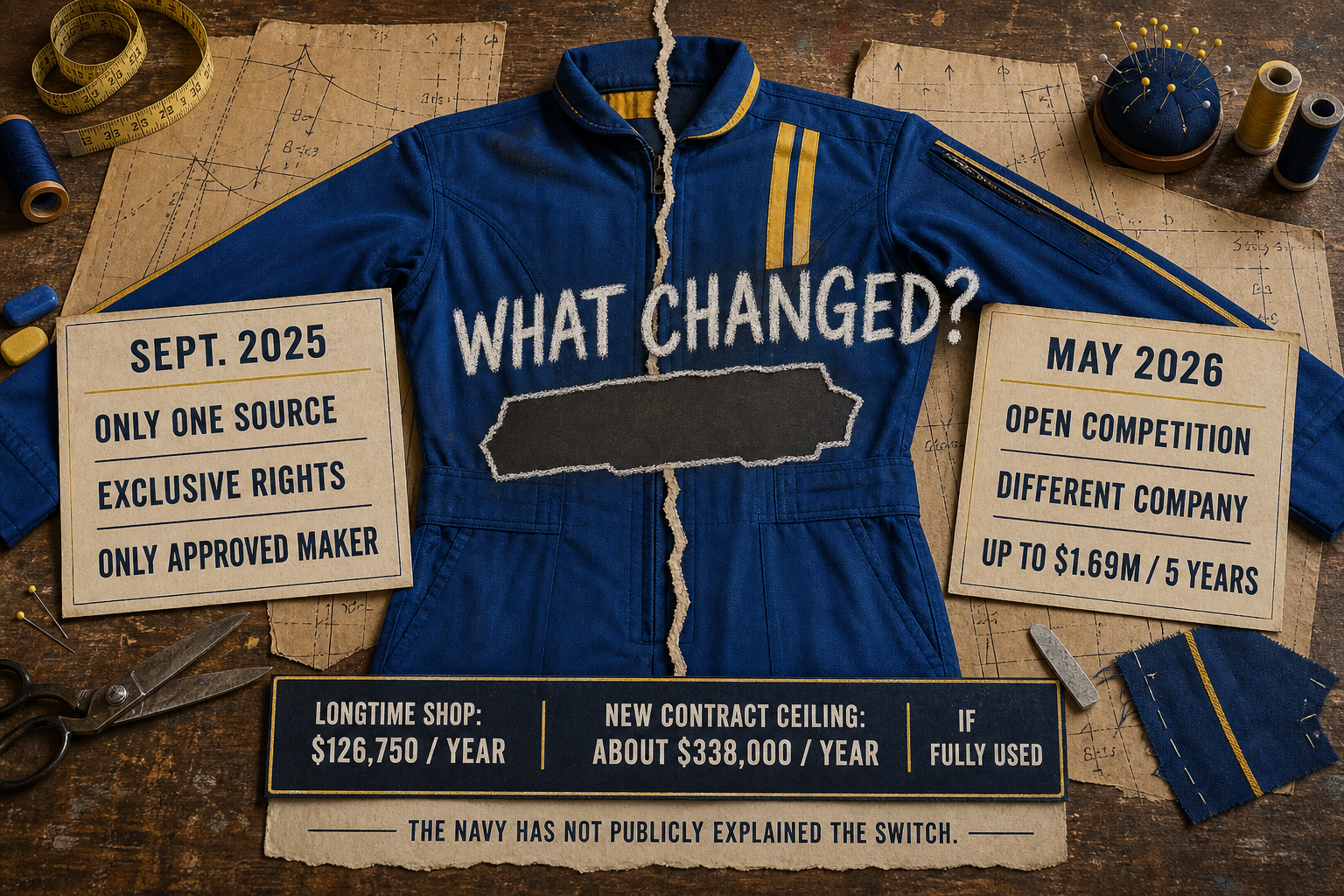
The Navy kept sole-sourcing the work: $99,250 in 2024, then $126,750 on September 10, 2025, contract N6883625PS106, awarded to the shop's registered business, Jellie B The Sewing Box, LLC -- confirmed directly on SAM.gov (the federal government's public contracting website). That 2025 award cited the same legal basis as before: federal law letting an agency skip competition when only "one source" is "reasonably available." Per Military.com's reporting on that justification, it went further than prior years -- stating the shop held exclusive licensing rights, possessed the established patterns, and was the only manufacturer approved under the naval aviation safety manual that governs the Blue Angels' gear.
Four months later, in January 2026, a different company -- Aquila International, based in Dulles, Virginia -- found a new solicitation posted on SAM.gov. Aquila had already been supplying the Blue Angels flight gloves and compression gear since 2024. The Navy held an "Industry Day" in San Diego that February, inviting companies to learn about the requirement. On May 14, 2026, it awarded Aquila a five-year contract worth up to $1,691,506.40 -- confirmed directly on SAM.gov, contract N00244-26-D-0003 -- through a fully open, unrestricted competition.
The exclusivity claim, and the switch that didn't explain it
Here's the part that doesn't add up on paper: the Navy's own September 2025 justification said the Sewing Box was the only manufacturer legally and practically able to make these suits -- it held the licensing rights, it had the patterns, and it was the only shop approved under the safety manual that governs Blue Angels equipment. Eight months later, the Navy ran a competition open to anyone and picked a company that, as far as any public record shows, held none of those things when it applied.
Neither the Navy nor Aquila has explained, on the record, how that gap closed. Stars and Stripes asked the Navy directly about ownership of the flight suit design and the decision to move production; the Navy did not respond. No outlet reviewed for this piece has gotten Aquila to address the safety-manual-approval question specifically -- its principal, Todd Kelsey, has spoken about finding the solicitation and winning the bid, not about whether or how his company obtained safety-manual approval, a separate requirement the Navy's 2025 paperwork said only the Sewing Box held at the time.
There's also a cost question nobody's answered. The Sewing Box's most recent confirmed award was $126,750 for a year. Aquila's contract is a five-year, up-to-$1,691,506.40 ceiling -- not a guaranteed spend. The Navy's own award synopsis, pulled directly from SAM.gov, describes it as a "Firm-Fixed-Price (FFP) Indefinite Delivery, Indefinite Quantity (IDIQ) contract" and lists the dollar figure as the "Maximum over 5-year Ordering Period" -- the Navy only pays for orders actually placed against it. Annualized, that ceiling works out to roughly $338,000 a year -- about 2.7 times what the Navy had been paying its longtime vendor, if the contract is fully exercised. The Navy had a cheaper, known, 43-year vendor and chose to move flight-suit production to a company with no prior track record making that specific item, at up to nearly triple the annual rate. Nothing in the public record says why. Not a budget memo, not a capacity assessment, not a statement from the contracting office -- nothing. The Navy has not explained the cost gap any more than it's explained the exclusivity gap.
There is a plausible, boring explanation that doesn't require anyone to have broken a rule: under federal contracting law, the government often ends up owning the underlying technical data -- the measurements, the pattern -- for something built under a long-running government contract, even if the contractor did the physical work. If that's what happened here, the Navy never needed the Sewing Box's permission to open the work to competition; it may have owned the necessary rights the whole time. But if that's the real answer, then the "exclusive licensing rights" language in the Navy's own September 2025 justification -- signed eight months before the switch -- described a legal exclusivity that didn't actually exist. Either the justification was wrong when the Navy signed it, or something changed that the Navy hasn't disclosed. Both are real possibilities. Nobody with the authority to settle it has been asked to, on the record, and answered.
One structural fact makes this harder to check than it should be: federal law (Section 844 of the 2008 National Defense Authorization Act) requires agencies to post sole-source justifications publicly within 14 days of the award. Both the September 2025 justification and the record of the switch to Aquila are well past that deadline. The justification that is posted is marked "redacted."
Two accounts that don't match
Separately from the design question, Whitehurst and the Navy disagree about something more basic: whether she was told the contract was up.
Whitehurst says the Navy always called her personally in past years to ask if she wanted to bid again. This year, she says, that call never came: "Before they always announced to me, Miss Candy, do you want the contract? You need to put your bid in. This year, I didn't hear from no one. No one called me."
Cmdr. Amber Lewis, a spokeswoman for Naval Supply Systems Command, told reporters that the formal, open bidding process for the next Blue Angels uniform supplier began "the following month" after Whitehurst indicated she planned to retire -- and said Whitehurst had told the Blue Angels in January that she intended to step back. Whitehurst denies telling anyone she planned to retire.
Federal procurement rules require the Navy to post a solicitation publicly on SAM.gov; they do not require it to personally notify an incumbent contractor that a contract is coming up for renewal. So even if Whitehurst's account is entirely accurate, the Navy did not break a rule by not calling her -- it simply stopped doing something it had, by her account, always done before.
What is and isn't established here
Confirmed, from the government's own public contract record and multiple independent outlets: the Sewing Box held sole-source Blue Angels flight suit contracts for 43 years, most recently at $126,750/year; the Navy's September 2025 sole-source justification asserted the shop's design/licensing exclusivity and safety-manual approval (per Military.com's direct reporting on that document); an unrestricted competition eight months later resulted in the switch to Aquila International, at a five-year ceiling that annualizes to roughly 2.7 times the Sewing Box's most recent award if fully exercised; and neither the Navy nor Aquila has publicly reconciled the exclusivity claim or the cost gap.
Not established: why the Navy's position on exclusivity changed, whether Aquila obtained rights to the existing pattern or built something new, why the Navy chose a materially costlier, unproven vendor over its cheaper and known one, and whether the shift was planned before or after Whitehurst's account of the renewal call not coming. This piece takes no position on any of those questions -- they're open because the people who could answer them haven't, and it does not offer explanations on the Navy's or Aquila's behalf that neither has offered for itself.
What Ms. Whitehurst -- or any small business in this position -- can actually do
Whitehurst has already been referred to a government-contracts attorney; what follows is general public information about resources available to any small business in this situation, not case-specific legal advice.
A federal bid protest at the Government Accountability Office is the strongest tool a company has for challenging a contract award it thinks was handled wrong -- but it comes with a hard 10-calendar-day clock, starting from when the contractor knew or should have known the grounds for protest. Aquila's award was made May 14, 2026; this became public reporting in early August. That window has almost certainly closed. It's a real option for a company that acts fast the next time -- not a live one here.
Three things still are:
The Florida APEX Accelerator (a free, state-run small-business program) offers one-on-one help for small businesses navigating federal contracting -- preparing bids, understanding requirements, and pursuing future work. Its Pensacola office is at 220 W. Garden St., Suite 302; 850-898-3479.
The Department of Defense Hotline (1-800-424-9098) is where a contractor -- or anyone -- can formally flag a concern about how a federal contracting decision was made, for review by the DoD Inspector General.
A letter from your member of Congress is a standing tool available to any constituent, not a special favor. U.S. Rep. Jimmy Patronis (R-FL1) sent the Navy a letter on August 4 requesting support for the Sewing Box and a meeting to discuss future work -- two weeks ahead of his own August 18 primary. Any constituent can ask their own representative's or senator's office to do the same for an unresolved dispute with a federal agency -- it's called casework, and it's part of the job.