What happened, in order
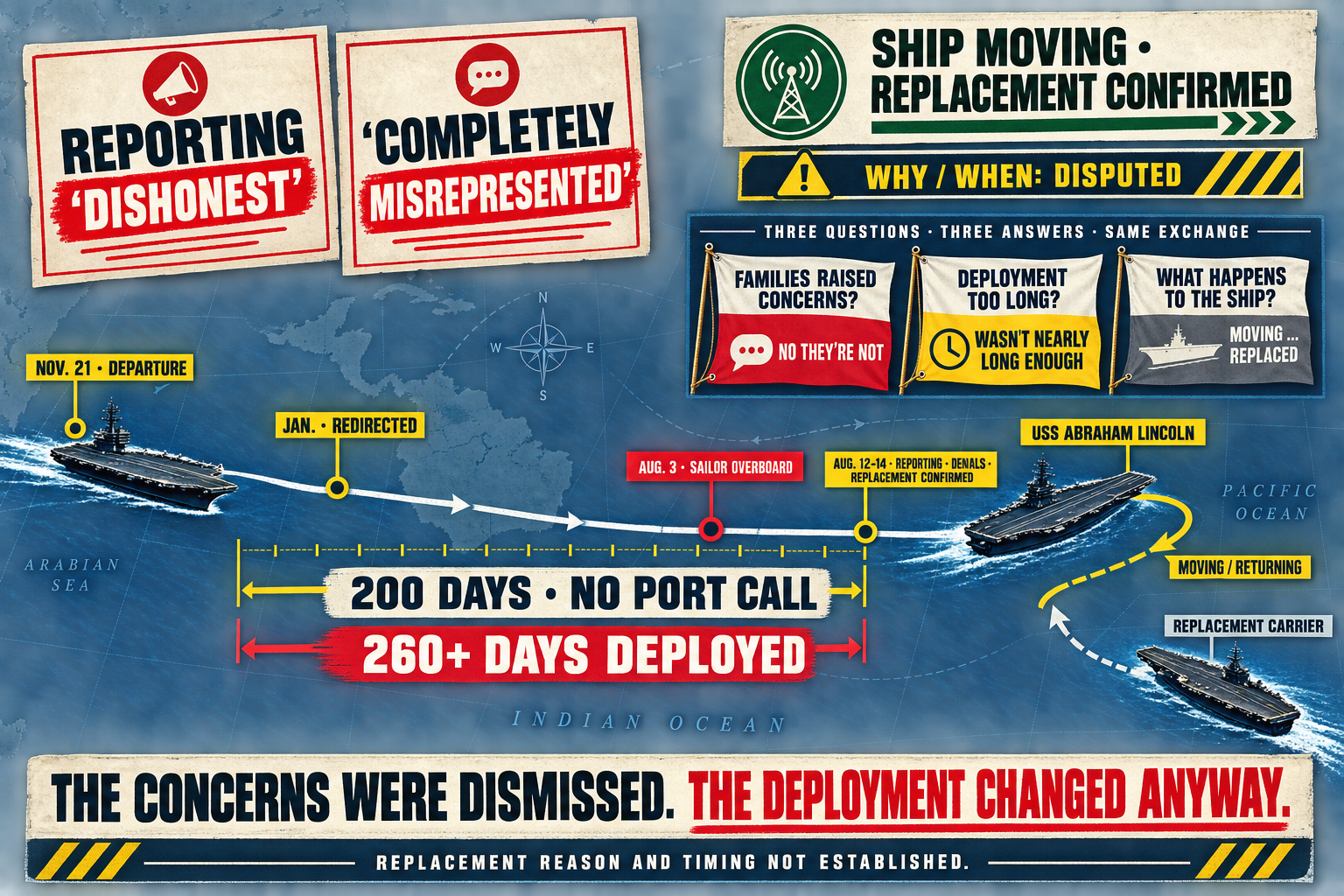
The USS (United States Ship) Abraham Lincoln left San Diego on November 21, 2025, on a deployment the Navy originally expected to run about seven months. In January it was redirected to the Middle East. By mid-August its total deployment had passed 260 days, and — a separate, sharper number — it hadn't made a single port call in 200 days, a modern-day record for an American aircraft carrier, according to Sen. Richard Blumenthal (D-Conn.). A port call is what lets a crew resupply, rest, and regroup mid-deployment; the Lincoln has been supporting U.S. operations in the war with Iran, with roughly 5,000 sailors and Marines aboard.
On August 3, a sailor went overboard. The Navy says the sailor was wearing a life vest, was recovered quickly, and was not injured; the incident is being treated as a mental health episode.
By August 12, the story had moved from a single incident to a pattern. Interviews with sailors and family members described exhaustion, declining morale, and — per congressional reporting — lack of food, personal supplies, and plumbing backups, along with reports of suicidal thoughts. Military Times reported on two more cases beyond the August 3 incident: one Navy spouse said her husband tried to jump overboard; a second spouse described her husband intervening in a separate incident. Multiple military spouses said they had already raised these concerns directly to Acting Secretary of the Navy Hung Cao and other senior officials, in person, at a town hall in San Diego — before any of it became a national story. The same day, Sen. Richard Blumenthal (D-Conn.) sent a letter to Hegseth and Cao writing that the Lincoln's deployment "raises broader questions about the Navy's ability to sustainably generate carrier forces while preserving servicemember well-being, maintenance schedules, fleet readiness, and the capacity to respond to future contingencies."
A separate, broader claim also spread online: that numerous sailors were attempting to jump overboard. U.S. Central Command directly denied that version, calling it "rampant misreporting," and fact-checkers examined the claim specifically. That broader claim is not what this piece is about, and shouldn't be conflated with it — the confirmed incident, the two additional cases described by spouses, and the pattern lawmakers are demanding answers about are a different, better-sourced thing than the viral exaggeration CENTCOM pushed back on.
The denial, read closely
Asked about the reports, a Navy statement said: "Based on information available to the command, we have not identified an increase in reported suicidal ideation or suicide attempts aboard the ship."
Read slowly, that sentence does four separate, narrower things than it sounds like it does. "Based on information available to the command" scopes the claim to whatever reached leadership, however that happened — and there's a real gap here: journalists who asked the Navy directly whether sailors had been medically evacuated or pulled from duty for mental health reasons did not get an answer. "We have not identified" is a claim about the command's own detection process, not a claim about what happened — it doesn't rule out an incident that happened but wasn't counted, or wasn't logged under these specific terms. "An increase" only denies a change from whatever the existing rate already is; it says nothing about whether that baseline is a serious problem. And "suicidal ideation or suicide attempts" are two narrow labels that don't have to cover exhaustion, declining morale, or an incident the Navy itself calls a "mental health episode" rather than an attempt.
None of that proves the statement is false. It proves the statement is built to be defensible word for word without directly answering the specific things being alleged.
Separately, Cao himself has acknowledged that "a small number of mental health cases were treated" during the deployment. That's not the same claim as "no increase identified" — it's a plain admission that real cases existed, just not quantified against any baseline that would tell you whether "small number" means normal or elevated. Both statements can be technically true and still leave the actual scale of the problem unresolved.
"Victims," not "warriors"
The sharper move came next. Acting Navy Secretary Hung Cao said news coverage was trying to paint "our warriors as victims." In his words: "Not only is that dishonest, but it takes away the focus on the enemy and the threat it poses against our nation, people and way of life." He said "our force and their families are not victims" and called them "the epitome of American strength and resilience." Defense Secretary Pete Hegseth said the conditions reporting had been "completely misrepresented."
That framing does real work beyond denying specific facts. It sets up a binary where acknowledging that a sailor is struggling gets relabeled as calling him a "victim" — and a "victim," in this framing, is the opposite of a "warrior." The effect is that nobody can validate what the crew is going through without being accused of insulting them. It's a trap built into the language, not just a disagreement about facts: agree the reporting has a point, and you've supposedly stripped a service member of their own strength by definition.
The binary doesn't hold up on its own terms. Cao calls them "warriors" in the same breath he denies they could be harmed by what they're enduring — but the two aren't opposites, they're the same fact seen from two directions. A sailor can only be a victim of a 260-day deployment with no port call because he's a warrior who was sent on it. A civilian was never at risk of this specific harm; a warrior is exposed to it by definition, as the direct cost of the job. Being strained by conditions that would strain anyone isn't evidence a sailor has stopped being a warrior — it's evidence the deployment did what a 260-day deployment with no relief does to a human being, warrior or not. Treating "harmed by the war" and "a warrior" as mutually exclusive doesn't protect the sailors from being called victims. It just makes it impossible to also call what happened to them a problem.
It's also, on this record, coming from an official who can't credibly claim he hadn't heard the specific concerns. Cao is the same Acting Secretary the military spouses say raised these issues with directly, in person, before the story broke nationally.
The denial and the confirmation, in the same exchange
Friday, a reporter asked Trump directly whether families of Lincoln sailors had raised concerns. "No they're not," he said. Asked next whether the deployment had gone on too long, he said it "wasn't nearly long enough." In that same appearance with reporters, he also confirmed: "That ship is moving right now or very shortly, and it's being replaced with another very similar ship." Available reporting presents these as three separate answers in one exchange, not one continuous quote — worth being precise about, because the piece's argument doesn't need to overstate it. What holds up either way: the same person, in the same sitting with the press, said the families' concerns aren't real and confirmed the ship everyone is worried about is being pulled and swapped out "right now or very shortly."
One counter-claim needs the same scrutiny as everything else in this piece before it gets to stand: reporting states the George Washington rotation was already scheduled before the conditions concerns went wide. Worth noting exactly how that claim is sourced, because the same article sources its other claims explicitly — the overboard incident is "according to a U.S. official," the 200-days-without-a-port-call figure is "according to Sen. Richard Blumenthal." The scheduling claim carries no attribution at all, sitting between two properly sourced sentences with nothing behind it. It doesn't get treated as more credible than the on-record denials this piece is already skeptical of just because it points the other direction — if anything, an unsourced claim deserves less benefit of the doubt than a sourced one, not more. Take it for what it is — an assertion with nothing behind it in the reporting available to this piece — not as a fact that settles the question.
What doesn't need that theory to hold up at all: the President was asked directly whether the families' concerns were real, said no, and in the same sitting with reporters confirmed the exact fix those concerns would call for. Whether the George Washington's timing was truly independent of the scandal or not, that contradiction sits entirely inside his own words that day.
It's also not the first time this has happened under this administration. The USS Gerald R. Ford came home in May after 11 months at sea — the longest continuous carrier deployment since the collapse of the Soviet Union. The Lincoln is the second carrier in a row to run into a historic-length deployment. That's a pattern worth naming on its own, separate from whatever caused any single ship's timeline to stretch.
Trump's "not nearly long enough" isn't pure bravado, either, and this piece won't flatten it into that. It appears tied to a specific strategy: continuing a naval blockade meant to pressure Iran economically into giving up its nuclear program, with aides reportedly having talked him into giving that approach more time before any return to military strikes. That's a real, statable policy rationale for wanting ships to stay on station — and it's a separate question from whether the people on those ships are being kept fed, supplied, and mentally intact while they do it.
"Now they're actually spewing lies"
Retired Major General Randy Manner — more than 35 years of Army service, including Deputy Commanding General of the 3rd Army in Kuwait, Acting Vice Chief of the National Guard Bureau, and Acting and Deputy Director of the Defense Threat Reduction Agency — put a sharper word on it than this piece has used anywhere above, responding directly to the denials already laid out here: Hegseth's "completely misrepresented," Cao's "dishonest," Trump's "No they're not." Speaking on CNN's OutFront with Erin Burnett, Friday, August 14, Manner said: "I used to say that the president and the secretary of defense were spewing propaganda. Unfortunately, now they're actually spewing lies." He called the President's comments "totally inappropriate" for a commander in chief, and said they would have gotten Manner himself "relieved within minutes" if he'd said something comparable while still in uniform.
That's a real, credentialed distinction worth sitting with. "Propaganda" is spin — shaping true facts toward a preferred conclusion. "Lies" is a claim that the facts themselves are being misstated. Manner, a two-star general who spent his career inside military command structures, is the strongest-credentialed voice in this piece saying the second thing, not the first — directed at statements from the sitting Commander in Chief and Secretary of Defense that are quoted in full earlier in this piece, not summarized or taken on faith.
What is and isn't established here
Confirmed, sourced to multiple outlets: one overboard incident, recovered safely, in early August; a deployment that hasn't made a port call in 200 days — a modern-day record, per Sen. Richard Blumenthal — inside a total deployment past 260 days; lawmakers, including Blumenthal in an Aug. 12 letter to Hegseth and Cao, demanding answers about food, supply, plumbing, and mental-health conditions; two additional overboard-adjacent cases described directly by military spouses; those spouses having raised concerns with Navy leadership before the story broke nationally; the specific quotes from Cao, Hegseth, and Trump, including Trump's own same-day denial-and-confirmation; retired Maj. Gen. Randy Manner's on-record "spewing lies" characterization; the Gerald R. Ford precedent; and the George Washington relief order becoming public August 13.
Not established here, and explicitly not what this piece claims: the viral claim of numerous sailors attempting to jump overboard, which CENTCOM denied and which is a different, weaker-sourced claim than what's above. Also not established, in either direction: whether the George Washington's timing was genuinely independent of the scandal or accelerated by it. The claim that it was "already scheduled" carries no attribution in the reporting available to this piece — no named official, no document, not even the "according to a U.S. official" language that sources the article's other claims. It does not get to walk in as settled fact just because it argues nothing is wrong. This piece takes no side on that specific question. What it does establish, on the President's own words alone: in one appearance with reporters, he denied the concerns and confirmed the fix, and that contradiction doesn't depend on resolving who's telling the truth about the scheduling.
If you or someone you know is a service member or veteran in crisis, the Veterans Crisis Line is available 24/7: call 988 then press 1, text 838255, or chat at veteranscrisisline.net.
The Receipts
- CNN: sailor overboard incident, lawmakers' demands, spouse accounts
- Military Times: spouse interviews on two additional cases
- Stars and Stripes: spouses raising concerns to Acting SECNAV Hung Cao at San Diego town hall
- CENTCOM statement denying "rampant misreporting" of mass overboard claims; Snopes fact-check
- Task & Purpose: full Navy statement text; Cao's "small number of mental health cases" admission
- The Hill: Pete Hegseth "completely misrepresented" quote; Hung Cao "victims"/"warriors" quote
- Forbes, CBS News, ABC News, Yahoo News, CNN, SCMP, Al Jazeera: Trump's three separate answers on families' concerns, deployment length, and the ship swap
- USNI News, Stars and Stripes, ABC7, CBS News: USS George Washington Middle East redirect, dated August 13, 2026
- The Hill, Just The News, KSN, UPI, WAVY: Hung Cao's August 14 announcement that the Lincoln is returning home "as part of a planned rotation"
- Wall Street Journal: full text of the August 14 report, confirming the "already scheduled" claim carries no attribution unlike the article's other sourced claims; USS Gerald R. Ford's 11-month deployment; the naval-blockade/Iran context; the 200-days-without-a-port-call figure attributed to Sen. Richard Blumenthal; Blumenthal's Aug. 12 letter, quoted directly
- Mediaite: retired Maj. Gen. Randy Manner's "spewing lies" and "relieved within minutes" quotes from CNN's OutFront, August 14, 2026; his credentials cross-checked against his professional biography