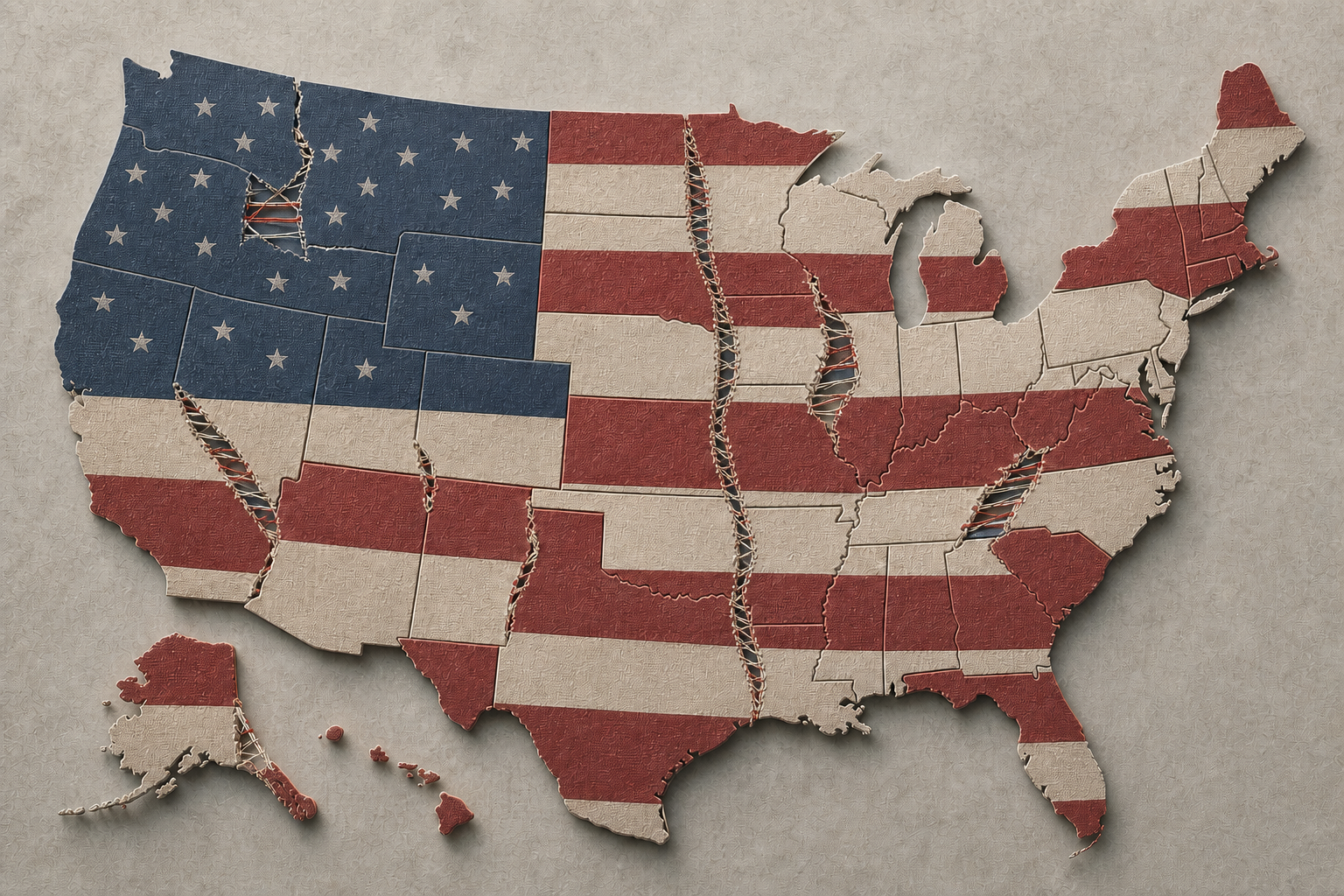
1. THE WEDGE — "Why is everyone in office so much more extreme than the people I know?"
You've probably felt it. The people you actually live next to are mostly reasonable — they disagree, sometimes sharply, but they aren't the cartoon villains cable news says the other side is. Then you look at Washington, and the people who supposedly represent all of you sound like they're auditioning for the most furious voice in the room.
That gap is real. But the usual explanation — "the country is full of extremists now" — gets it backward. The extremism isn't mainly coming from the voters. It's coming from the machine that decides which voters a politician has to listen to. One both parties built, and both feed.
2. THE MACHINE — how a safe seat quietly pays a politician to ignore you
Start with a number that should stop you. Eighteen months before Election Day 2026 — before most candidates had announced — analysts could already call the winner in 81% of all 435 U.S. House seats. Only about 9% were true tossups. The race was over before it began, because in those districts one party is so dominant the other can't realistically win. (FairVote, Monopoly Politics 2026, Apr 28 2025)
Two forces draw those safe lines. First, partisan gerrymandering — the party in power in a state redraws maps to pack the other side's voters into a few districts and spread its own across many, locking in seats for a decade. After the last map-drawing round, the Brennan Center found only about 1 in 10 congressional districts is competitive at all. Both parties do it wherever they hold the pen. (Brennan Center)
This isn't abstract right now. Texas redrew its map in August 2025 to target five Democratic seats, and the Supreme Court upheld it 6-3 in April 2026; California answered with its own Democratic-favoring map via a November 2025 ballot measure, which the Court left in place too. Missouri and Ohio redrew their own maps the same year. Both parties, doing the identical thing, in the identical year — the live version of exactly the dynamic described above, not a hypothetical. Second, geographic self-sorting — Americans increasingly live surrounded by people who vote as they do; the share of "super-landslide" counties (a presidential candidate taking 80%+ of the two-party vote) jumped from about 6% in 2004 to 22% in 2020. (Whether people move for politics is disputed; that neighborhoods have grown more lopsided is not.) (Sabato's Crystal Ball, UVA; contested: Hoover, "The Myth of the Big Sort")
Here's where the machine turns. In a safe seat a politician can't lose to the other party — the general election is a formality. The only election that can end their career is their own party's primary, decided by a small, unusually intense slice of voters. In 2024, the Unite America Institute calculated, just 7% of eligible voters cast ballots in the primaries that effectively decided 87% of House seats — and that 7% doesn't look like the country: independents are 39% of adults but 11% of those decisive voters; moderates are 47% of the public but again just 11%. (Unite America Institute; NPR, Feb 22 2026)
So put yourself in the politician's shoes. You can't be beaten by the other party. You can be beaten by someone in your own party who calls you a sellout and turns out the base. The rational move isn't to win the middle — the middle can't fire you. It's to never get outflanked by your own side. Winner-take-all elections plus a two-party system with no third option lock the logic in. The map doesn't ask politicians to be extreme. It just quietly stops rewarding them for being moderate.
3. WHO PROFITS — follow the incentive
No cartoon villain runs this. It's people and organizations each doing the sensible thing for themselves, summing to a Congress pulled toward the edges.
- Incumbents in safe seats: a guaranteed job as long as they never lose the primary. Researchers who tracked candidates' positions found that when a well-funded primary challenger appeared, safe-seat incumbents of both parties shifted toward the extreme in the three months before the primary — then drifted back. Strategic, and bipartisan. (NYU / Grose, Mar 2025)
- The primary-activist base: the most ideological voters and donors get outsized power precisely because turnout is so low; a committed minority can "primary" anyone who strays. (Brookings)
- Party organizations: safe seats let a party spend on a few battlegrounds instead of everywhere — efficient for the party, even as it writes off competition in most of the country.
- The consultants: a permanent, high-stakes primary war is steady work for the strategists, ad-makers, and fundraisers whose paychecks depend on the fight.
The through-line of this whole series holds: someone downstream of the fight is getting paid, and it usually isn't you.
4. COMMON GROUND — the fixes are real, and honestly, they're debated
The machinery isn't a law of nature — it's a set of rules, and rules can change. Three reforms are being tried:
- Independent redistricting commissions take map-drawing away from the politicians whose seats depend on it (Arizona, California, Colorado, Michigan — often created by voters via ballot measure). Studies find commissions are associated with more competitive elections — real but limited, and dependent on design. (Cambridge, PS; New America)
- Open or nonpartisan primaries let all voters, including independents, help pick the finalists instead of leaving it to one party's base.
- Ranked-choice voting lets second choices matter, giving candidates a reason to appeal beyond their hardcore supporters.
Alaska adopted a combined version in 2020 (nonpartisan top-four primary + ranked-choice general); some researchers link it to more moderate winners (they note Sen. Lisa Murkowski likely would've lost a traditional closed primary). (USSC; Sightline) But the caveat the boosters skip: the research is divided. Other scholars find that in a highly polarized electorate one common form of ranked-choice voting can eliminate the moderate compromise candidate early, and a related study finds ranked-choice voting doesn't reduce racially polarized voting either — the broader academic evidence is mixed, not settled. A promising tool, not a magic wand. (Atkinson, Foley & Ganz, Illinois Law Review 2024; Atsusaka & Landsman, New America)
One real move for you: the machine runs on the fact that almost nobody shows up for primaries. Find out — now — when your state's next primary is and whether you, as an independent, can even vote in it (rules vary by state). In a safe district, that primary is the real election, and voting in it is the most direct way an ordinary person claws back a sliver of the power the map hands to the 7%. Where redistricting or primary reform is on the ballot as a measure, that's one of the rare times you vote on the rules of the game itself.
The exhausted majority didn't vanish — it just stopped showing up for the one election that counts. The country's neighbors aren't the extremists. The map is. And a map is only a set of choices — which means it can be redrawn.