1. THE WEDGE
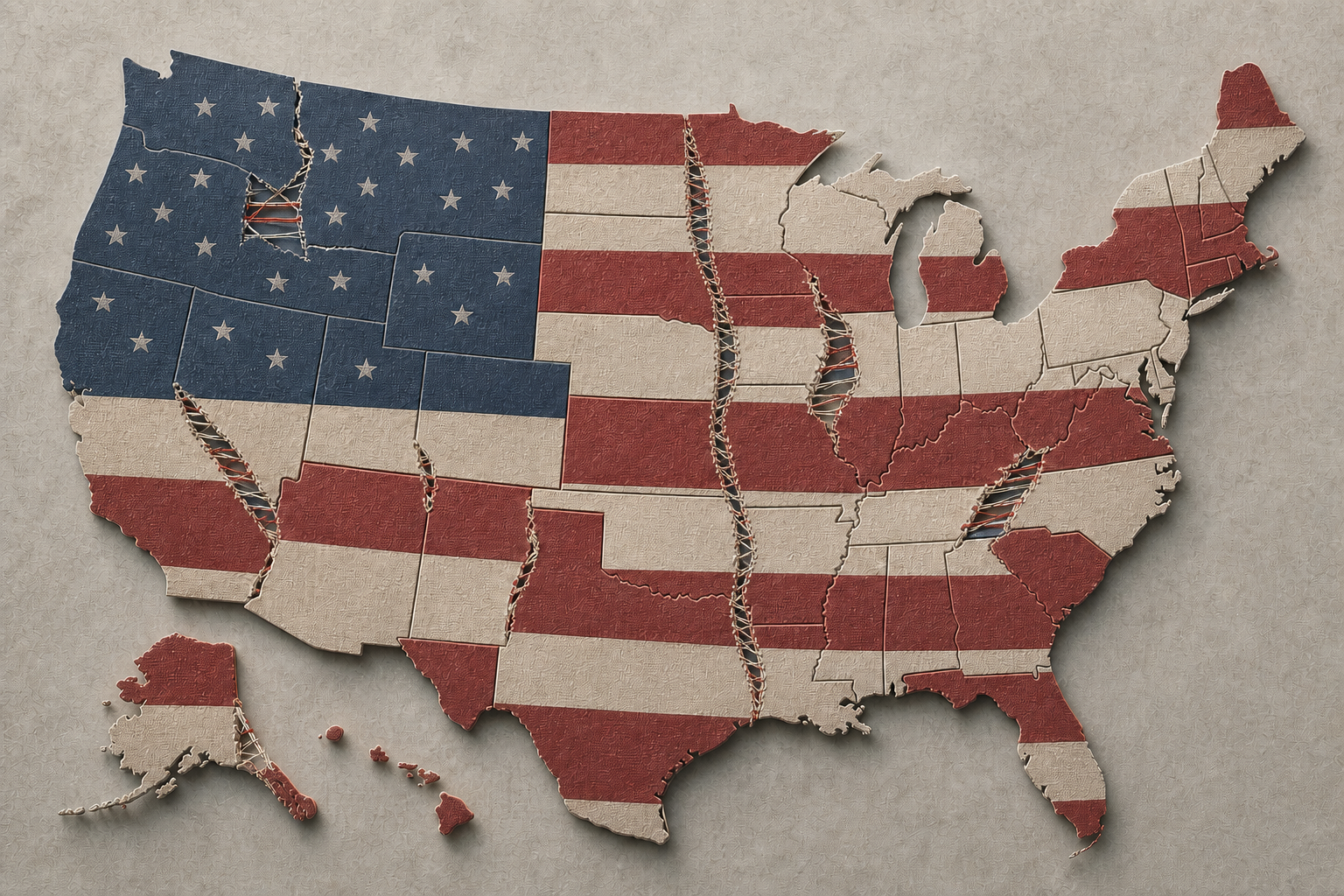
You've probably felt it: a fight online that seems too vicious, too fast, too coordinated to be just your neighbors being mad — a rage that shows up on cue, hits every nerve at once, always pushing you to hate a specific group of people.
Most of the time, that anger is organic. Americans really do disagree — about guns, abortion, immigration, race. This series has never pretended otherwise. But some of it isn't organic. Some of it was built. And the people who built it weren't trying to win the argument — they were trying to make sure it never ends, because they get something every time you scream at a stranger. This piece is about them: the amplifiers.
2. THE MACHINE — the documented record
The troll farm that took both sides — for $200. In May 2016, two crowds faced off outside the Islamic Da'wah Center in Houston. One rally, "Stop Islamification of Texas," was promoted by a Facebook page called "Heart of Texas." The counter-protest, "Save Islamic Knowledge," was promoted by "United Muslims of America." Both pages were run by the same office: Russia's Internet Research Agency, from St. Petersburg. Per the U.S. Senate Intelligence Committee's bipartisan report, the total spend to make Americans confront each other in the street was about $200, and "the entire operation was conducted from the confines of the IRA's headquarters." The point wasn't Islam, or Texas. It was the collision. (Senate Intel Cmte, Vol. 2, Oct 8 2019; Texas Tribune, Nov 1 2017)
Not a one-off. The same report found the IRA ran pages pointed at Americans across the spectrum and pitted them against each other — an anti-immigrant "Heart of Texas" and a "Blacktivist" page (11.2M Facebook engagements on its own), stoking both sides of America's rawest divides, especially race; the committee found the IRA targeted African Americans "more than any other group." The tell: it wasn't pushing one position. It was manufacturing the fight. (Senate Intel Cmte, 2019; NPR, Oct 8 2019)
The teenagers who faked the news for money, not politics. Reporters traced a wave of viral fake U.S. election stories to one small town: Veles, North Macedonia — 100+ websites cranking out hoaxes ("Pope Francis endorses Trump"). They weren't ideologues; some tried pro-Clinton content first, found it didn't pay, and switched to pro-Trump purely because it drew more clicks (and American clicks are the most valuable ad traffic in the world). One 18-year-old told NBC he'd made tens of thousands (self-reported). BuzzFeed found that in the campaign's final three months, the top 20 fake election stories drew more Facebook engagement than the top 20 real stories from the Times and Post. (BuzzFeed News, Nov 2016; NBC News, 2016; Cambridge PS, 2020)
Not over, and not only foreign. An internal Facebook report obtained by MIT Technology Review found that as of October 2019, "troll farms" chasing engagement for profit reached 140 million Americans every month — and Facebook's own recommender, not user choice, pushed most of it. Those farms ran all 15 top Facebook pages aimed at Christian Americans, 10 of the top 15 aimed at Black Americans, and 4 of the top 12 aimed at Native Americans — financial motive, not political. (MIT Tech Review, Sept 16 2021)
3. WHO PROFITS
Two beneficiaries, one business model: your anger is the product. Foreign adversaries buy division cheap. For a hostile government, a fractured, distracted America is a strategic win — cheaper than a weapons program, harder to trace. The Senate committee's blunt finding: the goal was "to sow societal discord and erode public confidence" by exploiting divisions that already existed. They didn't invent American conflict; they turned up the volume, at $200 a rally. Domestic rage-farmers just want the ad money. The Veles teens and modern troll-farm operators aren't running foreign policy — they're running an ad business. Outrage travels farther than nuance, so they manufacture outrage, pro- or anti-anything the algorithm rewards this week. The series through-line holds: someone downstream of your anger is getting paid — sometimes a foreign intelligence service, sometimes a 19-year-old with a Facebook page and an ad account.
4. COMMON GROUND (and the honest caveat)
The honesty this topic demands. It's tempting to blame every bad feeling in American life on a troll in St. Petersburg. Don't. The best research says the persuasion effect was small: a 2023 study in Nature Communications (Eady, Paskhalis, Zilinsky, Bonneau, Nagler, Tucker) linked real Twitter feeds to survey answers and found no measurable relationship between exposure to Russian troll accounts and changes in attitudes, polarization, or votes in 2016. Exposure was wildly concentrated — 1% of users saw 70% of it, mostly strong partisans who already agreed — and dwarfed by ordinary domestic news. (Nature Communications, 2023)
So did the amplifiers change America, or just make noise in an already-loud room? Researchers genuinely disagree, and this piece won't pretend it's settled. The fair reading: the evidence they flipped elections or converted minds is weak; the evidence they amplified existing anger, cheaply and deliberately, is strong and documented. Amplification is real even when persuasion isn't.
The both-sides tell. The amplifier's signature move — Houston to Veles to today — is to run both sides of a fight it doesn't care about, because the fight is the product. So when content seems perfectly engineered to make you despise a whole group, ask: who benefits if I share this in anger? If the answer is "someone selling ads" or "someone who wants my country weaker," you've spotted the machine.
One real move. The defense that holds up in testing isn't fact-checking after the fact — it's "prebunking": learning the manipulation tricks before you meet them. A 2022 study in Science Advances (Roozenbeek, van der Linden et al.) found short videos teaching people to spot the techniques — emotional manipulation, scapegoating, false either/or choices — measurably reduced how easily they were fooled. (Science Advances, 2022) You don't have to fact-check the world; you have to recognize the shape of the con. Slow down. Check the source before you share.
The amplifiers exploit the very gap the rest of this series measures — they need you to believe your neighbor is the enemy, when about two-thirds of the country is a tired middle that mostly isn't. The enemy was never the person on the other side of that Houston sidewalk. It was the office in St. Petersburg that paid $200 to put them there.