There is a YouTube channel, built with a straight face as a college. It is called Con-crete University — con, the old word for convict, fused to the gray concrete of a cell. It has a Dean. It has a syllabus. It has lessons. Its mission is not to get you a degree. It is to teach you how to survive being stripped of your rights.
The Dean's curriculum is the intake process, taught as freshman orientation. Arrested Development. Skipping Admission. Shackled, Cuffed, Detained. A lesson titled Your Rights? — the question mark doing all the work. Holding Cell Hell, in two parts, because the cruelty of a holding cell is time itself: no clock, no window, lights that never go off, no idea if it's been two hours or two days. Somebody's Watching You. And then the booking photo. You did not apply. You were enrolled.
The conceit is his, not ours — a man with years inside choosing to file his own undoing as a curriculum. Take it as testimony from someone who was there, then check it against the record. The record is the point of this piece, and the record is not in dispute.
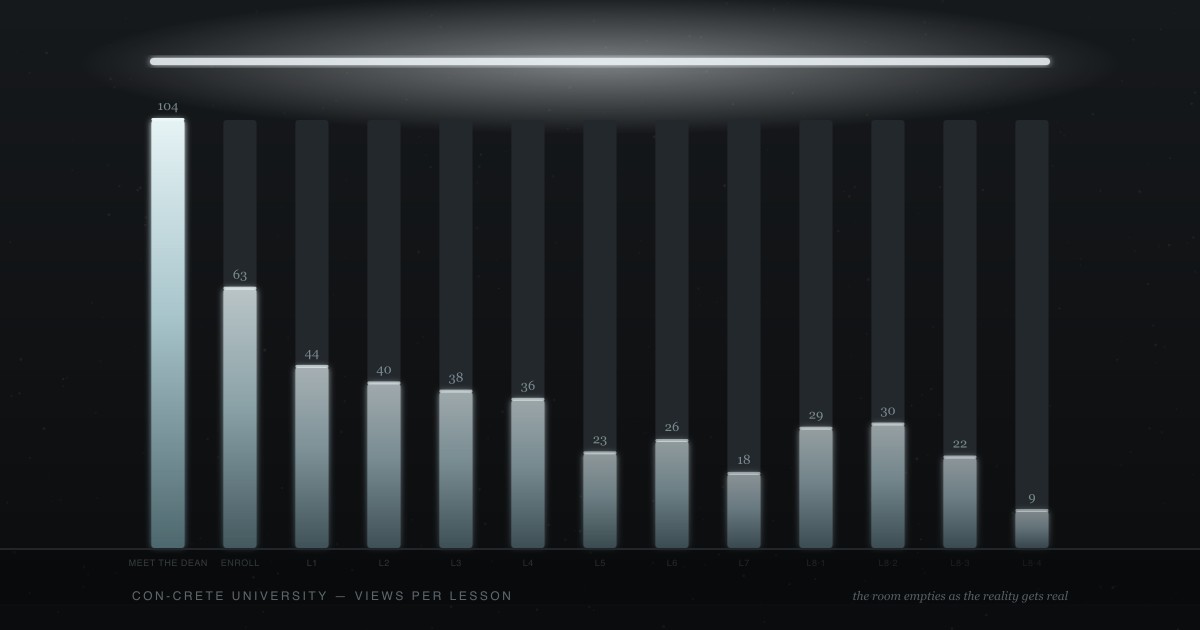
Here is the part worth sitting with. The channel has 72 subscribers, and you can watch the audience leave in real time. The "Meet the Dean" introduction pulls a bit over a hundred views. The first lesson — the arrest itself — draws 44. And as the curriculum descends into the grinding, administrative reality of the thing — the holding cell, the strip search, the fourth straight video on booking — the audience walks out. By the deep lessons, the view count is in the single digits. The Dean doesn't slow down as the room empties; he keeps posting — live every Wednesday night, 7 o'clock Central — still trying to reach whoever's left. We will binge a ten-hour true-crime documentary about a serial killer without blinking. But the ordinary machinery of how a person is taken apart empties the room. We tap out of the reality after a few minutes.
If you have lived this, none of what follows is news to you. This is for the rest of us — the ones it hasn't reached yet.
And that's most of us, until it isn't. About half of all U.S. adults — roughly 113 million people — have an immediate family member who is currently or formerly incarcerated (FWD.us + Cornell, 2018). It is the most common American experience almost nobody talks about. And the weight isn't carried evenly — Black adults are 50% more likely than white adults to have a loved one inside.
Now, the part the rest of this depends on. Most people who land in that system did something to get there, and a lot of it is serious. That is not in dispute, and it is not the subject. Victims are real; accountability for a crime is real. But "they broke the rules" and "look what we're allowed to do to them once we have them" are two separate ledgers — and only one of them is being kept. You can believe every person in a cell earned the cell and still be unable to defend a clogged toilet, a withheld meal, or a man dead in a holding cell before he was ever tried. Jails exist for a reason. None of that reason requires cruelty. The cruelty is a separate failure, riding on top of the legitimate one.
You can watch the country's empathy switch on the day it arrives at the right doorstep.
When crack tore through Black neighborhoods in the 1980s, it was a crime. Congress wrote a law in 1986 that punished crack a hundred times harder than powder cocaine — five grams of crack triggered the same five-year mandatory minimum as five hundred grams of powder (Anti-Drug Abuse Act; CRS). By the mid-2000s, about 80% of the people convicted of federal crack offenses were Black — a share that had topped 90% in the early 1990s and still stood at 81% as recently as 2019 (USSC). When opioids tore through white suburbs two decades later, it was a crisis — a public-health emergency, met with treatment and sympathy. The sentencing gap was eventually narrowed, not closed — to 18:1, in 2010. Researchers documented the split in plain terms: the media drew "criminalized urban Black and Latino" drug users against "sympathetic suburban white" ones (Netherland & Hansen, 2016). Race wasn't the only reason the two epidemics were treated so differently — the legal, prescription origin of opioids and a real shift in addiction medicine mattered too, and the 1986 law itself drew support at the time from Black leaders watching crack devastate their own blocks. That's part of why the disparity was structural rather than simple. But it was central, and the contrast is not subtle.
You can watch it switch on with conditions, too.
In 2021, January 6 defendants drew national attention to the squalor of the D.C. jail. The conditions were real. They were also not new. That same jail had been under federal court oversight for 32 years over unconstitutional conditions, and was the subject of a 2020 class action by the Public Defender Service and the ACLU on behalf of the people held there (Banks v. Booth, settlement court-approved in April 2022). Here is the part that should stay with you: when the U.S. Marshals finally ran a surprise inspection, they found one building — the Central Detention Facility — unfit for human beings: toilets clogged with human waste, staff withholding food and water. They moved the roughly 400 people living in it out to another federal prison. The January 6 detainees were in the other building, the Correctional Treatment Facility, which passed inspection. They stayed. The cameras came with the famous prisoners. The squalor had belonged, all along, to the anonymous ones in the building next door (WUSA9; TIME).
None of the cruelty the Dean documents is hidden, and almost none of it is alleged. "Diesel therapy" — being shackled and bused between facilities for days or weeks, no notice to you or your lawyer, mail unforwarded, out of contact the whole way — is real enough that federal courts use the phrase in their own opinions (Ford v. Garland, 2022); a Marshall Project contributor described losing 37 pounds over 73 days of it. Roughly 1,200 people die in America's local jails in a year, and two-thirds of them had not been convicted of the charge that put them there (BJS; Reuters). Many were dead within days of intake — suicides, untreated withdrawal, a heart that gave out — before a trial was ever possible. That timing doesn't soften the number; it sharpens it. A jail is responsible for keeping alive everyone it holds, tried or not. Gaven Picciano, an inmate with documented celiac disease, was told in effect to eat what he was given or go hungry; he collapsed, and settled for $630,500 in September 2025 (case). The federal government's own civil-rights investigators keep finding the same thing. Their 2024 report on Atlanta's Fulton County Jail found medical and mental-health care so deficient it violates the Constitution — after Lashawn Thompson, held in the mental-health unit, was found dead in his cell, his body covered in insects (DOJ, 2024).
And when it happens to you, here is your recourse: almost none. Most people charged can't buy a defense — about 82% of felony defendants in the country's largest counties rely on a public defender or appointed counsel (BJS), lawyers carrying hundreds of felonies at a time. Once you're inside and want to challenge how you're treated, you're on your own: more than 90% of prisoner petitions in federal court are filed with no lawyer at all. And the rarest escape of all — a commuted sentence — goes to a vanishing few; modern grant rates run under five percent (DOJ Office of the Pardon Attorney). When a wealthy, famous defendant complains loudly about prison conditions and then walks out on a presidential pardon, that is not the system working. That is the system working for the one person in ten thousand who has the microphone and the connections. (Todd Chrisley said, without independent corroboration, that staff were recorded discussing a plan to put him through diesel therapy; the record does not show it happened — he was never transferred. The point isn't him. The point is everyone left behind, for whom no pardon is coming.)
It is tempting to file all of this the way the Dean files it — a tidy syllabus, a clean arc, a story that closes. But a man dismantled in a holding cell is not a lesson plan, and the neatness is its own kind of looking away. The point of laying it out in order is not to make it bearable to read. It's to make it harder to keep scrolling.
So go back to the channel, posting its lessons to almost no one. What it shows — not what anyone wants from it, just what it shows — is an account of how a person is processed, written down by someone who went through it, because someone should write it down. The architecture of the channel is the architecture of the thing it describes: it takes you in fast, strips your illusions about your rights, leaves you in the dark, and files you — while everyone else scrolls past.
The cruelty was never the secret. The looking away is.
Con-crete University (@Con-creteUniversity) — new lessons, and live every Wednesday at 7pm Central.
The Receipts
BL:UF doesn't ask you to trust us. Check our work:
- Family incarceration: FWD.us + Cornell, 2018
- Crack/powder 100:1 → 18:1, race by year: CRS IF11965; USSC Quick Facts: Crack Cocaine; framing: Netherland & Hansen 2016
- DC jail / Jan 6 (CDF failed/emptied; CTF passed/Jan 6 stayed): WUSA9; TIME; Banks v. Booth (ACLU-DC)
- Diesel therapy: Ford v. Garland, 2022; Marshall Project
- Deaths / medical neglect: BJS Mortality in Local Jails; Reuters Dying Inside; DOJ Fulton County 2024; celiac settlement $630,500
- Recourse: BJS Defense Counsel; BJS Prisoner Petitions; DOJ clemency stats