1. THE WEDGE
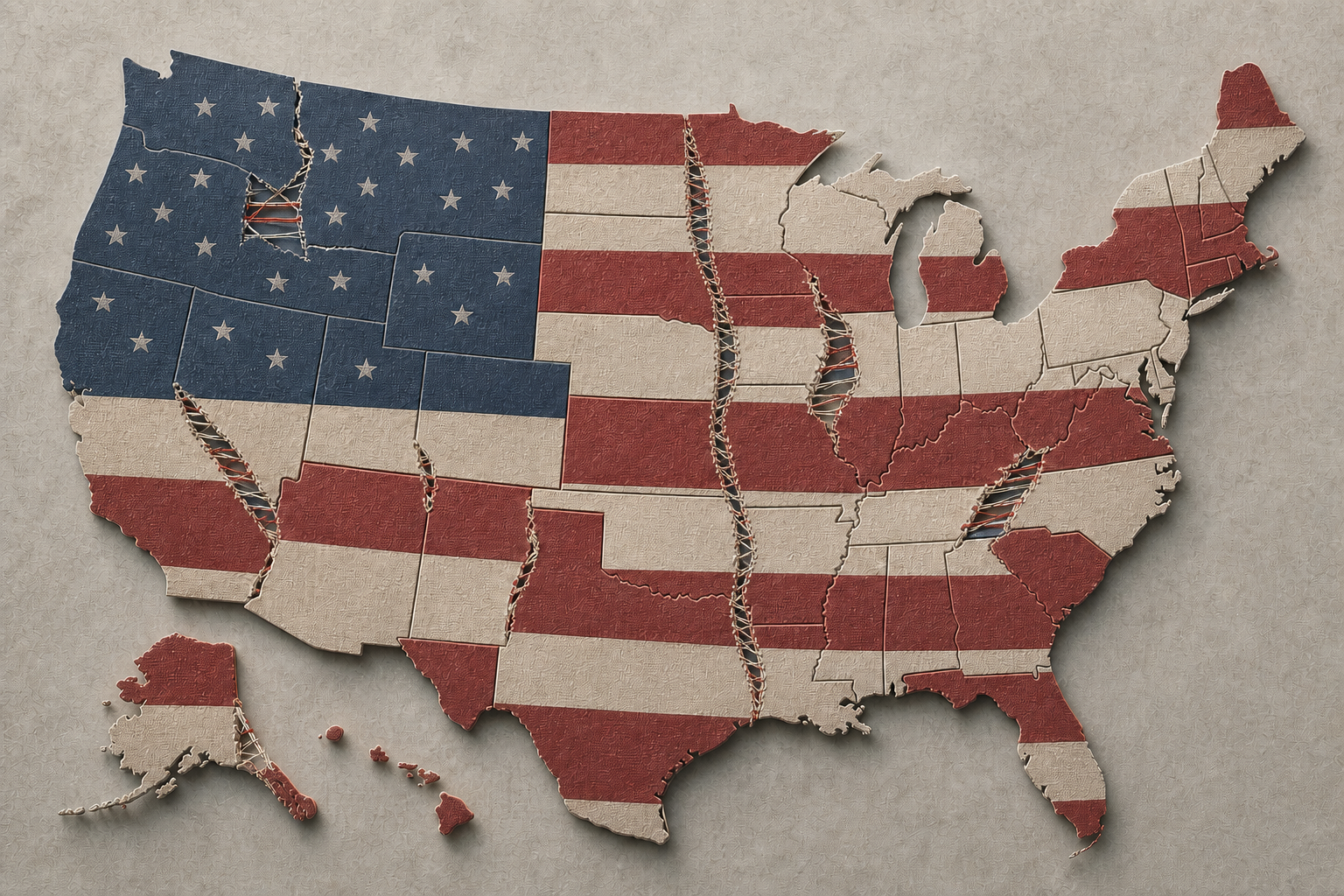
Turn on the loudest channel and you'll be told, with total confidence, who did this to you. The immigrants. The coastal elites. The rednecks. The other race, the other party, the other side of the country. The message is always horizontal — your enemy is another group roughly as broke and as tired as you are.
Here's the strange part. Put a struggling factory worker in Ohio and a struggling home health aide in Georgia in a room and ask about their lives — the rent that eats the paycheck, the surprise medical bill, the kid who can't afford to move out — and you'd hear the same story in two accents. They are, literally, drowning in the same water. But they've been handed a map that says the person treading water next to them is why they're sinking. This piece is about who drew that map, and why the water keeps rising no matter who wins the argument.
2. THE PAIN IS REAL — this beat is FACT
Before anyone argues about why, the what has to be nailed. None of the following is opinion.
Your work got more valuable. Your paycheck didn't. From ~1948 to the 1970s, pay and productivity rose together. Around 1979 the lines split: 1979–2019, net productivity rose 59.7% while typical-worker compensation rose 15.8% — productivity grew about 3.5× as fast as pay. (EPI, Productivity–Pay Gap, 2024)
The basic promise — kids do better than parents — is now a coin flip. Absolute mobility (share of children out-earning their parents at the same age) fell from about 90% for those born in 1940 to about 50% for those born in the 1980s. (Chetty et al., "The Fading American Dream," Science, 2017)
People are dying of it. Case & Deaton named the pattern in 2015 — "deaths of despair" (overdose, alcohol, suicide), rising since 1999. In 2021, 209,225 Americans died from alcohol, drugs, or suicide. (TFAH, Pain in the Nation 2023; Case & Deaton, Princeton) A correction to how this usually gets told: first documented among middle-aged white Americans, but by 2020 the overdose death rate among Black Americans overtook the white rate, reaching 1.4× higher by 2022. (Pew, 2022; Am. J. Psychiatry, 2024) The despair does not check your race at the door.
The big costs outran the paycheck. Real published four-year tuition more than doubled over recent decades (College Board); about half of renter households are rent-burdened (>30% of income on rent) ([Pew]); one study estimated the average family lost ~$125,340 in earnings 1988–2019 to health-premium growth (JAMA Network Open, 2024).
And the gains went up. As of early 2024, the top 1% held ~30.5% of household wealth; the bottom 50% held ~2.5%. (Federal Reserve, Distributional Financial Accounts) That's the water — deep, rising, and rising on Republicans and Democrats alike.
3. THE REDIRECTION — this beat is INTERPRETATION (read the labels)
Everything above this line is measured. Everything in this section is argued. We're switching from a thermometer to a theory, and we're telling you so on purpose — this is exactly where a piece could slip a claim past you.
The argument: when people hurt economically and no one offers a structural explanation, the anger looks for a target, and the easiest one supplied is another group of struggling people. Point the anger sideways and it never travels upward at the arrangement. Heather McGhee calls the historical version "drained-pool politics" — mid-century towns that filled in public pools rather than integrate them, so everyone lost the pool; her thesis is that zero-sum racial framing leaves the whole community worse off, forfeiting a "solidarity dividend." (McGhee, The Sum of Us, 2021) [Her interpretation, attributed — not established fact.]
Who gains — name incentives, not a cabal. No secret room. But you don't need a conspiracy to see who benefits when voters spend anger on each other instead of economics: safe-seat politicians rewarded for feeding the base (FairVote, 2025); outrage media earning ratings from anger; and anyone whose position depends on the status quo (low top taxes, weak labor power, light regulation) is better off if the electorate argues about culture than unites to change economics. [Interpretation: that these actors deliberately redirect anger is an inference; the incentives are documented, intent is not asserted.]
The serious counterargument — real weight, not a strawman. First, the cultural disagreements are genuine: views on abortion, guns, religion, identity are real moral commitments held by tens of millions; telling someone their values are a manufactured distraction is condescending and wrong. Second — directly challenging the economics-first read — the best-known 2016 study found economic hardship was not the main driver: Diana Mutz (PNAS, 2018) concluded perceived cultural/status threat best explained the shift, and "concern about future expenses" didn't predict the vote the way the economic story requires. (Mutz, PNAS, 2018) A broad line of research finds racial attitudes often a stronger predictor than economic anxiety. If that's right, "the culture war is a decoy" is at minimum an over-read — for many people culture is the main event, not a curtain.
Where this honestly leaves us: "divide-and-rule" is a real, ancient dynamic, and the Beat-2 pain is beyond dispute. But the claim that today's culture war is primarily redirected economic anger is a contested interpretation serious scholars push back on. We report it as an argument with evidence on both sides — not settled truth. What we won't do is tell you the person across the cultural line is why your paycheck is thin. The data says they're in the same water.
4. COMMON GROUND — back to fact
The tell: on the cultural fights we can't resolve, the volume is deafening; on the kitchen-table things where big majorities of both parties already agree, it's oddly quiet.
- Drug prices: 85% support letting the government negotiate Medicare drug prices — 90% D / 87% I / 79% R. (KFF, Sept 2024)
- Money in politics: reducing it is a top priority for 65% D / 60% R; 72% want campaign-spending limits (76% D / 71% R). (Pew, 2024)
- Corruption: ~72% say there's too much money in politics — agreement spanning Trump and Harris voters. (Pew)
The things quietly uniting big majorities — the cost of medicine, big money, corruption — are pocketbook problems a united electorate could actually move. The fights that get airtime are the ones that can't be resolved.
One move (WCID): pick one issue where you already agree with people you're told to hate — drug prices is cleanest (79% R / 90% D) — and ask any candidate where they stand on that, specifically, before you let anyone tell you who your enemy is.
Throughline — the Perception Gap. Americans overestimate how extreme and hateful the other side is, and the most engaged have the biggest gaps. This piece is that gap in one sentence: you've been taught to see an enemy in someone who, by the numbers, stands in the same rising water. The disagreement over culture is real. The idea that your neighbor is draining your paycheck is not. The enemy was never your neighbor — it's the water, and how quiet everyone stays about who profits from it staying high.