Who gains, who loses — in plain terms
Who wins, and what they win, right now, in dollars:
- The nuclear industry saves about $9.5 million a year in compliance costs — the NRC's estimate for the rule's full set of changes, not the ALARA piece alone.
- The NRC itself saves about $704,000 a year in reduced review and paperwork.
- State radiation regulators save about $244,000 a year.
- Companies building brand-new reactors get a faster, more flexible licensing path — the old ceiling on public-dose-limit requests, and the rule limiting that option to plants built before 1991, are both gone.
- The administration gets a concrete deliverable against its own stated goal: quadrupling nuclear capacity by 2050 to power AI data centers, landed inside its own deadline.
Who's exposed to the cost, and why it's harder to see:
- Workers lose the standing pressure that's kept their real doses well under the legal cap for 50 years, and those with a clean 4-year monitored record gain a legal path to double their annual dose in a single year.
- People living near a facility — especially new construction — lose the fixed ceiling on how high a case-by-case public dose request can go, and get a higher default assumption for routine emissions.
- Nobody specific, yet: because the risk here is a small probability increase, not a guaranteed injury, and because any resulting harm could take ten, twenty, or thirty years to show up, if this rule change ever does produce real harm, there is no person alive today who can point to it and prove where it came from.
The plain version: the winners collect a real, countable number this year. Whoever eventually bears the cost — if there is one — doesn't know who they are yet, may not find out for decades, and likely could never prove it either way. That mismatch, concentrated and immediate gain against diffuse and delayed risk, is an easy trade to make when you're the one collecting the win.
Three places where something does change, even though the "limits" stay on the books
1. Workers can get double their annual limit in a single year
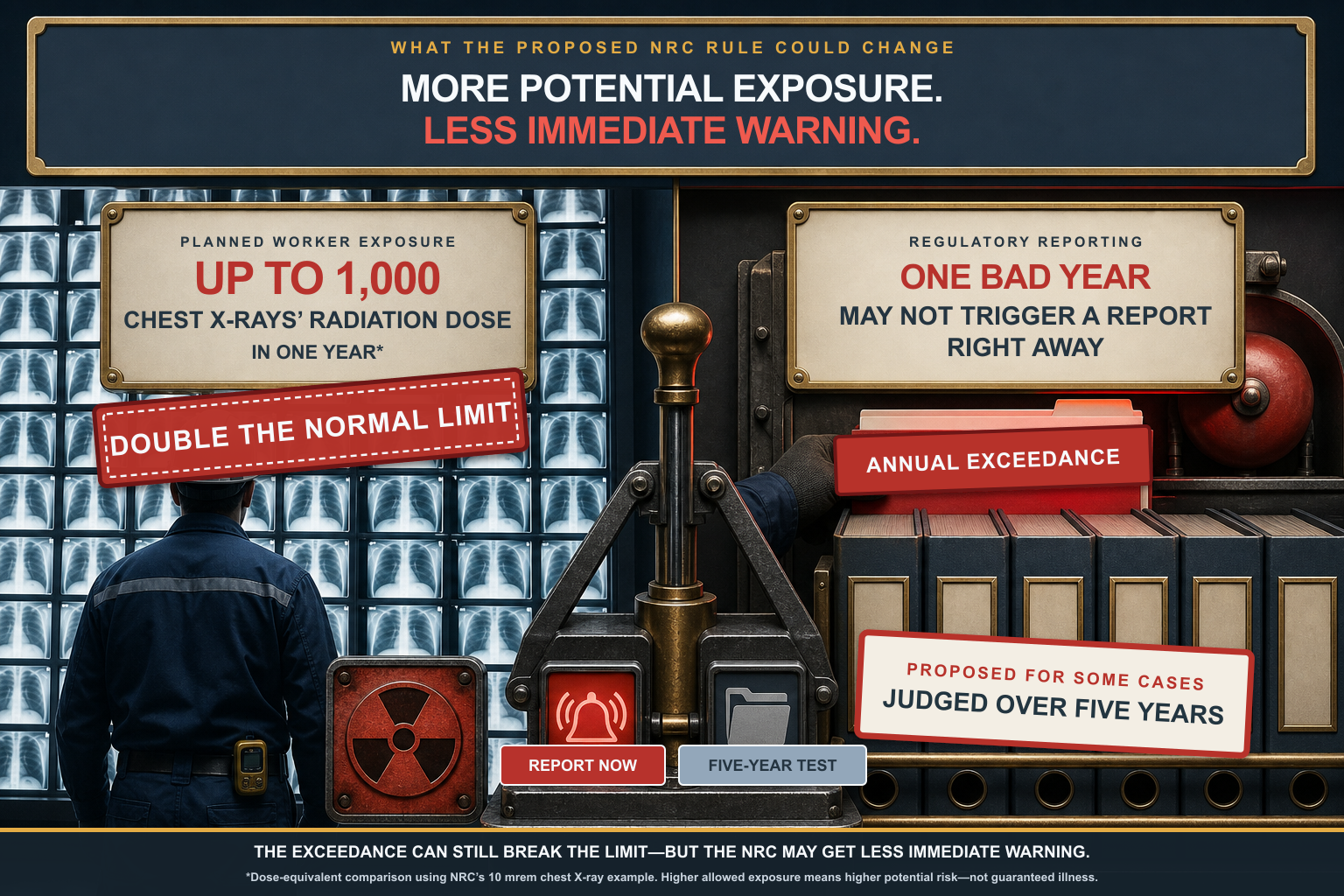
The current occupational dose limit is 5 rem (5,000 millirem) per year. The proposal adds a new mechanism — the "planned occupational dose limit extension" — letting a worker receive up to double that, 10 rem, in one year, by drawing on dose they didn't use in the previous four years. The math: 5 years times 5 rem is 25 rem of allowed exposure over any 5-year stretch; if a worker used less than that in past years, the unused amount becomes available as a one-year "extension," capped at twice the normal annual limit.
This isn't unbounded. It requires written authorization before the exposure happens, the worker must be told the purpose, the estimated dose, and the risks; declared pregnant women and minors are excluded entirely; and it doesn't apply to the separate, more cautious eye-lens dose limit at all. The NRC's safety argument is that annual limits were always a fractional stand-in for lifetime risk management, not a hard line where harm begins — so redistributing unused room across years doesn't itself change a worker's real cumulative risk.
Still: a worker can legally receive twice the current one-year cap in a single year under this system. That's a real, new, quantifiable change to how the annual limit functions — not just a label swap.
One more thing worth being precise about, and worth correcting from an earlier version of this reporting: this isn't simply "available to almost anyone." The lookback is only four years — a 20-year worker gets no extra credit for years 5 through 20 — but the proposed regulatory text (§ 20.2104(e)(2)) is explicit that a worker is not eligible at all for this mechanism if records for the current year and preceding four years "are not complete." A brand-new hire with no prior radiation-job history would likely fail that requirement outright and be excluded from the mechanism entirely, not advantaged by it. Among workers who do have a complete 4-year monitored record — which, because ALARA has kept doses low across most of the industry for decades, likely describes most people who've been in a radiation job that long, whether that's their 4th year or their 24th — the amount of "unused" dose available depends on recent exposure history, not total tenure beyond that 4-year window.
Also worth knowing, since it changes when a worker crosses from routine to closer regulatory attention: the proposal keeps a graded set of thresholds tied to expected annual dose — above 100 mrem/year, licensees must give workers radiation-safety training; above 500 mrem/year (10% of the applicable limit), individual dose monitoring kicks in; and above 5 rem/year, the new extension mechanism (or the older planned-special-exposure process) comes into play.
2. The public dose limit can go higher, with fewer restrictions on who can ask
The general public radiation limit — 100 millirem per year — genuinely isn't changing as a default number. But the process for exceeding it is changing in two ways.
Right now, a licensee can already ask the NRC for permission to expose the public to more than 100 millirem/year, but only up to a hard ceiling of 500 millirem/year, and this option only exists for facilities that were already operating before the rule took effect in 1991.
The new proposal removes that 500-millirem ceiling entirely, and opens the request process to any licensee or applicant — new construction included, not just legacy facilities. It also adds a separate, new path letting a facility seek a higher public dose limit specifically for its "controlled area" — a zone inside the site boundary where the public sometimes goes temporarily (tours, deliveries, visitors), as opposed to the fully open "unrestricted area" outside the site. Separately, the routine radionuclide emissions standard — modeled on a hypothetical person living at a plant's property line — is proposed to rise from 10 to 25 millirem per year, a 2.5x increase in the default assumption; the NRC's own proposed compliance approach would let projected doses below 25 mrem/year skip further dose-reduction analysis entirely, while doses at or above that line would trigger a cost-benefit review that values one avoided "person-rem" of exposure at $5,200 (in 2014 dollars).
The NRC's justification: the 500-millirem cap and the pre-1991-only restriction were leftovers from a specific 1991 transition problem, not a permanent safety judgment — and a case-by-case review, with a required written justification and dose-management plan, still has to show the higher limit "remains protective of the public health and safety" before the NRC approves it.
But the actual ceiling on how high a case-by-case public dose limit can go is being removed. There would be no fixed cap left in the regulation itself — just NRC discretion, case by case. The agency's own "Specific Requests for Comments" section confirms it hasn't settled on a replacement number either — it's asking the public what a new limit should even be.
3. A single bad year might not have to be reported anymore
Currently, if any individual — a worker or a member of the public — receives more radiation than their annual limit allows in a given year, that has to be reported to the NRC as an overexposure, on its own, regardless of what happened in other years.
The proposal changes the trigger to a 5-year cumulative total. An occupational overexposure only becomes reportable if the person's total dose over the current year plus the preceding four years exceeds 25 rem. A public overexposure only becomes reportable if that same 5-year total exceeds 500 millirem. A single year that blows through the annual limit, on its own, would no longer automatically trigger a report — only a pattern that adds up over five years would.
The NRC's rationale connects directly to the other two changes: since annual limits are being treated as multi-year averages rather than absolute yearly lines, the reporting trigger is being aligned with that same multi-year logic.
One distinction worth being exact about: this changes when NRC must be notified, not whether an unplanned exceedance is lawful. Going over the annual limit outside of an authorized extension or planned special exposure remains an exceedance of the underlying dose limit itself — the regulatory text still ties the reduced reporting requirement specifically to "unplanned exceedances," not to a general loosening of what's in compliance. What's changing is the threshold for when NRC has to be told about it, not whether it was allowed to happen in the first place.
Where this is actually happening
This isn't an abstract national policy — it's tied to specific places where new reactors are already moving through NRC review or restart. Seven named projects are furthest along as of late July 2026:
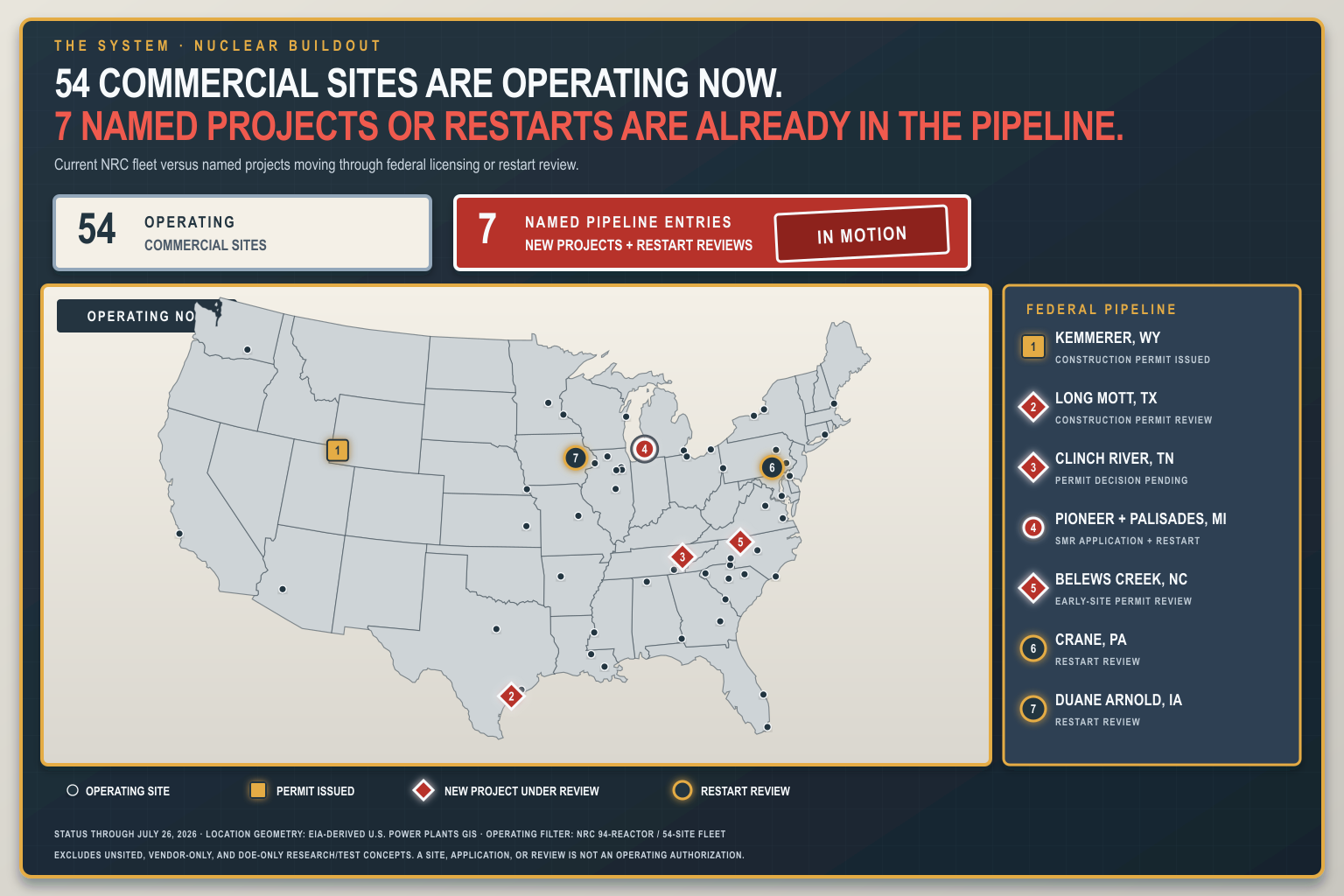 Operating sites shown as small markers; the 7 numbered pipeline entries are keyed to the table below. A site, application, or review is not an operating authorization.
| Project | Company | Status | Nearest community | What's known about nearby population |
|---|---|---|---|---|
| Kemmerer Power Station, WY | TerraPower (Natrium reactor) | Construction permit issued March 2026; construction underway | Kemmerer/Diamondville, Lincoln County | Kemmerer + Diamondville combined ~2,900 people; county ~19,600 over 4,095 sq. mi. No verified 10-mile figure. |
| Long Mott site, TX | Long Mott Energy (linked to Dow's Seadrift site — exact corporate relationship not independently confirmed) + X-energy | Environmental review complete; final safety evaluation due Nov. 2026 | Point Comfort/Seadrift, Calhoun County | Nearby towns ~2,000 combined; county ~20,100. No verified 10-mile figure. |
| Clinch River, TN | Tennessee Valley Authority (SMR) | NRC staff recommended approval June 2026; commissioners' hearing Aug. 13, 2026 | Oak Ridge, Roane/Anderson County | Oak Ridge ~31,400; Roane County ~53,400. No verified 10-mile figure. |
| Palisades restart + "Pioneer" SMRs, MI | Holtec International | Palisades restart underway/imminent; "Pioneer" SMR units are in preapplication engagement with the NRC, an earlier stage than a filed application | Covert Township, Van Buren County | Nearest towns ~2,500–4,000 each; 10-mile zone spans into two more counties. No verified aggregate figure. |
| Belews Creek, NC | Duke Energy (SMR, early site permit) | Application filed Dec. 2025; NRC scoping an environmental review | Walnut Cove, Stokes County | Walnut Cove ~1,500; county ~44,500. Winston-Salem (~380,000+) is roughly 20+ miles away — likely outside a true 10-mile radius. |
| Crane Clean Energy Center (former Three Mile Island Unit 1), PA | Constellation Energy | Draft environmental review released June 2026; restart targeted 2027–2028 | Middletown, Dauphin County | Best-sourced figure of the seven: ~230,000 people within 10 miles, per a Pennsylvania emergency-management official, up from ~135,000 in 1979. |
| Duane Arnold Energy Center restart, IA | NextEra Energy | Restart panel established; possible approval 2028, restart targeted 2029 | Palo, Linn County (near Cedar Rapids) | Palo ~1,400; Cedar Rapids ~137,700 is 8 miles away — likely the second-largest nearby population of the seven. |
The honest gap: true 10-mile population data for six of these seven sites exists only inside each project's NRC environmental filings, not in any public source — this piece is reporting town and county Census figures as the closest available proxy, not a precise ring count. Getting the real numbers would mean pulling the population tables directly from each project's NRC filing (accession numbers available on request).
The national picture is even more out of date. The most rigorous population-near-reactors count found for this piece is an Associated Press analysis from 2011, using 2010 Census data: about 4.08 million Americans lived within 10 miles of an operating reactor at that time. We did not find a more recent, equally rigorous recalculation — that's a statement about what turned up in this research, not proof that none exists anywhere. A commonly repeated "nearly 3 million" figure floats around several local government websites with no traceable source or date — it should not be treated as current fact.
On how many reactors are actually operating, the count depends on what you're counting. The NRC's own operating-reactor list puts the number at 94 operating reactors. A broader count from the federal Energy Information Administration puts it at 96 reactors across 57 plants — the difference appears to be that EIA's figure includes reactors currently in restart or extended-outage status (like Palisades or Crane) that aren't generating power today but are counted as part of the fleet, while the NRC's operating count reflects units actually running. Neither number is wrong; they're answering slightly different questions, and this piece uses the NRC's stricter "currently operating" figure unless noted otherwise. The single most useful, honestly stated fact here may be this: the federal government is planning to significantly expand where nuclear reactors sit, and this research could not find a national recalculation of how many Americans that will put within range of one, since 2011.
What these numbers actually mean, and what "overexposure" really does
The regulatory limits at the center of this story — 100 millirem/year for the public, 5,000 millirem (5 rem)/year for workers — only mean something in context. Here's the real-world scale, straight from the NRC's own public data:
The average American already gets about 620 millirem a year, from everything combined — roughly half from natural background (mostly radon gas, plus cosmic rays and the ground itself), and half from man-made sources, 96% of which is medical. A chest X-ray is 10 millirem. A full-body CT scan is 1,000 millirem — a full rem, in one scan, ten times the entire annual public allowance from a licensed nuclear facility. The NRC's own stated position: "In general, a yearly dose of 620 millirem from all radiation sources has not been shown to cause humans any harm."
Why 5 rem for workers and only 100 millirem for the public — a 50-times gap: dose limits split around two different kinds of harm. "Deterministic" effects (burns, cataracts) only happen once you cross a specific threshold — below it, nothing happens. Those limits get set well under the known threshold, with margin. Cancer — the "stochastic" effect — has no identified safe floor under the LNT model; risk just scales down proportionally as dose drops, without a clean zero. Regulators instead pick an acceptable added risk and work backward to a number. Workers get more allowance because they chose the job, are trained, and are monitored adults — the same logic that lets other hazardous professions accept a higher standard of risk than the general public, which includes children, pregnant women, and people with no say in the matter.
The US numbers are not always the most protective available, and the NRC has said so itself, twice, in this same rulemaking:
- The international scientific body (ICRP) currently recommends an occupational limit of 2 rem/year on average. The US actual limit is 5 rem/year. The NRC has openly said it hasn't matched the lower number because measured doses already run well below 5 rem — that's ALARA doing its job — and tightening the rule would be costly.
- Separately, on the eye-lens dose limit specifically: newer science (NCRP Commentary 26, 2016) recommends cutting that limit from 15 rem/year to 5 rem/year, because cataracts may form at lower doses than previously believed, and might not have a clean safe threshold at all. The NRC's current limit is still 15 rem/year. It hasn't moved — though the agency's own document acknowledges "further research in this area may merit reconsideration... in the future," and notably, the new dose-extension mechanism below explicitly excludes the eye-lens limit from ever being stretched, specifically because of this uncertainty.
What actually happens if you exceed the regulatory number, honestly: for deterministic effects, the annual limits sit far below any documented injury threshold — acute radiation sickness starts around 50–100+ rem as a single dose, nowhere near even the doubled 10 rem worker ceiling discussed below. For cancer risk, this is the NRC's own actual argument for the whole rule: the added individual risk from exceeding these specific annual numbers is generally too small to detect against the baseline — the agency's own document cites data showing roughly 20% of the US population is expected to die from solid cancer regardless of any of this. Exceeding the limit doesn't mean "you're now sick." It means a calculated probability ticked up by an amount that's often impossible to trace back to a specific cause — which is exactly why the precautionary layer existed in the first place: not because anyone could point to specific harm at these doses, but because nobody could rule one out either.
The body keeps score — but be precise about which mechanism actually tracks that
It's worth separating two things the NRC's own document says, because running them together overstates the case. Conceptually, the agency treats annual dose limits as "fractionated lifetime totals" — a point about why an annual number was chosen at all, not a claim that every mechanism tracks a literal lifetime account. Only the older, separate planned-special-exposure process actually requires reconstructing a worker's full lifetime dose history. The new mechanism described below is explicitly bounded to a rolling 5-year window — current year plus the preceding four — not a career-long ledger.
That distinction matters, but the underlying concern still holds in a narrower, more defensible form: nothing stops a worker from using the new extension repeatedly across a career, each time within its own fresh 5-year window, and every use still adds real dose to that worker's actual cumulative lifetime exposure — a quantity that radiation risk doesn't reset on, whatever accounting window the paperwork uses. The mechanism's window is short; the body's ledger isn't. Removing ALARA's day-to-day pressure to stay meaningfully below the annual number, in a framework that already concedes real uncertainty at low doses, means more of that real accumulation could plausibly happen over a career — not because the regulation itself tracks a lifetime total for this mechanism, but because a person's actual body does, regardless.
What ALARA actually was, and why the NRC wants it gone
Two separate safety standards currently work together. "Dose limits" are hard caps — the maximum radiation the public or workers can legally be exposed to. ALARA sits on top of that: even under the cap, facilities have to keep exposure as low as practical, not just legal. It's the layer of caution that's kept actual doses running well below the legal ceiling for 50 years, not the ceiling itself.
The NRC's stated reason for dropping it isn't new science — it's cost and speed, and the document says so in its own words. Executive Order 14300, signed by Trump in May 2025, directs the NRC to help expand US nuclear capacity from about 100 gigawatts today to 400 gigawatts by 2050. (The docket also lists a second order, E.O. 14154, "Unleashing American Energy" — Trump's broader, first-day-of-term energy-deregulation order — as part of what this rule responds to; E.O. 14300 is the one that specifically directs the ALARA/LNT reconsideration.) The NRC's own text describes ALARA's history of "wide variance within the U.S. nuclear industry in how much a given licensee is willing to spend to reduce radiation exposure," with industry practice consistently exceeding what the NRC itself calculated as reasonable. The NRC's cost analysis of the proposed rule as a whole — not the ALARA change in isolation — projects roughly $9.5 million a year in industry savings, plus $704,000/year for the NRC itself and $244,000/year for state radiation regulators. Every one of the three specific mechanisms below traces back to the same trade: less margin of caution, in exchange for building faster and cheaper, on a deadline set by AI power demand.
NRC Chairman Ho Nieh, on a call with reporters: "We're just removing the ambiguity. But the standard for exposure to workers and the public, those are not changing. We're just putting in place greater clarification."
This isn't the fight the NRC already had in 2021 — and the document says so
Before getting to what changes, there's a question worth settling first, because it's the one that actually matters for whether this is a safety rollback: is the NRC reversing its own science?
In 2015, three petitions asked the NRC to scrap the LNT model itself — the assumption that any radiation dose, however small, carries some proportional cancer risk with no safe floor — on the grounds of "hormesis," the contested claim that low-dose radiation is actually good for you. The NRC denied all three petitions in 2021, stating plainly: "There is scientific uncertainty and no compelling evidence as to whether the hormesis concept is valid for application to radiation protection requirements. None of the national and international authoritative scientific advisory bodies … support the hormesis concept as a regulatory model for radiation protection" (86 FR 45923).
Reading the full 2026 proposal directly, it does not relitigate that finding, and it says so in its own words. The document reaffirms, in its own "Reconsideration of LNT and ALARA" section: "the NRC recognizes that there is insufficient evidence to refute the use of the LNT model" and "the NRC reaffirms its position that the linear dose response model is the most appropriate available consensus model for formulating radiation protection standards." The LNT model itself — the actual science of how radiation risk is assumed to scale down to zero — stays. Hormesis stays rejected. Nothing in the 164 pages claims new evidence that overturns 2021.
What's actually changing is narrower and more specific: not the model, but ALARA — the practice of pushing exposure below the legal limit "as low as reasonably achievable." The NRC's own stated argument is that ALARA, as implemented, drifted from a reasonableness test into something closer to a rote minimize-at-any-cost mandate, and that this is a regulatory-experience and cost problem, not a scientific one. Its own text: "regulatory experience has demonstrated that the primary issue is not the standards themselves, but their implementation." That's a real distinction — eliminating a compliance practice built on top of a model is not the same as eliminating the underlying science — and it's also not nothing: ALARA existed precisely because the science leaves real uncertainty at low doses, and the same document concedes "there are inherent limitations in the LNT model, particularly at low doses" without resolving what that means for actual exposures once the day-to-day pressure to stay low is gone. Removing the practice built to manage that uncertainty is a real policy choice, made explicitly to speed nuclear buildout under Executive Order 14300 — not a neutral cleanup of outdated paperwork, and not a case of the agency conceding hormesis was right after all.
An executive order can't rescind a rule by itself — but it can set the destination and the clock
It's worth being precise about what's actually happening procedurally, because it's easy to get wrong in both directions. An executive order cannot, on its own, repeal or rewrite a federal regulation. That legally requires the same notice-and-comment rulemaking process the original 1991 rule went through — publish a proposed rule, take public comments, respond to them, then issue a final rule. That is exactly the stage this is at: a proposed rule, comments open through August 31, 2026, no final rule yet. So mechanically, this is not a shortcut around the process — it's going through it.
But E.O. 14300 doesn't ask the NRC to independently study whether ALARA is obsolete and report back neutrally. The NRC's own document frames Section 5(b) as requiring the agency to reconsider its reliance on the LNT model and ALARA, and directly quotes the order's own text on what comes next: "In reconsidering those limits, the NRC shall specifically consider adopting determinate radiation limits." That's the President telling an agency exactly which conclusion-space to work inside, and the order set an 18-month clock for a final rule (landing around November 2026, per the order's own target — not a guaranteed date) before a single public comment had been filed. That's meaningfully different from an agency independently deciding, from its own ongoing safety review, that a 50-year-old rule needs updating. Whether that produces a worse outcome than organic rulemaking would have is a separate question — but the process itself was directed toward a specific destination, on a deadline, and that's a documented fact, not an inference.
One fact cuts the other way, for fairness: the NRC didn't do everything the order asked. The order specifically told the agency to consider adopting "determinate radiation limits" — a more radical change than killing ALARA — and the NRC's own document explicitly declined that piece, stating plainly that the science doesn't currently support it. This isn't a rubber stamp start to finish; there's at least one documented instance in this same rulemaking of the agency pushing back against what the order asked for.
One open, unresolved question this piece does not answer: how much practical independence the NRC — structured as an "independent regulatory commission" with fixed-term commissioners — actually has from White House direction right now, given ongoing, unresolved legal fights over presidential removal power at independent agencies generally. That needs its own verification before any claim about it goes in a piece like this.
What this piece is not saying
This isn't saying the NRC is secretly raising the risk to the public without saying so — every mechanism described here is written into the actual public proposal text, not hidden, and each comes with its own procedural safeguards. It isn't saying officials lied when they said "the standard... [is] not changing" — the headline numbers (5 rem occupational, 100 millirem public) are, in fact, unchanged as defaults. It isn't saying the NRC is reversing the science it stood behind in 2021 — it explicitly isn't; the LNT model and the rejection of hormesis both stay intact in this document's own words. It isn't saying an executive order illegally rescinded a rule — it didn't; this is going through the legally required notice-and-comment process. And it isn't saying the NRC's safety reasoning is wrong on its face — the argument that annual limits were always meant as fractional stand-ins for lifetime risk, not literal safety cliffs, is a real position with real scientific support. What's true and specific: "the limits aren't changing" describes the numbers written at the top of the page. It doesn't describe how much radiation a person could actually legally receive over a career, whether the public would necessarily hear about it if they did, or who ends up bearing whatever risk this trade produces.
What can I do?
File an actual public comment, by 11:59 PM Eastern Time, August 31, 2026, referencing Docket ID NRC-2025-1140:
- Submit at regulations.gov/commenton/NRC-2025-1140-0001
- Comments can be filed anonymously — no name required
- If you can't use the website, contact Caylee Kenny at the NRC directly: 301-415-7150, Caylee.Kenny@nrc.gov, for alternate submission instructions
- Every comment becomes part of the official public record, posted exactly as written
Attend the public meeting. The NRC has scheduled a webinar specifically on this rulemaking for August 10, 2026, 1:00–2:30 PM Eastern, to explain the proposal and take public questions. Confirmed directly on the NRC's own meeting notice page: nrc.gov/public-involve/public-meetings/pmns/20260627.
Read the actual proposal, not a summary of it — including this one. It's public — 164 pages in the pre-publication format, about 48 pages as officially printed in the Federal Register: Reforming and Modernizing the NRC's Radiation Protection Framework, 91 FR 43456 — and the NRC's own reasoning for each change is worth reading in full.
Watch whether the National Council on Radiation Protection and Measurements formally weighs in. The council, chartered by Congress specifically for independent radiation guidance, hadn't taken an official position as of this writing. Its president, Kathryn Higley, told the AP she personally likes some things in the proposal and thinks others are problematic — AP's own headline characterized that as a "mixed bag," which is the outlet's framing, not Higley's own words. Its formal comment, if filed, will carry more weight than any individual quote here.
The Receipts
- Federal Register — "Reforming and Modernizing the NRC's Radiation Protection Framework," 91 FR 43456 (full 164-page proposed rule text, read directly)
- [NRC's 2021 denial of the petitions to eliminate LNT/ALARA on hormesis grounds, 86 FR 45923 (Aug. 17, 2021) — cited and quoted directly in the 2026 proposal's own Background section]
- Regulations.gov — direct comment submission, Docket NRC-2025-1140-0001; docket status independently confirmed live via regulations.gov's own public API
- NRC — public meeting notice, Aug. 10, 2026 webinar on this rulemaking, confirmed directly
- NPR — "Nuclear regulator prepares to abandon a decades-old radiation safety rule," Aug. 27, 2026
- NRC — "Doses in Our Daily Lives" (background/medical radiation dose figures)
- Associated Press, "Nuclear Neighbors" population-near-reactors analysis (2011, based on 2010 Census data) — cited via secondary reporting; original AP interactive not independently re-verified in this pass
- NRC — "NRC Proposes Modernization of Radiation Protection" (official announcement PDF)
- ANS Nuclear Newswire — "A closer look at NRC's proposed rule eliminating ALARA"
- Holland & Knight — "NRC Proposes Overhaul of Radiation Protection Framework"
- [Executive Order 14300, "Ordering the Reform of the Nuclear Regulatory Commission" (May 23, 2025) — cited directly in the proposed rule]
- Executive Order 14154, "Unleashing American Energy" (Jan. 20, 2025) — listed alongside E.O. 14300 in the docket's own official abstract, not independently read in full for this draft