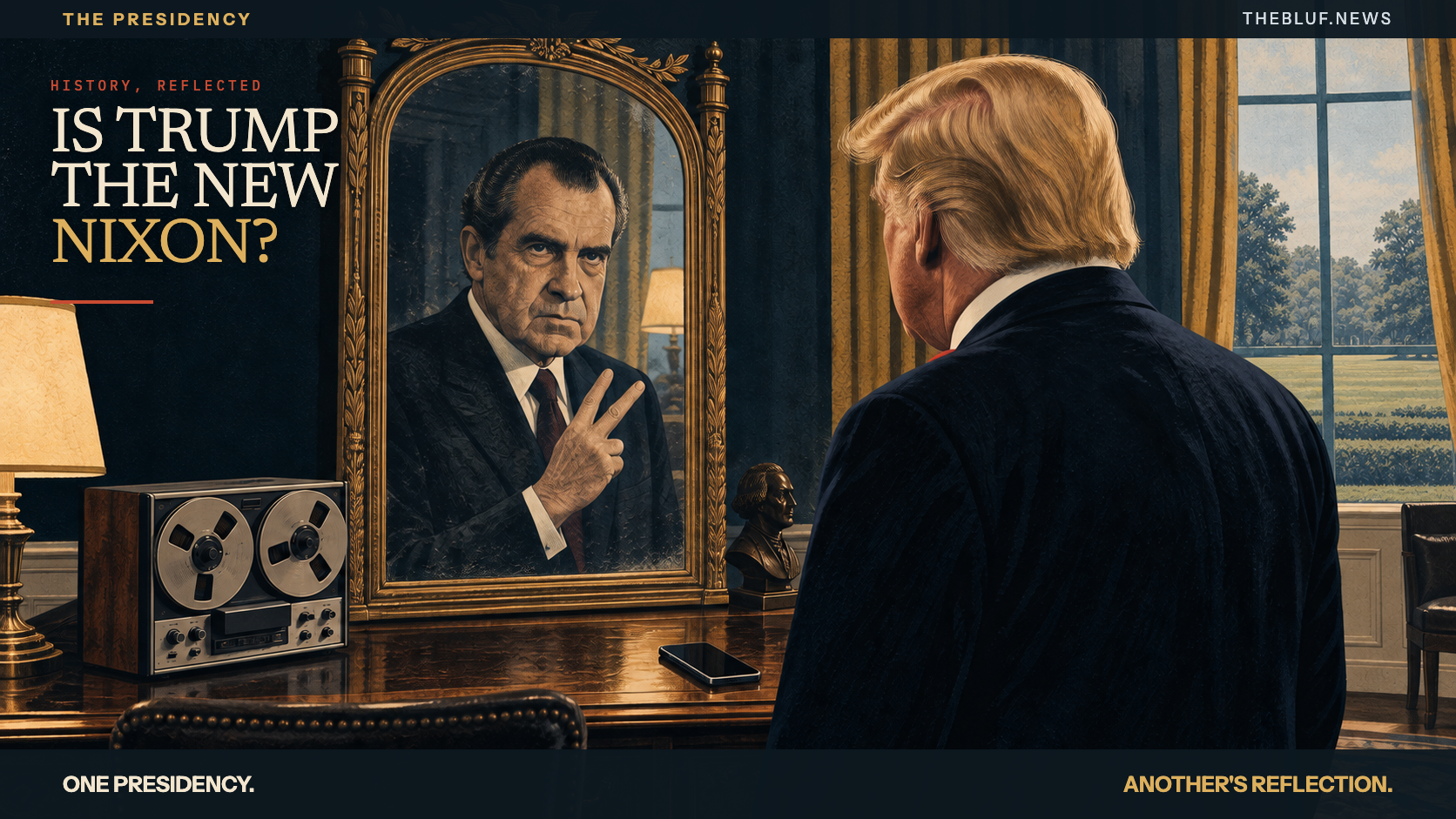
People have been asking some version of this question since Trump's first term. It's usually asked like a gotcha, or dismissed like an insult. It deserves better than either. Some of the comparison actually holds up under a straight look. Some of it falls apart completely. And the reason it falls apart is more interesting than the comparison itself.
Where it genuinely holds
Nixon thought he was above the law, and said so. His own words, later, were blunt: "when the president does it, that means it is not illegal." That's not a guess about what he believed — he said it, on tape. It matches how this White House has treated court orders and independent federal agencies: acting like the president's word beats the rules built to check him.
An actual enemies list, not a metaphor — though what happened to it is more interesting than the myth. Nixon and his aides tried, repeatedly, to turn the IRS loose on a literal list of named political opponents. It didn't work: the IRS commissioner at the time, Donald Alexander, refused to audit anyone on the list, and a later congressional investigation found no unusual pattern of audits against the people named on it. Separately — a different program, in the same spirit but not the same mechanics — the FBI did wiretap and follow administration critics on Nixon's orders, and that one wasn't blocked the way the IRS effort was. Using federal law enforcement against named political opponents and media outlets isn't a new invention this term. Some of that same internal pushback still shows up now, too — federal prosecutors have quit rather than pursue cases they saw as political — but it happens one resignation at a time, not because the whole agency refused, the way the IRS did with Nixon.
Open war with the press as strategy, not friction. Nixon treated the press like an enemy to be beaten, not an annoyance to be managed. Calling outlets "the enemy of the people" and using lawsuits and pressure from the FCC (the agency that licenses TV and radio stations) against broadcasters is the same instinct — just said out loud instead of done quietly.
Loyalty over competence. Nixon was convinced the federal workforce was secretly against him. This administration has pushed a real plan for the same fear — called Schedule F — that would make it far easier to fire longtime federal employees and replace them with people picked for loyalty first, experience second.
Where it breaks down badly
Nixon actually fell. He resigned because members of his own party told him, in person, he'd lose a Senate trial. Trump was impeached twice, acquitted twice, and won a second term. That's not a footnote. It's the whole difference. Treating the two men as equivalent quietly implies an ending that isn't coming the same way, and that's worth saying plainly instead of leaving it implied.
One crime versus a hundred fights. Nixon went down over one specific thing: a break-in, a cover-up, and his own voice on tape admitting it. One crime, one smoking gun. What surrounds this presidency isn't one crime — it's a dozen separate fights going at once, on immigration, business deals, foreign policy, federal rules. There's no single tape sitting out there that could end all of it the way the Watergate tape ended Nixon, because there's no single thing to catch on tape.
Nobody's watching the same news anymore. In 1974, almost the whole country watched the same three TV channels and read the same big newspapers. When the Watergate tape came out, Republicans and Democrats heard the exact same words at the exact same time — there was nowhere else to go for a different version. Today, a fact that would have ended a presidency in 1974 can come out and just never reach half the country as a big deal, because their side of the internet never told them it was one.
So why didn't it happen this time? That's the actual question.
Everyone who makes this comparison eventually arrives at some version of "it's different now." Almost nobody says exactly why. Here's the scene that shows what "different" actually means.
August 7, 1974. Senator Barry Goldwater, Senator Hugh Scott, and Representative John Rhodes — all Republicans, all from Nixon's own party — went to the White House to tell their president it was over. Accounts of exactly what Goldwater told him differ — as few as 10 votes by Goldwater's own later telling, 15 by the Nixon Library's contemporaneous account — but every version lands well short of the 34 votes Nixon needed to survive a Senate trial. Rhodes said publicly, that same day, that Nixon's ability to govern "has been sadly impaired." Nixon resigned the next morning.
That scene — three men from his own party, in the room, telling him it's finished, and meaning it — is the actual thing people are asking about when they ask if Trump is the new Nixon. Not the personality. That moment. And it hasn't happened. Here's the honest breakdown of why not.
One: the evidence itself. Nixon's collapse came down to a single "smoking gun" tape, released two days before that White House meeting — his own voice, on record, directing the cover-up. Nobody could spin it away, including the people trying hardest to. Today's controversies are scattered across many separate fronts, with no single piece of evidence that forces everyone to reckon with it at once.
Two: nobody agrees on the facts anymore, let alone the verdict. In 1974, nearly everyone got their news from the same three television networks and a handful of major papers. When the tape broke, Republican voters heard the exact same thing Democratic voters heard, at the same time. Today's split, partisan media means a true and damaging fact can still fail to register as damaging for most of a president's own base — a different version of events gets to them first, inside their own feed, before the original fact ever lands.
Three: the actual numbers. Trump's first term averaged over 87 percent approval from his own party — the highest of any president on record. Nixon and Lyndon Johnson, by contrast, both watched their own party's approval collapse to well under 60 percent at their worst. Nixon's party turned on him because Nixon's own voters turned on him first. That hasn't happened to Trump. The numbers show the opposite.
Four: the party rebuilt itself around one man. In 1974, the Republican Party was a coalition of different factions — a senator could break from his own president and stay a senator afterward. Goldwater, Scott, and Rhodes all did exactly that and kept their careers. Since 2016, the party has largely rebuilt itself around Trump personally, rather than staying its own independent thing that he happens to lead. That changes the math completely: breaking from Trump now risks breaking from the party's actual voters, not just disagreeing with its president. The clearest proof: the Republicans who did break sharply — Liz Cheney, Adam Kinzinger — didn't stay in the party's good graces the way Goldwater, Scott, and Rhodes did. They lost their seats or walked away instead.
Put plainly: none of this happened because Republicans in 1974 were braver or more honest than Republicans today. It happened because three specific things lined up then that don't line up now — undeniable evidence, a country hearing the same facts at the same time, and a party that could survive disagreeing with its own president. That's a fact about the situation both parties are operating inside, not a character difference between two eras of the same party. It's also a more honest answer than "one side had integrity and the other doesn't."
The clearest piece of proof: an agency built to win an argument, torn down to win one back
Here's one fact that doesn't require anyone to accept the bigger Nixon comparison to feel it.
Nixon didn't create the Environmental Protection Agency out of conviction. By his own first EPA Administrator William Ruckelshaus's account, Nixon didn't share the public's concern for the environment and thought the movement itself "reflected weaknesses of the American character." The real reason Nixon built it: politics. His likely 1972 opponent was Senator Edmund Muskie of Maine, nicknamed "Mr. Clean" for chairing the Senate's pollution subcommittee. Nixon had no intention of handing the environment to a Democratic rival for free, so he moved to look more protective of it than Muskie was. The EPA was created by Reorganization Plan No. 3, effective December 2, 1970. Nixon signed the Clean Air Act four weeks later, on December 31, 1970.
Fifty-six years later, that same law is being taken apart by his own party. In February 2026, the EPA finalized the repeal of the 2009 "endangerment finding" — the finding that greenhouse gases endanger public health, which is the entire legal basis the Clean Air Act uses to regulate carbon. In September 2026, EPA repealed the 2024 rule limiting carbon emissions from coal and gas power plants, calling it, in its own words, the largest deregulatory action in the history of the U.S. power sector — and is separately drafting a rule specifically meant to stop any future administration from ever regulating this again.
One detail says as much as either policy move: Nixon proposed the EPA to Congress that July, months after the largest civic demonstration the country had ever seen — the first Earth Day, that April. This EPA announced its repeal at a G20 industry meeting in Houston, not from Washington. One administration built its case for the public. The other made its case to industry. Historian Douglas Brinkley put the whole comparison in one line: this EPA keeps wanting to "turn back the clock to a pre-Richard Nixon era" — a credentialed historian already saying, out loud, the exact thing this piece is asking.
The honest answer
Is Trump the new Nixon? In how each man thought about the power of his own office, there's a real, documented case. In how it ends, no — and pretending otherwise hides the more useful point. What actually stopped Nixon wasn't that the people around him were better people. It was three specific things: undeniable evidence, a country hearing the same facts at the same time, and a party that could survive disagreeing with its own president. None of those three things exist right now, for either party. That's worth knowing whether or not you think the personal comparison to Nixon is fair — because the thing that's actually gone missing isn't Richard Nixon. It's the guardrail that stopped him, for any future president, of either party, not just this one.