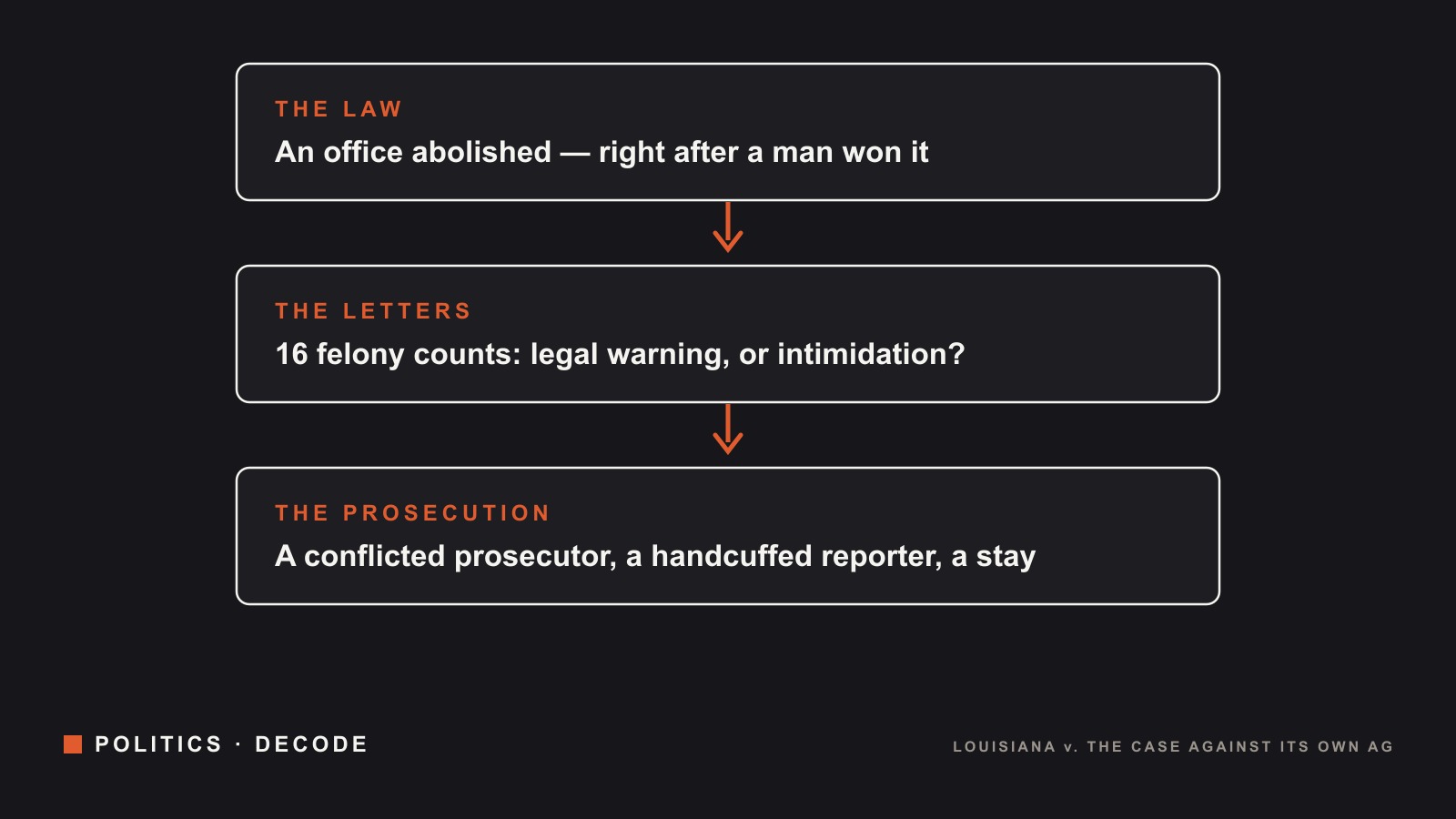
Louisiana indicted its own attorney general on Thursday. On Friday — in under a day — the state's highest court froze the case. Nearly everyone covering it has picked a villain. The record supports something messier: three separate fights, stacked on top of each other, each with documented problems.
Fight one: the law that started it
Calvin Duncan spent about 28 and a half years in prison for a murder conviction that was formally wiped away: released in 2011 through a plea deal he took while maintaining his innocence, then exonerated in August 2021 when a court vacated the conviction and the state dismissed the charges. He spent those decades as Angola's most famous jailhouse lawyer, earned a law degree at 60, and in November won the Orleans Parish criminal court clerk's office with 68% of the vote.
Days before his May 4 swearing-in, Gov. Jeff Landry signed Act 15, abolishing that office and folding it into the civil clerk's. In the state's reading, there was no longer any office for Duncan to hold. He sued; a federal judge briefly blocked the law; the Fifth Circuit restored it; and on June 1 the Louisiana Supreme Court upheld Act 15, 4–3. The city says it will ask the U.S. Supreme Court to review. However you score it, the sequence is: voters chose a man, and the state eliminated the job — a fight that is still alive in the courts.
Fight two: the letters
On May 13, Attorney General Liz Murrill sent letters to eight New Orleans officials — Mayor Helena Moreno, District Attorney Jason Williams, retired Judge Calvin Johnson (whom the council had named interim clerk), and five council members — warning that their plan to work around Act 15 was illegal — that they "have put your own offices in jeopardy," in her words — under Louisiana's "usurper" statutes, and that the governor would fill any forfeited seats.
On July 2, an Orleans Parish grand jury indicted her: eight counts of malfeasance in office and eight of public intimidation — one pair per letter — with bond set at $400,000. The legal question is genuinely unsettled: Murrill says the letters were legal advocacy that cited a real statute, and that the case is a "political witch hunt." The special prosecutor, Laurie White, calls it "very open and shut": "We're very interested in elected officials in New Orleans not being intimidated or threatened by letter or any other way." Moreno's version was drier: "It is surprising that the attorney general put all of this in a letter, considering that there is a criminal law that prohibits intimidation."
That question — when does an official warning become a criminal threat? — never got tested. Because of fight three.
Fight three: the case against the case
The Supreme Court's stay is built on how the prosecution was run, and the defects it cites are not small:
- The special prosecutor has a conflict the court itself flagged: the attorney general's office is currently defending White in a sexual-harassment claim dating to her time on the bench — meaning she is prosecuting the same official whose office represents her. The order also noted White once represented Calvin Duncan himself in his criminal case — a prior tie the court called, per the Associated Press, "a likely conflict of interest."
- The courtroom was closed for the indictment's return, which state law says must happen "in open court." Judge Leon Roche's defense: "open court" only requires a judge on the bench, and letting the public in would have "threatened the safety and secrecy of the grand jury." The Supreme Court's order says he violated the law by closing it.
- A journalist was handcuffed. In the hallway scene — "I'm gonna start cuffing people if y'all don't move," in one sheriff's deputy's words, per The Advocate — court security handcuffed and briefly detained a WWL-TV journalist and a First Amendment attorney who objected to the closure, citing that same open-court law.
- Murrill's filing also alleges politically tinged grand-jury tampering — an allegation, hers, with specifics not yet public.
The stay — and its own asterisk
The court's brief, roughly three-page order (5–2) said the indictment "appears to turn the law on its head," said Murrill is "likely to succeed on the merits of a motion to quash this indictment," and that she faces irreparable harm. Fair enough — read the defects above.
But the dissents deserve their own quote block. Chief Justice John Weimer: "The lower courts are not inferior courts meant only for those without means or title or prestige." Justice John Michael Guidry: "This is not supposed to be how the system works" — arguing, per WWL, that Murrill received "preferential treatment" no ordinary defendant would get. And, in his dissent, a question aimed past this case: "Can our court truly say with a straight face after today's ruling, on the eve of the 250th anniversary of our nation's independence, that we truly believe that no one is above the law?" Their objection isn't that the defects are fake; it's that the state's most powerful lawyer got a same-day rescue from a process that everyone else has to endure motion by motion. And it's worth saying plainly: this is the same court that upheld Act 15 a month earlier, 4–3.
What each side's version conveniently skips
- The stay is about the prosecution's process, not her innocence. A conflicted prosecutor and a closed courtroom don't answer whether the letters crossed a legal line. No court has ruled they didn't.
- The indictment was never a ruling on Act 15. Even if you think erasing Duncan's office was wrong, that fight lives in the civil courts — and it's headed toward a Supreme Court cert petition.
- A dismissal here wouldn't necessarily end it. As legal background: double jeopardy attaches at trial, not before — so charges quashed over a tainted process could, in principle, be re-presented by an unconflicted prosecutor. The practical question is who that would be; the DA is recused and the AG's office obviously can't.
- The pardon promise is louder than it is powerful. Gov. Landry pledged to pardon Murrill "as fast as the law allows" — but under Louisiana's constitution a pardon follows a conviction and requires a Board of Pardons recommendation first; it doesn't erase a pending indictment. White's answer captured the whole strange moment: "Good, let's get her convicted, and then he can pardon her."
What to watch: the motions to quash and to recuse both the special prosecutor and the judge (Murrill says they're coming); the live standoff over her arrest warrant, which her office says White has refused to withdraw despite the stay; and the Act 15 case's path toward Washington. This story has three verdicts still to come — and so far, nobody has gotten one on the merits.
The receipts
- Louisiana Supreme Court order staying the case (July 3, 5–2) and its Act 15 opinion (June 1, 4–3) — lasc.org.
- Louisiana Illuminator and WWNO on the indictment (July 2); NOLA.com "See the charges."
- The Advocate on the closed courtroom and hallway detentions (July 2); Fox8 on Judge Roche's defense (July 3).
- NOLA.com and WWL on the stay's language; Shreveport-Bossier Advocate on the Weimer and Guidry dissents (July 3).
- KSLA on the arrest-warrant standoff (July 3).
- On Calvin Duncan: National Registry of Exonerations; Innocence & Justice Louisiana; Verite News on Act 15 and the council fight (April–May).