What's documented
This is the first piece in a series called Advise and Consent — the actual constitutional phrase for what a Senate confirmation vote is supposed to be. The premise is simple: when a senator later says they were misled by someone they voted to confirm, we check whether the information that would have told them otherwise was already public at the time. Robert F. Kennedy Jr.'s confirmation as HHS Secretary is as clean a test case as exists.
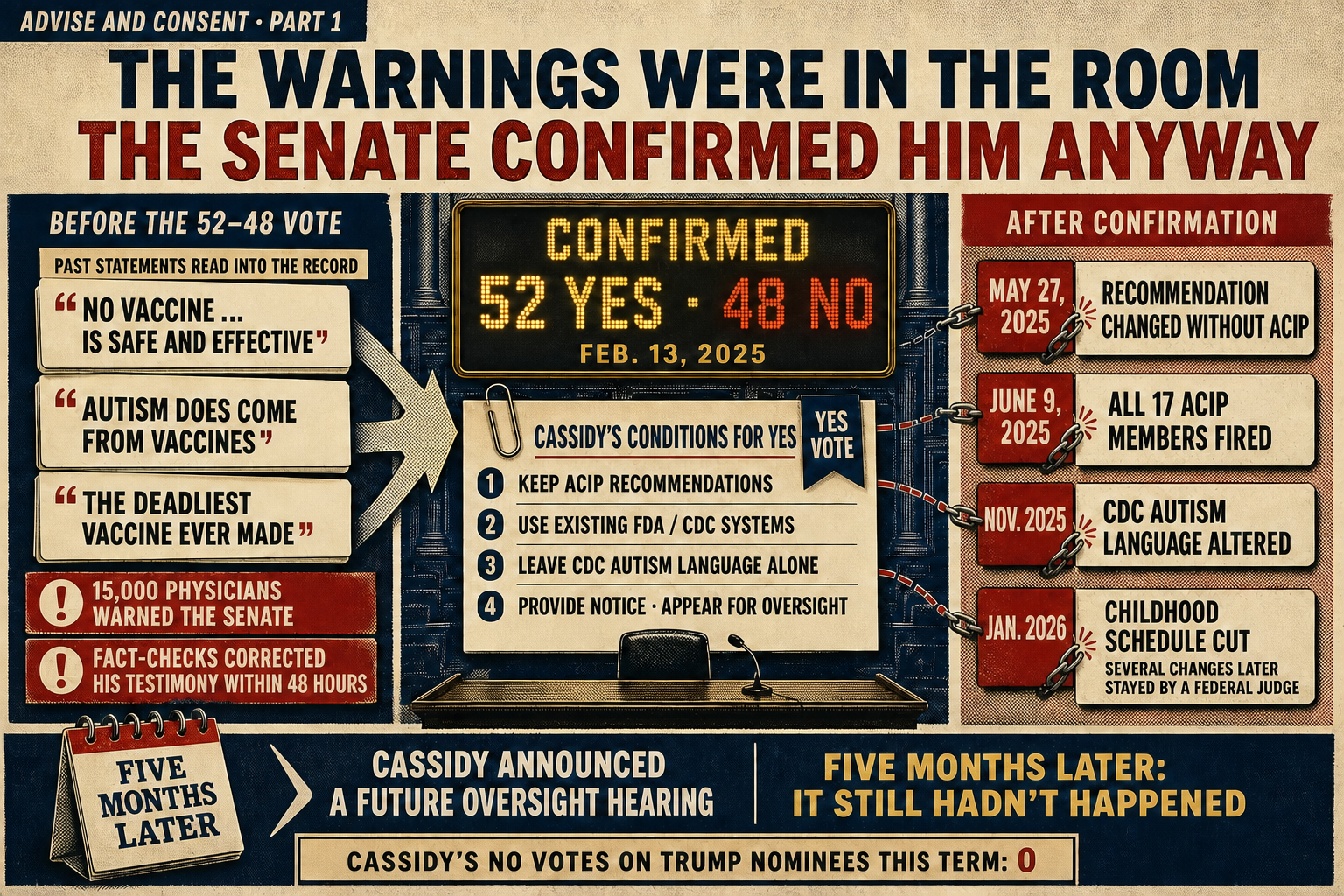
Kennedy was nominated November 14, 2024. His Senate Finance and HELP Committee confirmation hearings ran January 29-30, 2025. The full Senate confirmed him 52-48 on February 13, 2025 — every Republican voted yes except Mitch McConnell, a polio survivor.
None of what happened afterward required hindsight. In the hearing room itself, on January 29, at the Senate Finance Committee, Sen. Ron Wyden read Kennedy's own past statements back to him: a July 2023 comment on the Lex Fridman podcast — "No vaccine... is safe and effective" — and the 2020 Children's Health Defense podcast quote, "What would I do if I could go back in time and I could avoid giving my children the vaccines that I gave them? I would do anything for that. I would pay anything to be able to do that." Kennedy had also said, in a separate 2023 Fox News interview, "I do believe that autism does come from vaccines," and had called the COVID-19 vaccine "the deadliest vaccine ever made" in December 2021 remarks to Louisiana lawmakers — a claim PolitiFact rated Pants on Fire, its most severe rating, since it was based on raw, unverified VAERS report counts that aren't evidence of causation. Wyden's response, on the record, in the room: "Mr. Kennedy, all of these things cannot be true."
At the hearing, Kennedy said "I am pro-safety," insisted "I am not anti-vaccine," told senators he supports "the childhood schedule," and said all of his own children are vaccinated. Pressed by Sen. Bill Cassidy — a physician and the committee's key swing vote — to reassure mothers that vaccines don't cause autism, Kennedy would only say "If the data is there, I will absolutely do that," then cited a non-peer-reviewed paper that biostatistician Jeffrey Morris said had "so many severe methodological issues, it clearly should not have passed any legitimate peer review." FactCheck.org was publishing corrections to his sworn testimony within 24 to 48 hours of him giving it — not months later, not after some later scandal. In real time, during the confirmation window itself.
Fifteen thousand physicians, organized by the Committee to Protect Health Care, signed a letter before the vote stating Kennedy was "not only unqualified to lead this essential agency — he is actively dangerous." Georgetown's Lawrence Gostin warned in TIME, the day after the nomination, that Kennedy could "cherry pick" data and put out misleading information that reduces vaccination rates. None of this was buried. It was in the hearing room, in the letters senators received, in same-week national coverage.
The promises Cassidy says he got in writing
Cassidy didn't vote yes on faith, and he wasn't negotiating from a position of no leverage — he had chaired the Senate Health, Education, Labor and Pensions (HELP) Committee, which has direct oversight jurisdiction over HHS, since January 3, 2025, weeks before Kennedy's hearing even happened. He says he negotiated specific commitments, and cited them in his February 4, 2025 floor speech explaining his vote: that Kennedy would maintain the CDC's ACIP vaccine recommendations "without changes"; work within the existing FDA/CDC approval and safety-monitoring systems rather than build parallel ones; meet or speak with Cassidy multiple times a month and appear before the HELP Committee quarterly if requested; consult Cassidy on HHS hiring beyond Senate-confirmed posts; leave the CDC's webpage stating vaccines do not cause autism untouched; not divert or reduce congressional vaccine-program funding; and give the HELP Committee 30 days' notice before any change to federal vaccine safety-monitoring programs.
What happened after confirmation
Kennedy fired all 17 sitting ACIP members on June 9, 2025 — in one action, something no HHS secretary had done before. Kennedy's own stated reason: "A clean sweep is necessary to reestablish public confidence in vaccine science," citing what he described as conflicts of interest on the panel, though HHS did not detail what those conflicts were. He replaced the members two days later with 8 new appointees, including Robert Malone and Martin Kulldorff, both of whom have publicly cast doubt on COVID-19 vaccine safety and, per AJMC's reporting on the appointments, are among several new members with documented records of vaccine skepticism. He bypassed ACIP entirely on May 27, announcing via social media (not a committee process) that CDC would drop its COVID-19 vaccine recommendation for healthy children and pregnant women; HHS sent Congress a document citing studies to justify the change, which one independent health expert who reviewed it called "willful medical disinformation," and the American Academy of Pediatrics said it wasn't consulted on before the announcement. The reconstituted ACIP went on to restrict the combined MMRV vaccine and move to drop thimerosal-containing flu vaccines. In November 2025, Kennedy personally ordered the CDC's website changed to cast doubt on the vaccines-don't-cause-autism language Cassidy said he'd been promised would stay untouched — two days later, the presidents of the National Academy of Medicine and National Academy of Sciences issued a joint statement reaffirming that vaccines do not cause autism. In January 2026, CDC cut the recommended childhood immunization schedule from 17 diseases to 11.
CDC Director Susan Monarez was fired August 27, 2025, 29 days into the job — the shortest tenure in the agency's history. She later testified to the Senate that she was fired for refusing Kennedy's demand that she pre-commit to approving every ACIP recommendation regardless of the underlying science. Her attorneys, in a statement at the time of her firing, said Kennedy and HHS had "set their sights on weaponizing public health for political gain." HHS has not offered its own public account of the firing to contest her version. Three senior CDC officials resigned in the same period in what CNN described as the relationship between Kennedy and Cassidy reaching "a breaking point."
Not everything has actually taken effect. In March 2026, a federal judge stayed several of the post-June-2025 changes — the ACIP reconstitution and the January 2026 schedule overhaul — ruling that the American Academy of Pediatrics and co-plaintiffs were likely to succeed in showing the changes violated federal administrative procedure. That litigation is ongoing; the stayed changes are currently frozen, not implemented.
Cassidy's response: strong words, limited action
Cassidy's public language has escalated. In a June 2026 CBS interview, he said "If you build public health upon a foundation of lies, then you're going to have the absence of adequate public health." On ABC's This Week on August 16, 2026, asked directly whether Kennedy had lied to him, he said "Again, it speaks for itself. So it's pretty evident," and that "the American people have been poorly served." Notably, "misled" and "duped" are how headlines have characterized his allegation — his own words are more oblique, closer to a physician choosing not to say the word "lied" about a colleague on the record than a flat accusation.
What he's actually done with the power he has is thinner. He asked HHS to delay a June 2025 ACIP meeting over concerns about the new members' qualifications; the meeting proceeded on schedule anyway. On September 17, 2025, his own committee held a hearing — "Restoring Trust Through Radical Transparency" — where fired CDC Director Susan Monarez and former Chief Medical Officer Debra Houry testified about Kennedy's conduct. At the end of it, Cassidy's committee invited Kennedy to appear at a future session to respond directly. As HELP chairman, scheduling that session is entirely within his own authority — he isn't waiting on Kennedy's permission, or anyone else's. Per NBC News, five months later, it still hadn't happened, and Cassidy's office has not publicly explained the delay. Kennedy has appeared before Senate committees since then on other business, including an April 2026 budget hearing where, per American Press, Cassidy "took a tough but measured tone," nudging Kennedy on vaccine-preventable disease outbreaks rather than confronting him on the broken commitments directly — but not at the accountability hearing his own committee invited him to. He has not called for Kennedy's resignation. He has not voted against any subsequent Kennedy-related nomination or policy. His criticism, per NBC's own characterization, has been "limited... to posts on social media and press statements."
Is this just party politics?
This deserves a direct answer, not a dodge. Real Republican dissent on Trump's nominees does exist — Sens. Mitch McConnell, Lisa Murkowski, and Susan Collins have each cast multiple no votes this term (Hegseth, Kennedy, Kash Patel, Todd Blanche among them), and defections have gotten more frequent, not less: Blanche's August 2026 confirmation as Attorney General survived by a single vote, 50-49, the closest margin yet. Two nominees — Ed Martin for U.S. Attorney and Paul Ingrassia for the Office of Special Counsel — were withdrawn before ever reaching the floor after Republican senators signaled they'd vote no.
But no cabinet-level nominee has actually been blocked. Defections have never exceeded 3 votes on any single confirmation, never enough to flip a 53-47 majority. Senate Republicans backed Trump on 96% of votes cast in 2025, and 170 of 171 confirmation votes succeeded — the highest floor success rate on record for a same-party Senate majority, aided by a September 2025 rules change letting the GOP bundle nominees into en bloc slates for faster floor votes. Political scientists studying the pattern (Jeffrey Stonecash, writing in PS: Political Science & Politics) attribute this less to fear than structure: for the first time, 52 of 53 Senate Republicans represent states Trump himself carried — a level of electoral alignment prior Republican presidents, including Reagan and George W. Bush, never had with their own Senate majority.
And Cassidy specifically: he has not cast a single no vote against any Trump nominee this entire term — not Hegseth, not Kennedy, not Blanche. Reporting repeatedly described him as a "critical holdout" and the Democrats' best hope on exactly these three nominations. He negotiated concessions, delayed his announcement, gave interviews expressing doubt — and voted yes every time. That's the honest answer to what a constituent should actually expect: public hesitation has a real track record of turning into a yes vote, and no track record, so far, of turning into a no.
What can I do
There's no lever here that fixes this from outside government — this is fundamentally about whether the Senate's own committee members use the oversight tools they already have. What's real: HELP Committee hearings are public, and a senator who says he's owed a hearing that hasn't happened can be asked, publicly, why not. Contacting Sen. Cassidy's office directly (or calling his DC office at (202) 224-5824) to ask when the promised HELP oversight hearing on Kennedy will actually occur is a real, specific ask a constituent or reporter can make — not a symbolic one.
The Receipts
- FactChecking RFK Jr.'s Other Health Claims During HHS Confirmation Hearings — FactCheck.org
- Robert F. Kennedy, Jr. used VAERS data to claim that the COVID-19 vaccine is the 'deadliest vaccine ever made.' That's not true. — PolitiFact
- Kennedy faces tough questioning on vaccine views at HHS confirmation hearing — CIDRAP, University of Minnesota
- More than 15,000 doctors sign letter urging Senate to reject RFK Jr. as health secretary — NBC News
- RFK Jr.'s "Broken Promises" — KFF Health News, on Cassidy's specific commitments
- RFK Jr. removes all current members of CDC vaccine advisory committee — CNN
- RFK Jr. cites flawed paper claiming link between vaccines and autism in HHS confirmation hearing — FactCheck.org, published Jan. 31, 2025, within 48 hours of the hearing, with the Jeffrey Morris quote
- Susan Monarez ousted as CDC director — Washington Post
- Former CDC director says she was fired for resisting pressure from RFK Jr. — NPR
- RFK Jr. ordered CDC website changed on vaccines-autism language — STAT News
- RFK Jr. vaccine overhaul cuts children's shots, mirrors Denmark — NBC News
- Federal judge blocks RFK Jr.'s CDC childhood vaccine schedule changes — NBC News
- Cassidy: Kennedy built public health "upon a foundation of lies" — CBS News
- Cassidy accuses RFK Jr. of misleading him on vaccine promises — HuffPost
- Five months since Cassidy asked RFK Jr. to testify, it still hasn't happened — NBC News
- Cassidy asks for delay of ACIP meeting — BioPharma Dive
- How senators voted on Trump's Cabinet nominees, 2025 — Ballotpedia
- Presidential support, Congress Vote Studies 2025 — Roll Call
- Political Realignment and Congressional Deference to Donald Trump — Jeffrey Stonecash, PS: Political Science & Politics
- Senate Republicans change rules to speed Trump nominees — NBC News
- Todd Blanche narrowly confirmed as Attorney General, 50-49 — Washington Post
- Kennedy removes all ACIP members, eyes replacements — CIDRAP, on Kennedy's stated "clean sweep" rationale
- RFK Jr. names new slate of vaccine advisers after purging CDC panel — NPR, on Malone, Kulldorff and the new ACIP members' records
- RFK Jr. sent Congress 'medical disinformation' to defend COVID vaccine schedule change — NPR, on HHS's own justifying document and the expert pushback
- RFK Jr.'s vaccine policy sparks a lawsuit from the American Academy of Pediatrics — NPR
- Cassidy takes tough but measured tone in Kennedy hearing — American Press