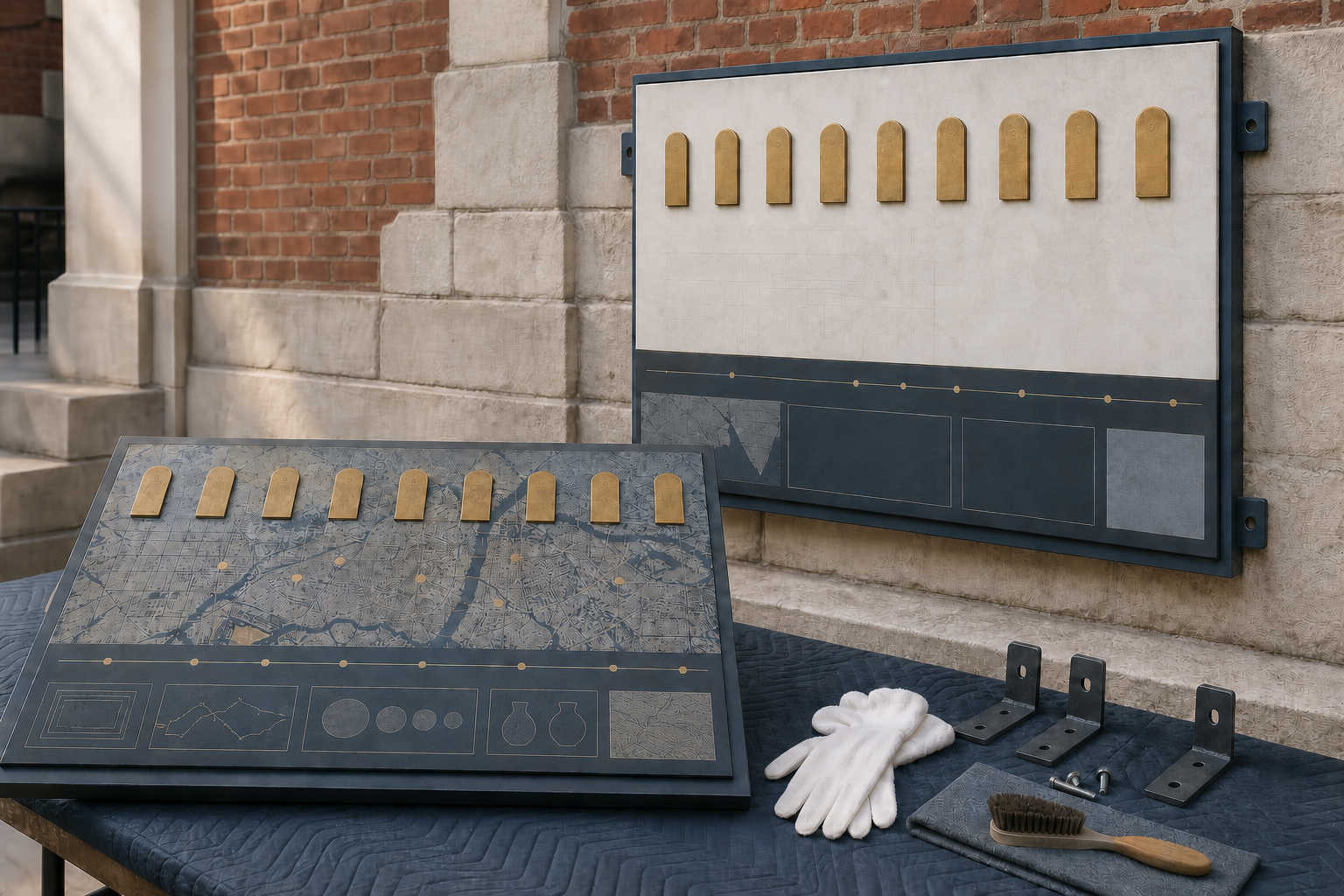
Federal workers replaced the slavery exhibit at Philadelphia's President's House overnight Tuesday, July 14, after the Third U.S. Circuit Court of Appeals cleared the Trump administration to control the interpretation at the federally owned site. The new panels still acknowledge that George Washington enslaved people and identify the contradiction between liberty and bondage. But reporting from the Associated Press and Philadelphia outlets shows that the replacement drops material from the earlier exhibit, including a slave-trade map and a timeline of slavery, while shifting the center of gravity toward Washington and the presidency. This is not disappearance. It is revision by subtraction.
What changed overnight
The President's House sits steps from Independence Hall and the Liberty Bell, on the footprint of the Philadelphia residence where George Washington and John Adams lived while serving as president. Washington brought at least nine enslaved people there: Austin, Christopher Sheels, Giles, Hercules, Joe, Moll, Oney Judge, Paris and Richmond.
The open-air memorial that opened in 2010 was designed around the collision between the nation's promise of liberty and the lives of the people Washington held in bondage. The National Park Service removed its interpretive panels in January. Philadelphia sued. A district judge ordered part of the exhibit restored; the Third U.S. Circuit Court of Appeals later allowed the federal government to install its replacement while the litigation continued.
Workers made that replacement Tuesday night. The timing prompted Philadelphia Mayor Cherelle Parker to accuse the administration of acting "under the cover of darkness." The Interior Department says the new panels contain historical context, acknowledge slavery's evils and explain events at the President's House.
Both facts can be true: the replacement mentions slavery, and it tells less of that history.
What the new version keeps — and what it loses
According to the Associated Press and WHYY, the new exhibit says Washington enslaved people, discusses the Fugitive Slave Act, and describes a nation divided over slavery. The names of the nine enslaved people remain physically embedded at the memorial.
But the replacement reportedly omits details found in the earlier interpretation, including a map of transatlantic slave-trade routes and a timeline placing slavery in a wider national and global system. The older exhibit treated the enslaved people as historical subjects with lives, choices and resistance of their own — including Oney Judge, who seized her own freedom while the Washingtons sat down to dinner, and reached New Hampshire with help from Philadelphia's free Black community and a white ship captain willing to risk it. The new one gives more explanatory space to Washington's private doubts and public responsibilities.
The clearest single example is a title swap. A panel in the original exhibit was called "The Dirty Business of Slavery." In its place now stands one called "Celebrating Independence Throughout the Years." Another new panel, on "The Constitution and Slavery," reads: "In 1774, Washington helped draft the Fairfax Resolves at Mount Vernon. These condemned the slave trade as 'wicked,' 'cruel,' and 'unnatural' and called for putting 'an entire Stop' to it." Both sentences are true — Washington did help draft that document. What changed is which true sentence a visitor is now handed first: not what was done to the nine people who lived at that address, but what Washington once wrote condemning the trade that held them.
That is the meaningful change. A museum does not have to state a falsehood to distort the record. It can keep every sentence technically defensible while changing who receives detail, agency and attention.
The legal point is narrower than the historical one
The Third Circuit's ruling was about authority over a federal site and the agreements under which Philadelphia transferred the property — not a judicial finding that the replacement is the best or most accurate account of slavery. The federal government won room to choose the panels. It did not receive a court's endorsement of their historical emphasis.
That distinction matters because "the court allowed it" can easily become "the court approved the history." It did not.
This updates our earlier finding
BL:UF previously documented a larger pattern: federal material involving Black, Indigenous, women's and other histories disappeared, then often returned only after public reporting. The President's House now adds a new category. The record can return physically without returning whole.
The earlier piece called this "un-invoicing": the contribution remains in the structure while its identifying receipt is reduced or removed. At the President's House, the nine names still stand. The surrounding account now asks visitors to see more of the enslaver's dilemma and less of the system and people he controlled.
What can I do?
Compare the record yourself. The original exhibit plans and text were preserved by Philadelphia history organizations, and current reporting describes the replacement panels. Read them side by side before adopting either side's characterization. Make a simple inventory: which people, maps, timelines, quotations and subjects appear in each version? That turns "sanitized" from a slogan into a checkable claim.
Ask the park directly. Use the official Independence National Historical Park contact page and request the curatorial rationale, historian review, source list and accessibility plan for the replacement. Ask for the name or office responsible for correcting factual errors.
Request the paper trail. A federal Freedom of Information Act request can seek drafts, review comments, approval correspondence, contracts and the list of historians or subject experts consulted. Keep the request narrow by naming the President's House replacement, a date range and specific record types; broad requests are slower and easier to delay. If the request is denied, delayed past the legal deadline, or improperly redacted, the Interior Department's Office of Inspector General handles FOIA appeals — a formal written appeal, distinct from the original request, generally due within 90 business days of the final response.
File directly with the Park Service or the Inspector General. The National Park Service's Office of Professional Responsibility takes complaints about conduct at a specific site. For concerns about the broader decision-making process — mismanagement, undue political direction — the Interior Department's Office of Inspector General takes complaints separately from both the park contact and the FOIA process.
If you visited before or after the replacement: Preserve your photographs with the original date and location metadata. Do not crop away the surrounding panel or present an undated image as current. Side-by-side public documentation is especially valuable when the dispute is over what changed.
If you are local: Philadelphia's elected officials and historical organizations are the most direct public pressure points because they created and defended the original memorial. Ask what independent interpretation the city can provide on city-owned land, by QR-linked archive or online while the case continues. Also ask whether the city will maintain a public side-by-side archive rather than relying on descriptions from either litigant.
The bottom line
The administration did not make slavery vanish from the President's House. The change is subtler and therefore easier to defend: the names remain, the subject remains, and the context contracts. History can be sanitized without being scrubbed clean. Sometimes all it takes is deciding whose complexity deserves the wall space.
The Receipts
- Associated Press: Federal government replaces the President's House exhibition
- WHYY: National Park Service replaces the exhibit
- PBS NewsHour: Federal government replaces the slavery exhibition
- Philadelphia Inquirer: slavery exhibits swapped for the administration's version
- Complaint and original exhibit history
- Prior BL:UF reporting: "The Un-Invoicing"
- WHYY: panel title swap, "Dirty Business of Slavery" to "Celebrating Independence," Fairfax Resolves panel text
- NBC10 Philadelphia: panel replacement details
- Association for Public Art: original exhibit title, "Freedom and Slavery in the Making of a New Nation"
- DOI Office of Inspector General: FOIA appeals process
- National Park Service: file a complaint (Office of Professional Responsibility)