What's documented
Just after 6 p.m. on Sunday, July 26, gunfire tore through the Bite of Seattle food festival at the Seattle Center Armory. Three people were killed and four more were wounded. Two of the dead — Ashley Whitehead, 56, and Carlos Israel Sanchez Villalba, 44 — were bystanders; a third, Junior Cee Niko Semo, 19, was killed as well and is believed by police to have been one of the shooters. A 15-year-old has been charged, and police say at least one more suspect remains at large.
Officers were already at the festival and moved toward the gunfire almost immediately. That part of the response is not what got the police chief pushed out.
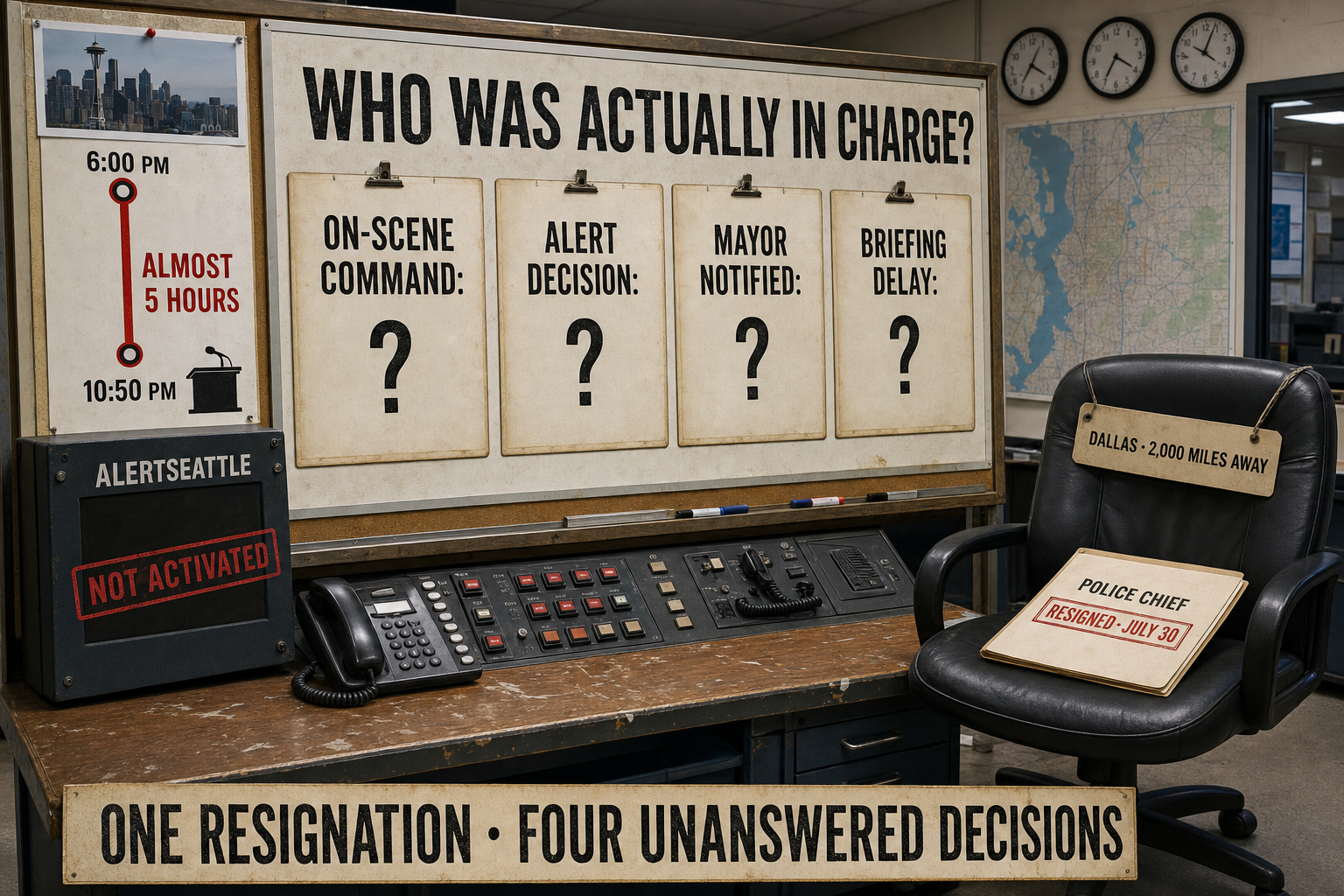
What did: for nearly five hours, the city told the public almost nothing. After one social-media post around 6:30 p.m., Seattle did not hold a formal briefing until roughly 10:50 that night. It never activated AlertSeattle, the city's emergency notification system, even as police searched for another possible shooter. Four days later, Mayor Katie Wilson announced that Police Chief Shon Barnes had resigned under pressure from her office over the response, and named Deputy Chief Andre Sayles interim chief.
There is a clean, simple version of this story: a shooting happened, the city fumbled the response, and the person in charge paid for it. The problem is that almost every part of "the person in charge" falls apart the moment you ask who was actually in the room.
The timeline
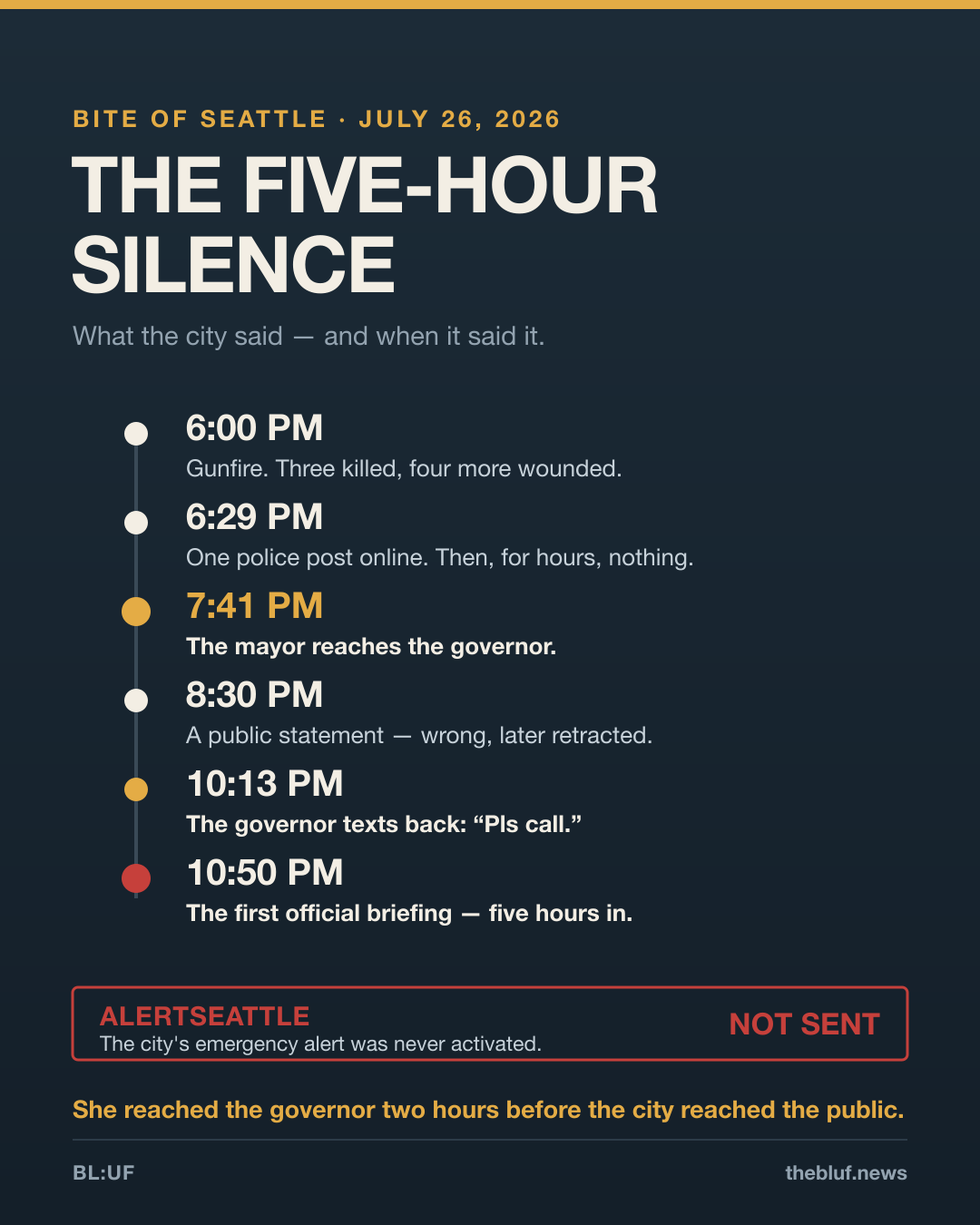
Everything the city has confirmed about that night, in order:
- ~6:00 p.m. — Gunfire erupts at the Bite of Seattle, at the Seattle Center Armory. Three people are killed and four more are wounded.
- ~6:01 p.m. — Officers already at the festival move toward the gunfire.
- ~6:29 p.m. — Seattle police post once to social media: "Police are investigating a shooting. Multiple shooting victims." It is the only public update for hours.
- 7:41 p.m. — Mayor Wilson texts Governor Bob Ferguson: "We are pulling together a conference call now, and most likely a public conference later tonight." Ferguson replies that he can be there by 9. (The texts were obtained through a public-records request to the governor’s office and reported by The Center Square and MyNorthwest.)
- ~8:30 p.m. — Wilson issues a public statement — including a claim that two people are in custody, which she later retracts.
- 10:13 p.m. — The public still has heard nothing official. The governor texts the mayor: "Pls call." It is 37 minutes before the city’s first briefing.
- ~10:50 p.m. — Nearly five hours after the shooting, the city holds its first formal briefing. Acting Chief Tyrone Davis speaks.
- At no point that night is AlertSeattle, the city's emergency alert system, activated.
Read down that list and one gap stands out. The mayor was coordinating with the governor by 7:41 and had issued a public statement by 8:30 — but the people who were actually at the festival waited until nearly 11 p.m. to hear anything official. She reached the governor more than two hours before the city reached the public.
The failure wasn't the chief's to prevent
Start with where Barnes was. He wasn't in Seattle. He was in Dallas — some 2,000 miles away — at the national conference of Black law-enforcement executives. So the man who resigned over the night's response was on the other side of the country when it happened.
Then look at the specific failures the city named. The emergency alert that never went out? AlertSeattle isn't run by the police chief. It belongs to the city's Office of Emergency Management, not the police department. The department has not publicly explained why no alert was sent, and no official has said who made — or didn't make — that call.
Meanwhile, two senior officers were in Seattle that night: Assistant Chief Tyrone Davis, whom the department's own calendar had designated acting chief in Barnes's absence, and Assistant Chief Nicole Powell, who the mayor later said was leading the investigation. Davis delivered the late-night briefing — but delivering a briefing is not the same as having run the response, and nothing in the record says he did. Whether the "acting chief" label came with actual command of the scene, and who owned the decision not to alert the public, is simply not in the public record. That's not a question about Davis. It's a question the city hasn't answered about anyone.
The mayor was not in the dark
Here is the part that complicates the official story most.
By 8:30 that night — about two and a half hours after the shooting — Wilson had issued a public statement, including a claim that two people were in custody that she later had to retract. She was not a bystander waiting to be informed. She was communicating.
Days later, explaining the delay, Wilson said this — and it's worth reading slowly:
"What I did not fully understand in that moment was how little information had reached the public or the press since the incident began at 6 p.m. Had I known that, I would have pushed for an immediate briefing, rather than waiting for a press conference to be organized."
Look at what she is actually saying. She places herself "in that moment" — aware, engaged, present. Her one claimed blind spot isn't that a shooting had happened; it's how little was reaching the public. By her own account, in other words, she was in the room while the timing of the response was decided — and the single thing she says she didn't grasp is the exact failure she then removed her chief over.
Which raises the one fact that would settle the most: exactly when was Mayor Wilson notified? That is not public. And it matters, because the accountability she handed down depends on it. If she knew early and the city still stayed silent for five hours, the delay she forced her chief out over is a delay she was part of.
There is also an unresolved dispute about why the briefing waited until nearly 11 p.m. A police sergeant told reporters it was held to wait for dignitaries to arrive. Wilson denies that dignitaries caused the delay. An unnamed police source told FOX 13 that officers wanted to brief the public earlier but were told to wait. Those accounts don't agree, and no one has reconciled them on the record.
The reason the city gave — and the one it didn't
The stated reason for Barnes's departure was the shooting-night response. But set the two columns side by side.
What Barnes could actually have controlled that night is thin: he was in Dallas, the alert system isn't his to trigger, two assistant chiefs were on the ground, and the mayor herself was communicating within hours.
What actually accumulated against Barnes over his time in the job is something else entirely. A records analysis by KOMO News found roughly 47 to 50 days when he was not working from his Seattle office over about four months — including seven work conferences and four trips to Chicago, where his family lives. He canceled a scheduled interview 30 minutes beforehand. When a reporter asked about his travel, he bristled on camera: "I don't have to tell you where I go." And separately, Seattle's police watchdog had logged some 60 complaints against him since he took over in early 2025 — a raw count that includes the unsubstantiated and the still-open, not 60 findings against him — and opened two new inquiries after that on-camera exchange.
None of that has anything to do with the night of the shooting. And that is exactly the point.
One more fact sharpens it: Barnes wasn't Wilson's hire. He was appointed by her predecessor, Bruce Harrell, and she inherited him — a new mayor parting with a chief she didn't choose is an ordinary thing, but it's a different story than the one the city told, which was strictly about five hours on a Sunday night. It leaves two possibilities, and the city has never reconciled them:
- If the shooting-night communications really are why Barnes is gone, then the city placed the blame on the one senior official least able to have prevented the specific failure it named — a man who was in another state, over a system he doesn't control.
- If his travel record and his standing were why he's gone, then the city used a mass shooting as the occasion for a personnel decision it had not made on its own merits — and presented it as being about that night.
We can't tell you which it is. We can't read the mayor's mind, and we won't pretend to. But those are the only two readings on the table. A chief who was too often absent may well have needed to go. If that's the reason, the honest thing is to say so — not to route it through a tragedy he wasn't in the state to cause.
The questions the city hasn't answered
Line up everything that would let you assign responsibility for that night accurately, and notice what they have in common:
- Who actually held command at the Seattle Center during the response? Not who was the acting chief on a calendar — who ran it. Not public.
- Who owned the decision not to activate AlertSeattle — and did anyone present even have the authority to send it? Not public. The Office of Emergency Management and the police department could answer.
- When was Mayor Wilson personally notified? Not public. The mayor's office could answer.
- Why did the briefing wait until nearly 11 p.m.? Three officials give three different answers.
- What did the after-action review actually find? Wilson has said it revealed "real gaps," but the review itself has not been released. The mayor's office holds it.
- Did Deputy Chief Andre Sayles, now the interim chief, have any role in the night's response? The city hasn't said — which isn't an insinuation about him, just another basic fact left blank.
Every one of those is either unreleased, unclear, or — in the case of the key text messages — behind a paywall. And this isn't only our characterization: as the ouster played out, the local outlet PubliCola reported that the mayor's office was not responding to its questions about the response.
The single accountability question that got a clean answer is the one that pointed at the man who wasn't in the building. Everyone whose decisions actually shaped that night remains unnamed.
That is the story. Not that Barnes was innocent — he had real problems, and we've laid them out. It's that a city facing a botched response to a mass shooting resolved exactly one question — the one aimed at the person who was out of state — and left every question aimed at the people in the room unanswered.
What this piece is not saying
This isn't a claim that Barnes was blameless; his travel record, his standing with the watchdog, and his handling of the press were real and are documented above. It isn't a claim that Assistant Chief Davis mishandled anything — the record shows only that he was the designated acting chief and gave the briefing, and nothing more should be read into that. It isn't a suggestion that Andre Sayles, the new interim chief, did anything wrong — only that the city hasn't described what role, if any, he played that night. It isn't a claim that we know why Mayor Wilson sought the resignation; we've laid out the two possibilities precisely because the city has not said. And it isn't a verdict on anyone's guilt in the shooting itself — the charges against the 15-year-old are allegations, and the description of the man who died as a shooter is what police believe, not a settled fact.
What can I do
The through-line of this story is withheld information — a timeline the public still can't see. That's the one place an ordinary person actually has a tool.
If you're in Seattle, the response being fought over is reviewable. The civilian Community Police Commission and the Office of Police Accountability exist to examine exactly this kind of question, and both take public input. The Seattle City Council holds public-safety oversight hearings you can attend or submit comment to — and the council has already signaled unease about how this was handled.
Anywhere, the tool that pries loose a hidden timeline is public-records law. Washington's Public Records Act — like every state's version — lets any resident request the dispatch logs, the notification records, and the after-action review the city hasn't volunteered, and the state Attorney General's guide walks you through how it works. In Seattle, you file through the city's public-records portal. It's the same instrument a newsroom uses, and it's available to you.
The Receipts
- PBS NewsHour (AP) — Seattle mayor says police chief has resigned after criticism of festival shooting response
- OPB — Seattle police chief resigns; mayor makes it official after hours of silence
- KUOW — Fired or resigned? Barnes supporters rally amid reports he's been ousted
- PubliCola — Multiple sources say chief is out; mayor's office not responding to questions
- KOMO News — Timeline: untangling inconsistencies in the Bite of Seattle shooting response
- KOMO News — Seattle police chief cancels interview, acknowledges frequent travel outside city
- KING 5 — Seattle police watchdog opens two investigations into Chief Barnes after reporter clash
- South Seattle Emerald — Reporter's Notebook: I asked the Seattle police chief a question. The response went viral.
- FOX 13 Seattle — Why the Bite of Seattle press conference took hours
- FOX 13 Seattle — Mayor Katie Wilson addresses Bite of Seattle shooting response
- MyNorthwest — "Information could have gone out much faster": Wilson addresses 5-hour delay