1. THE WEDGE — the fight you already recognize
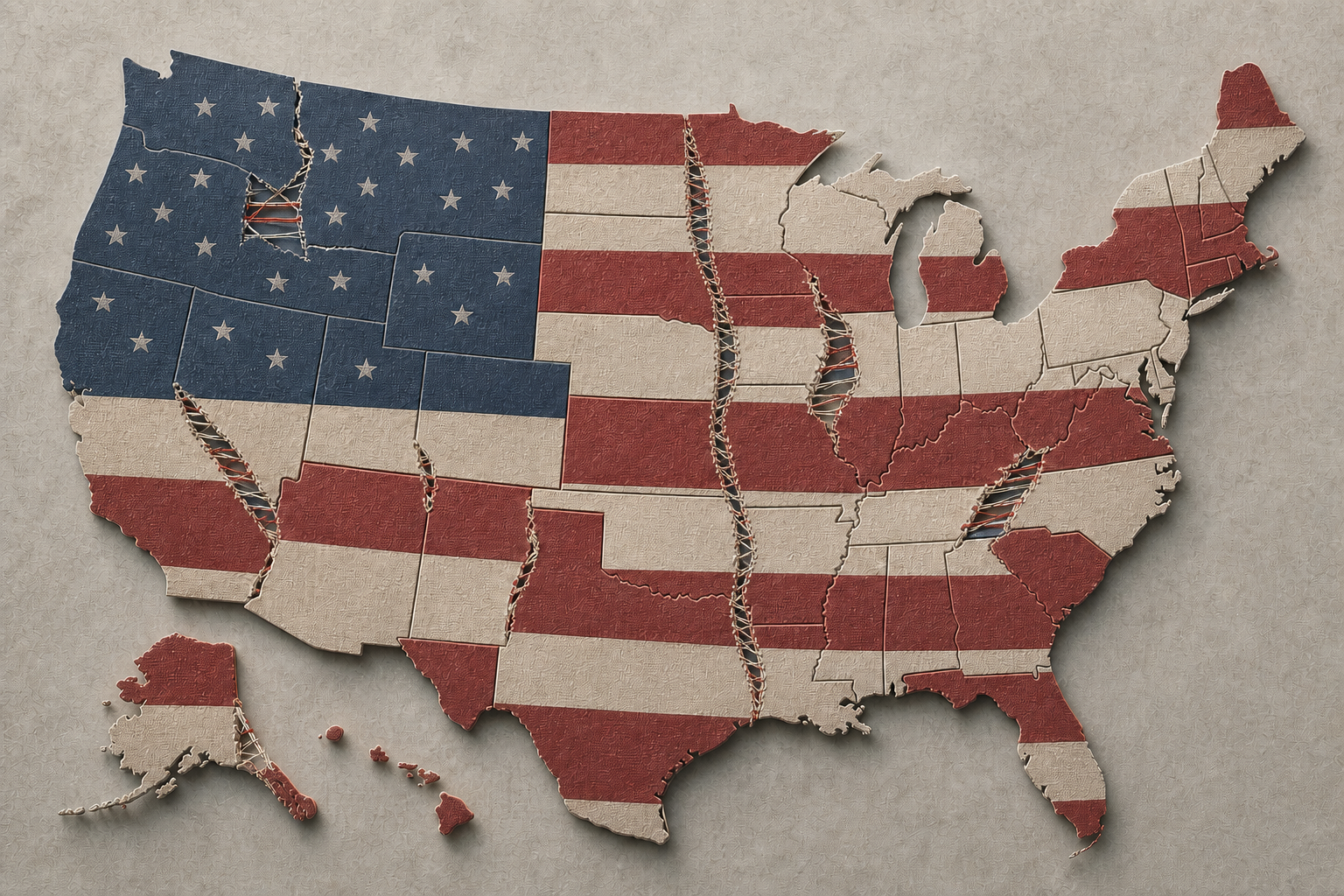
Think about the last time a political post made your stomach clench. Odds are it wasn't your neighbor, your coworker, or your uncle at dinner. It was a stranger on a screen — a clip, a quote, a "look what THEY just said." In real life, most Americans rub along fine with people who vote differently. Online, the other side looks like a cartoon villain.
That gap — between the people you actually know and the enemies your feed shows you — is the whole story of this piece. It isn't your imagination, and it isn't a personal failing. It's the output of a system doing exactly what it was designed to do.
2. THE MACHINE — how the anger gets manufactured
Platforms don't show you posts in the order they were written. They rank them, predicting which will keep you engaged — liking, commenting, sharing, staying. That single choice — ranking by engagement — is the engine everything else bolts onto.
Then researchers measured what engagement actually rewards. In a 2021 study in PNAS, a team led by Steve Rathje, Jay Van Bavel, and Sander van der Linden analyzed 2,730,215 posts from news outlets and members of Congress. The finding was blunt: each additional word about the political out-group — "they," the other party — raised the odds of a share by about 67%. The out-group effect was 4.8× stronger than negative emotional words and 6.7× stronger than moral-outrage language. It held for liberal and conservative outlets, and for Democratic and Republican members of Congress. The machine has no side; it rewards whoever points across the aisle. (PNAS, 2021)
The platforms didn't just passively benefit — at times they poured fuel on it. In 2018, Facebook rebuilt its News Feed around "Meaningful Social Interactions," boosting posts that drew reactions and shares. Its own data scientists watched it backfire: a leaked memo in the Wall Street Journal's "Facebook Files" warned the change "has had unhealthy side effects on important slices of public content, such as politics and news," and that parties felt "trapped in an inescapable cycle of negative campaigning by the incentive structures of the platform." (WSJ, Sept 15 2021)
More specific: from 2017 Facebook weighted emoji reactions — including the "angry" face — as five times a "like" in ranking. By 2019 its own researchers found angry-reaction posts were disproportionately misinformation, toxicity, and low-quality content. When the company cut the angry weight to zero in 2020, users got measurably less misinformation and graphic violence. (Washington Post, Oct 26 2021) A dial existed. Someone turned it up. Turning it down worked.
3. WHO PROFITS — how your anger becomes their revenue
Follow the money. These platforms are almost entirely advertising businesses. Of Meta's $164.5 billion in 2024 revenue, roughly 98% — about $160 billion — came from ads. (Meta FY2024 results)
The chain is simple. Advertisers don't buy your outrage directly — they buy your attention, sold as ad slots in a real-time auction. The more you scroll, the more slots there are to sell; in 2024 Meta's ad impressions rose 11% and price per ad rose 10% year over year. So anything that keeps you glued — and the research says out-group anger is among the most reliable things there is — flows downstream into inventory, and inventory into revenue.
No one in the building has to want you to hate the other party. They just have to optimize for time-on-app and let the out-group effect do the rest. That's the uncomfortable core of this series: the division is a design consequence, not a conspiracy — which is worse, in a way. A conspiracy you could expose and end. A business model you have to redesign.
4. COMMON GROUND — what turns the dial down
If engagement ranking cranks animosity up, what happens if you crank it down? Someone ran that experiment. In a 2024 study in Science, researchers built a browser extension that quietly re-ranked real feeds in real time, scoring how much partisan animosity each post carried. In a week-long field experiment with 1,256 people on X during the 2024 campaign, turning the hostile content down shifted how warmly people felt toward the other party by more than 2 points on a 100-point scale — with no difference between Democrats and Republicans — a shift the authors compared to about three years of national polarization, in days. (Science, 2024) The hostility isn't baked into you. A lot of it is baked into the ranking.
Three things de-escalate this driver:
- Change your own ranking. Most apps still offer a less-engineered feed — chronological or "Following"-only (X's "Following" tab, Facebook's "Feeds → Friends"). Less sticky. That's the point.
- Watch your own reactions. The post most engineered to travel is usually the one making you angriest at "them." When a post spikes your blood pressure, that's a signal it was selected for you — not a random sample of reality.
- Regulation is real but unsettled. Proposals on feed transparency and Section 230 are live and genuinely contested across the spectrum. This piece doesn't tell you the answer; it tells you the dial exists.
And the throughline this series always returns to: Americans wildly overestimate how extreme the other side is — and the more political media you consume, the worse your estimate gets. (More in Common, The Perception Gap, 2019) That's the Attention Machine's fingerprint: the feed that promised to connect you handed you a funhouse mirror of your neighbors, because a clear mirror doesn't sell as many ads.
The one move: tonight, switch your main app off the algorithmic feed onto its chronological or "Following" view for one week. Notice what stops showing up. That quiet is what your attention is worth.