The gap you can measure
Start with a number that should stop you. Ask a Democrat what the average Republican believes, and ask a Republican what the average Democrat believes, and both sides are badly, measurably wrong — they imagine the other side as far more extreme than it actually is. Researchers at More in Common call it the Perception Gap, and its cruelest finding is this: the more political news you consume and the more engaged you are, the worse your estimate of the other side gets. The people who post the most, donate the most, and watch the most are the most sure their neighbors are monsters — and the most wrong about it. (More in Common, The Perception Gap, 2019)
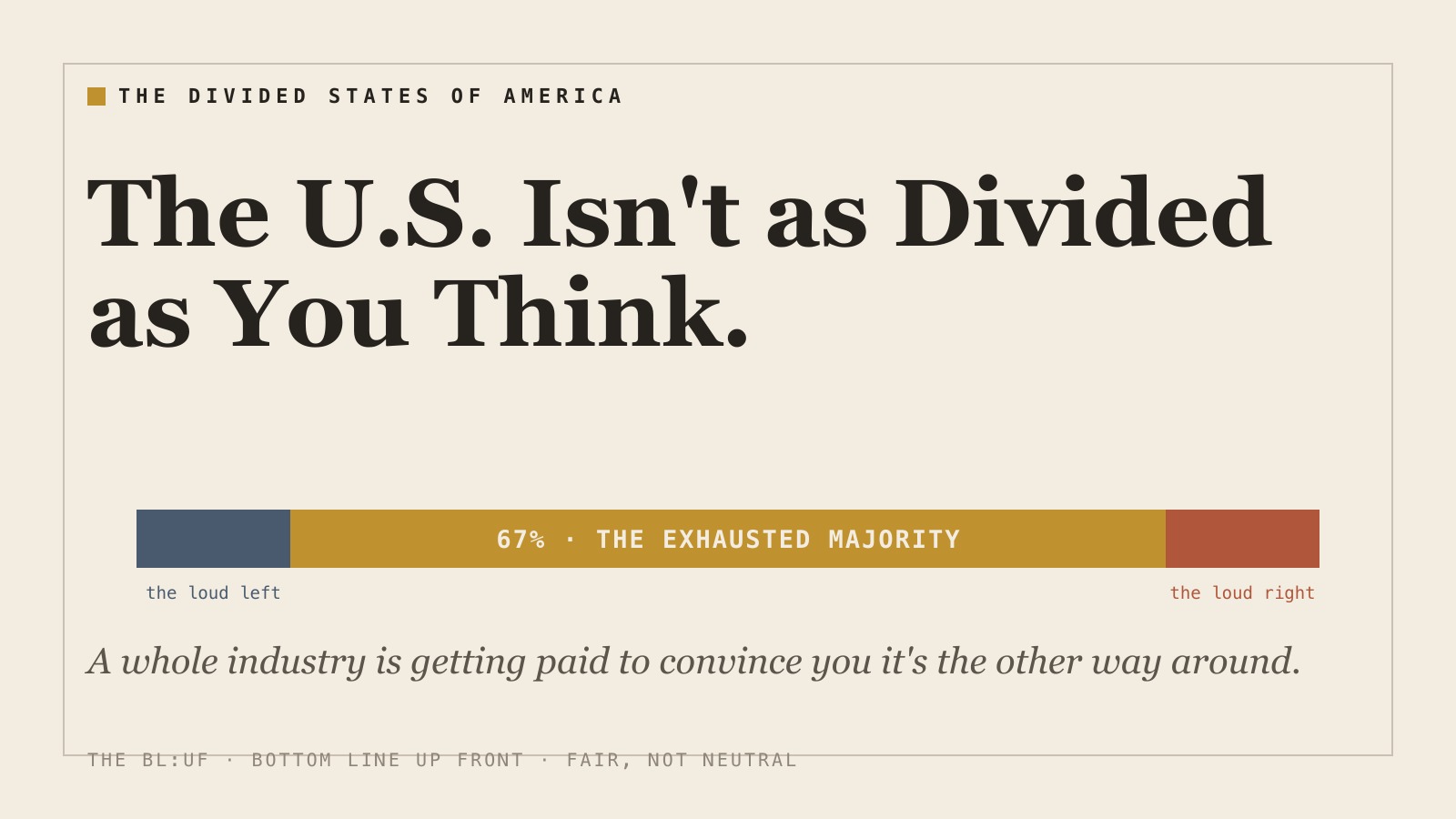
The same research group found that about two-thirds of Americans — 67% — belong to what it calls the "Exhausted Majority": people who hold varied views but are tired of the fight, believe we have more in common than divides us, and want out. The loudest wings are not the country. They are the wings. (More in Common, Hidden Tribes, 2018)
So if most of us are exhausted and most of us misread each other on purpose-built terms, one question runs the whole series: who is doing the purpose-building, and what do they get for it?
Follow the money to the anger
The feed pays for outrage. The most reliable way to make a post travel is not to be smart or true — it's to attack the other side. In a 2021 study of hundreds of thousands of posts, researchers found that each word about a political out-group raised the odds of a share by 67%, and that out-group animosity predicted spread more strongly than any emotional language. The algorithms didn't invent our tribalism; they found it, measured that it kept us scrolling, and turned the volume up — because attention is what they sell. (Out-group animosity drives engagement on social media, PNAS, 2021) When researchers later re-ranked feeds to show less partisan animosity, people's hostility toward the other side measurably dropped. The dial is real, and it's been set to "angry." (Science, 2024)
Some of the anger was planted on purpose. In May 2016, two crowds faced off outside an Islamic center in Houston — one rallying to "Stop Islamification of Texas," the other to "Save Islamic Knowledge." Both events were created by the same office: Russia's Internet Research Agency, working two Facebook pages ("Heart of Texas" and "United Muslims of America") at once, from St. Petersburg. The total cost to make Americans scream at each other in the street was about $200. That's not a conspiracy theory; it's in the U.S. Senate Intelligence Committee's bipartisan report. The goal wasn't a policy. The goal was the fight itself. (Senate Select Committee on Intelligence, 2019)
The map is drawn to reward the extremes. Eighteen months before Election Day 2026, 81% of U.S. House seats were already effectively decided — safe for one party. (FairVote, 2025) In a safe seat, a politician can't lose to the other party; the only real threat is a primary challenge from their own flank, decided by a small, more partisan slice of voters. So the rational move isn't to court the middle — it's to feed the base. The machinery of our elections quietly pays politicians to be more divisive, not less. (Brennan Center for Justice; Unite America)
Across the series we'll add the rest of the machine — the outrage-media business model, the fundraising emails engineered to frighten you into a recurring donation, the consultants whose paychecks depend on the war never ending. The pattern is always the same: someone downstream of your anger is getting paid.
The agreement they'd rather you not notice
Here's what the fight hides. On the things that actually hit your kitchen table, the "divided" country keeps quietly agreeing:
- Roughly 9 in 10 Americans (92%) — 90% of Republicans, 93% of Democrats, and 93% of independents — say corruption is a big problem in U.S. politics. (Brennan Center, 2026)
- 79% of voters — including 84% of Democrats and 75% of Republicans — support amending the Constitution to restore limits on money in elections. (Brennan Center, 2026)
- Lopsided majorities of both parties say the government does too little to limit prescription-drug prices. (KFF)
- A 2024 survey catalogued more than 100 national policy proposals with genuine bipartisan majority support — heaviest in government reform, criminal justice, and health care. (YouGov, 2024)
None of this means the real disagreements — on abortion, on guns, on immigration — aren't real. They are, and this series won't paper over them. But notice what tends to get the algorithm, the airtime, and the fundraising email: the fights we can't resolve, not the corruption we could. That is a choice someone is making, and it isn't yours.
What this series does
Every episode of The Divided States of America takes one wedge and does four things: shows you the surface fight, finds the machine underneath it, names exactly who profits, and maps the ground where the two-thirds of us already agree. We are fair, not neutral — we'll name the machinery on every side, and we won't tell you the other half of the country is your enemy, because the evidence says it isn't.
The enemy was never the person across the line. It's the line — and the people who need you to believe it was always there.