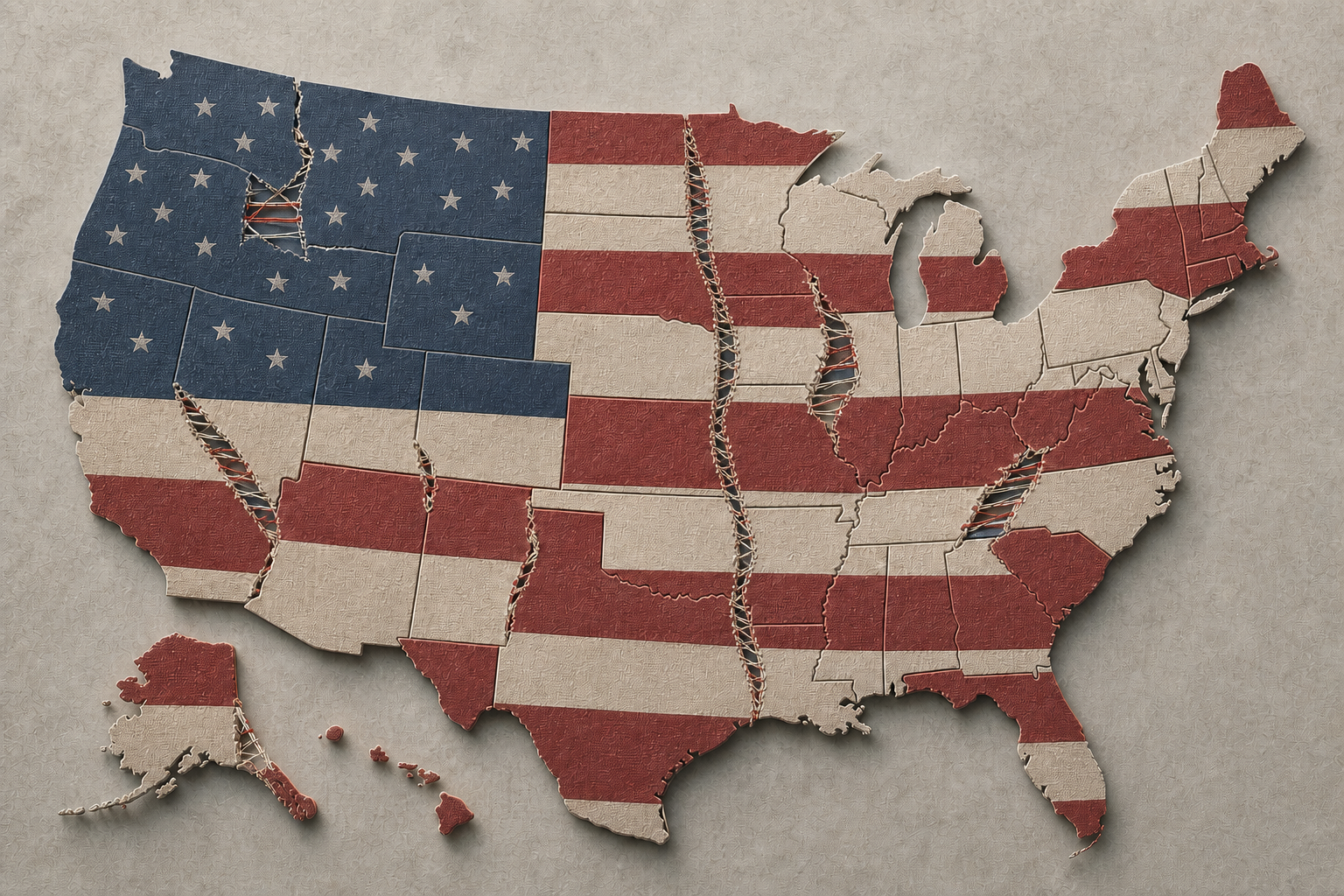
A democratic socialist runs New York City. Zohran Mamdani won the mayor's race in November 2025 and was sworn in on January 1, 2026. Almost overnight, "democratic socialist" went from a label a handful of members of Congress wore to the word on every front page — used to mean everything from Bernie Sanders to Soviet communism.
It's neither — and the gap between those two caricatures is exactly what this piece exists to close. "Democratic socialist" means something specific, and the people under the banner are a specific, countable group. Here's the map.
The spectrum, plainly
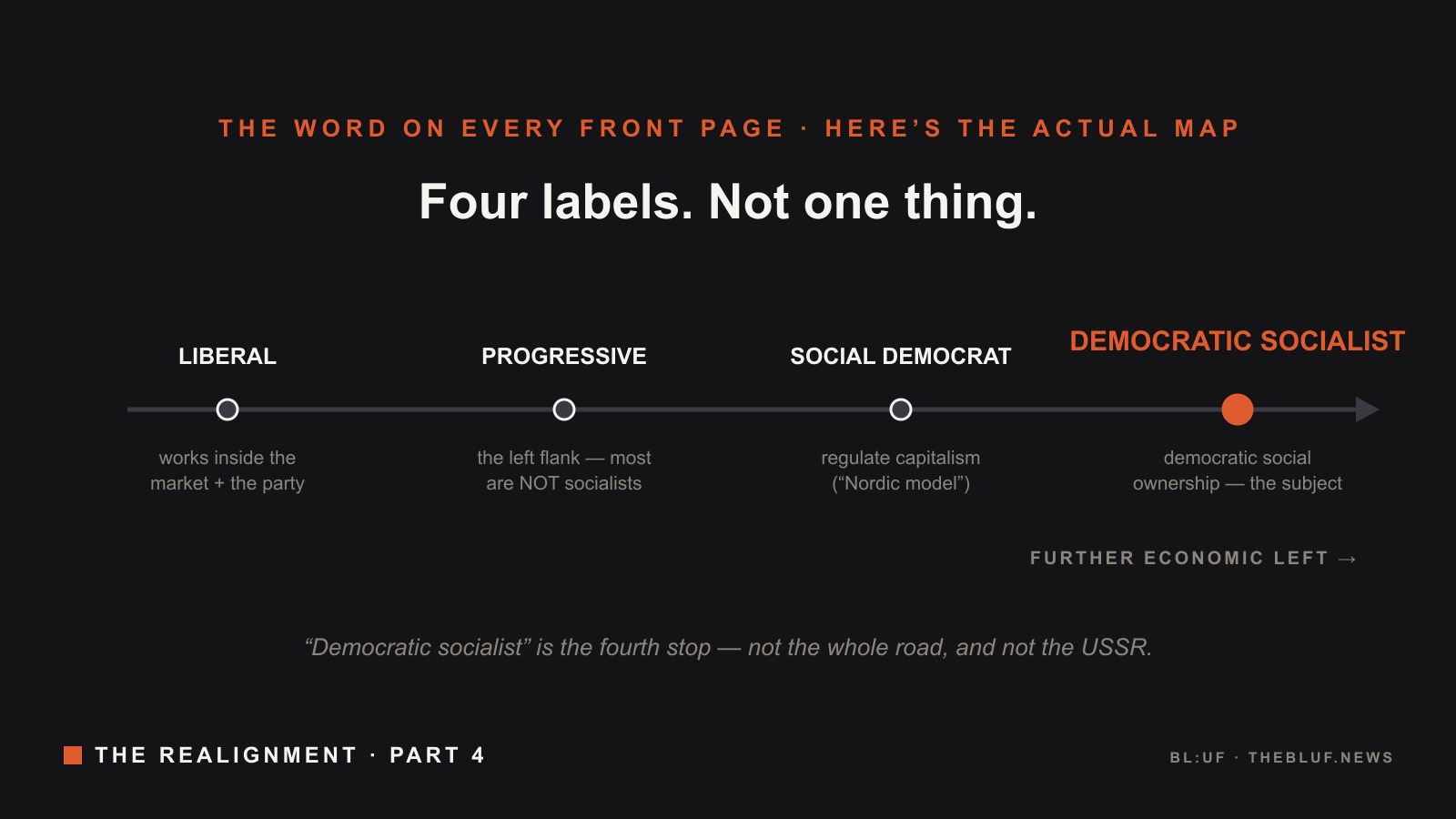
Move left on economics and the labels stack up:
- Liberal — center-left. Accepts a market economy; works inside the system and the Democratic Party.
- Progressive — the party's left flank (the Congressional Progressive Caucus). Most progressives are not socialists — that's the first thing people get wrong. The socialist bloc is a small subset of it.
- Social democrat — wants to regulate and reform capitalism with a strong welfare state. The reference point is the "Nordic model." Denmark's own prime minister once pushed back on the socialist label: "Denmark is a market economy."
- Democratic socialist — goes further: the long-term goal is what DSA calls democratic social ownership of the economy. The movement says the word "democratic" is the whole point — a hard line against the one-party, authoritarian socialism of the former Soviet Union, which it explicitly rejects. Critics counter that "social ownership" is public seizure of private enterprise by another name, and that the distinction is more rhetorical than real. Both halves of that argument are real; this piece maps them, it doesn't settle them.
Two conflations worth dropping. First: critics often use "socialist" to summon Venezuela or the USSR — authoritarian communism. That is the exact thing democratic socialists say they oppose; conflating the two is the single biggest source of confusion in the debate — though critics argue the disclaimer is easier to write than to honor. Second: Bernie Sanders calls himself a democratic socialist, but many economists and analysts note he governs more like a social democrat — he points to Denmark, not to nationalizing industry. Label and practice don't always match.
The banner: DSA
The organizing home is the Democratic Socialists of America — the largest socialist organization in the U.S.: north of 90,000 members, and past 100,000 by DSA's own count in early 2026. Two things to know: it is an organization, not a political party. It has no ballot line; its members run and serve as Democrats. And its membership just roughly doubled — from about 50,700 in late 2024 to about 92,900 by the end of 2025 — a surge both DSA and outside reporting tie to the Mamdani campaign.
What it says it wants: Medicare for All, a Green New Deal, stronger unions (the PRO Act), housing treated as a right, and higher taxes on wealth.
Who's actually under it
The countable part:
- In Congress, the confirmed DSA members are Alexandria Ocasio-Cortez and Rashida Tlaib. (On AOC: national DSA withdrew its (conditional) endorsement in 2024 over differences on Israel and Gaza, but New York City's DSA re-endorsed her in April 2026. She's a member.)
- Greg Casar — who now chairs the Progressive Caucus — and Summer Lee are former or lapsed members, not current DSA. Progressive is not the same as DSA.
- Bernie Sanders wears the label but is an independent and not a DSA member.
- Zohran Mamdani — a DSA member — is the mayor of New York.
- And to keep the categories honest: Elizabeth Warren is a progressive who is flatly not a socialist — "I am a capitalist to my bones," she said in 2018.
What they stand for — and where they go further
Shared with mainstream progressives: Medicare for All, a Green New Deal, a $15-plus minimum wage, strong unions, affordable housing, taxing the wealthy.
Where democratic socialists go further than progressives — the real dividing line:
- Ownership. Not just regulating big industry but social or worker ownership of it — utilities, the energy grid, worker-run firms.
- Decommodifying housing and health care — treating them as public goods rather than markets to subsidize.
- Capitalism itself. Progressives want to reform it; democratic socialists, in their own platform language, want to "transform" it over the long run — concretely, the ownership and decommodification items above, not an overnight abolition. Where that long arc ends is debated within the movement itself. That's the line that separates the two.
The "rise" — the honest version
It's real, and it's smaller than the headlines suggest. Real: DSA's membership doubled, and a democratic socialist now runs the largest city in the country; polls show souring views of capitalism among young people (though analysts caution many of them mean "fairness," not state ownership).
But it isn't all up. In 2024, two of the movement's own — Jamaal Bowman and Cori Bush — lost their primaries, against record outside spending. DSA is openly split, including over Israel and Gaza. And it remains concentrated at the city and state level — a handful of House members and no senators — by design as much as by limit: DSA's stated strategy is to win Democratic primaries and build from local office up, not to launch a third party. Skeptics add a substantive caution: the broader socialist project has a contested economic track record, and "democratic" social ownership has rarely been tested at national scale in a way that settles the question; supporters counter that the Nordic-style programs they actually campaign on are working policies, not experiments.
Why the word matters
You can love or loathe the politics. But "democratic socialist" is not a synonym for "communist," and it's not a synonym for "progressive." It's a specific banner, with a specific platform, worn by a specific and still-small group of people — one of whom now runs New York. Knowing what the word actually means is the difference between following the argument and getting played by it.
Receipts: DSA (dsausa.org — membership, 2021 platform, "What Is Democratic Socialism?"); Pew Research 2026 political typology; Britannica (social democracy; democratic socialism); City & State New York (DSA membership figures; the 2024 conditional-endorsement withdrawal and April 2026 NYC re-endorsement of AOC; DSA caucuses); AP / NPR / THE CITY (2025 NYC mayoral primary + general results; Mamdani inaugurated Jan 1 2026); Gallup (Aug 2025, views of capitalism vs. socialism); reporting on the 2024 Bowman and Bush primary losses. Membership figures are ranges where sources differ; DSA publishes no public membership roll. Spotted an error? editor@thebluf.news
The Realignment, Part 4 — the close of our series on how the Democratic Party is being remade from below. It starts with Part 1.