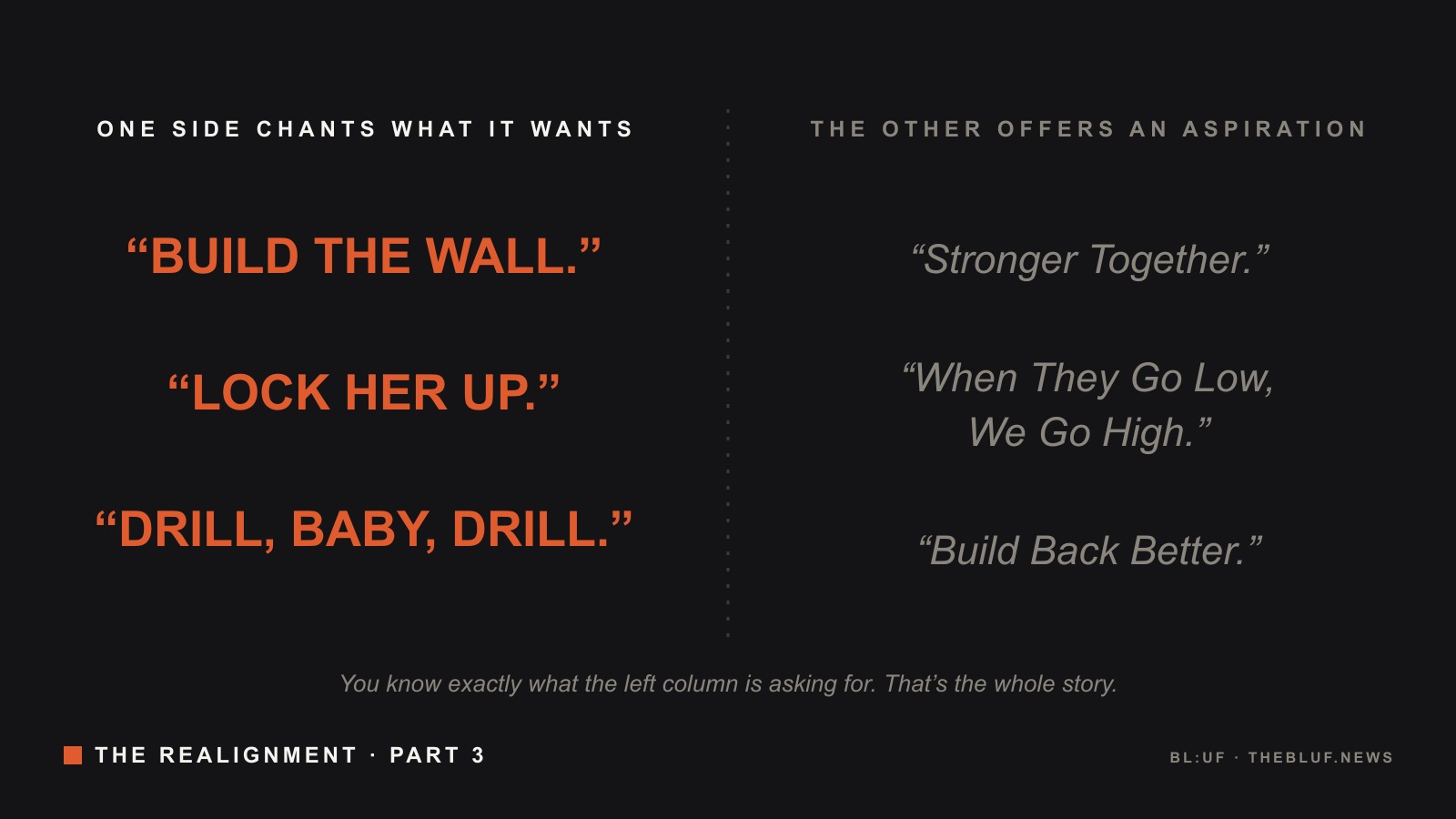
"Build the Wall." "Lock Her Up." "Drill, Baby, Drill." Whatever you think of them, you know exactly what they're asking for. Now the other column: "Stronger Together." "When They Go Low, We Go High." "Build Back Better." Those are values, moods, hopes — you can't quite picture what they do on Monday morning. One side tends to chant what it wants; the other tends to offer an aspiration.
But hold that contrast loosely, because it's messier than it looks — and the mess is part of the point.
The gap is real, it isn't an accident, and it isn't proof one side is smarter. It's a documented difference in how the two parties tend to talk — and it cuts both ways.
What the linguists have said for 20 years
George Lakoff, a cognitive linguist who has studied political language for decades, puts it bluntly: Democrats tend to run on "a laundry list of positions," while the other side speaks in concrete moral frames, repeated until they stick. And the part that's easy to miss — negating a frame reinforces it. Say "I am not a crook" and people hear "crook." The pollster Drew Westen found a kindred pattern in dial tests: careful, abstract phrasing ("undocumented worker") can read to voters as "liberal code" — a sign you're managing them, not talking to them.
Concrete tends to beat abstract for stickiness. An imperative ("build," "lock," "drill") lodges harder than an aspiration ("together," "forward," "hope"); a target lodges harder than a value. None of that is about who's right — it's about what the brain keeps. And the concrete style carries its own built-in cost: the same lines that rally a base can repel the middle. "Lock Her Up" is unforgettable — and, to a lot of swing voters, disqualifying.
The split isn't clean
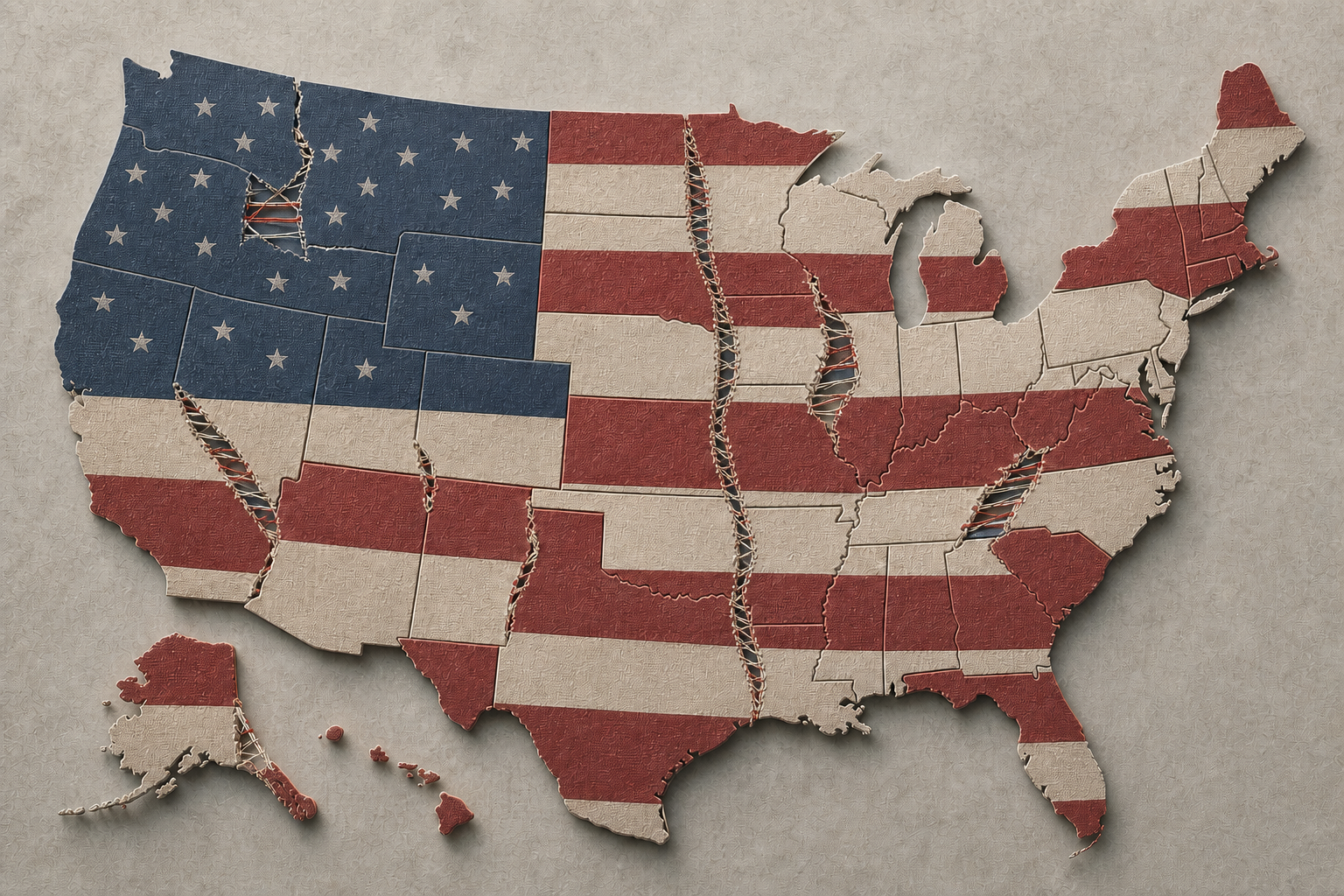
Before this hardens into "Republicans concrete, Democrats vague," look at the exceptions, because they break the rule in both directions. The right's most famous slogan of the era — "Make America Great Again" — is itself an aspiration, a mood about a remembered past, not an imperative. And Democrats reach for concrete imperatives when they want to: "Tax the Rich," "Medicare for All," "Cancel Student Debt," "Codify Roe." The pattern is a tendency, not a law. And notice where the Democrats' sharpest, most concrete lines tend to come from — the insurgent wing the party keeps at arm's length. That's the thread running through this whole series.
The politeness problem
"When they go low, we go high" — Michelle Obama, 2016 — wasn't just a nice line. It became a posture: stay civil, take the high road, don't match the other side's heat. It was a real strategy with real wins — a deliberate pitch to the suburban and moderate voters who powered the 2018 House gains and the 2020 presidential win. But it collides with what the party's own voters now say they want. Poll after poll, the top complaint Democrats have about their party isn't its positions — it's that leadership won't fight. Decorum, to a base that feels under siege, reads as weakness.
The catch: the party sidelines its own fighters
Here's what makes it self-reinforcing. The Democrats who do talk in concrete, combative terms — the left's firebrands — don't only take incoming from Republicans. They take it from their own side. The establishment lane and the money aligned with it spent record sums against members like Jamaal Bowman and Cori Bush in their own primaries; both lost. Party leadership keeps the loudest progressives at arm's length. So the fight — and the plain talk that comes with it — keeps getting pushed out of the party's center and toward its insurgents.
Before you score it
The asymmetry is real. The verdict isn't ours to hand you, because the costs run both ways: the concrete, combative style rallies a base and alienates the middle, and a fair amount of what "cuts through" does so by breaking norms — and a norm, once broken, doesn't stay broken for only one side.
So one party tends to speak in verbs and the other in adjectives, and that shapes what voters retain. What it doesn't tell you is who should win. What it does explain is why the Democrats with the clearest, most concrete offer right now aren't in the leadership at all — they're the insurgents running at it. Who are they, and what do they actually want? That's Part 4.