What's documented
At a cabinet meeting at Camp David on Friday, July 31, a reporter asked President Trump about compensating January 6 defendants — the roughly 1,500 people he pardoned on his first day in office. His answer went further than "yes."
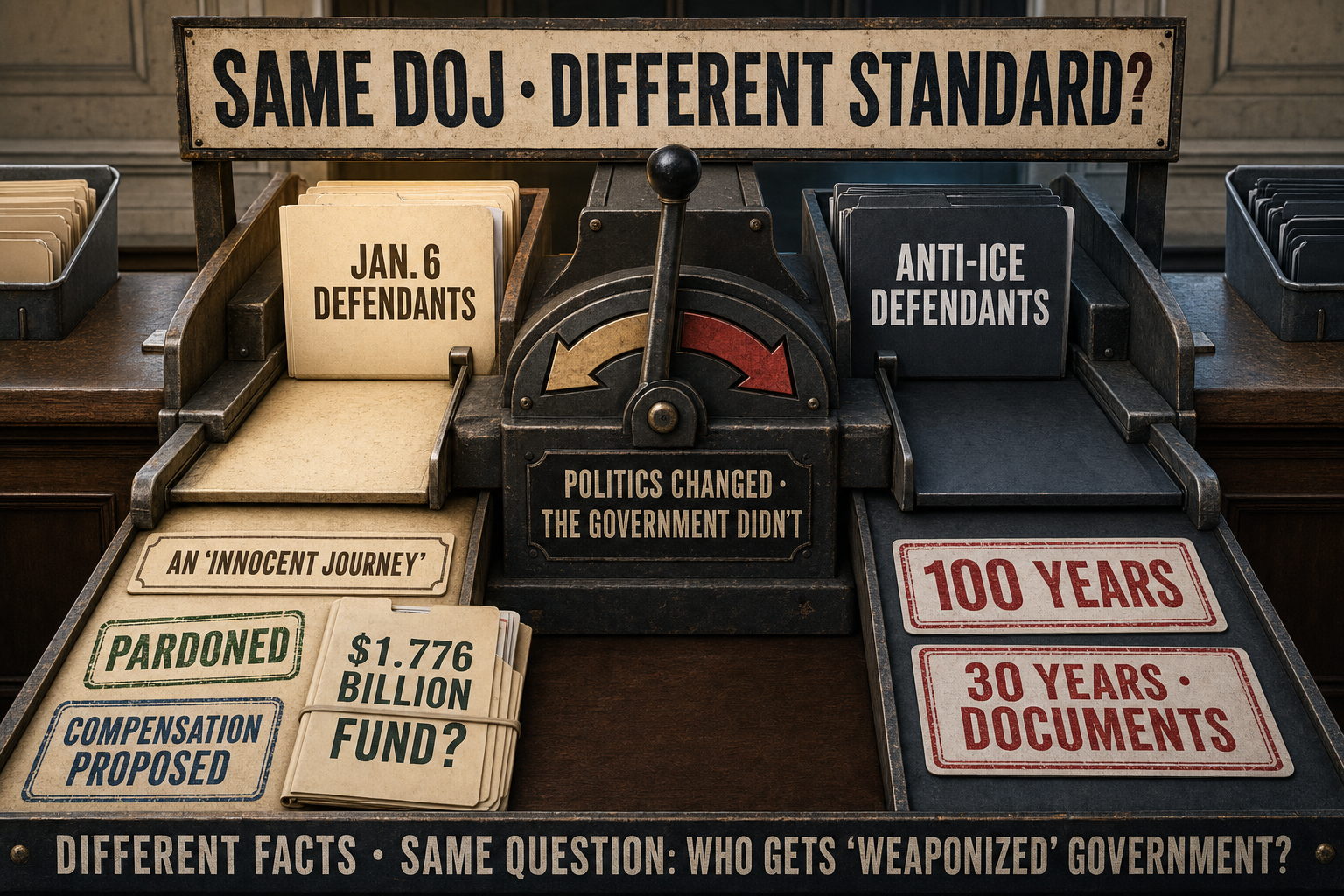
"I'd like to see them compensated," he said. Then, describing the toll of prosecution: "They lost their families. They committed suicide, many people committed suicide." Then the line that gives this piece its headline: "They went down for an innocent journey." He closed by blaming the prosecutions on the prior administrations: "The Biden administration and the Obama administration weaponized government and destroyed lives."
That's the full quote, not a clip. It matters because "innocent journey" isn't a slip — it's Trump's word for what several hundred of the people he described drove, flew, or walked to Washington to do: some pleaded guilty to trespassing, others to assaulting police officers with flagpoles, chemical spray, and stolen riot shields. More than 140 officers were injured that day.
The fund that was supposed to be dead
Trump didn't name a bill or a budget line. He's talking about a specific $1.776 billion mechanism — and at the same Camp David appearance, asked directly whether that mechanism was even still alive, he gave an answer that made news of its own.
Back up: in May 2026, Trump dropped his own $10 billion lawsuit against the IRS and Treasury Department over the leak of his tax returns. As part of that settlement, the Justice Department created the "Anti-Weaponization Fund" — money pulled from the Judgment Fund, a pool Congress set up in 1956 to pay court judgments and settlements against the government — meant to compensate people "investigated, audited, prosecuted, surveilled, or otherwise harmed" by politically motivated federal action.
It was controversial from day one. Senate Appropriations Chair Susan Collins, a Republican, publicly pressed Acting Attorney General Todd Blanche on its legal basis. Sen. Cory Booker wrote Blanche demanding answers. By June, with his own confirmation to become permanent Attorney General stalled, Blanche told the Senate under oath that the fund was dead — the administration was abandoning it. Two Republican senators, John Cornyn and Thom Tillis, are withholding the votes Blanche needs to be confirmed until DOJ puts that in writing.
Then, Friday, a reporter asked Trump directly whether the fund was really dead. "Well, it is dead," he said, "but you know, I wish it weren't, to be honest with you. I think people were horribly treated, horribly abused" — and repeated that he'd like to see them "compensated for the pain."
In one appearance, Trump both said the fund is dead and said he wishes it were paying out the exact compensation he'd just finished describing for January 6 defendants. That's not a contradiction he resolved — it's the sentence that undercut his own nominee's sworn testimony to the Senate and handed Cornyn and Tillis fresh grounds for exactly the fight they're already having.
The fight that sentence just reopened
That fight escalated within 24 hours. On Saturday, Trump posted that he would "push hard" to codify the fund through Congress if the Senate won't confirm Blanche, writing: "Todd Blanche was a voice of reason! It will immediately be back on the table, and I will get it done." He also repeated that he'd simply leave Blanche running the Justice Department as acting Attorney General indefinitely if permanent confirmation never happens.
Tillis's response was immediate. Blanche, whom he called "qualified for the job," "will not be confirmed because of this reversal," Tillis wrote on X: Trump "clearly intends to resurrect the payout pot for punks either by inappropriately establishing another bogus fund or pushing Congress to vote for a bill that the majority of Republicans in the Senate would be against."
Blanche's nomination has a Senate Judiciary Committee vote scheduled for Tuesday, August 4 — the first attempt, earlier in the week, was pulled after Cornyn and Tillis raised objections, and it remains unclear whether this one goes forward either, given how fast Trump's own comments keep reopening the fight. Committee Chairman Chuck Grassley's office said Friday he'd like to see Blanche confirmed before the August recess, which is itself a sign no deal has been struck. Cornyn has a second demand tangled into this one: written confirmation that a tax-immunity provision in the same IRS settlement covers only past investigations of Trump and his family, not future ones — a commitment Blanche has so far avoided putting in writing.
Whether the January 6 compensation Trump described Friday ever has a real mechanism behind it is tangled inside a Republican-on-Republican fight over his own attorney general that got worse, not better, over the next 24 hours — not a done deal, and not close to one.
The gap between the claim and the record
Trump's line — "they committed suicide, many people committed suicide" — deserves to be checked against what's actually documented, because it blends two very different groups of people.
The suicides connected to January 6 that are most extensively documented are on the other side of that day: Capitol Police Officer Howard Liebengood, Metropolitan Police Officer Jeffrey Smith, Capitol Police Officer Gunther Hashida, and Capitol Police Officer Kyle DeFreytag all died by suicide after responding to the riot — not after committing it. The Justice Department has recognized Liebengood's death as line-of-duty; DC recognized Smith's the same way. A fifth officer, Brian Sicknick, collapsed and died the next day of strokes DC's chief medical examiner said were connected to "all that transpired" — not a suicide, and not one of Trump's supporters either.
On the defendant side — the group Trump was actually describing Friday — court and news records document at least three: Christopher Stanton Georgia, a Georgia man who died by suicide within days of his arrest; Matthew Perna, a Pennsylvania man who died by suicide in February 2022 while awaiting sentencing on a guilty plea, whose family said the prosecution's delays broke him; and Mark Aungst, another Pennsylvania man who died by suicide in July 2022 ahead of sentencing on a single misdemeanor "parading" charge. That's a real, documented toll, and it's fair to weigh against roughly 1,500 people charged. It is not, on the public record we found, "many."
The pattern
Friday's comments aren't a one-off. They're the latest step in a rhetorical shift Trump has been building for two years — from distancing himself after the riot, to calling defendants "patriots" and "hostages" on the campaign trail, to calling the day itself "a day of love" in October 2024, to pardoning roughly 1,500 of them — full pardons for most, sentence commutations for 14 more, including the leaders of the Oath Keepers and Proud Boys — on his first day back in office.
The administration has also already paid one Capitol-riot-related settlement: $5 million to the family of Ashli Babbitt, the rioter shot by a Capitol Police officer as she climbed through a barricaded door. Capitol Police Chief Tom Manger, whose department's own 2021 investigation found no wrongdoing by the officer, called the settlement "extremely disappointing" and said it "sends a chilling message to law enforcement nationwide." Separately, the White House's own January 6 retrospective page describes the crowd that day as "orderly and spirited" and says it was Capitol Police who "deliberately escalat[ed] tensions." Former Capitol Police officer Winston Pingeon, injured that day, told Congress the pardons were "a complete slap in the face" to the more than 140 officers hurt defending the building.
The same government, a different "journey"
If "weaponized government" and an "innocent journey" is the standard for people who attacked a federal facility on Trump's behalf, it's worth checking whether Trump's own Justice Department applies that standard to people who've attacked one against him.
On July 4, 2025, protesters at the Prairieland Detention Center — an ICE facility in Alvarado, Texas — set off fireworks, spray-painted slogans, and damaged a guard station and vehicles. When police responded, someone fired from a wooded area and wounded Alvarado Police Lt. Thomas Gross. Nineteen people were eventually charged. Using the domestic-terrorism designation Trump signed against Antifa in September 2025, DOJ tried them as terrorists — the first prosecution under that order.
The sentences, handed down in June and July 2026: Benjamin Song, who fired the shots, got 100 years. Maricela Rueda got 70. Six co-defendants got 50 each. Daniel Sanchez Estrada — convicted only of concealing a document and conspiring to conceal one, not of any violence or "material support" of terrorism — got 30. Six others who pleaded guilty got 2 to 15 years; a final defendant got 6. Acting Attorney General Todd Blanche — the same nominee Trump's Friday comments just complicated — said the sentences prove "Antifa terrorists who attack law enforcement and federal facilities will face swift and uncompromising justice."
No one who actually breached the Capitol on January 6 is serving any of that. Stewart Rhodes, the Oath Keepers founder convicted of seditious conspiracy for organizing around the attack, got 18 years — commuted on Trump's first day back in office. Enrique Tarrio, the Proud Boys chairman convicted the same way, got 22 — also freed. Estrada's 30 years, for handling documents, is longer than either of them served.
It isn't a clean one-to-one: some Prairieland defendants, unlike Estrada, were convicted of real violence, and not every anti-ICE prosecution has held up — in Illinois, DOJ dropped every charge against the "Broadview Six" in May 2026, after defense attorneys accused prosecutors in court filings of "gross misconduct"; the U.S. Attorney's office itself described its own conduct more narrowly, as unintentional "mistakes" and "errors," saying "no prosecutor acted intentionally in misleading" the court. The picture is uneven on both sides. But nothing in it has ever been called an "innocent journey." No one facing a 30-, 50-, or 100-year sentence for a comparable or lesser federal-facility incident has been offered "compensation for the pain," an apology, or a dropped case because the government "weaponized" itself against them. Trump built that framework, and that fund, specifically for people who share his politics. He has not been asked, and has not said, whether it should apply to people who don't.
What this piece is not saying
This isn't equating Prairieland's convicted shooter with a January 6 misdemeanant, or claiming every anti-ICE defendant is innocent — some, per the trial record, are not. It is asking whether "weaponization" and "innocent journey" are principles Trump applies consistently, or only to people already on his side. It isn't saying Georgia, Perna, and Aungst's deaths, or their families' accounts of them, weren't real — they were, and they're the documented cases. It isn't saying the Anti-Weaponization Fund is definitely gone for good, or definitely coming back — Trump himself just made that murkier, not clearer, and it's a live fight in the Senate right now. And it isn't taking a position on whether every one of the roughly 1,500 pardoned defendants deserved their original charges — the piece is about what Trump said Friday, what's documented against it, and where the money would even come from if he gets his way.
What can I do
The fund's actual status — dead, revivable, or something in between — is being fought over in the Senate right now, not settled. Sen. Collins has publicly demanded legal-basis answers from the Acting Attorney General; Cornyn and Tillis are holding a confirmation vote hostage to get the fund's death in writing. You can find and contact your own senators if you want a say in how that fight resolves, including whether Blanche's confirmation and the fund's fate get a real public accounting.
Because the fund's status keeps changing publicly, it's also worth knowing: the actual claims process, if it ever opens, is supposed to be free. Watch for private "filing services" trying to charge a fee for what the Justice Department itself has said would be a free, voluntary process — that's a red flag, not a shortcut, whenever this story moves again.
The Receipts
Trump threatens to revive 'anti-weaponization' fund as he signals he will keep Blanche in acting AG role — CNN, updated Aug 1
Tillis says Blanche won't be confirmed as AG amid Trump fund fight — Axios
Trump poses ultimatum on Blanche, will push for anti-weaponization fund if AG not confirmed — CBS News
Prairieland shooter gets 100 years, others 30-70 for ICE detention center 'antifa' protest — Houston Public Media
Prairieland Defendant Sentenced to 30 Years in Prison for Moving a Box of Antifascist Zines — The Intercept
Ninth Prairieland defendant sentenced to 50 years in prison, 6 who pleaded guilty get 2-15 years — KERA News
2025 Prairieland ICE detention center incident — background/timeline
Charges dismissed for 2 of 'Broadview 6' ICE facility protesters — NPR Illinois
Conspiracy charge dismissed for 'Broadview 6' as other ICE protesters sue over DNA collection — Capitol News Illinois
'Broadview Six' defendants cleared after federal prosecutors drop charges — FOX 32 Chicago
Pardon of January 6 United States Capitol attack defendants — background on Rhodes/Tarrio sentences and pardons
Trump defends "anti-weaponization" fund, further complicating Blanche nomination — NBC News
Trump further muddies Blanche negotiations, saying he wishes "anti-weaponization" fund weren't dead — CNN
Trump Doubles Down On Anti-Weaponization Fund Amid Blanche Confirmation Fight — Forbes
Todd Blanche's AG prospects uncertain as 2 key GOP votes hold out — ABC News
Sen. Collins Asks Acting AG for Anti-Weaponization Fund's Legal Basis — Senate Appropriations Committee
Trump offers long-promised pardons to some 1,500 January 6 rioters — NPR
Trump administration agrees to pay Ashli Babbitt's family $5 million — Fox News
2 more officers who responded to Jan. 6 Capitol riot have died by suicide — ABC News
Jan. 6 rioter who pleaded guilty dies by suicide ahead of sentencing — The Hill
Mark Aungst Dies by Suicide Before Jan. 6 Sentencing — Law & Crime
Georgia Man Charged In U.S. Capitol Attack Dies By Suicide — Forbes