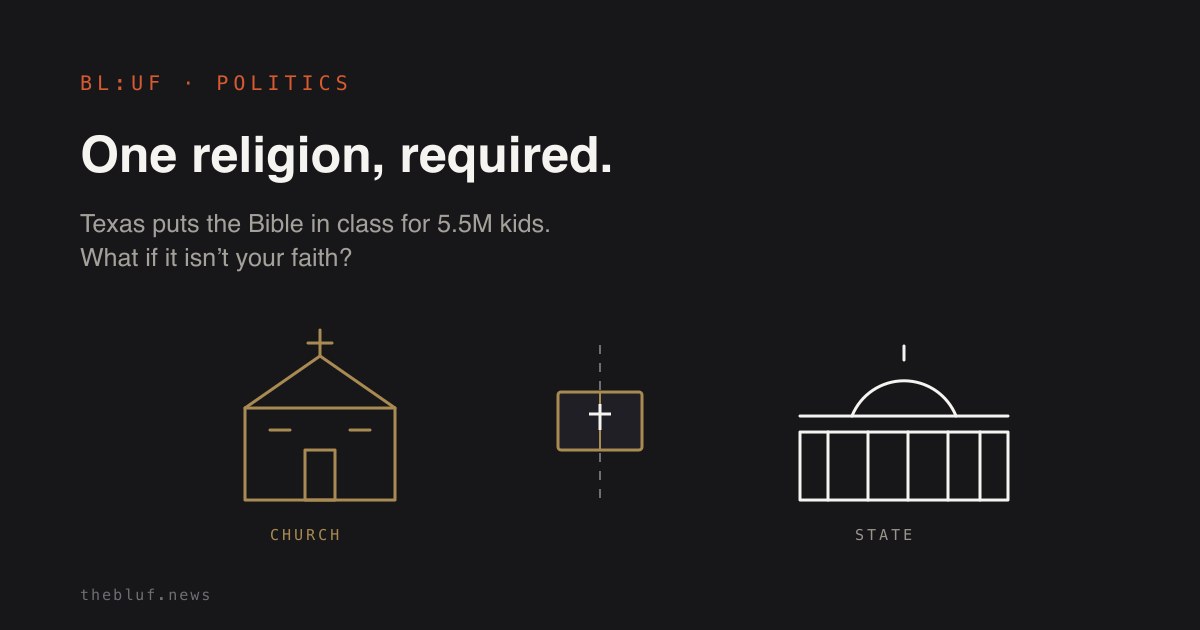
On June 26, the Texas State Board of Education voted to put Bible stories into the required reading curriculum for the state's 5.5 million public-school students. Parents can pull a child out of the lessons — but the state acknowledged the child can still be tested on the material, including on Texas's standardized STAAR exams. For the roughly one in three Texas families who aren't Christian, that leaves no real way out. That's the part the "first state to mandate the Bible" headlines skip.
What's actually required
The board approved a required K-12 reading list that folds at least one Bible passage into each grade, alongside classic literature. The Bible content, by grade:
- Elementary: picture-book versions of David and Goliath and Daniel and the Lion's Den.
- Middle school: passages from the Sermon on the Mount in the New Testament.
- High school: Adam and Eve and the parable of the Prodigal Son.
This is the Bible specifically — Christian and Hebrew scripture — not a survey of world religions. Courts have long allowed public schools to teach about religion academically: comparative-religion classes, the Bible as literature. The line is whether the state is teaching one faith's texts as the material every child must know. Texas just stepped over it.
The opt-out that isn't one
Texas says parents may opt their children out of the instruction. But state officials acknowledged that students who opt out can still be tested on the material — including on the state's standardized STAAR exams — because the passages are part of the tested curriculum.
Sit with that. A Muslim, Jewish, Hindu, or atheist family can keep their kid out of the Bible lesson — and the kid can still face David and Goliath on the state test, with their score, and the school's rating, on the line. An opt-out you can't actually use isn't an opt-out. It's a formality.
Who that leaves out
About a third of Texas adults are not Christian, according to Pew Research: roughly 18% are religiously unaffiliated — atheist, agnostic, or "nothing in particular" — and the rest include Muslim, Jewish, Buddhist, and Hindu Texans. (Those are figures for Texas adults; the student mix isn't identical, but it's the families who'd make the opt-out call.) Across 5.5 million students, that is a very large number of children assigned one religion's scripture as required schoolwork.
That is the question the coverage keeps skipping: not whether Texas is "first," but what a required Bible curriculum means for the kid in the room who isn't Christian — and whose parents, not the state, expected to handle their religious upbringing.
Why this is a constitutional fight, not just a culture-war one
The First Amendment's Establishment Clause bars the government from establishing or favoring a religion. It exists for exactly this situation. Legal challenges are expected, reopening a fight the courts have refereed for a century — going back to the 1963 ruling that barred devotional Bible reading in public schools while still allowing the academic study of it.
One thing has shifted in the state's favor: in 2022, the Supreme Court (Kennedy v. Bremerton) scrapped the old three-part church-state test for a "history and tradition" standard. Supporters will argue Bible-grounded schooling has deep historical roots; critics counter that a required, graded scripture curriculum reaches well past anything that tradition blessed. That's the legal terrain this will be fought on.
And it cuts toward religious families, not only away from them. When the state puts the Bible in the curriculum, the state picks which Bible — which translation, which stories, whose reading of them. A Catholic, a Baptist, an Orthodox Christian, and a secular family can all object to the government making that choice for their child. Mandated scripture isn't a win for faith; it's the government taking faith's pen.
What the supporters say
Backers — the board's majority and state leaders, including Gov. Greg Abbott — argue the Bible is foundational to Western literature, art, law, and history, and that students can't fully understand those without it. As historical and literary context, that argument has real weight, and it's why "the Bible as literature" has long been permitted. The dispute is whether this program stays on the academic side of the line. The state's optional companion curriculum, "Bluebonnet Learning," already teaches kindergartners the Genesis flood story and fifth-graders the Golden Rule "using text from the Bible" — which reads to critics as devotion, not literature.
The timeline, kept straight
Two things are easy to blur. The required reading list rolls out on a stagger, starting with elementary grades in 2030 — a normal multi-year runway between a Texas board vote and the classroom. Separately, the optional Bluebonnet curriculum — state-developed, with a $60-per-student payment to districts that adopt it — is rolling out now; Houston ISD, the state's largest district, opted in on June 26 for about $3 million. One is a paid invitation. The other is a requirement.
What you can do
The people who decided this aren't far away. The State Board of Education is elected — its members run in districts, and this passed on a board vote. Local school boards decide whether to adopt the optional pieces, in public meetings that take public comment (Houston's just did). And the courts will weigh the required curriculum against the Establishment Clause. Knowing who sits on your state board and your local school board — and that their meetings are open to you — is the lever, whichever way you'd push it.
Sources: Texas State Board of Education / Texas Education Agency; CNN; The Texas Tribune; KERA; PBS NewsHour; CBS Texas; Pew Research Center (Texas adults); Baker Institute, Rice University. Verified June 27, 2026.