On July 8 — hours after Iran's Revolutionary Guard attacked three commercial tankers in the Strait of Hormuz — President Trump, from a podium at the NATO summit in Ankara, declared the Iran ceasefire finished: "I think it's over. I don't want to deal with them anymore. They're scum." U.S. Central Command answered with the sharpest escalation since the war paused in June: more than 80 targets across Iran — air defenses, command networks, coastal radar, and over 60 Revolutionary Guard boats in the Strait — roughly eight times the size of June's strikes.
That is a decision to restart a war. Here is how the President described the enemy he was ordering struck, in the same set of remarks, on camera.
- He called Iran the "Islamic Republic of Japan." Not a passing slip — he built a claim on it: "We had 111 missiles shot by the Islamic Republic of Japan," he said, describing them hitting an American aircraft carrier. His own Central Command had earlier denied any carrier was struck. So the attack he described — 111 missiles at a warship — is one his own military says never happened.
- Seated directly beside Ukraine's president, he gestured at him and asked reporters, "Do you have a question for President Putin — not Zelensky — Putin?" — mixing up the leader of the country being invaded with the leader doing the invading.
The standard is his own
There's a reason to hold these up rather than wave them off as ordinary stumbles. For years, Trump made exactly this kind of stumble the measure of a man's fitness for office. He called Joe Biden "never the sharpest guy" and "not sharp as a tack," and turned a cognitive screening into a running boast — the Montreal Cognitive Assessment, a test built to catch early dementia — reciting the five words it asked him to recall, "person, woman, man, camera, TV," as his proof of a sharp mind, and claiming extra credit for saying them in order. That is the yardstick he chose. Held against it: on the day he restarted a war, a president who could recite five words from a memory drill could not reliably name the country he was bombing.
Does the strike itself add up?
Set the words aside and the decision still has its own questions. Iran's provocation was real — the Revolutionary Guard hit the tankers first. But the June ceasefire, formalized in the "Islamabad Memorandum" signed June 17, had bought a 60-day window for talks, with passage through the Strait guaranteed while negotiations ran — a window that doesn't close until mid-August. Answering the tanker attacks by declaring the whole ceasefire "over" and hitting eighty targets was the third time the United States has struck Iran while talks were ongoing — a pattern Tehran says has broken its trust in the process.
Whether that scale of response, six weeks into a negotiated pause, is coherent strategy is a fair question, and not only ours. Retired U.S. naval officer Harlan Ullman read the exchange as Iran "taunting" Washington and trying to "further the divide between the United States and NATO" — analysis of the logic, not the motive. The Center for Strategic and International Studies had already called the ceasefire "less a resolution than a pause," predicting "recurring clashes." Reasonable people can conclude the strikes were justified. What's harder to argue is that they were routine.
What else was happening
Here is the part we won't editorialize. We'll give you the dates.
July 2. A federal judge, Emmet Sullivan, ordered the Justice Department to release specific Epstein files it had been withholding — redacted emails, a 2007 draft indictment with co-conspirator names blacked out, FBI interview notes — under the Epstein Files Transparency Act. He found that the acting attorney general had "conceded that he is in violation of the Act." The Department still refused: it defended the redactions, asked for a 60-day delay, and said it would appeal. Strip away the war for a moment and hold that on its own — a sitting Justice Department declining a federal court order to disclose, its own top official conceding it is breaking the law. That is a serious story. It is also a quiet one.
July 8. The ceasefire is "over." Eighty targets. A war back on, announced from a stage where the President could not say which country he was bombing.
We are not telling you those two things are connected. We are telling you when each of them happened. That distinction — between when and why — is the whole discipline here, and it's worth explaining why we hold it so tightly.
The oldest suspicion, and the line we won't cross
The suspicion writes itself, and it is nearly two thousand years old. Around 100 AD the Roman poet Juvenal mocked a public kept docile by "panem et circenses" — bread and circuses — fed spectacle in place of good government. The modern American shorthand comes from a movie: Wag the Dog, in which a president fakes a war to bury a sex scandal.
That film stopped feeling like fiction in August 1998, when Bill Clinton — three days after testifying before a grand jury about Monica Lewinsky — ordered cruise-missile strikes on Sudan and Afghanistan. The comparison was immediate and loud; roughly a third of Americans believed the strikes were mainly a diversion. And here is the part that matters most for how we cover 2026: the administration denied it, and years later the 9/11 Commission's investigators found no reason to dispute the denial. The timing was real. The suspicion was widespread. The motive was never proven — because a motive that lives inside a person's head almost never can be.
That is exactly why we lay out the calendar and stop. To assert that the July 8 strikes were ordered to bury the July 2 court defiance would be to claim we can see inside a man's decisions — the same reach we criticize when anyone else makes it. The honest move is the harder one: keep both stories in the same frame, refuse to let the louder one erase the quieter one, and trust you to weigh the sequence yourself.
Why this is a BL:UF story
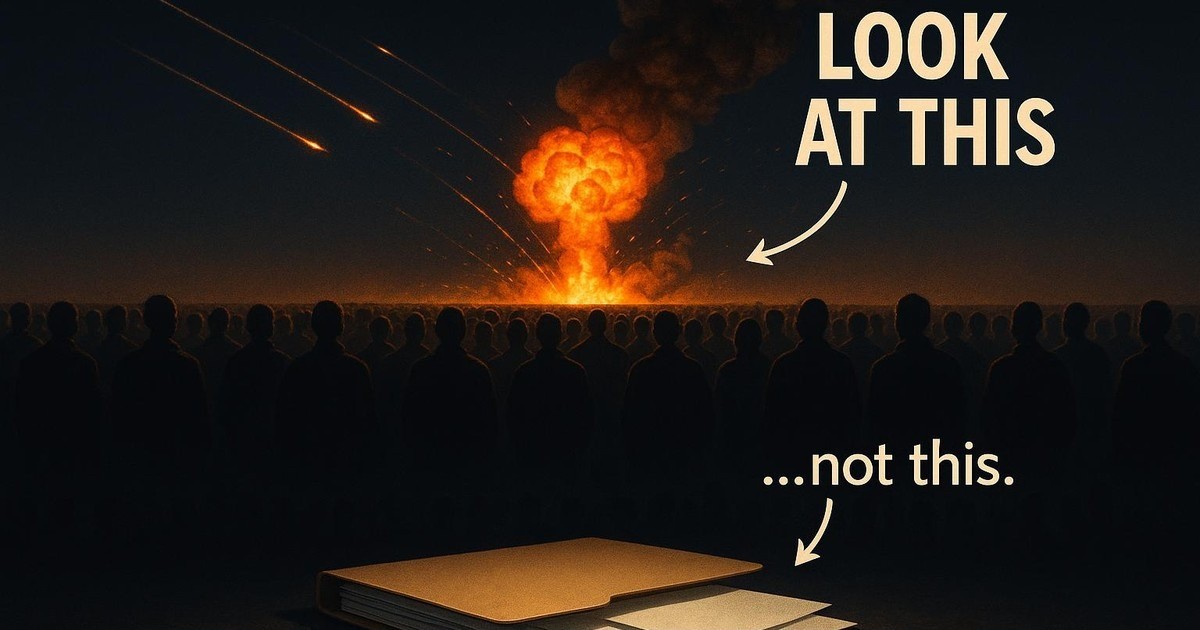
The machine Juvenal described doesn't require a conspiracy. It doesn't need a president who plots a distraction. It only needs a public whose attention can be pulled to the loudest thing in the room — and something loud, always, ready to pull it. A war is very loud. A redacted court filing is very quiet. In the week of July 2 to July 8, one of those got wall-to-wall coverage and one did not; both were true, and both mattered.
The bottom line: we're not going to sell you a story about a puppet master. We're going to keep the quiet story on the page next to the loud one, with the dates attached, and let you decide what — if anything — the calendar means. The one thing we're sure of is that a public that only ever looks at the loudest thing in the room has already lost the plot.
The Receipts
BL:UF doesn't ask you to trust us. Check our work:
July 8 strikes — 80+ targets, IRGC boats, Strait of Hormuz — Al Jazeera, July 8, 2026: aljazeera.com; The Hill; Times of Israel.
Trump declares the ceasefire "over" ("they're scum") — Al Jazeera, July 8, 2026: aljazeera.com/news/2026/7/8/trump-says-ceasefire-over-after-us-iran-trade-attacks; TIME; CBS News.
The June ceasefire / "Islamabad Memorandum" (signed June 17), 60-day window — NPR, June 19, 2026: npr.org.
"Islamic Republic of Japan" and the 111-missiles carrier claim — The National, July 8, 2026: thenationalnews.com; Mediaite, July 8, 2026 (video).
CENTCOM earlier denied any US carrier was struck (the USS Abraham Lincoln, re: Iran's Feb–March claims) — Yahoo News / Mediaite, July 8, 2026.
Mistaking Zelensky for Putin — Forbes, July 8, 2026: forbes.com.
Trump on Biden's fitness ("never the sharpest guy") and his own MoCA brag ("person, woman, man, camera, TV") — Nexstar/NBC16, 2025; CBS News; Boston University, 2024.
July 2 court order (Judge Sullivan), DOJ refusal + 60-day delay, acting AG "conceded… in violation" of the Epstein Files Transparency Act — Forbes, July 2, 2026: forbes.com; The Hill, July 2, 2026.
Clinton's August 1998 strikes, the "Wag the Dog" comparison, 9/11 Commission "found no reason to dispute" the denial — Operation Infinite Reach (Wikipedia); Baltimore Sun, Aug 23, 1998.
"Panem et circenses" — Juvenal, Satire X (~100 AD) — "Bread and circuses" (Wikipedia); ACOUP.