The setup: one tournament, three countries, 16 cities
The 2026 World Cup runs June 11 to July 19 across 16 host cities — 11 in the United States, 3 in Mexico (Mexico City, Guadalajara, Monterrey), and 2 in Canada (Toronto, Vancouver). Most matches, including the final, are in the US, but the group and knockout draw scatters games across all three countries. Follow one team deep into the tournament, or chase more than one, and you can easily need to be in more than one country — which means clearing more than one border.
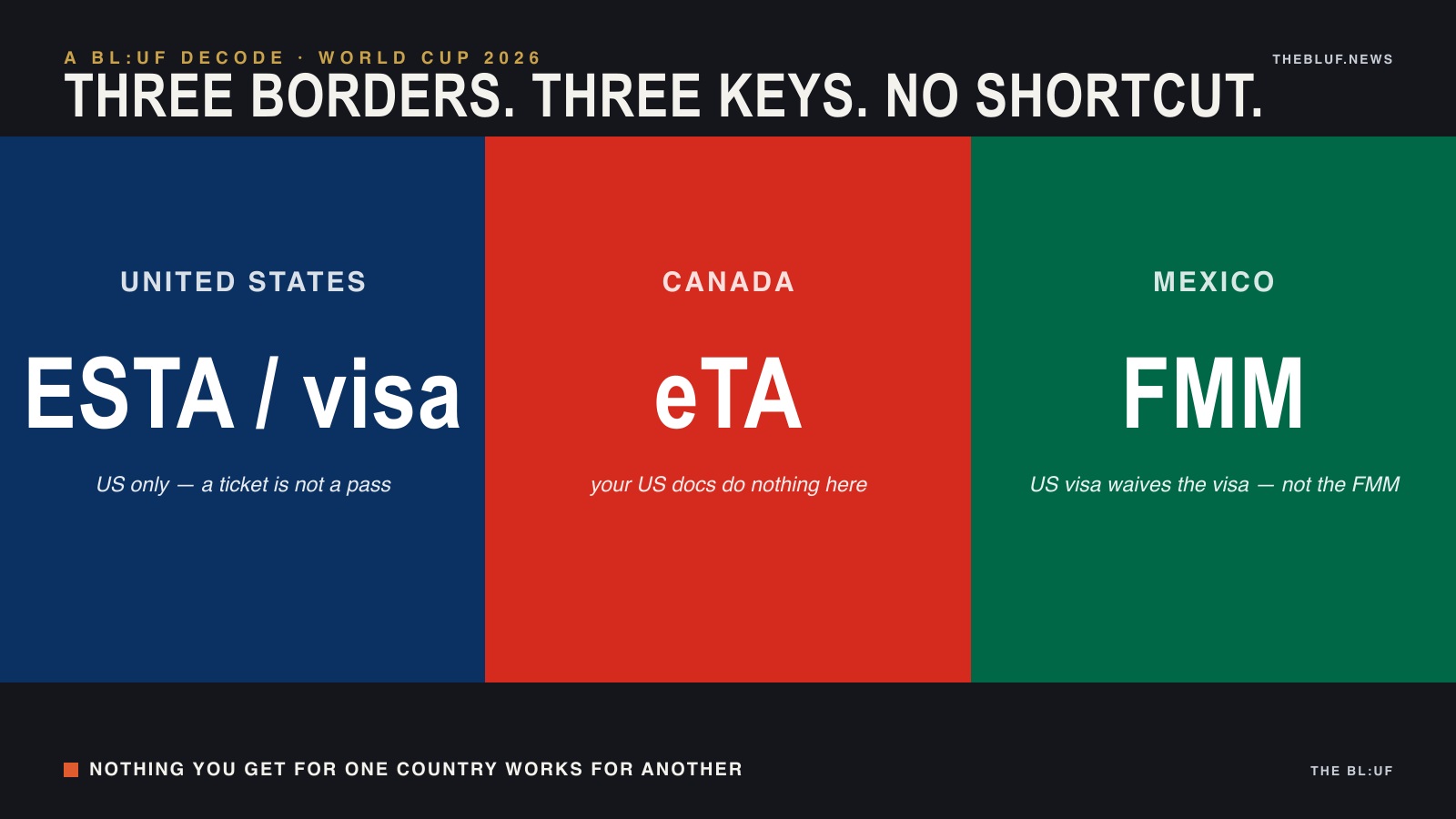
Here's the part that catches people: nothing you get for one country is accepted by another. Three countries, three separate keys.
Three doors, three keys
United States. Two ways in. Citizens of the roughly 40 Visa Waiver countries (the UK, most of the EU, Japan, South Korea, Australia, and others) can visit for up to 90 days on an ESTA — an online approval (about $40, good for two years) you must get before you board. Everyone else needs a B-1/B-2 visitor visa, which requires a consular interview. Either way, approval is not admission: US Customs decides at the border, and a match ticket buys you no special treatment.
Canada. Completely separate. Visa-exempt travelers flying into Canada need an eTA (about CAD $7, valid up to five years); others need a Canadian visitor visa. Your US visa or ESTA does nothing here — Canada requires its own authorization and its own border officer signs off, on Canada's rules. (The eTA is for air travel; entering Canada by land or sea works differently.)
Mexico. Tourists enter on an FMM (a tourist permit, not technically a visa); flying in, it's usually bundled into your airfare. Mexico is where a US document finally helps — but only here: a valid US visa waives Mexico's visa requirement for any nationality, for up to 180 days. That's the one genuine crossover in the whole tournament. Note the shape of it: the US visa covers Mexico's visa requirement, not the FMM, and it does nothing for Canada.
The traps that actually get people
- "I'm cleared for the US, so I'm cleared for the tournament." No. US clearance is US-only. The fan who books a Monterrey or Toronto match on the same paperwork finds out at the airport.
- The 90-day reset that isn't. On the visa waiver, you can pop to Canada or Mexico and come back — but only for the balance of your original 90 days. The side trip does not hand you a fresh 90. To reset the clock you'd have to leave North America entirely. (There's a separate, narrower mechanism called "automatic revalidation" for certain visa holders re-entering from Canada or Mexico — it is not a blanket "you can always get back in," and it's easy to confuse with the visa-waiver rule. Different rules; don't mix them up.)
- The border always has the last word. Every country states plainly that an approval or authorization is not a guarantee of entry — the officer at the crossing decides. Mistime your paperwork or misjudge the 90-day balance and you can be turned around between matches.
- The appointment wall. Fans from countries that need a full US visa have faced consular wait times running many months in some places. If that's you and you haven't started, the calendar itself may be the obstacle. (The US set up a priority-appointment lane, "FIFA PASS," for people who bought tickets directly from FIFA — but read the next line before you count on it.)
- There is no Fan ID. Unlike Qatar 2022's Hayya card, 2026 has no special tournament entry document and no special World Cup visa. FIFA PASS only moves you up the appointment queue if you bought tickets from FIFA — it does not grant a visa, does not guarantee one, and confers no right to enter anything. If a site is selling you a "World Cup visa," it's selling you nothing.
Who's actually at risk (and who isn't)
Don't read this as a crisis. For the largest blocs of traveling fans — from visa-waiver and eTA-eligible countries — it really is a three-item checklist: ESTA for the US, eTA for Canada, and for Mexico either the FMM on arrival or the US-visa waiver. Minutes to days online, small fees, done.
The genuinely hard cases are specific, not universal: fans from countries that need a full US visa and are staring down the appointment backlog, and anyone who miscounts the 90-day balance on a multi-country run. The system isn't broken. It's three normal systems that don't talk to each other — which trips up exactly the fan who assumed it was one.
Do this: figure out, per your passport, which of the three you need — ESTA or US visa, eTA or Canadian visa, FMM or US-visa waiver for Mexico — and sort the slow one (a US visa, if you need it) first. Check each country's official site for your nationality, because the details vary by passport and the fees and wait times move.
Rules and fees described here are current as of July 2026 and change; fees in particular should be confirmed against the official pages below before you rely on them. This is general information, not immigration advice. Confirm your own requirements before you travel via the official sources: travel.state.gov and esta.cbp.dhs.gov (US), canada.ca (Canada eTA/visa), and inm.gob.mx (Mexico). An approval from any country is never a guarantee of entry — the border officer decides.
More on the tournament: the confirmed quarterfinal matchups, Round of 16 results, official ticket-buying guidance, and where locals actually eat in each US host city — The World Cup Hub.