Point a solar panel at the winter sun and you get almost nothing back — short days, low sun angle, and the panel is often the thing buried under snow. That's the standard story, and it's why most of the world's solar farms are built flat, in valleys, and produce the bulk of their power in summer. A power grid built mostly on that kind of solar has a predictable hole: exactly when winter demand for heat and light is highest, solar supply is lowest.
Switzerland built something that breaks that pattern, and it works for a simple reason nobody planned around: altitude and snow, which ruin most solar, are the two things this design is built to exploit.
The plant
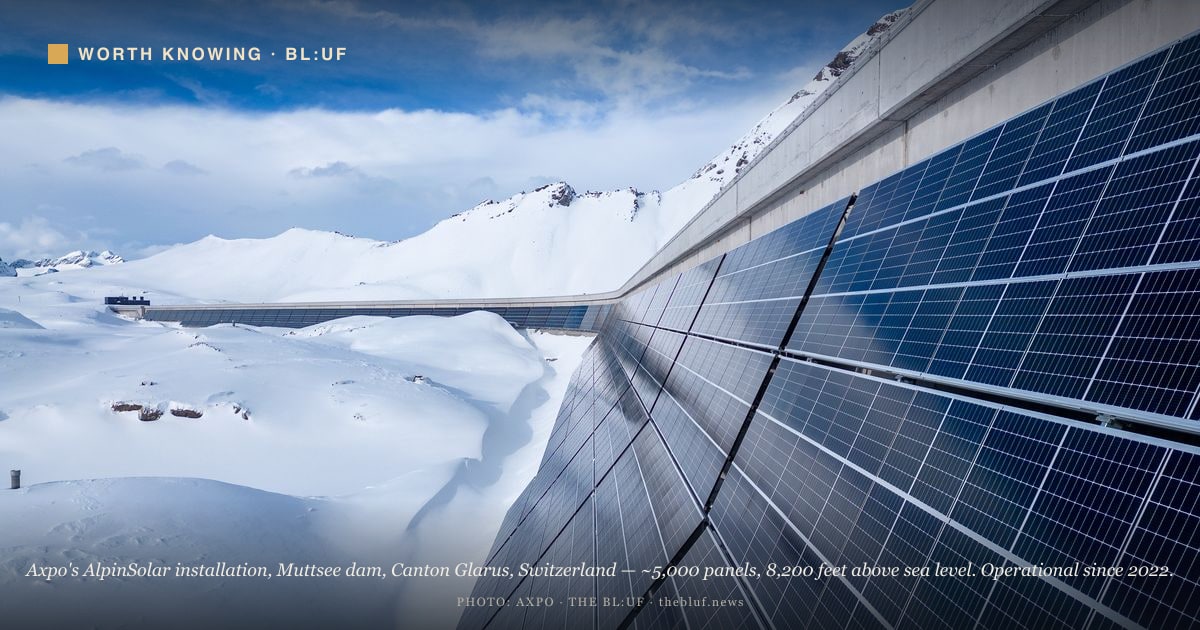
AlpinSolar, on the wall of the Muttsee dam in canton Glarus, sits at roughly 2,500 meters (about 8,200 feet) — above the cloud layer that blankets the lowlands all winter. About 5,000 panels, rated at 2.2 megawatts, are bolted vertically to the dam's face rather than laid flat. It has been running since 2022, built and operated by the Swiss utility Axpo.
The two things that would kill a normal solar farm are exactly what make this one work:
- Altitude puts it above the fog. Swiss winters bury the valleys in a persistent low-cloud layer — locals call it Nebelmeer, "sea of fog." At 2,500 meters, the plant sits above it, in clear winter sun the lowlands never see.
- Snow becomes a mirror, not a blanket. Because the panels are mounted vertically on the dam wall, snow doesn't pile up and cover them — it slides off. And the snowfield in front of the dam reflects sunlight back onto the panels from below, on top of what hits them directly.
- Cold air makes panels more efficient. Photovoltaic cells lose efficiency as they heat up; a panel in crisp alpine cold converts sunlight to electricity more efficiently than the same panel baking in summer haze at low altitude.
The number that matters
Stack those three effects together and the output curve inverts. AlpinSolar generates about 3.3 gigawatt-hours a year — and roughly half of that arrives in winter, when a comparable flat, lowland solar farm produces only a small fraction of its output. Yale's E360 and Axpo's own project data put the winter yield at about three times what an equivalent lowland farm delivers over the same months.
That inversion is the entire point. It's not that this plant makes more power overall — it's that it makes power when the grid needs it most and has the least of it, which is a harder problem than raw output.
Why this stays small, not why it's fake
This isn't a case of "just build more of these." A dam wall at 2,500 meters is a rare piece of infrastructure — most alpine dams don't have a south-facing rock or concrete face ready to bolt panels to, and building new mounting structures at that altitude is expensive and logistically brutal (helicopters, short work seasons, harsh weather). AlpinSolar works because it reused infrastructure that already existed for something else.
That's also why it's a genuine niche fix, not a proof that Switzerland has solved winter power: 2.2 megawatts is small next to national demand. What it demonstrates is the principle — altitude and reflectivity, not more panels, are the lever for winter solar — and utilities are already looking for the next dam wall to try it on.
Do It Now
This one's a "worth knowing," not an action lever — there's no consumer step attached. File it under: the next time someone says solar can't carry winter, this is the counterexample, and here's exactly why it works.
Explainer, built on prior reporting — not an original BL:UF investigation. Sources: Yale E360; Axpo's AlpinSolar project page; Euronews.