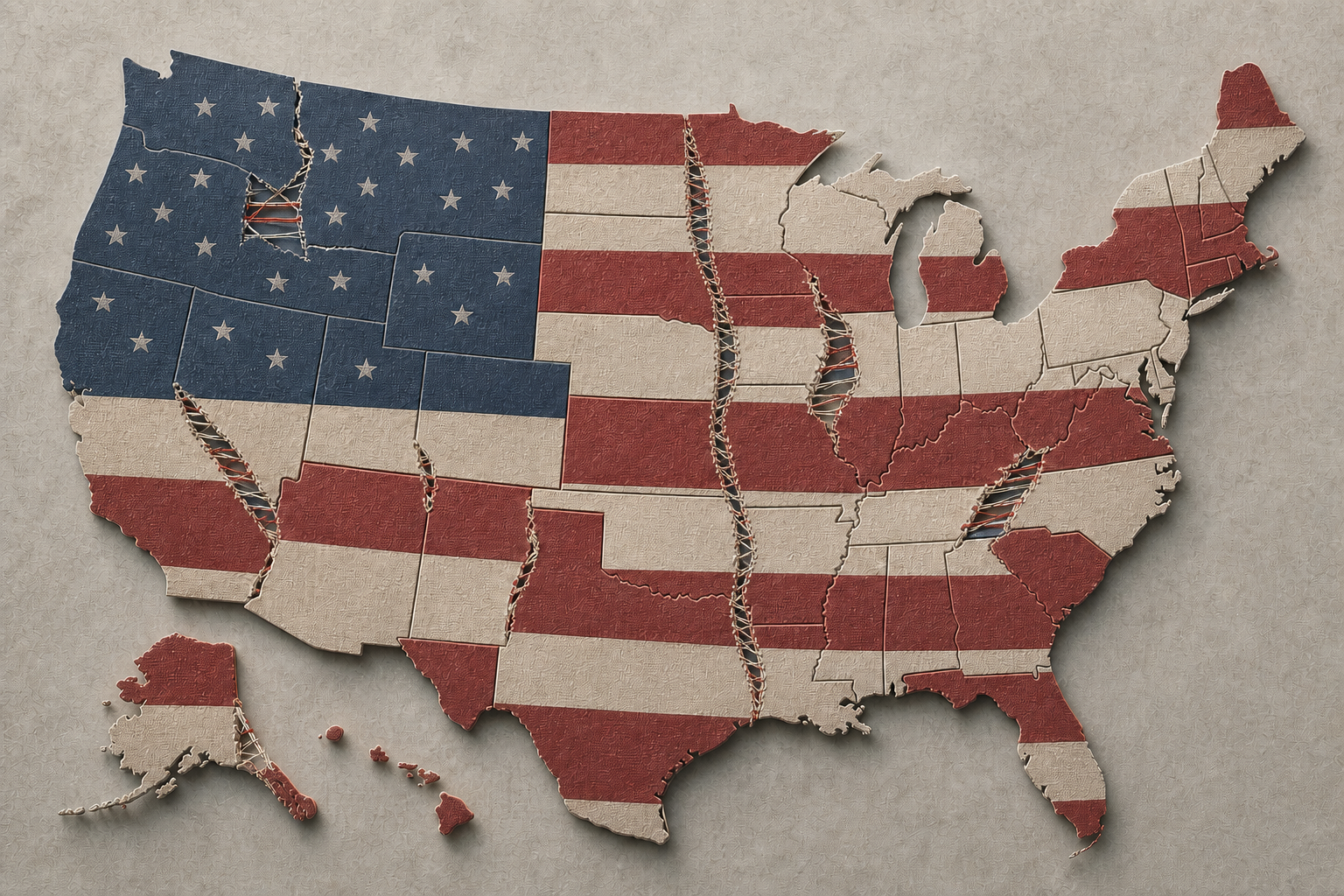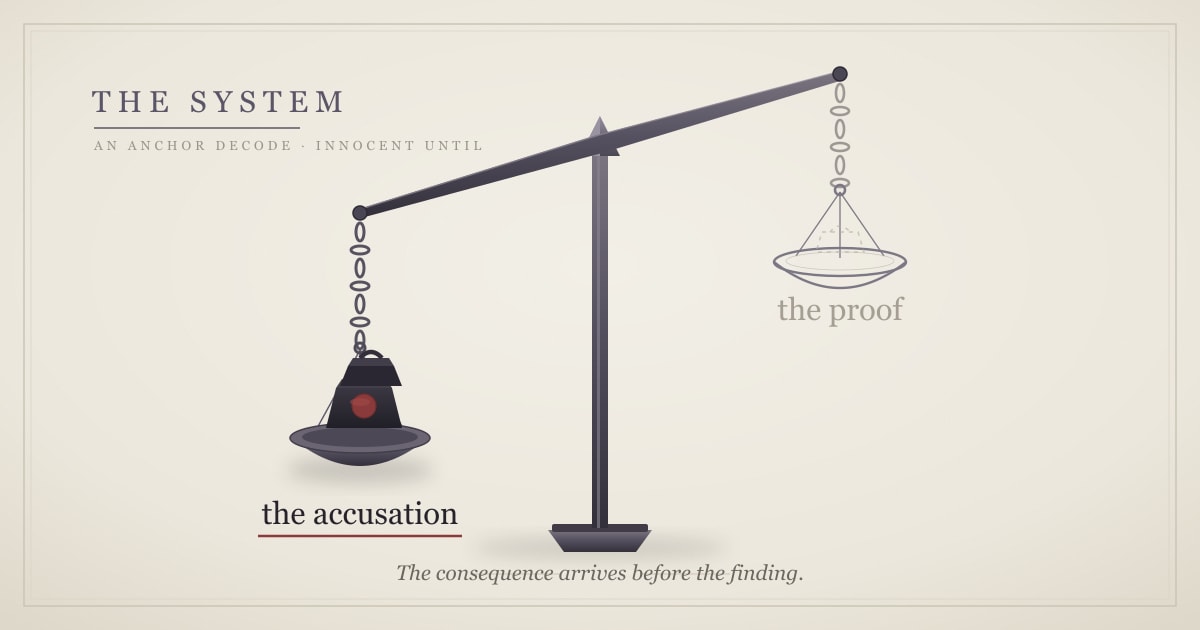
An accusation used to be the beginning of a process. Now it is frequently the end of one.
In the time it takes a claim to travel — a post, a headline, a forwarded screenshot — the consequences can already be total. An endorsement is withdrawn. A job is gone. A reputation, built over decades, is reassigned in an afternoon. None of it waits for a finding of fact, because none of it is bound by one. By the time anyone knows whether the accusation was true, the punishment has already been served.
We tell ourselves this isn't how it works, because we have a phrase for it. Innocent until proven guilty. It is one of the most-repeated sentences in the country. It is also one of the least understood — and the gap between what it means and what people think it means is where the damage lives.
What the presumption actually is — and where it stops
The presumption of innocence is a rule about the state and you. It says the government cannot take your liberty unless a prosecutor proves your guilt, to a jury, beyond a reasonable doubt — and that you never have to prove your innocence to keep your freedom. (The presumption itself traces to Coffin v. United States in 1895; the companion rule that guilt must be shown beyond a reasonable doubt became a constitutional requirement in In re Winship, 1970.) It is a shield built for the single most dangerous relationship a person can be in: the one with a government that can imprison them.
It was never a rule for anyone else. It does not bind your employer, who can fire you for the appearance of a problem. It does not bind a political party, which can drop you the moment you become a liability. It does not bind your neighbors, your followers, or the algorithm that decides who sees what. The presumption of innocence has no writ outside the courthouse doors — and the culture never built anything to take its place.
That is the actual gap. Not that people are ignoring a principle, but that the principle was only ever load-bearing in one building, and most of life happens in the others.
The edge everyone can see: the wrongly accused
The clearest cost lands on people who did nothing and are treated as if they did.
- Richard Jewell, the security guard publicly named as a suspect in the 1996 Atlanta Olympic bombing, was never charged and was formally cleared — but only after the coverage had already made his name a synonym for the crime. (The actual bomber, Eric Rudolph, later confessed.)
- Brian Banks, a high-school football star, spent about five years incarcerated on a rape accusation his accuser later admitted was fabricated; his conviction was overturned in 2012, and a civil judgment was later entered against her — awarded to the school district that had paid out on the claim — years after the accusation had taken the life he'd planned.
- the Duke lacrosse case, in which a serious accusation drew national condemnation of the accused players before it collapsed — and the district attorney, Mike Nifong, was disbarred (N.C. State Bar, 2007) for his conduct in pursuing it.
The pattern in each is the same, and it is the pattern this whole piece is about: the punishment was instant and the correction was slow — or never came at all. The accusation moved at the speed of a headline; the exoneration moved at the speed of a legal system, if it moved at all. And an exoneration does not give back the years, the job, or the name.
If the story ended there, it would be a simple one: believe accusations less. But that is exactly where honest coverage has to slow down, because that "solution" has its own body count.
The edge that's harder to hold: why the culture stopped waiting
The wrongly accused are easy to rally to once you've seen a case. The harder discipline is holding the other harm in view at the same time — because the reason belief became the default is not that people got hysterical. It is that the old default — doubt the accuser, protect the accused, especially if the accused had standing — failed for generations, and it failed in a direction that is easy to forget once you're worried about the wrongly accused.
Sexual assault remains one of the most underreported crimes in the country: by the government's own victimization survey, only about 310 of every 1,000 assaults — roughly one in three — are reported to police at all. The reasons victims gave for staying silent were rarely mysterious: they would not be believed, or believing them would cost too much. And when the disbelief was official, it did its own damage:
- "Marie," in Lynnwood, Washington, reported being raped, was pressured by police into recanting, and was herself charged with false reporting — until the same man was caught assaulting other women and the record confirmed she had been telling the truth all along.
- Larry Nassar's abuse of gymnasts ran for years while complaints and warnings reached the institutions around him and went unacted on — so that by the time he was finally stopped, the number of girls and women he had assaulted had grown into the hundreds.
A system tuned to disbelief did not protect the innocent. It produced victims who were punished, or ignored, for being victims.
So "just go back to skepticism" is not a neutral reset. It is a choice with a known cost, paid by real people, and any honest account of this has to say so plainly. Belief-by-default and doubt-by-default are not opposites where one is safe. They are two ways of making the same mistake.
The mistake underneath both
Look at what the wrongly accused and the disbelieved victim have in common. In one direction, a person is punished for a crime that was never proven. In the other, a person is punished for reporting a crime that was, in fact, real. In both, the outcome was decided by the accusation and the reaction to it — not by any process built to find out what happened.
That is the malfunction, and naming it correctly matters, because it points at a fix that neither tribe wants to hear. The answer to the wrongly accused is not to disbelieve accusers — that just rebuilds the machine that buried Marie. The answer to the buried victim is not to treat every accusation as a conviction — that just rebuilds the machine that took Brian Banks's years. The answer is the thing both sides skipped: take accusations seriously enough to actually investigate them, and hold consequences proportional to what has actually been established.
Seriously investigating is what protects real victims — it is the opposite of the shrug that buried them. Proportional consequence is what protects the falsely accused — it is the opposite of the reflex that ruins someone at the first claim. They are not in tension. They are the same missing middle, the one the presumption of innocence guards inside a courtroom and nothing guards outside one.
The bottom line
The presumption of innocence does not fail when it protects the sympathetic. Anyone can extend it to someone they already like. It fails — or holds — on the person you are most sure is guilty, because that is the only case where the presumption is doing any work at all. The moment it applies only to the people we're inclined to believe, it has stopped being a principle and become a headcount.
None of this asks anyone to withhold judgment forever, or to pretend that true and false accusations are equally common, or that they feel the same to the person making them. It asks something narrower and harder: that the consequence wait for the finding — in both directions — instead of racing ahead of it. That is all the courtroom rule ever really said. The rest of life just stopped listening.
🔎 The Ledger
Part of The Ledger — a running thread in The System on who the record counts, who it protects, and the language in between. See also: Nolan Wells got one story; Gabby Petito got 844 and “Lie,” the one word the press won’t use on the powerful.