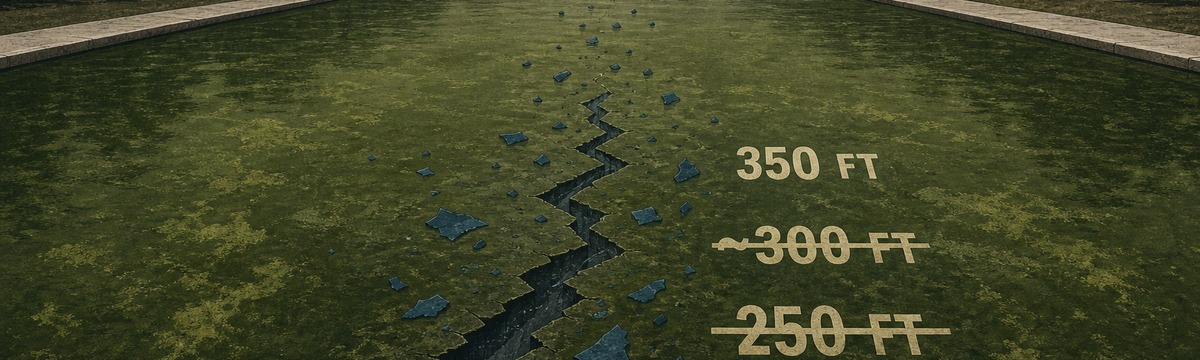
When the Lincoln Memorial Reflecting Pool turned green this summer (July 2026), days after a renovation whose federal contracts totaled more than $16 million, the President said it was sabotage: vandals, he claimed, had taken "a box-cutter or a knife of some kind" to the lining and put fertilizer in the pool to make it bloom. Every serious outlet checked it. Every serious outlet found the same thing — no evidence for the gash he described, experts calling it an ordinary bloom of a harmless algae, and federal authorities who made arrests over damage to the pool but never substantiated that vandalism, rather than the renovation, caused the algae or the pool's failure.
Update, July 31, 2026: The Justice Department has moved to dismiss the felony property-destruction charge against David Hearn, 67, the former Olympic canoeist — one of three Olympics for him, a ninth-place finish at the 1996 Atlanta Games — who was arrested and charged over the Reflecting Pool damage the President described as sabotage.
The reversal is not a quiet one. On July 2, announcing the charge, U.S. Attorney Jeanine Pirro said "the evidence shows and we will prove beyond a reasonable doubt that Hearn willfully destroyed property," and that National Park Service employees saw him "forcefully and violently" pulling up and removing the pool's bottom liner with both hands. Twenty-nine days later, her office's own filing to drop the case says the damage was not vandalism "as initially represented by DOI" — the Department of the Interior, which Pirro's filing says supplied the original evidence — but the result of "flawed installation by the contractor," and that "the rush to complete the project prior to events associated with the America 250 celebration" contributed to it. The filing goes further still: given what's now known, it is "difficult to attribute the widespread damage to the Reflecting Pool to vandalism, let alone to establish that fact beyond a reasonable doubt." Hearn's attorneys: "Its dismissal today does not erase the abuse of government power in arresting and charging a patriotic American who did nothing wrong."
Separately, three other people — Cameron Thiers, Sophie Dennison-Gibby, and Justin Carreno — were charged with misdemeanors over allegedly peeling and removing pieces of the pool's protective coating, a different act; nothing in this filing addresses those cases, and this piece isn't asserting anything about them.
What changed here is narrower than "the President lied," and more precise: the specific felony theory tied to his account — a blade, a deliberate gash, sabotage — is the one his own Justice Department now says it can't support, weeks after that same office said it would prove that theory "beyond a reasonable doubt." (Sources: PBS NewsHour, CBS News, Newsweek, ABC News.)
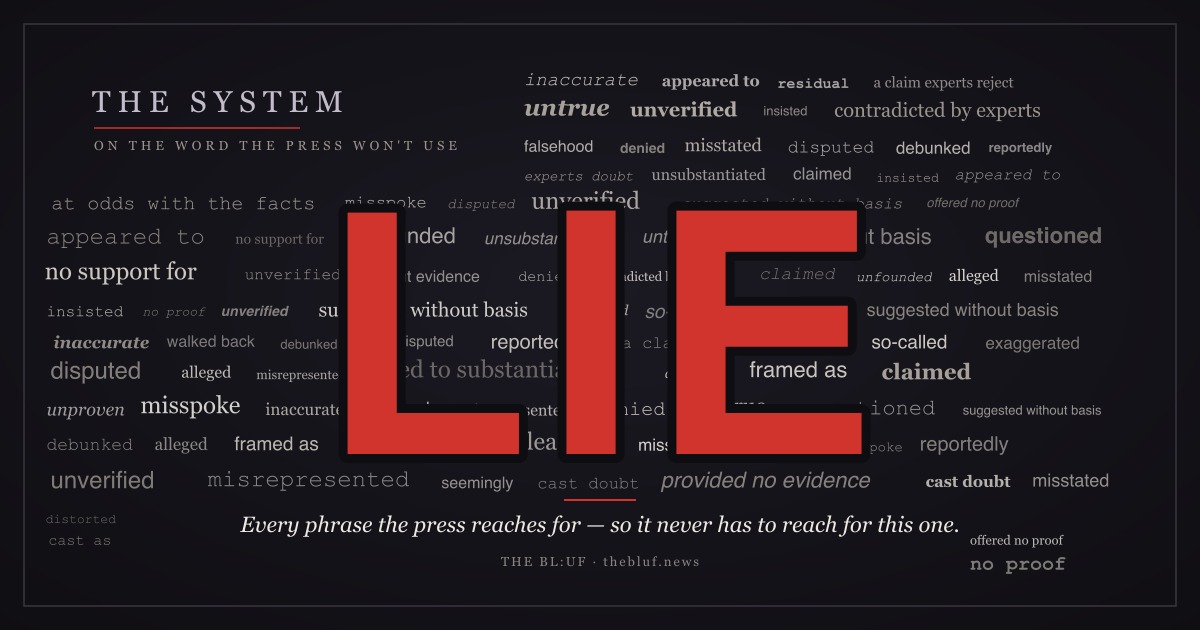
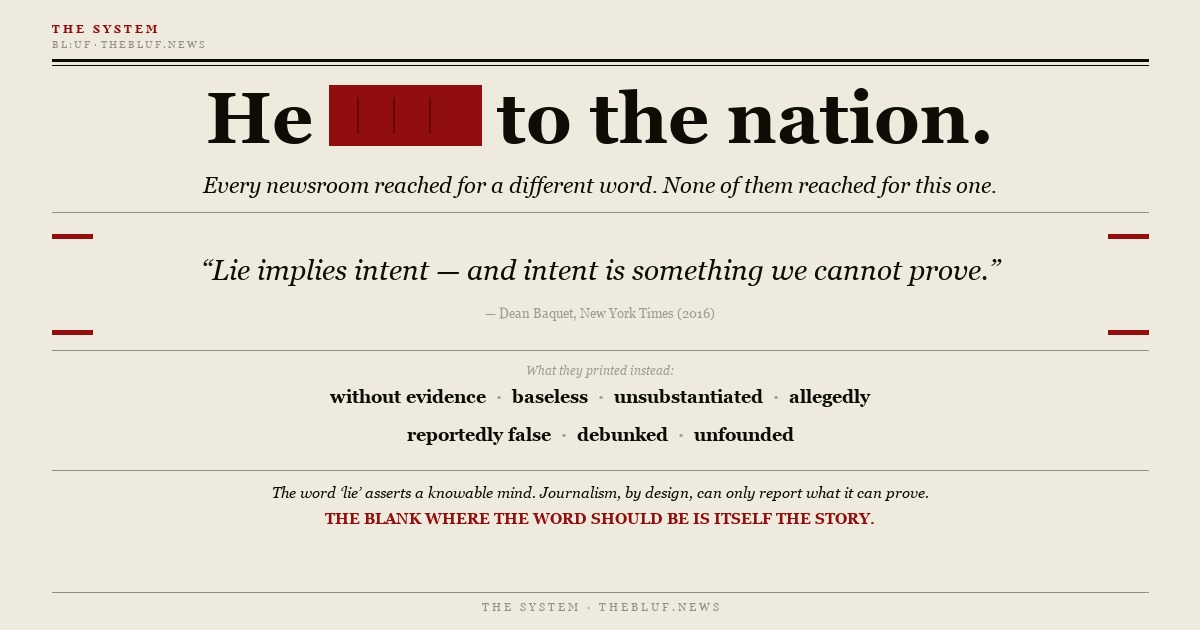
And then watch what the coverage actually said. "Without evidence." "Baseless." "Cast doubt." "Unsubstantiated." A whole thesaurus of restraint — and almost nowhere, in a straight news voice, the plain word a reader might reach for at their own kitchen table: he lied.
That gap is not an accident, and it is mostly not cowardice. It is built. Here is what's holding the word back — and why the blank it leaves is the real story.
A lie is a claim about a mind
Start with the honest reason, the one that isn't about fear at all. You can prove a statement false. You cannot prove what a person knew. "False" describes the world; "lie" describes the inside of someone's head — it asserts they knew better and said it anyway. Journalism can verify the first and can almost never verify the second.
This isn't a dodge reporters invented; they've argued about it in the open. When The New York Times began using "lie" for some of Donald Trump's claims, its own executive editor at the time, Dean Baquet, cautioned in 2016 that the word "implies intent," and not just a passing intent — a sustained one you can actually establish. NPR decided the other way and largely declined the word at all. Fact-checkers who do nothing but this for a living — Daniel Dale, then of the Toronto Star, among them — landed on "false" and "falsehood" precisely because those describe the claim without pretending to X-ray the claimant. Calling it a "falsehood" instead of a "lie" isn't an excuse. It's an admission that we can be sure of the statement and can only guess at what he knew.
That is a real wall — you genuinely cannot see inside another person's head — and it is the first reason the word stays holstered.
The law rewards the caution
The second reason is the one we ran into ourselves reporting this out. Call a private person a "liar" and you can be sued for defamation; call a powerful person a liar and you can be sued by someone with lawyers. Truth is a defense — but "he lied" puts his state of mind on trial, and now you're proving the unprovable in a courtroom, on his clock.
The law does leave a door open, and it's worth knowing where it is. A bare epithet — "liar!" — is exposed. But a conclusion a reader draws from facts you've fully laid out is protected opinion. In plain terms: you don't get to announce the verdict, but you get to show every piece of evidence and let the reader reach it. So the safest thing a careful newsroom can do is exactly what looks like timidity — pile up the facts, decline the word, and let the audience supply it. The caution and the euphemism are the same reflex.
No one is assigned to make the finding
Here is the part almost no one says out loud. There is no institution whose job is to rule that a public official's public claim was a lie.
Perjury? That only exists under oath, and a President talking about a pool is not under oath. Fraud? That's for selling a thing, not for governing. The fact-checkers rate the statement — "False," "Pants on Fire" — not the person; their whole design is to grade a claim, not to indict a character.
And this wall is not partisan — it sits under whoever is standing on it. When a Democratic president promised "if you like your health care plan, you can keep it," the claim was ruled false so widely that PolitiFact made it a "Lie of the Year" — and even then, the honor attached to the statement; no institution ever adjudicated what he knew when he said it. The word, on the rare occasion it surfaces at all, lands as a label on a claim, never as a finding about a mind. The one place in American life where "he lied" is a formal finding, with a burden of proof and a person empowered to make it, is a witness stand. And a witness stand is the single venue a public political claim never has to visit.
So the word has no home. The courtroom has it and never sees these statements; the newsroom sees them and can't safely say it; the reader thinks it and has no standing. It floats, unattached.
The ladder and the firehose
Then there's what fills the vacuum. A graduated vocabulary — "misspoke," "misstated," "misleading," "unfounded," "unsubstantiated," "without evidence" — each rung a little softer than the truth, each one technically accurate, all of them soften the same act one degree at a time. And when false claims arrive not one at a time but in a constant stream — what RAND memorably called a "firehose of falsehood" — the math turns against the word entirely. Each individual claim gets its mild, correct descriptor. No single one ever trips the bigger word. And because nobody names the pattern, the pattern never has to answer for itself. Volume is its own camouflage.
The blank is the story
Put it together and the picture isn't a press corps too scared to speak. It's a language, and a set of institutions, with a precise hole in them — one that happens to sit exactly where accountability for the powerful is supposed to go. You can describe everything about an official claim that falls apart under scrutiny — except whether the person knew it was false. And whether he knew is the only part that would cost anyone anything.
The powerful have learned to live in that blank. The pool is the whole mechanism in miniature: a claim that collapses on contact, a number that grows in the retelling — a "250-foot" gash that becomes "290 to 300," then "350 feet of little slips" — with no evidence ever produced for any of them. His own Interior Department told CNN the algae was "residual," from reactivated supply lines — a mundane, non-sabotage explanation from inside his own government — while the sabotage story rolled on untouched. A D.C. grand jury did later indict a man on a felony property-destruction charge over a torn section of the lining — but even that is about damage to the sealant, not proof of the President's story that sabotage caused the algae; in the government's own filings, the cut liner and the green water remain two separate things. The U.S. Attorney for D.C., Jeanine Pirro, went on Fox and warned that "anyone who is in a position of vandalizing or attempting to vandalize the Reflecting Pool will face the criminal justice system in D.C." — lending the authority of a prosecutor's office to a story her own government's experts never tied to the algae. Not one of those steps required anyone to knowingly say anything false in a way you could prove. That's the design. The blank does the work.
The bottom line
The answer was never the word. It's the record.
You don't have to call it a lie. You can just lay the pieces side by side. He described a blade cutting the pool; his own department called the green water "residual." He said the gash was 250 feet, then 300, then 350. His own government's investigators never once tied the vandalism to the algae — and on July 31, his own Justice Department would say so in writing, dismissing the one felony charge built on that theory. Put those facts next to each other and the reader reaches the conclusion on their own — faster, and surer of it, than any label could make them. That isn't bravery, and it isn't a verdict we're too timid to render. It's just refusing to stop at the euphemism.
The missing word is missing for reasons — some principled, some legal, some merely convenient. But its absence is not neutral. A vocabulary that can describe everything about a claim like this except what its speaker knew when he made it ends up doing one thing regardless of anyone’s intent: it hands the powerful the benefit of the doubt. The least we can do is show the whole record, and let you read it for yourself.
🔎 The Ledger
Part of The Ledger — a running thread in The System on who the record counts, who it protects, and the language in between. See also: Nolan Wells got one story; Gabby Petito got 844 and Innocent Until.