What happened on the Fourth
As the country marked its 250th birthday, roughly 700 members of Patriot Front — the figure reported by The New York Times; the group itself claimed about 400 — marched through Washington. They wore matching khakis and navy shirts, covered their faces with white cloth, carried U.S. flags (some upside down) and Confederate flags, beat drums, and chanted "Reclaim America." They moved through Union Station, past the Capitol, and out to New Carrollton, Maryland, riding the Metro. They were gone before 11 a.m. No violence or arrests were reported.
Patriot Front is not a fringe question mark. It formed in 2017 out of the fascist group Vanguard America, in the aftermath of the deadly "Unite the Right" rally in Charlottesville, where a counter-protester, Heather Heyer, was killed. The Southern Poverty Law Center classifies it as a white nationalist hate group; the Anti-Defamation League calls it white supremacist; George Washington University's Program on Extremism describes it as a fascist organization dedicated to creating a white ethnostate.
What a Cabinet secretary said about it
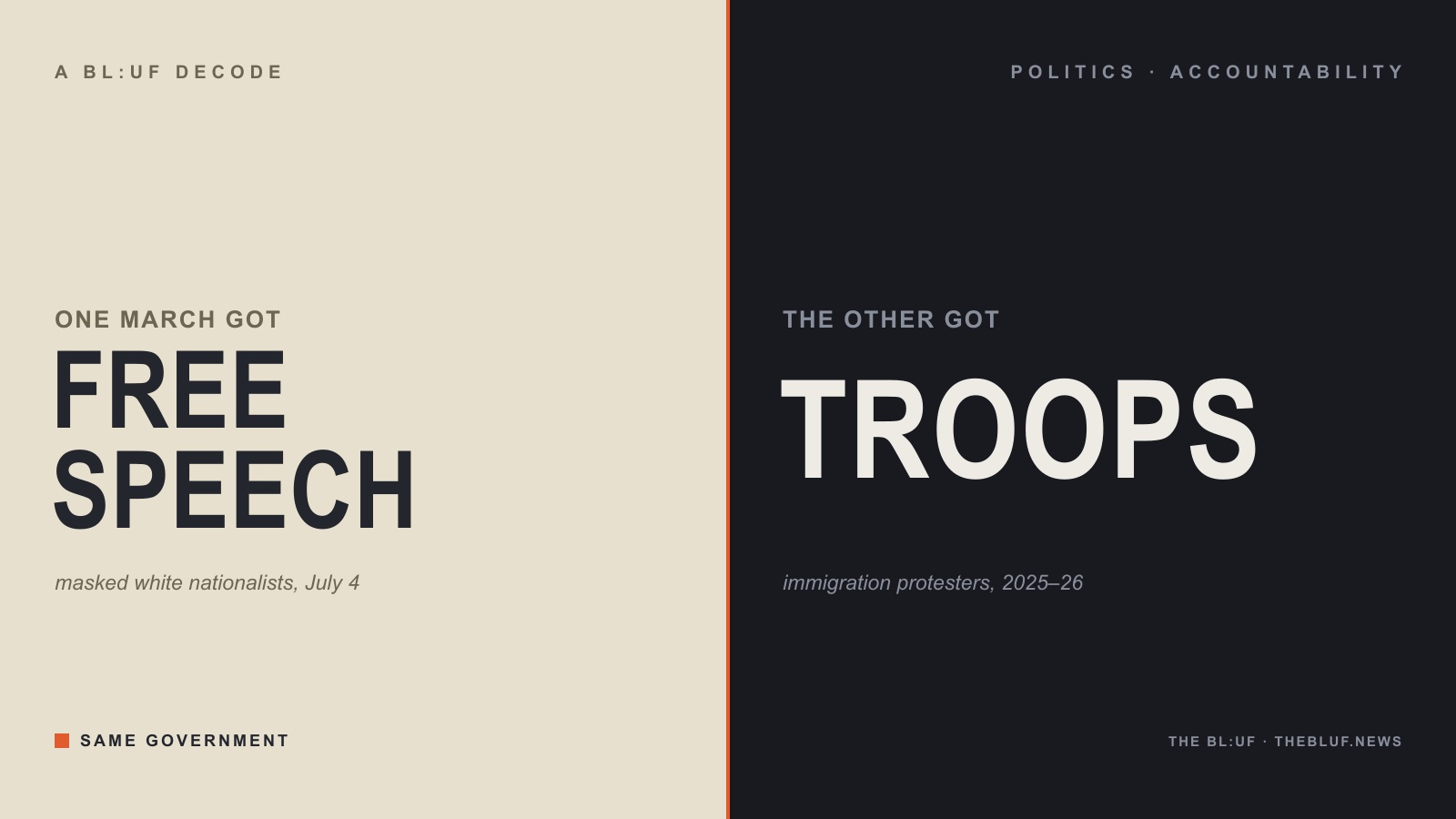
The next morning, on CNN's State of the Union and ABC's This Week, Interior Secretary Doug Burgum was asked about the march. He did not hide his distaste for the group: "What they stand for is nothing that I could possibly agree with." But he declined to condemn it, and framed the march as protected expression.
"One of the foundational principles of the United States, which makes democracy messy, is free speech," he said. He drew a parallel to protesters who criticize the president: "There are protests on the mall that people say things that I think are reprehensible about President Trump, and yet they're allowed to go on because of free speech in our country."
Pressed on whether he condemned Patriot Front, or would urge the president to, he would not.
Hold that standard in mind — the right to march is protected, even for people whose message is reprehensible — because it is not the standard this administration applied to the other marches of the past year.
How the same government treated the other side
When the marchers were protesting immigration enforcement, the response was not a Sunday-show reflection on messy democracy.
Troops. After ICE raids sparked protests in Los Angeles in June 2025, President Trump federalized California's National Guard over the governor's objection — the first time a president had done so without a governor's consent since 1965 — and added roughly 700 Marines. On September 2, 2025, U.S. District Judge Charles Breyer ruled the deployment violated the Posse Comitatus Act, finding "there was no rebellion, nor was civilian law enforcement unable to respond."
The label. Administration officials repeatedly described the protesters as paid and seditious. The president called them "paid agitators and insurrectionists." Vice President JD Vance asked "who paid for the brick?" Homeland Security Secretary Kristi Noem referenced "funded protesters." PBS NewsHour and PolitiFact both fact-checked the "paid agitators" claim and found no evidence for it.
Surveillance. Beginning in early 2026, DHS issued hundreds of administrative subpoenas — which require no judge's approval — to Google, Meta, Reddit, and Discord, seeking the identities behind accounts that criticize or track ICE. The ACLU says that each time one has been challenged in court, the agency has withdrawn it rather than let a judge rule. In Minnesota, a class-action suit, Tincher v. Noem, alleges federal agents scanned observers' faces, followed them home, and told them they were in a "domestic terrorist" database; more than 30 people gave sworn statements. ICE denies keeping such a database.
Lethal force. NBC News reported that federal immigration officers shot 14 people between September 2025 and February 2026. Two of them — both U.S. citizens — were killed in Minneapolis. Alex Pretti, 37, was filming masked federal agents in January when he was shot; the government says he resisted and had a gun, while bystander video his family points to appears to show an agent removing that gun before shots were fired. Renee Good, 37, died after a masked ICE agent fired at her SUV; the government says she weaponized the vehicle, and local officials dispute that, with video described as ambiguous. Both accounts are contested. What is not contested is that federal agents killed two citizens, and that no Cabinet secretary went on television to call their deaths the price of a messy democracy.
The fair objection — and why it doesn't erase the point
Here is the strongest good-faith counter, and it deserves a straight answer: the conduct wasn't the same. The Patriot Front march was brief, orderly, and peaceful. Some anti-ICE assemblies were not — in Los Angeles, self-driving cars were burned and a federal building was surrounded; there was vandalism and objects thrown at officers. The government can lawfully respond to conduct — violence, blocking federal facilities — no matter the message. A defender would say force followed the violence, not the viewpoint.
That's true, and it's why this isn't a story about identical acts getting opposite treatment. But it doesn't dissolve the asymmetry, because the asymmetry lives in the government's words and posture, which fell on the movements as a whole, not just on the people who broke the law:
- The peaceful majority of immigration protesters — and even observers and bystanders — got "insurrectionists," troops, and subpoenas. In Los Angeles, federal prosecutors brought 38 felony cases but secured only 7 indictments, many later dismissed or reduced.
- A federal judge found the troop deployment unlawful, which means "we were responding to conduct" was, in at least one case, rejected by a court.
- And a Cabinet secretary extended to avowed white nationalists exactly the free-speech grace the administration denied, rhetorically, to people protesting deportations.
The march-versus-riot comparison was never the point. The point is how a government talks about and mobilizes against two movements. On that axis, the asymmetry is documented, and it points one direction.
The bottom line, restated
The First Amendment protects the Patriot Front's right to march. It also protects the right to protest ICE. A government that means "free speech" as a principle applies it to speech it hates in both directions. This one, by its own words over the past year, applied "messy democracy" to white nationalists and "insurrectionists" to the people marching the other way.
Reporting compiled from AP, CNN, NBC News, PBS NewsHour, PolitiFact, ProPublica, Al Jazeera, and court filings including Judge Breyer's September 2025 ruling and Tincher v. Noem. Extremist-group designations are those of the SPLC, ADL, and the GW Program on Extremism.