What's documented
In November 2025, Congress passed the Epstein Files Transparency Act with near-unanimous bipartisan support. President Trump signed it on November 19, 2025 — Public Law 119-38. The law gave the Department of Justice 30 days to publish, in a searchable and downloadable format, all unclassified records connected to the Jeffrey Epstein investigation: investigative materials, flight logs, travel records, named individuals. DOJ was allowed to withhold five specific categories, including victims' personal information and material that would jeopardize an active investigation — nothing else.
The statutory deadline was December 19, 2025. DOJ missed it. What followed, per court filings: redactions the court has since found excessive and legally unsupported in places, documents released and then retracted, and — in a separate failure pointing the opposite direction — some victims' personal information that wasn't properly redacted at all. The DOJ's own Inspector General opened an audit in April 2026 into whether the department complied with the law.
The lawsuit, and why it's moving fast
In April 2026, journalist Katie Phang — an attorney, former MSNBC/MS NOW host now reporting independently on the MeidasTouch network — sued Acting Attorney General Todd Blanche in his official capacity. Her attorneys, Brendan Ballou and Samuel T. Ward-Packard of the Public Integrity Project, argued DOJ's slow-walking of the required release was actively harming her ability to do her job as a journalist covering the case — a legal theory called "informational injury." Judge Emmet G. Sullivan accepted that theory, letting the case proceed.
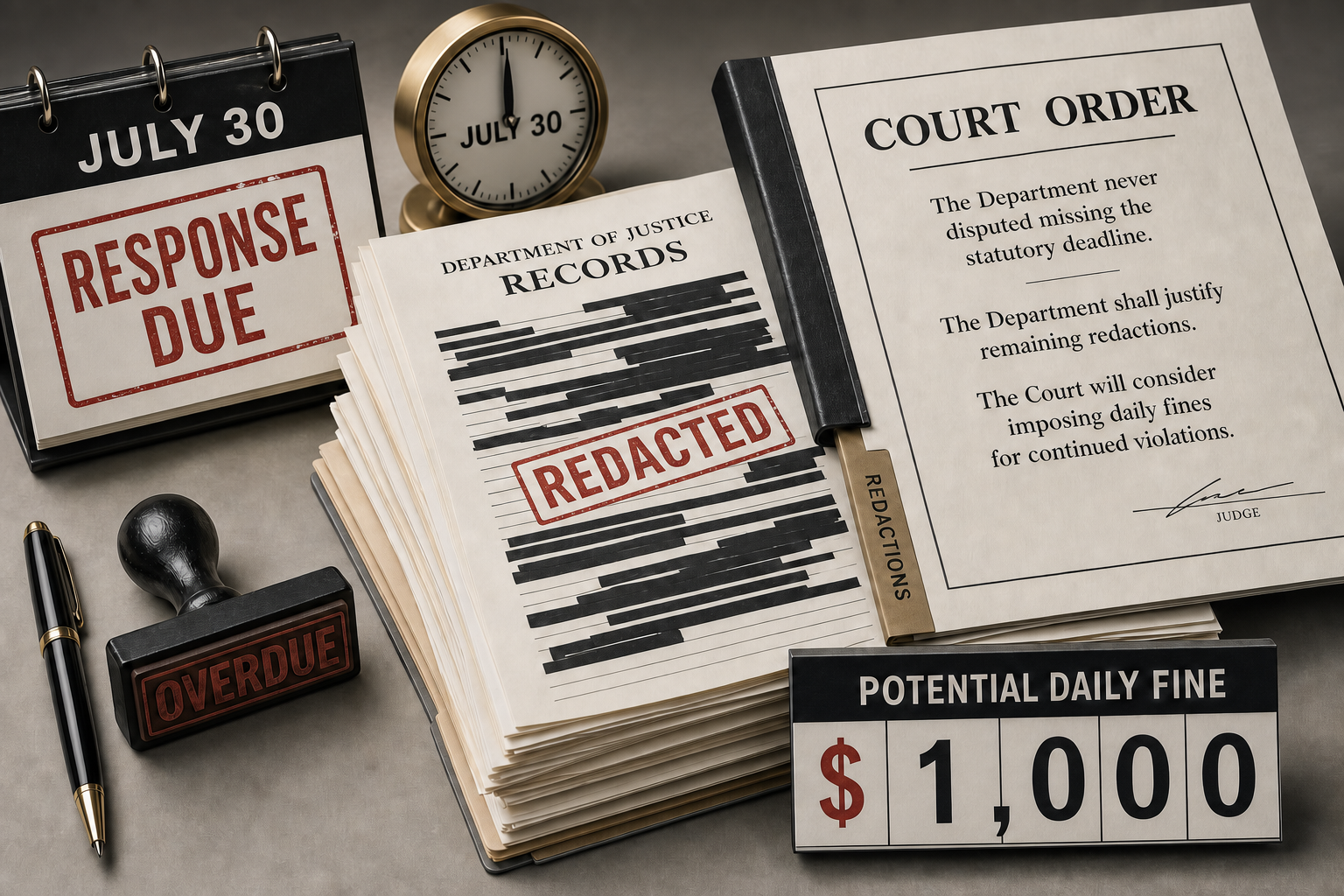
In June 2026, Sullivan ruled in Phang's favor on the central facts of the case — finding that Blanche had never actually disputed, in any filing, that DOJ missed the release deadline, made improper redactions, or withheld documents the Act required. That's a significant point on its own: the fight remaining isn't over whether DOJ complied. It's over what happens because it didn't.
In a new order issued in late July 2026, Sullivan directed Blanche to submit unredacted versions of key Epstein-related emails and documents directly to the court for private review, along with evidence justifying each redaction DOJ wants to keep — due by July 30, 2026. Phang has also asked the court to fine Blanche $1,000 a day until DOJ complies. Sullivan hasn't ruled on that yet.
DOJ's actual defense
Blanche's lawyers make several distinct arguments, and they're not equally strong. The broadest one is jurisdictional: DOJ argues Phang should have used a FOIA request instead of suing under the Administrative Procedure Act, since FOIA provides an "adequate remedy" for getting documents — citing D.C. Circuit precedent that the remedy doesn't have to be identical, just comparable.
On the specific redactions, DOJ's strongest ground is victim protection: for six of eight redacted emails cited in the case, DOJ says the redactions withhold victims' personally identifiable information — a category the Act explicitly allows, and one that's hard to argue with on its face. DOJ separately says most of the names that looked like redacted "co-conspirators" in a 2007 draft indictment were actually mislabeled victims. Its weaker arguments are about process: redacting handwritten FBI interview notes because they're "duplicative" of typed reports, and failing to review foreign-language documents because first-level reviewers couldn't assess them — justifications that don't trace to anything the Act actually permits.
In his own reply brief, Blanche called Phang's $1,000-a-day fine request "outlandish" and "absurd," and her suit "sensational and unsubstantiated."
What this piece is not saying
This isn't a claim that DOJ is hiding evidence of wrongdoing by any specific person, or that the redactions are all improper. Some of DOJ's redaction arguments — particularly the ones protecting victims' identities — are exactly the kind of withholding the Act was written to allow, and this piece isn't second-guessing those. What's documented and undisputed, per Judge Sullivan's own June ruling, is narrower and more concrete: DOJ missed a legal deadline, made some redactions the court hasn't yet accepted as justified, and hasn't disputed either fact in its own filings. Whether Blanche personally should be fined, and whether the specific redactions due for review on July 30 survive that review, are both still open.
This piece also isn't naming, describing, or speculating about any Epstein-case victim or any individual referenced in the files. The story here is a federal transparency law, whether it was followed, and what a court is doing about it — not the underlying investigation's contents.
The Receipts
- Public Law 119-38 — Epstein Files Transparency Act, full text
- Congress.gov — H.R.4405, Epstein Files Transparency Act
- Civil Rights Litigation Clearinghouse — Phang v. Blanche complaint
- CourtListener — Phang v. Blanche docket
- The New Republic — Blanche begs judge not to fine him $1,000 a day over Epstein files
- Wichita Liberty — Phang v. Blanche: DOJ fights back on Epstein files order
- Yahoo/AP — Judge demands to see what Trump's DOJ is hiding in Epstein files
- Attack of the Fanboy — DOJ redaction evidence due by July 30
- Joe.My.God — Judge: Blanche must produce unredacted Epstein docs
- Raw Story — Todd Blanche begs judge not to hit him with $1K-a-day fine