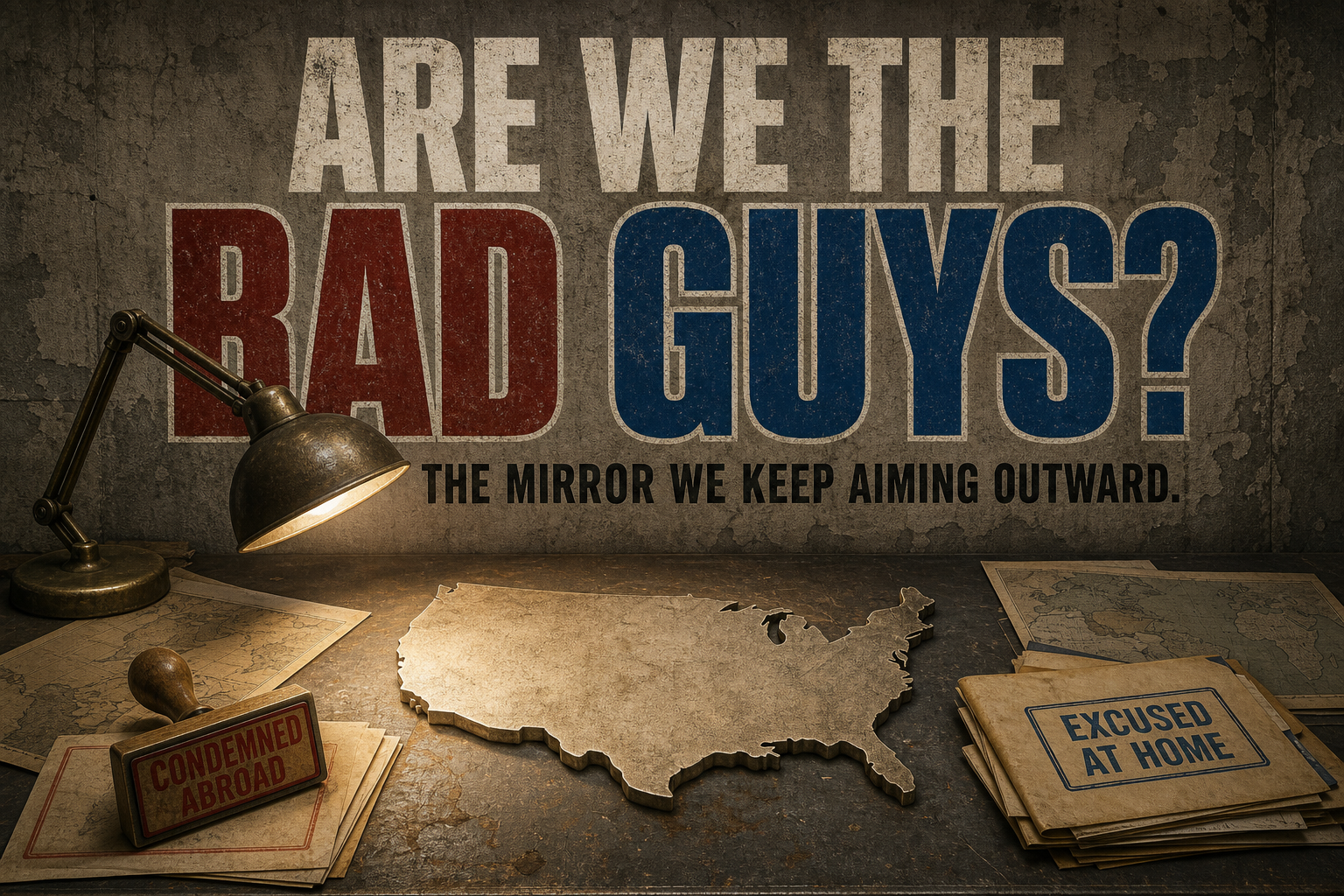
The title asks a question that some people consider already answered and others consider too dangerous to ask. We’re not interested in either position.
The question mark is load-bearing. A series called Are We the Bad Guys. — with a period — begins with a verdict and spends its run decorating it. A series called Are We the Bad Guys? — with a question mark — begins with a test. The difference is everything.
What counts as a charge
The series starts with a charge. Not “America is hypocritical.” That’s a mood. You can’t fact-check a mood.
A charge sounds like this: the United States condemned a defined act when another government did it, then committed or enabled materially similar conduct itself. The charge has to be specific enough to fail. It has to be anchored to something in writing — an annual human-rights report, a State Department statement, a treaty commitment, an executive order. And it has to lead somewhere real: a verdict one way or another, not a trailing gesture at complexity.
The first charge already published: Trump ordered the Smithsonian to install government-written signage telling visitors its exhibits were wrong, commissioned a corrective exhibit, and directed four federal officials to use the museum’s funding as leverage to make it comply. The United States condemns China and Russia, by name, in its own State Department reporting, for exactly this — using government power to force museums and cultural institutions to tell a state-approved version of history instead of an honest one. The tool is the same. The consequences, so far, are not — no one has been arrested. That gap is the honest center of that episode, not a footnote.
How the test works
Four steps, same order every time.
First: what is the stated American standard? This has to come from a primary source — an actual report, an actual speech, an actual treaty provision. Not a paraphrase of one, not a description of one. The document.
Second: what is the documented American conduct? Verified, sourced, specific — not “America has historically” but this event, this date, these actors, these consequences.
Third: what is the strongest available defense? Every episode runs the defense — the legal distinctions, the factual differences, the legitimate reasons a comparison might not hold — with equal care. Carrying the defense is not editorial charity. It is the only way to know what the charge actually proves.
Fourth: what does the record support? One of four findings: sustained, partly sustained, not sustained, or open because the record isn’t there yet. Every finding comes with the receipts.
Comparison is not equivalence
This is the part that most of these arguments get wrong.
Two governments do something that looks similar. Someone puts the cases next to each other. The headline writes “same.” That is almost never accurate.
Two cases can share a feature and differ on five others. Every episode runs the comparison through six questions before any verdict: Was the governing law the same? Was the stated intent the same? Was the scale comparable? How long did the conduct continue? Who was harmed and how many? And when the conduct became public, what happened — accountability, cover-up, or silence?
One civilian death is a tragedy. A deliberate campaign against civilians is something else. A policy stopped by a court is not the same as one the system protected. An unlawful order by a subordinate is not the same as a policy written at the top. The differences don’t disappear because they complicate the story. They are the story.
The series also won’t hide the Americans who dissented, exposed the conduct, stopped it, or tried to repair it. Accountability is part of the American record too, and a comparison that deletes it is as distorted as one that deletes the misconduct.
When the charge doesn’t hold
“Not sustained” is a real verdict. The series will produce it.
Some charges turn out to be genuine misreadings of what the standard covers. Some comparisons fall apart when you run the six-question test because the scale is genuinely incomparable, or the legal context is genuinely different, or the conduct turned out to be something other than what the source claimed. When that happens, we say so.
The charge ledger is public. The cases under review are listed. When a charge is sustained, partly sustained, not sustained, or left open, the reasoning is on the record — including the primary sources, the disputed facts labeled as disputed, and the questions we couldn’t settle.
What you can do with this
Read the receipts. Challenge the comparison — specifically, not generally. If a primary source is missing or wrong, send it. If the defense is stronger than the episode made it, show where it breaks.
Submit a charge. You cannot choose the verdict.
Are We the Bad Guys? is a BL:UF series testing specific charges against America’s own stated standards. Every episode publishes its primary sources, its limiting evidence, and its correction history. Charge 4 — the Smithsonian executive order — is already on record. Charge 1 — immigration enforcement — is next.