The order doesn't just summarize that report — it repeats its harshest lines directly. It says the report "demonstrates that current leadership of both the Smithsonian Institution and the Museum cannot be trusted to tell America's story with honesty and gratitude," and that museum leadership treats American history as a "prime tool" to advance "ideas of social justice and the radical transformation of our society."
What the order actually does
The executive order, "Restoring Trust in the Smithsonian Institution," signed July 24, 2026, is built on a 162-page Domestic Policy Council report called "Saving America's Story: How Ideological Capture at the Smithsonian Institution's National Museum of American History Erases Our Heritage," released July 4 — the same day as the country's 250th-anniversary observance.
Section 2 of the order directs the Secretary of the Interior, the OMB Director, the GSA Administrator, and the Assistant to the President for Domestic Policy to use "any and all available authorities... including... compliance with any applicable statutes, regulations, executive actions, and funding or contract conditions" — explicit leverage over an institution where about two-thirds of its roughly $1 billion annual budget is federal money.
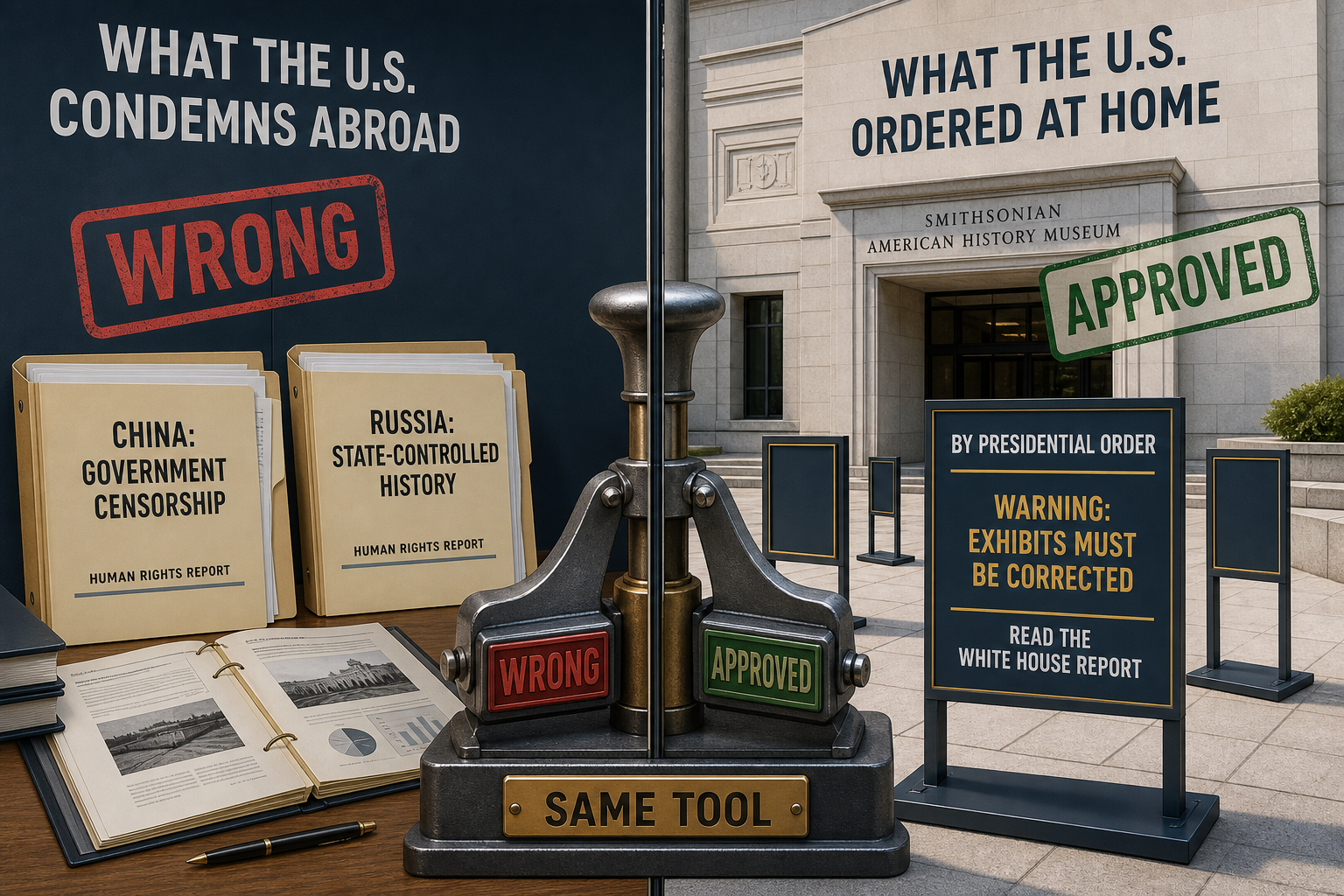
Section 3 does two concrete things: it orders the National Park Service to install signage on the public sidewalks outside the museum stating the exhibits "should be renovated consistent with the findings in the Report," and it separately orders a second, corrective exhibit inside the museum because it "failed to appropriately honor the 56 signers of the Declaration of Independence during this 250th anniversary year."
This has been building for 16 months, not one order
This is the fourth documented step, and each one has gone further than the last: Executive Order 14253, "Restoring Truth and Sanity to American History" (March 27, 2025) → a letter demanding an internal review of Smithsonian exhibitions (August 12, 2025) → a second letter demanding a review of exhibitions and materials (December 18, 2025) → this order (July 24, 2026). The first three steps were private pressure — orders and letters aimed at the Smithsonian itself. This is the first one aimed at the public: a government-written message, planted on the sidewalk the museum's own visitors walk across to get inside. It's also not just paperwork. BL:UF reported in July 2026 that the President's House site in Philadelphia had already replaced a memorial built around nine enslaved people held there with a shorter account that gives George Washington more room and slavery less detail — a real exhibit, already changed, before this order even existed.
The standard America holds everyone else to
The U.S. State Department's own human rights reports — the same reports that inform U.S. foreign policy and foreign aid decisions — document this exact pattern abroad and call it out by name.
On China, the department's 2024 report states plainly: "Those who made comments deemed politically sensitive in public speeches, performances, exhibitions, academic discussions, or remarks to media... were subject to punitive measures, as were members of their families." The same report documents the case of Xu Guang, a 1989 Tiananmen student leader sentenced in April 2024 to four years in prison for protesting and "demanding the government acknowledge the massacre" — noting the Chinese government still has not given "a comprehensive, credible accounting" of who was killed, detained, or disappeared that year.
On Russia, the department's 2023 report describes an education law subjecting "any educational activity, including informal training sessions, YouTube lectures, and peer-to-peer tutoring, to government regulation," whose stated goal was protecting schoolchildren from "anti-Russian propaganda submitted under the guise of educational activities" — a law "prominent academics warned... would stifle intellectual freedom," under which the government "sanctioned academic personnel for their teachings, writing, research, or political views." The same report documents Russia's FSB opening a criminal investigation into the Center of Historical Memory in Perm — an organization whose entire purpose is preserving historical memory, and the successor to Memorial, the human rights group Russia forcibly liquidated in 2022 — accusing its staff of trying to "illegally export" the group's archives out of the country.
Is it actually the same?
Not entirely, and the honest answer matters more than a clean headline would.
Where the comparison holds: the method works the same way. In both directions, a government decided a museum, an archive, or a school was telling the wrong version of the national story — and used its money and authority over that institution to force a different one. The Smithsonian order's own words — a report dictating what "should" be in the exhibits, tied directly to "funding or contract conditions" — aren't a soft version of that. They're a direct one.
Where the comparison breaks down: in every case above, the foreign government went further and punished a specific person for it. Xu Guang went to prison. The Center of Historical Memory's staff are under active FSB investigation. Nothing in the Smithsonian's case reaches that. National Museum of American History director Anthea Hartig has already, publicly and on the record, said the government's report is wrong about her museum — and nothing has happened to her for saying it. Her full statement: "As we continue to fact check the report, we unwaveringly attest that it does not fairly or accurately characterize the full body of work at the museum. There is always room for improvement. But I also know the beauty and the inspiration and the expertise that lies in our collections, our exhibits, and our programming."
That difference is real, and it matters. The United States is not doing to its own museum staff what China and Russia do to theirs. But it is using the same tool — government pressure plus money, aimed at forcing a preferred version of history — that its own reporting calls a human-rights problem when someone else does it.
What this piece is not saying
This isn't saying the Smithsonian's exhibits are, or aren't, fairly presented — that's a live, unresolved argument between the report's authors and the museum's own director, and we aren't settling it here. It isn't saying the executive order is illegal — Congress and the president have real, long-standing authority over how federal money gets spent, and pretty much nobody disputes that. And it isn't saying the U.S. is now the same as China or Russia — the punishments aren't close, and saying otherwise would be its own kind of double standard, just pointed at ourselves instead of at other countries. What is true and documented: the U.S. government is now using, on its own most prominent history museum, the same kind of money-and-pressure tool it calls a human-rights problem when other governments use it.
What can I do?
Contact the people who actually oversee the Smithsonian. By law, its governing board — the Board of Regents — includes three sitting U.S. Senators and three sitting U.S. Representatives. None of them publish a direct email — Congress never does, by design — so "contact" below means their official web form, the real channel:
- Sen. John Boozman (R-AR) — Contact · X/Twitter
- Sen. Catherine Cortez Masto (D-NV) — Contact · X/Twitter
- Sen. Gary Peters (D-MI) — Contact · X/Twitter
- Rep. Doris Matsui (D-CA) — Contact · X/Twitter
- Rep. Adrian Smith (R-NE) — Contact · X/Twitter
- Rep. Carlos Giménez (R-FL) — Contact · X/Twitter
They're the people with actual, legal authority over how the Smithsonian responds to this — not a symbolic audience. If one of them represents you, that's a real call or letter, not a form email into the void.
Read the report yourself, in part. It's public, 162 pages, released July 4, 2026 — but it opens with pages of 1950s and '60s congressional testimony and LBJ speeches before it gets to any actual findings, and it's a one-sided argument, not a neutral study. Skim the executive summary and the findings on specific exhibits rather than treating the whole thing as required reading.
Watch what the physical signs actually say once they're installed. The order sets no deadline. When the signage goes up, its literal wording — not the order's paraphrase of its own intent — is the real test of how far this goes.
Track whether anything happens to Smithsonian funding or staff beyond the signage. The order's language about "funding or contract conditions" is broad. Whether that stays rhetorical or becomes a real budget fight is the next fact to watch for.
The Receipts
- White House — "Restoring Trust in the Smithsonian Institution" (Executive Order, July 24, 2026)
- Domestic Policy Council — "Saving America's Story" (162 pp., July 4, 2026) — the report itself
- White House — Fact Sheet: President Donald J. Trump Restores Trust in the Smithsonian Institution
- Smithsonian Institution — The Board of Regents (official fact sheet, member list)
- U.S. Department of State — Country Reports on Human Rights Practices for 2024: China
- U.S. Department of State — Country Reports on Human Rights Practices for 2023: Russia
- NBC News — "Trump orders signage warning visitors of 'inaccurate information' at Smithsonian"
- Fox News — "Trump orders signs outside Smithsonian museum amid row over its depiction of American history" (Hartig quote)
- NPR — "Trump executive order seeks to 'restore' American history through Smithsonian overhaul" (March 2025 predecessor order)