What happened, specifically
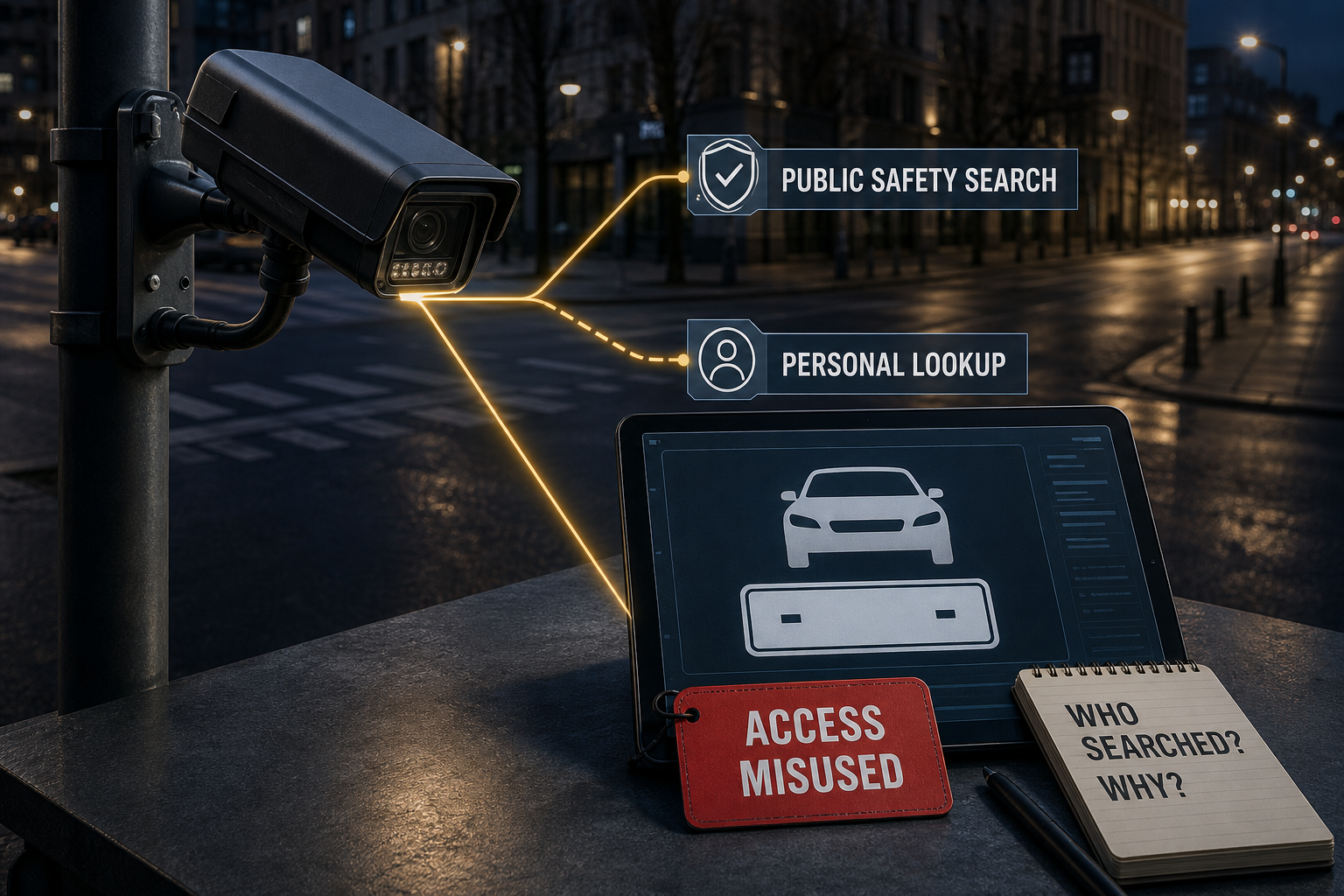
Ayala's case, per the criminal complaint filed in Milwaukee County: between March and May 2025, he ran the license plate of a woman he was dating 124 times, and the plate of her ex-boyfriend 55 times — every search logged with the justification "investigation." The ex discovered the searches through a public plate-lookup tool and reported it. Ayala's plea deal required him to resign; he pleaded guilty in June to attempted misconduct in public office and was sentenced in July to 12 months' probation and a $500 fine. Milwaukee County Deputy District Attorney Matthew Torbenson, at sentencing: "This case represents an abuse of power and a misuse of power. It results in a lack of trust from our community."
Then it happened again, inside the same investigation. Tehrangi Chapman was one of the two detectives assigned to look into Ayala. In July, Chapman was himself charged — with misconduct in public office and misuse of a GPS device. According to the criminal complaint, he ran two people's plates a combined 20 times and secretly installed a GPS tracker on one woman's car; prosecutors say he admitted to this in a recorded interview, though none of it has been proven in court and Chapman has not been convicted of anything. He's suspended with pay. As of the charges being filed, he had an initial court appearance scheduled and a $1,000 signature bond set; this piece has not independently confirmed what's happened at or since that appearance, and treats the case as unresolved pending a direct docket check before publication. (He was charged via a summons process, not a documented physical arrest — worth being precise about, since some coverage has used "arrested.")
This isn't confined to Milwaukee. Georgia's Bureau of Investigation arrested five Albany, Georgia police officers on July 6, all no longer employed by the department — Nicholas Richardson, Ty'Tianna Davis, Jade Jackson, Issac Whitus, and Brittney Smith, ages 23 to 32 — for what GBI's own press release describes as using retained license-plate data "for non-law-enforcement purposes," facing 11, 5, 2, 2, and 1 counts of license-plate-data misuse respectively. GBI's account credits an internal Albany PD audit of the Flock system with surfacing the cases; the department's own police chief has separately credited Flock's audit function specifically, though the two characterizations aren't identical and this piece treats GBI's own language as the more precise one. This remains an active, ongoing investigation, and none of the five have been convicted of anything. Two Greer, South Carolina officers were fired in late June for the same thing: one falsely logged his searches as a "welfare check" while tracking a former partner; the other logged his as "Alcohol Offense Non-DUI" while tracking several residents' vehicles for months.
The Institute for Justice, a nonprofit law firm that's separately suing over the underlying legal question (more below), maintains a running public count of cases like these — currently in the high twenties, up from 14 when the count started, and the group itself calls it "almost certainly an undercount," since most cases only surface through a victim's complaint or a records request, not a department catching its own.
The company says it's catching this. The independent data says the deeper problem is upstream.
Flock built and gave away, free, to every agency using its system, a tool called Audit Assistance that flags unusual search patterns for review. It launched in April 2026, not "last month" as some coverage framed it relative to a late-July news cycle; Flock's follow-up press release, three days before this story broke, claimed the tool "has helped several agencies identify misuse cases" without giving a number.
Michael Soyfer, an Institute for Justice attorney, makes the sharper point: an audit tool only catches misuse after it's already happened. It doesn't require an officer to have a warrant or even a specific, checkable reason before running a search in the first place. The Electronic Frontier Foundation's analysis of a dataset of 11.4 million Flock searches nationwide, cited by the ACLU, found that more than 14% of the required justification fields contained nothing but the word "investigation" — no case number, no context. Separately, the ACLU of Massachusetts found a similar pattern of vague, unfalsifiable descriptions using public-records requests to departments across that state. The justification field is supposed to be the guardrail. In practice, it's frequently nothing at all.
Separately, and for a different reason: the Los Angeles Police Department cut ties with Flock entirely this month after an internal audit found one in three of the system's "hot list" alerts — the automated flags meant to catch stolen vehicles or wanted plates — were false. That's not a misuse problem. That's a reliability problem, on top of everything else.
The bigger legal fight, and why it runs through Flock's own backyard
Underneath all of this is one unresolved constitutional question: does using a network of cameras to track where your car has been amount to a "search" that requires a warrant? Right now, courts disagree, and the most consequential live case is playing out in Norfolk, Virginia — over Norfolk's own roughly 170-camera Flock network.
Two Norfolk residents, represented by the Institute for Justice, sued the city, arguing the network's saturation-level coverage amounts to constant tracking the Fourth Amendment doesn't allow without a warrant. A federal judge initially let the case proceed past a motion to dismiss in February 2025, before ultimately ruling against the plaintiffs on summary judgment in January 2026, finding the network doesn't add up to a "search" — the cameras have coverage gaps, don't track continuously, and only capture what's visible on a public road. Flock itself intervened as a party in the case to help defend the city.
The case is now on appeal to the Fourth Circuit (No. 26-1227), and the amicus picture is bigger and more lopsided than a quick read suggests — cutting both ways, but not evenly. Seven separate briefs have been filed urging reversal: a joint brief from the ACLU, ACLU of Virginia, and EFF; the Cato Institute; a joint brief from the Innocence Project and NYU's Center on Race, Inequality, and the Law; the Policing Project at NYU; the New Civil Liberties Alliance; the Electronic Privacy Information Center; and the Project for Privacy and Surveillance Accountability. On the other side, six separate filings support Norfolk: the Commonwealth of Virginia; the United States government; a joint brief from sixteen states and the District of Columbia (South Carolina, Alabama, Alaska, Arkansas, Delaware, Georgia, Illinois, Indiana, Kansas, Louisiana, Missouri, Nebraska, Pennsylvania, South Dakota, Tennessee, and Utah, plus D.C.); the Florida State Hispanic Chamber of Commerce, Hispanic Outreach Taskforce, and Multicultural Business Alliance jointly; an anti-trafficking coalition of the Safe House Project, Operation Light Shine, and the Human Trafficking Training Center; and a law-enforcement coalition of the Virginia and North Carolina police chiefs' associations, the North Carolina Sheriffs' Association, the Major Cities Chiefs Association, and the Major County Sheriffs of America. No ruling yet — and with sixteen states, the federal government, and multiple law-enforcement and business groups weighing in for the city against seven briefs for reversal, this isn't a case where the outcome is a foregone conclusion in either direction, even if the volume of support currently favors Norfolk's side.
This isn't an abstract national story for Hampton Roads. It's a lawsuit against the city next door. A Christopher Newport University study found Norfolk-area Flock cameras surveil Black neighborhoods more intensively than white ones. A federal judge separately had to order roughly 600 camera locations across the region unsealed last December, after Hampton Roads localities had been refusing to release them under public-records requests. And while the constitutional question about its own camera network sits unresolved on appeal, Norfolk's city council voted, unanimously, to add more cameras near the casino development — not to pause and wait for the court.
The other thing the cameras get used for
Flock has no official contract with ICE. But state and local departments have run searches on the network for immigration enforcement anyway — sometimes traceable only because officers typed "ICE" or "illegal immigration" directly into the same justification field that's supposed to explain the search. One tracking project counted more than 4,000 such lookups. San Francisco's Flock database alone was queried more than 1.6 million times in seven months by law enforcement agencies from outside California — the basis of a pending California class-action lawsuit alleging Flock violated the state's ALPR privacy law. Flock added a toggle in January letting individual agencies block federal access to their data; several cities have canceled their Flock contracts specifically over this concern since.
What's actually changing, and what isn't
Washington state passed the most concrete response so far: the Driver Privacy Act, signed into law in March, caps how long ALPR data can be kept to 21 days, limits use to specific serious crimes, and — notably — bars sharing the data with civil immigration enforcement outright. A similar effort in Colorado died on the state Senate floor in April after the governor threatened a veto over its warrant requirement and law enforcement pushed back hard. At the city level, at least three councils (Bishop, CA; Columbia Heights, MN; Bandera, TX) voted this year to cancel their Flock contracts outright, while others (Costa Mesa, CA) voted to keep theirs after renegotiating terms. Virginia already has a state ALPR law on the books — retention caps, use restrictions, a logging requirement — but nothing currently pending would change how Norfolk's own network operates, and no Hampton Roads locality has a Flock vote scheduled.
What this piece is not saying
This isn't saying most Flock use is abuse — it isn't. Milwaukee police gave CNN a summary of 24 ALPR-assisted cases in April and 26 in May, including an arrest on a domestic-violence, robbery, and firearm-possession case and another on a strangulation warrant; law enforcement officials have also said Flock cameras helped identify the suspect in last year's mass shooting at Brown University. Torbenson, the same prosecutor who called Ayala's conduct an abuse of power, said at the same hearing that "the vast majority of law enforcement appropriately uses that tool to investigate crime." This also isn't saying the Fourth Circuit will rule against Norfolk — the district court itself denied the city's motion to dismiss before ultimately ruling in its favor on summary judgment, and with both Virginia's state government and the federal government now weighing in on the city's side at the appeals stage, the outcome is genuinely unresolved in either direction. And it isn't saying Flock is indifferent to misuse — the company built and gave away a real detection tool, even if its critics are right that detection alone doesn't fix a system with no warrant requirement in the first place.
What can I do?
Check whether your own plate has been searched. HaveIBeenFlocked.com aggregates audit logs obtained through public-records requests and lets you look up your own plate directly — coverage isn't universal since it depends on which departments have released their logs, but it's a real, personal way to see if this has touched you specifically.
Check whether ALPR cameras are near you. DeFlock is a crowdsourced, open-source map of license-plate-reader cameras nationwide (121,000+ mapped as of this writing) — not exclusive to Flock and not complete, but a real, continuously updated way to see what's actually near you, not a static list that goes stale.
Push back on it directly. The ACLU's Get the Flock Out toolkit has a model resolution for canceling a local Flock contract, guidance for testifying at a city council meeting, and a template email to local legislators — the same kind of organizing that got Bishop, CA, Columbia Heights, MN, and Bandera, TX to cancel their contracts (mentioned above).
If you're in Hampton Roads, your city is the case. The Institute for Justice's Plate Privacy Project is actively litigating against Norfolk's camera network right now and takes public case submissions from people with relevant experience — this is one of the rare instances where a national legal fight is being fought over your own city's cameras specifically.
Read the Institute for Justice's own case tracker on the Norfolk lawsuit, including the amicus briefs and current appeal status: Schmidt v. City of Norfolk case page.
The Receipts
- Milwaukee County criminal complaint — Josue Ayala
- Milwaukee County criminal complaint — Tehrangi Chapman, Case No. 2026CF003239
- Georgia Bureau of Investigation press release — 5 Albany, GA officers arrested (July 6, 2026)
- Post and Courier (Greenville) — Greer, SC officers fired for Flock misuse
- Institute for Justice — running tally of documented ALPR stalking cases
- ACLU — "Police Audit Logs," citing EFF's analysis of 11.4 million Flock searches and the ACLU of Massachusetts' separate findings
- CNN — "Inside the growing police use and misuse of Flock's license-plate reader cameras," by staff (July 26, 2026) — source for the Milwaukee case summary and the Brown University reference
- Courthouse News — "California Drivers Accuse Flock Safety of Sharing Data With Federal and Out-of-State Agencies," source for the San Francisco 1.6 million cross-agency query count
- Flock Safety — Audit Assistance launch, April 14, 2026
- TechTimes — LAPD cuts ties with Flock after 1-in-3 false hot-list alerts
- [Schmidt v. City of Norfolk, E.D. Va. No. 2:24-cv-00621 — summary judgment ruling, Jan. 27, 2026]
- Schmidt v. Norfolk, 4th Cir. No. 26-1227 — pending appeal; ACLU/ACLU-VA/EFF amicus brief
- VPM/CNU study — Hampton Roads Flock cameras and racial disparity
- Virginia Mercury — 600 Hampton Roads Flock camera locations unsealed
- Gibbs Mura v. Flock Safety class action (CA)
- Washington SB 6002, the Driver Privacy Act — signed March 30, 2026
- Colorado SB 26-70 — died on Senate floor, April 2026
- Have I Been Flocked
- DeFlock — crowdsourced open-source map of ALPR cameras nationwide
- ACLU — "Get The Flock Out" toolkit
- Institute for Justice — Plate Privacy Project