What's documented
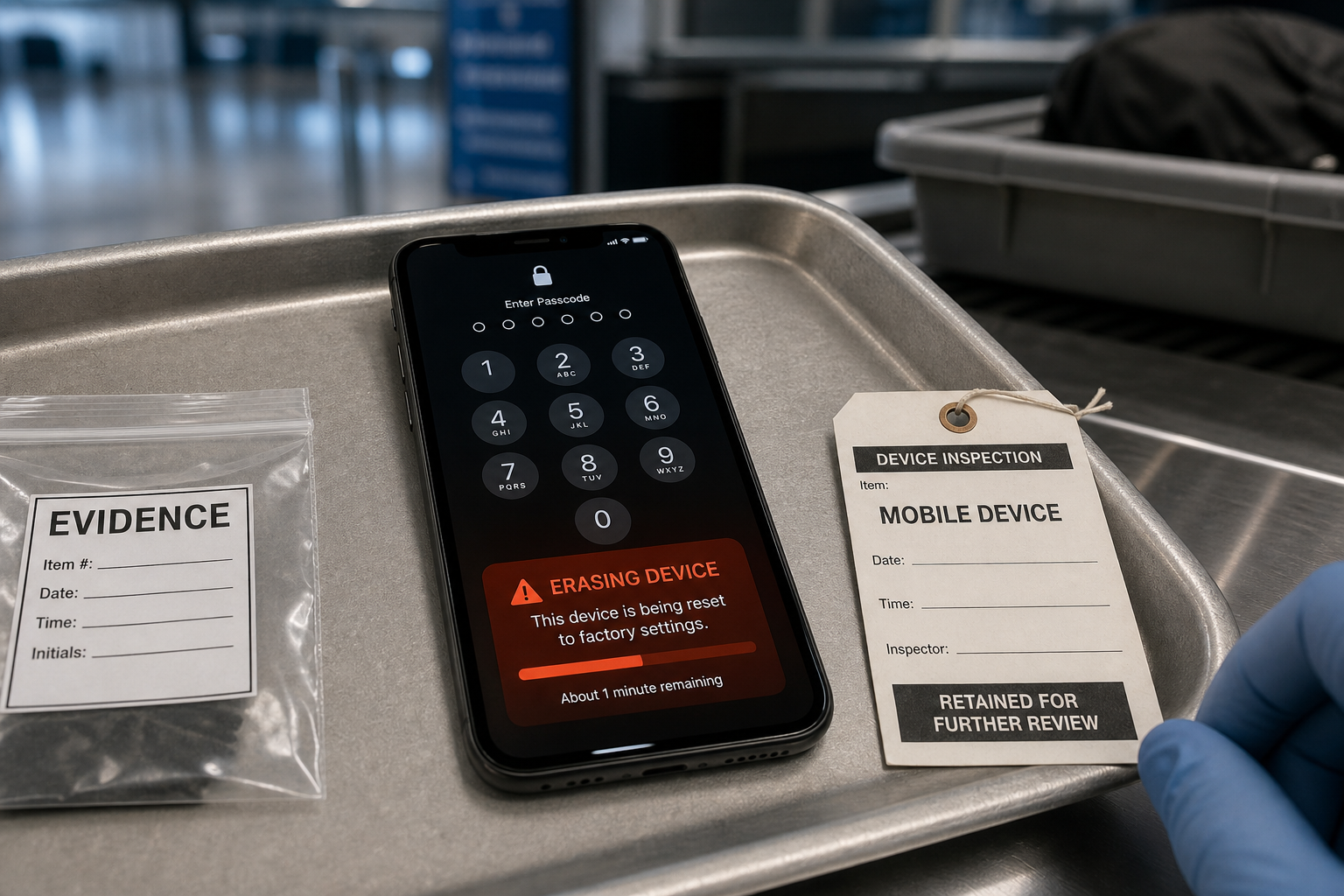
In January 2025, Samuel Tunick was returning to the US through Hartsfield-Jackson Atlanta International Airport when Customs and Border Protection agents stopped him and demanded the passcode to his Google Pixel phone, which ran GrapheneOS, a privacy-focused version of Android. CBP's stated reason for the search: suspected child exploitation material. Tunick gave the agents a code. Instead of unlocking the phone, it triggered the device's built-in duress feature — every account, message, photo, file, and setting on the phone was wiped immediately and permanently.
A federal grand jury indicted Tunick in November 2025 on one count under 18 U.S.C. § 2232(a) — destroying property to prevent its lawful seizure by the government, which carries up to five years in prison. He pleaded not guilty. This is believed to be the first case in the US where someone has been federally charged specifically over a phone's duress-wipe feature.
How a duress PIN actually works
GrapheneOS's duress password is a second, separate code you set up in addition to your real one. Enter your real PIN, the phone unlocks normally. Enter the duress code instead, and the phone immediately and irreversibly wipes every profile on the device — main and any secondary ones, along with installed eSIMs. To anyone watching, it looks like a simple mistake: the screen goes blank, flashes briefly, and the phone appears to restart — the same thing you'd see after fumbling your real PIN a few times. There's no confirmation screen, no announcement, nothing that would tell an officer standing next to you that you just erased the phone on purpose rather than fumbling a password. There's also no way to undo it afterward — no backup restores it, no recovery mode brings it back.
The dispute at the center of the case
Tunick's defense has moved to suppress all evidence from the stop, arguing the search itself was unlawful — and their central claim is that CBP's stated reason didn't hold up. Per their court filing, "the government's reports contain no indication that anyone suspected Tunick of carrying illegal images." If accurate, that's a gap in the government's own paperwork, not just a defense talking point — though it's an allegation made in a motion, not yet a finding by any court.
What the defense says was actually going on: Tunick has been connected to "Defend the Atlanta Forest," also known as "Stop Cop City," a movement opposing construction of an Atlanta-area police and fire training facility. His lawyers argue the child-exploitation justification was "a pretext for a fishing expedition into Mr. Tunick's connections with the Defend the Atlanta Forest movement" — in other words, that the real target was his activism, and the stated reason for the search was invented to get there.
Why the underlying movement matters here
Stop Cop City is not a small or quiet dispute. Georgia prosecutors have pursued a RICO indictment against 61 people connected to the movement's protests. In January 2023, a protester, Manuel "Tortuguita" Paez Terán, was shot and killed by police during a raid on the same encampment the movement was organized around. Whatever the merits of Tunick's specific case, it's happening inside a fight between Georgia law enforcement and this movement that has already produced some of the most serious confrontations between activists and police anywhere in the country in recent years. That context doesn't prove the pretext claim — but it's the reason the claim is being taken seriously rather than dismissed outright.
The bigger question the case raises
Separate from whether CBP's stated reason was genuine, the prosecution itself tests something that's never been tested in federal court before: is destroying your own data, on your own device, to keep the government from seeing it, a crime — even though CBP's own border-search authority already lets them seize and copy the phone's contents without a warrant in the first place? Tunick didn't take anything that belonged to the government. He erased his own property before agents could copy it. Whether that counts as "destroying property to prevent its seizure" under a statute written well before duress-wipe features existed is the actual legal question a court now has to answer.
What this piece is not saying
This isn't a ruling that CBP's search was pretextual, or that agents targeted Tunick for his activism. That's the defense's claim, made in a motion to suppress that hasn't been ruled on. It's also not a ruling that Tunick is innocent of the charge against him — a grand jury indicted him, and the case is proceeding. Both of those things can be true at once: a search can be lawful even if it's also aimed at an activist, and a charge can be legally valid even if the underlying search was flawed. This piece reports what's documented and what's disputed — not who wins.
What can I do
Know what CBP can actually do at the border. Under current law, CBP can search and copy the contents of any phone at a border crossing without a warrant — a lower bar than almost anywhere else in the country. Understanding that is the first step before deciding how you'd want to handle a similar stop.
Understand what a duress PIN protects against, and what it doesn't. It stops someone from seeing your data. It does not stop them from noticing the device is now empty, and — as this case shows — it can carry its own separate legal risk depending on the circumstances.
Follow the actual motion to suppress yourself — here's exactly how. The case is United States v. Tunick, No. 1:25-cr-00499, filed in the Northern District of Georgia on November 13, 2025. The full docket, free to browse with no account needed, is on CourtListener — every filing gets listed there as it happens, and many documents are free to read through CourtListener's RECAP archive once someone else has pulled them. For anything RECAP doesn't have yet, register a free account at pacer.uscourts.gov — registration itself costs nothing, and PACER doesn't charge you at all unless your usage tops $30 in a calendar quarter (documents run 10 cents a page, capped at $3 each), which most people never hit. Search by the case number above, not the party name, to go straight to the docket without triggering a search fee.
The Receipts
- CourtListener — United States v. Tunick, No. 1:25-cr-00499 (N.D. Ga.), full docket
- TechCrunch — US accuses American of allegedly wiping his phone using a 'duress' password during border search
- Decrypt — A Man Gave Border Agents His Phone Passcode. It Wiped Everything. Now He's Facing Federal Charges
- U.S. News — Border Battle: When Wiping Your Own Phone Is a Crime
- Boing Boing — Border agents entered his password. His phone erased itself. Now he faces a felony
- Cybernews — Man uses GrapheneOS feature to wipe his phone during border search
- Reclaim The Net — GrapheneOS Wipe at Airport Leads to Federal Charge in Atlanta
- NBC News — 61 indicted on racketeering charges in the Stop Cop City movement
- Android Authority — I use a duress PIN to protect my data: here's how it works and why everyone needs one