What's documented
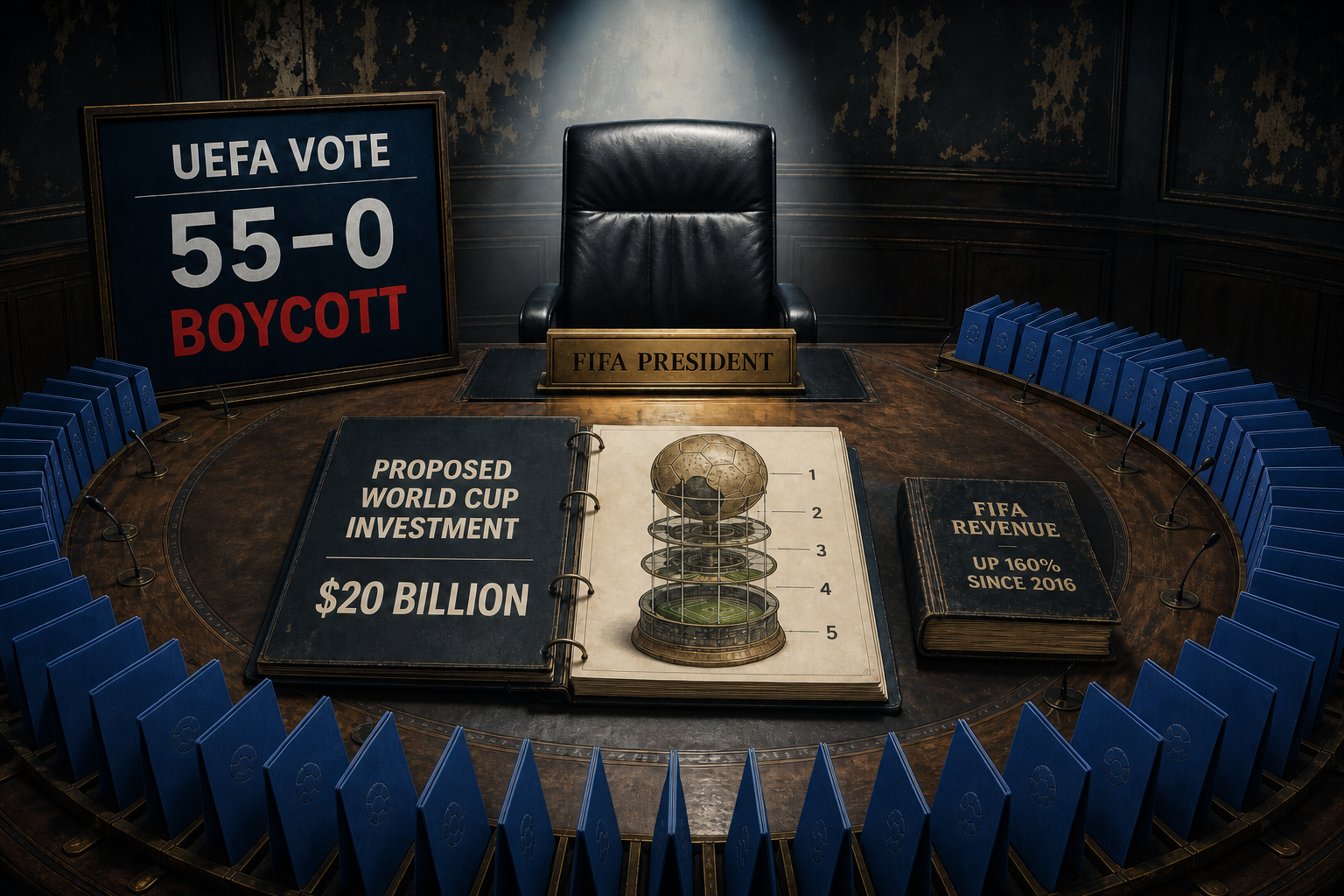
Gianni Infantino has run FIFA since 2016, and by the numbers he was hired to move, he has delivered. FIFA's revenue has climbed every four-year cycle since he took over — $5.72 billion in Sepp Blatter's last cycle, $6.42 billion, $7.57 billion for the Qatar World Cup, and now, per Infantino's own July 2026 statement, over $15 billion for the current cycle. That's roughly 160% growth. FIFA Forward, the program that funnels money to all 211 national federations, has paid out $5.1 billion total across his tenure — real money reaching football programs in countries that had never seen anything like it.
The 48-team World Cup, which just finished its first edition across the US, Mexico, and Canada, was a unanimous FIFA Council decision in 2017. The expanded Club World Cup carried a $1 billion prize pool this year, with FIFA saying $250 million of it went to solidarity payments for clubs that didn't even play in the tournament. Infantino's public case for all of it has been consistent: "in 80% of the world, if we don't invest, if we don't believe... nobody will."
That is the honest pro-case, and it is not nothing.
The pattern
Set against the revenue chart is a second column, and it has been filling in fast.
FIFA overruled its own committee on Qatar. After the 2022 World Cup, FIFA's own human rights subcommittee recommended using a legacy fund to compensate migrant workers for wages, injuries, and deaths tied to World Cup construction. Amnesty International and a coalition of unions had asked for $440 million — matching the tournament's total prize money. FIFA didn't do it. It launched a $50 million "Legacy Fund" instead, with no worker-compensation component at all. Human Rights Watch called FIFA's earlier promises "blatant falsehoods."
The Saudi 2034 human rights assessment was outsourced to a Riyadh-based firm. FIFA's own bid evaluation rated Saudi Arabia "medium risk" for human rights while giving it the highest technical score of any World Cup bid in FIFA's history. The independent risk assessment behind that rating was produced by AS&H Clifford Chance, a Riyadh affiliate of the law firm — and, per Amnesty and a coalition of 22 rights organizations, it consulted no independent experts, no affected workers, and no human rights groups. Amnesty called the whole process an "astonishing whitewash."
Term limits got reinterpreted in his favor. FIFA's 2016 reforms — passed specifically to prevent another Blatter — capped the presidency at three four-year terms, 12 years total. Infantino's first partial term (2016–2019, completing Blatter's unexpired term) was later ruled by FIFA's own governance committee not to count toward that cap. Critics call it a loophole; FIFA calls it a legitimate reading of the rule. Either way, Infantino is now standing for an unopposed fourth term running through 2031, with no declared rival.
And then there's Trump. The relationship built in stages. In March 2025, Trump created a White House Task Force on the World Cup with Infantino at his side. That December, Infantino awarded Trump FIFA's inaugural Peace Prize. Then, during the tournament itself in July 2026, Trump personally called Infantino asking him to review a red-card suspension against USMNT striker Folarin Balogun — and FIFA's disciplinary body reduced the ban. UEFA's own statement called it a decision that had "crossed a red line," calling it "unprecedented, incomprehensible and unjustifiable." A human rights group, FairSquare, filed a complaint with the International Olympic Committee alleging Infantino had breached rules on political neutrality; the IOC has since declined to act on it. UEFA president Aleksander Ceferin skipped the World Cup final entirely, after attending the tournament's opening match — widely read as a signal of disapproval, though he never said so on the record.
The deal that just broke it open
Here is where the Trump thread and the commercialization thread turn out to be the same thread.
In 2025, Infantino held secret talks with Joshua Kushner — the venture capitalist brother of Trump's son-in-law Jared Kushner — about maximizing FIFA's commercial revenue. Those talks became a plan: a new $20 billion subsidiary called FIFA Forward Enterprise, bundling the World Cup's broadcast rights, sponsorships, ticketing, and licensing into one entity, with up to 20% of it sold to outside investors to raise as much as $4.2 billion. Joshua Kushner's investment vehicle, Thrive Eternal, was lined up as the "cornerstone investor." JPMorgan was brought in early this year to package the media rights. FIFA gave its 211 member federations a September 19 deadline to approve it, and attached money to the answer: $20 million to each federation on approval, followed by payments of $20 million, $22 million and $24 million between 2027 and 2038 — roughly $86 million in all. Federations are in line for about $8 million in ordinary forward funding over 2027–2030 regardless. The gap between those two numbers is what a "yes" vote is worth.
(Jared Kushner has a separate, already-documented role in the World Cup story — as a White House contact who helped secure MetLife Stadium as the final's venue. That is a different thing from his brother's investment stake, and the two shouldn't be conflated.)
Today, all 55 UEFA member federations voted unanimously to boycott every FIFA competition, including the World Cup, unless the plan is scrapped entirely. UEFA's statement: "The World Cup cannot be treated as an investment product... No part of it should ever be surrendered to private investors. The World Cup is not for sale." The AFC's president separately called FIFA's lack of consultation "totally unacceptable." Infantino's response has been to downplay it: "a proposal, not an obligation."
An entire confederation voting to boycott the World Cup itself has no precedent in FIFA's history. It is also, so far, one confederation: as of this writing CONCACAF has been publicly critical without joining the boycott, CAF has not taken a position, and CONMEBOL has stayed silent. Whether UEFA stands alone or others follow is the thing to watch next — though UEFA may not need company. The commercial logic cuts against Infantino here: outside investors are unlikely to buy into a World Cup that Europe's teams have voted not to play in, which is why the boycott is being read as potentially fatal to the plan rather than merely symbolic.
That threat worked faster than anyone expected. On Friday, July 31 -- one day after UEFA's vote -- Infantino announced the plan was dead: "Having listened carefully to all the views, it has become clear that the project has created divisions of a nature that... are no longer in the interest of the objective set out in the first place. As a result, this proposal will not proceed." Concacaf (41 associations) and the AFC (47) had rejected it the same day, calling FIFA's process a lack of "due process" and "unacceptable." CONMEBOL held back from rejecting it outright, asking instead for more information; CAF said it would discuss the plan the following week; the Oceania Football Confederation opened its own member consultation, with a decision expected in August. Total opposition, at the moment the plan collapsed: 143 of FIFA's 211 member associations, across three confederations, on record against it.
The retreat didn't stop the bleeding inside FIFA itself. The same day Infantino killed the deal, his own Chief Operating Officer, Kevin Lamour, told the Associated Press: "It is the project of one person... Not only must this project not go ahead... but the time has now come for football political leaders to ask themselves the right questions and make the right decisions. And if that means I lose my job, then so be it. I will understand and respect that decision. At least I'll sleep well tonight." That's a sitting FIFA COO, not an outside critic, saying it in public. Carlos Cordeiro, a senior adviser to Infantino, had resigned a day earlier over the same plan: "I cannot stand by while FIFA considers selling a stake in the World Cup... It is a bad deal for FIFA's Member Associations, a bad deal for football, and a bad deal for the long-term future of the game."
Is it time for him to go?
The question has moved since the deal collapsed. It's no longer just a judgment call weighed against a scandal-free ethics record -- it now has an actual institutional mechanism behind it.
On Saturday, August 1, UEFA released a statement welcoming FIFA's reversal but making its unhappiness with Infantino explicit: "We cannot keep going on like this with secret schemes on fast track timescales, cooked up by faceless individuals and of dubious benefit to the game. We must identify those responsible and hold them to account." The statement said Infantino had promised to be "transparent" when he was elected in 2016 and had failed to deliver: "The shabby, back room, opaque deal he hatched and tried to force through were anything but transparent." That public statement, notably, stopped short of explicitly calling for his resignation.
Separately, the Telegraph reported -- since repeated by more than half a dozen other outlets citing the same account -- that UEFA privately told Infantino to resign or face a formal vote of no confidence. The mechanism for that vote is real and already sitting in FIFA's own statutes: an extraordinary congress can be forced by a written request from one-fifth of member associations, 43 of FIFA's 211. UEFA's 55 members clear that threshold by itself, without needing another confederation's support. As of this writing, Infantino has given no public indication that he intends to resign, and FIFA's own statement said his focus now is "to bring all interested parties back together."
Whether that adds up to disqualifying is still, honestly, a judgment call -- UEFA's own public language stopped one step short of demanding he go, and no formal FIFA ethics finding stands against him. But the shape of the pressure has changed entirely from where this piece started. It is no longer one league president (LaLiga's Javier Tebas, still the only person with domestic-league-level standing to call directly for resignation) and a scandal-plagued predecessor throwing stones. It is now: a sitting FIFA Chief Operating Officer breaking with the president in public; a senior adviser resigning over the deal by name; three confederations representing 143 national associations on record against the plan Infantino himself pushed through in secret; and the federation with the clearest legal path to force a removal vote saying, on the record, that it has lost confidence in his leadership. Sepp Blatter -- Infantino's own predecessor, banned from football activity in 2015 over ethics violations, and not a clean voice to invoke as a moral authority -- nonetheless said the Trump relationship specifically "has reached a financial dimension that is deeply damaging football." Even a discredited critic making that observation is a data point, not a verdict.
What this piece is not saying
This isn't a claim that FIFA caused the Qatar or Saudi human rights abuses directly — those are host-government responsibilities under host-country law. What FIFA is responsible for is its own due diligence process, its own committee's recommendations, and its own decision to award and defend those hosting rights anyway. That distinction matters and this piece has tried to hold it throughout. It's also not a claim that UEFA's public statement demanded Infantino's resignation -- it explicitly didn't, and the resign-or-face-a-vote account is reported, sourced to the Telegraph, not confirmed here directly. And it isn't a prediction that Infantino will actually be removed -- the mechanism exists, the numbers exist, and as of this writing he has shown no sign of stepping down.
It's also not a claim that Ceferin's absence from the World Cup final was a confirmed protest — that's a widely-held interpretation, not something he said himself. And it's not a claim that Jared Kushner is personally involved in the FIFA stake sale — the documented investor relationship runs through his brother Joshua's firm.
What can I do
The honest answer first: an ordinary fan has no direct lever into the vote that actually matters. FIFA's president is chosen by 211 national federations, one vote each, and how each federation casts that vote is almost entirely insulated from individual fans. Don't let anyone tell you otherwise.
What's real, underneath that:
Sign Amnesty International's current 2026 World Cup petition. Unlike stale Qatar-era campaigns, this one is live and tied to the tournament that just happened, asking FIFA and host governments to respect peaceful protest and stop using the tournament as cover for mass detention or discrimination.
Join a real fan organization — they're free, and they've actually won things. Football Supporters Europe helped drive a 2025 Council of Europe recommendation strengthening travelling fans' rights. The Football Supporters' Association (England/Wales) holds two seats on the FA's governing council. In North America, the Independent Supporters Council represents 140+ fan groups pushing FIFA on hosting commitments.
If you're a US Soccer member, there's an actual vote — the Fan Council sits as a voting bloc on decisions including Federation leadership. Eligibility starts at the Premium Insider membership tier, currently $45/year, which is worth knowing before you go looking for it.
What doesn't belong on this list, and shouldn't be mistaken for action: FIFPRO has no fan-facing membership or campaign — it's a players' union, not something you join. The various "remove Infantino" petitions circulating online have, at most, a few hundred signatures and no backing from any credible organization. And reading a watchdog's report card — Transparency International's FIFA tracker hasn't been updated since 2015 — is research, not leverage. Don't confuse it for the real thing.
The Receipts
FIFA scraps controversial $20 billion World Cup investment plan — CNN
European soccer declares loss of confidence in FIFA chief — CNN
UEFA welcomes FIFA U-turn but says Infantino 'has failed to deliver' — Yahoo Sports
UEFA threatens Infantino: resign or face a vote of no confidence — Goal.com, citing The Telegraph
Statement on behalf of Concacaf and its 41 Member Associations — Concacaf
UEFA vows World Cup boycott as Concacaf, AFC reject FIFA private equity plan — ESPN
CONMEBOL wants 'additional information' on FIFA private investor plan — theScore
OFC Statement on FIFA Forward Enterprise — Oceania Football Confederation
Sepp Blatter slams Gianni Infantino for selling FIFA to investors close to Donald Trump inner circle — IBTimes UK
FIFA — Infantino statement on $15B+ revenue for 2023-2026 cycle, July 18, 2026
Human Rights Watch — "FIFA: No Remedy for Qatar Migrant Worker Abuses," Nov 20, 2023
Amnesty International — Qatar Legacy Fund "ignores exploited workers," Nov 2024
Sport & Rights Alliance — "Flawed Human Rights Assessment of Saudi Arabia's FIFA 2034 World Cup Bid"
Amnesty International — statement on Saudi Arabia confirmed as 2034 host, Dec 11, 2024
CNBC — the FIFA stake-sale plan and the backlash, July 29, 2026
SWI swissinfo.ch — "Secret Talks With Kushner Led to FIFA's Controversial Sale Plans"
Al Jazeera — UEFA members vote to boycott FIFA, July 30, 2026
ESPN — Javier Tebas calls for Infantino to step down, July 21, 2026