Picture a courtroom in 1857. The Supreme Court is about to answer one question: can a Black man be a citizen of the United States? Its answer — seven justices to two — was no. Not "not yet." No, and never. That case, Dred Scott v. Sandford, helped push the country into the Civil War. It is also, strange as it sounds, where today's fight over birthright citizenship begins.
What the 14th Amendment actually is
After the war, the 13th Amendment (1865) abolished slavery. But ending slavery didn't make the formerly enslaved citizens — Dred Scott was still on the books saying they never could be, and Southern "Black Codes" kept freed people in a second-class limbo. So in 1868 the country did something extraordinary: it amended the Constitution itself to overrule the Court.
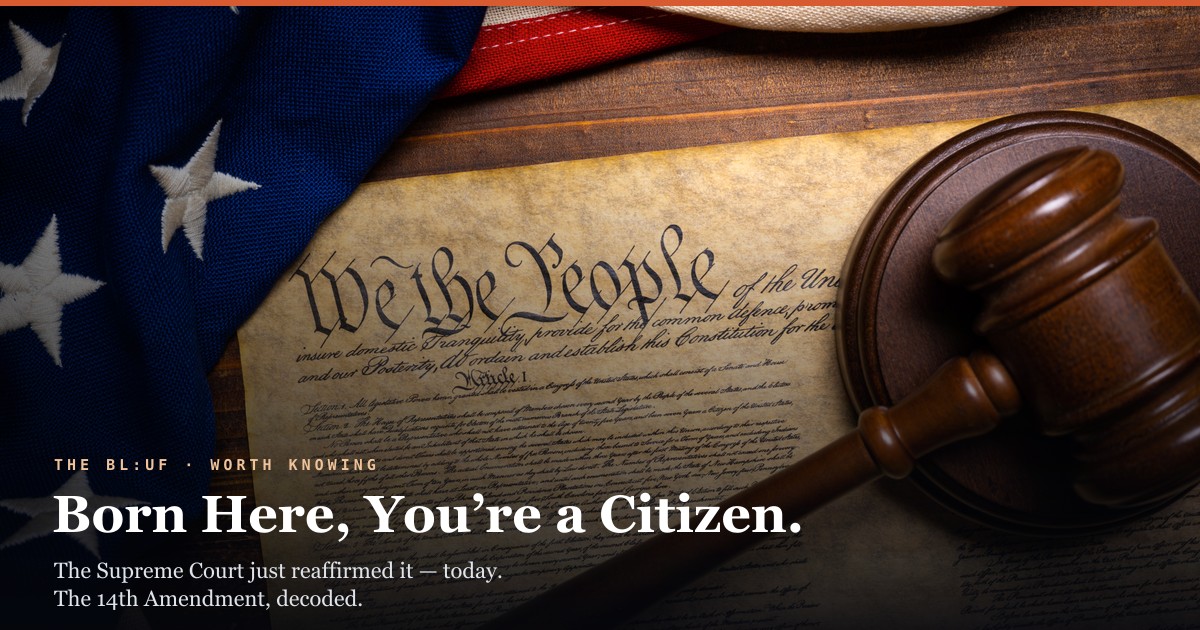
The 14th Amendment's first line settles it: "All persons born or naturalized in the United States, and subject to the jurisdiction thereof, are citizens." Born here — you're a citizen. It also guarantees equal protection and due process. It took the thing Dred Scott denied and wrote it into the nation's foundation, where a single court couldn't take it back. In 1898, United States v. Wong Kim Ark nailed it down: a man born in San Francisco to Chinese parents was a citizen, even though his parents — under the laws of the time — could not be.
What happened today
In January 2025, an executive order tried to deny citizenship to some children born here — to parents who were undocumented, or lawfully but only temporarily present. Every court that looked at it struck it down. The Supreme Court first weighed in only on procedure — Trump v. CASA (2025) limited how broadly lower courts could block the order, without touching the constitutional question.
Today — June 30, 2026 — the Court answered the constitutional question head-on. In Trump v. Barbara, by six to three, it struck the order down, holding it cannot be reconciled with the 14th Amendment. Birthright citizenship stays.
The claim that's wrong — and the one that isn't
You may have heard that getting rid of the 14th would "make Black Americans slaves again." That's false, and it's worth being precise about why: slavery was abolished by the 13th Amendment — a separate amendment. Repeal the 14th tomorrow and the 13th still bans slavery. Nobody becomes property again.
But don't hear "false" and think "no big deal." What ending the 14th would threaten is citizenship and equal protection — you could have people born here who are no longer automatically citizens, effectively stateless, and you'd weaken the rule that government must treat people equally under the law. That's not slavery. It's the legal foundation that turned "free" into "fully, permanently American." Both things are true: the slavery line is wrong, and the real stake is serious.
The honest other side
There is a good-faith argument on the other side, and it deserves a fair hearing. Some legal scholars read the phrase "subject to the jurisdiction thereof" as excluding people who owe allegiance elsewhere — arguing the 1868 framers weren't thinking about the children of people here unlawfully, so narrowing birthright citizenship isn't defying the 14th but reading a limit already in it. The counter — and the reading that has held for more than a century — is Wong Kim Ark: the Court read that phrase narrowly, excluding a small set (like children of foreign diplomats), not the children of ordinary immigrants. In Barbara, the Court took up that narrowing argument and rejected it.
The bottom line
The 14th Amendment was born to overrule a Supreme Court that told millions of people they could never belong. It says: born here, you're a citizen — and the government has to treat you equally. Today the Court reaffirmed that on the merits. The realistic path to ending birthright citizenship now isn't a court case — it's amending the Constitution. Know where the law came from, and the noise gets a lot quieter.
The receipts
- Dred Scott v. Sandford (1857); 13th Amendment (1865); 14th Amendment (1868); United States v. Wong Kim Ark (1898) — National Archives; the opinions.
- Executive Order 14160 (Jan 20, 2025); Trump v. CASA (June 27, 2025, injunctions only); Trump v. Barbara, No. 25-365 (June 30, 2026, 6–3, merits) — supremecourt.gov; Cornell LII; SCOTUSblog.