A federal judge found that President Donald Trump used a lawsuit against agencies he controls to lend judicial legitimacy to an agreement benefiting himself and his political allies—even though the court never approved that agreement and the two sides were never genuinely opposed.
The finding is not a commentator’s metaphor. U.S. District Judge Kathleen Williams concluded Monday that Trump’s $10 billion case against the Internal Revenue Service and Treasury Department was brought for an “improper purpose.” In a 56-page order, she described an attempt to use the court to legitimize an arrangement that had no viable basis in law or fact.
Her order attacks the mechanism at the center of the deal: Trump was both the private plaintiff and the president overseeing the executive-branch defendants. The Justice Department did not meaningfully defend the agencies. The parties then announced a “settlement” carrying extraordinary benefits for Trump and his allies—without placing it before Williams for approval.
That is the constitutional problem. Federal courts exist to resolve real disputes between genuinely adverse parties. They are not available as a backdrop for an agreement whose participants are ultimately controlled by the same person.
The legitimate grievance underneath it
Trump’s original complaint arose from a real crime. Former IRS contractor Charles Littlejohn unlawfully disclosed confidential tax information belonging to Trump and thousands of other wealthy Americans. Littlejohn pleaded guilty and was sentenced to five years in prison.
That breach could support a legitimate claim for a lawful remedy. It does not automatically validate the arrangement Trump reached after returning to office.
Trump, his two eldest sons and the Trump Organization sued the IRS and Treasury in January, seeking $10 billion. But Williams immediately confronted a structural contradiction: although Trump said he was suing in his personal capacity, he was also president of the United States, with authority over the agencies on the other side.
The government did not file a conventional defense. Trump later withdrew the case while the Justice Department announced what it called a settlement.
The agreement purported to shield Trump, his family and affiliated businesses from certain audits and tax claims. It also initially established a $1.776 billion “Anti-Weaponization Fund” for people who claimed they had been politically targeted by the federal government. Potential recipients included Trump allies and possibly people prosecuted for their roles in the January 6 attack.
The administration abandoned the fund in June after opposition from both parties. The tax protections remained the more durable benefit.
One person appeared to speak for both sides
Williams focused on Acting Attorney General Todd Blanche’s apparent ability to bind Trump and the agencies Trump had sued—and later to abandon part of the agreement on behalf of everyone involved.
That, she concluded, demonstrated that only one set of interests had been represented throughout the case.
The conflict was sharpened by the lawyers’ prior relationships. Blanche had served as Trump’s personal criminal-defense attorney. Associate Attorney General Stanley Woodward had represented January 6 defendants and a co-defendant in Trump’s classified-documents case. Rather than recuse or defend the federal agencies vigorously, Williams found, officials agreed to terms potentially benefiting former clients.
Williams also rejected the idea that Trump’s private identity could simply be separated from his presidential authority when evaluating what occurred. The parties’ formal labels said “plaintiff” and “defendant.” Their conduct, she concluded, did not reflect a real adversarial lawsuit.
What the judge actually did
Williams barred Trump, his family, his businesses and the federal agencies from describing or using the agreement as a legitimate settlement in any judicial, administrative, regulatory, arbitration or other official proceeding. That substantially undermines the purported immunity from future tax scrutiny.
She also imposed financial sanctions, referred Trump attorney Alejandro Brito to the Florida Bar for possible discipline, and blocked attorney Daniel Epstein from obtaining special permission to practice in the Southern District of Florida for up to one year. Copies of the order were directed to disciplinary authorities in New York and Washington, where complaints involving Blanche and Woodward were already pending.
The ruling can be appealed to the Eleventh Circuit. Trump’s lawyers may argue that Williams lost jurisdiction when the lawsuit was voluntarily dismissed. Courts, however, generally retain authority to investigate misuse of their proceedings and impose sanctions after an underlying case ends.
The remedy—and its limit
The court could remove the legitimacy the arrangement was designed to acquire. It could discipline lawyers who used its process and prevent the agreement from operating as an official shield. Williams has now done both.
What her order cannot do by itself is determine whether executive officials committed crimes or remove them from office. Criminal liability would require prosecutors to prove the elements of a specific offense. Removal or disqualification would require congressional action. Bar authorities, not Williams, will decide whether the referred lawyers should lose their licenses.
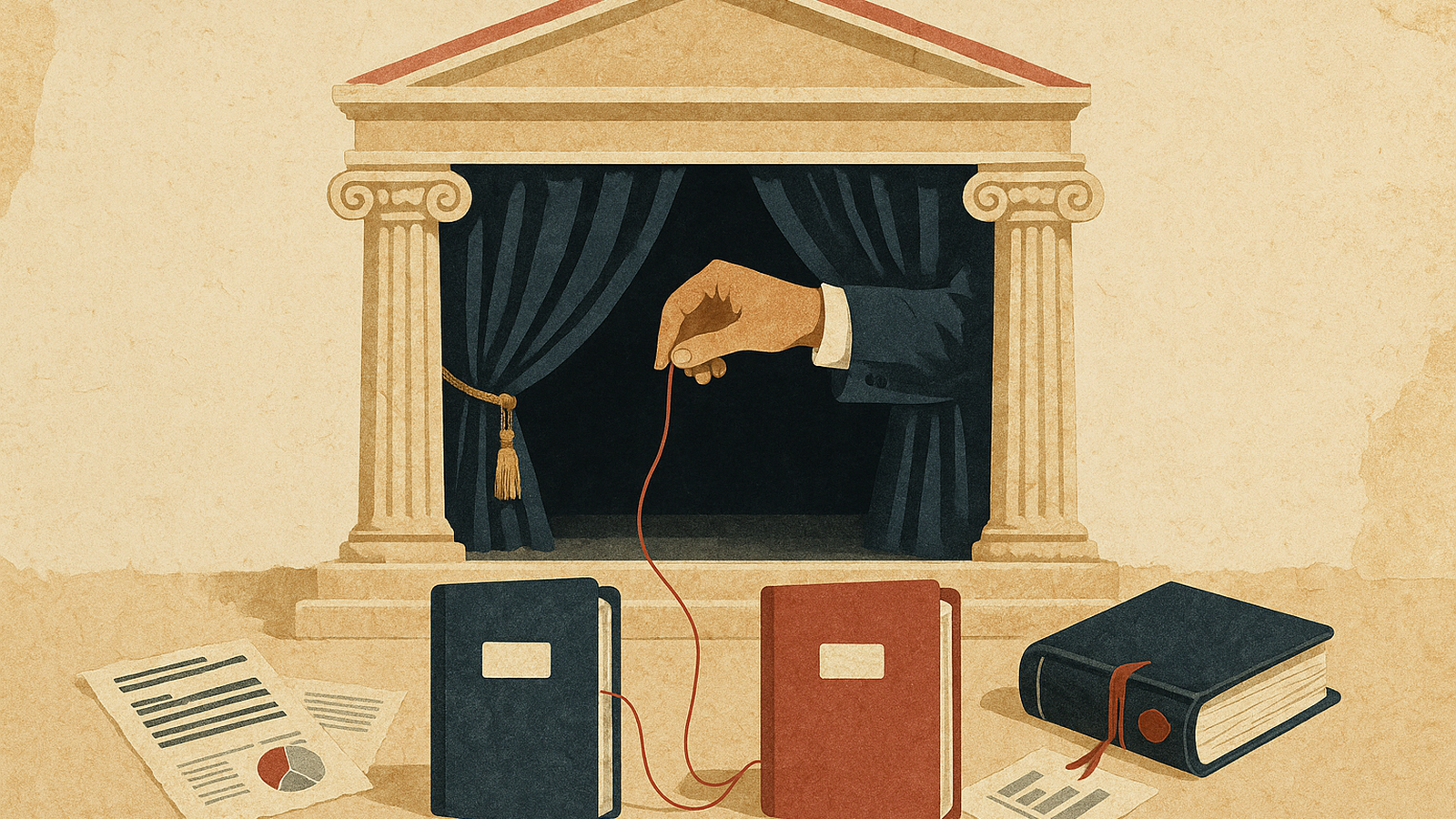
That division of responsibility is the larger test. The judiciary can say that its courtroom was used as scenery. Whether the political and legal systems impose consequences on the people who built the stage now belongs to Congress, professional regulators and—if supported by evidence—prosecutors.
WCID: Ask for the remedy the court cannot provide
- Ask Congress for a specific oversight record. Contact your House representative and U.S. senators and ask whether they support public hearings, preservation of the settlement records and enforceable recusal rules when Justice Department officials negotiate matters involving former clients. A focused request is easier to track than a general expression of outrage.
- Request the paper trail. FOIA.gov explains how to seek federal agency records. Requests should identify a narrow date range and specific records—for example, Justice Department communications approving or revising the agreement—rather than asking an agency to answer questions. Tax-return information, privileged legal advice and some law-enforcement material may lawfully be withheld.
- Follow the institutions already assigned to act. Read the court order, watch any Eleventh Circuit appeal and track the relevant bar proceedings. The judge has already made disciplinary referrals; flooding regulators with duplicate complaints based only on news coverage is unlikely to help. Anyone with independent, relevant evidence should preserve it and use the regulator’s official process.
Sources and reporting note
This analysis is based principally on Judge Kathleen Williams’ July 13 order in Trump v. Internal Revenue Service, the Justice Department’s published settlement agreement, and contemporaneous reporting by the Associated Press and Reuters. The BL:UF did not independently interview the parties.
Visual package
Hero: trump-irs-court-manipulation-hero.png. Use a 16:9 crop. Credit: “Original illustration for The BL:UF.”
Supporting visual 1: Screenshot of the first page or sanctions section of Judge Williams’ order. Credit: “U.S. District Court for the Southern District of Florida via CourtListener.”
Supporting visual 2: Screenshot of the signature or relief section of the Justice Department’s published agreement. Credit: “U.S. Department of Justice.”
Do not use: Unlicensed Politico, AP, Reuters or Getty photography; a generated photorealistic image of Trump or Judge Williams; or imagery implying an arrest, conviction or exchange of cash that did not occur.