Ask a Democrat what their party stands for and watch the pause. It isn't that there's no answer. It's that the answer doesn't come.
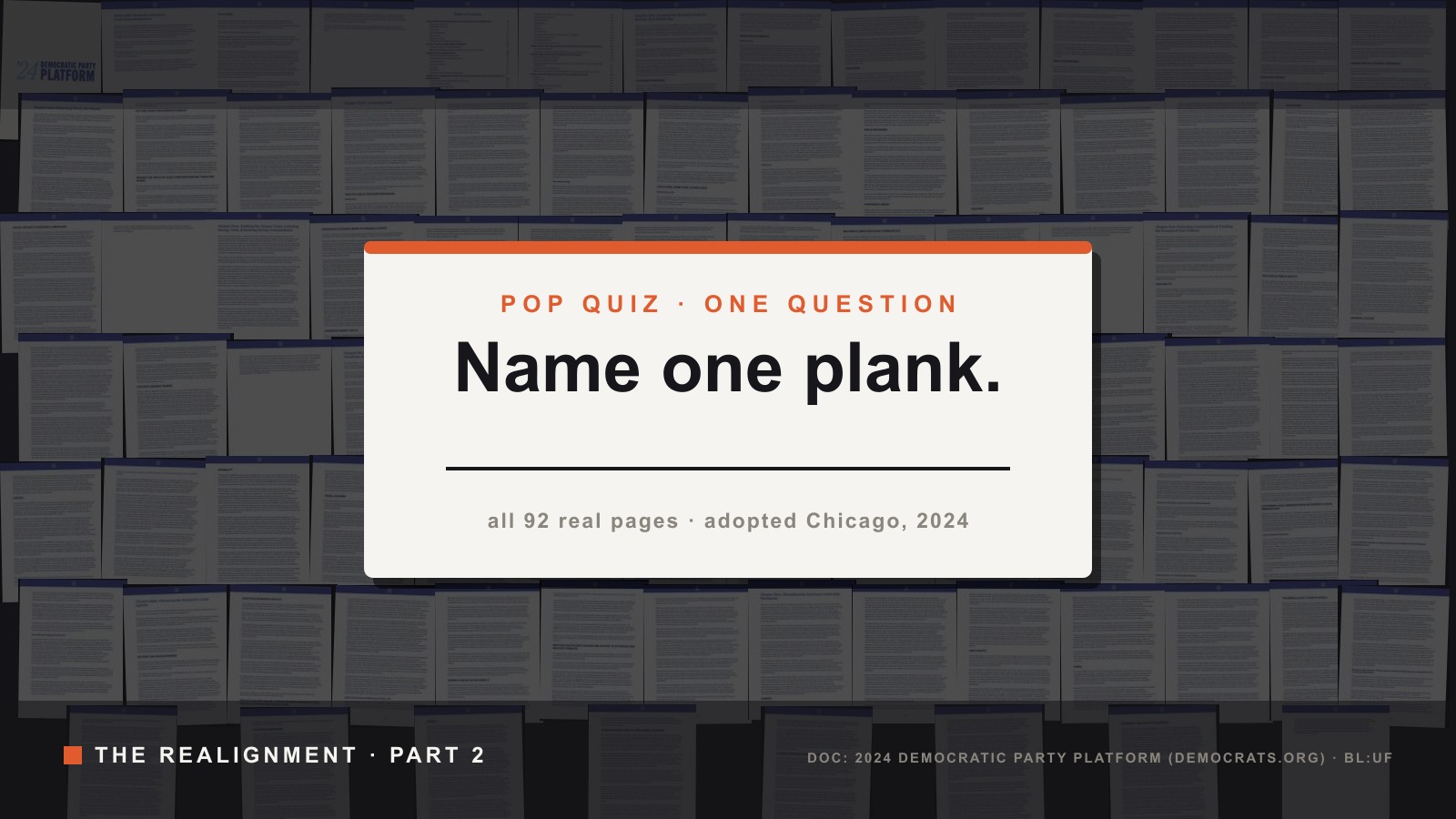
Here's the strange part: the Democratic Party has a platform. A long one — 92 pages, formally adopted at the 2024 convention in Chicago. So why can't most of the people who vote for it name a single plank? Not because the party believes in nothing. Because of three other things.
The platform exists
On paper, the planks are clear. The 2024 platform commits to writing Roe's abortion protections into law and safeguarding contraception and IVF; an economy built "from the middle out" with a focus on lowering everyday costs; protecting the Affordable Care Act and cutting prescription-drug prices; tackling climate change; closing the racial wealth gap; gun-safety laws; voting rights; and border security. Agree or disagree, that's a set of positions. The problem isn't a blank page.
Reason one: the platform is orphaned
That document was written for one moment — to defend an incumbent's record and ask voters to "finish the job." Then the ticket lost, and the president it was built around left office. What's left is a platform arguing to continue an administration that no longer exists. It's a playbook for last season, and nobody re-reads last season's playbook.
Reason two: there's no one to say it
Out of the White House, a party has no obvious leader. The Democrats have three on paper: Ken Martin, who became Democratic National Committee chair in February 2025; House leader Hakeem Jeffries; and Senate leader Chuck Schumer. None functions as a national megaphone — Martin's early tenure has drawn reporting on internal DNC infighting, and for the first time in over a decade more Democrats disapprove than approve of their party's leaders in Congress, with Schumer's standing among the base especially weak. A platform needs a voice that repeats it until it sticks. The loudest Democratic voices right now belong to the insurgents — which is the whole problem, and the subject of the rest of this series.
Reason three: it can't deliver
A plank you can't enact is a wish. Out of power in Washington, the national party can do two things — send a message, and block the other side. It can't pass the drug-pricing bill or the housing plan, because it doesn't have the votes. So the most visible Democratic activity is opposition, and the party's own base describes that posture as weak: in polling, the No. 1 complaint Democrats have about their party isn't ideology — it's that leadership isn't "fighting hard enough."
The honest complication
None of this means the party is losing. As of late 2025, Democrats held their largest lead in years on which party voters want running Congress — around 14 points. Much of that edge runs on opposition to the party in power rather than on a Democratic agenda voters can name — a real vulnerability if the other side isn't on the ballot. But a 14-point lead is still a 14-point lead, and it buys the party time to build the identity it's missing.
A platform nobody repeats isn't felt as a platform. Which raises the next question: when the party does talk, why doesn't it land? That's Part 3.