What's documented
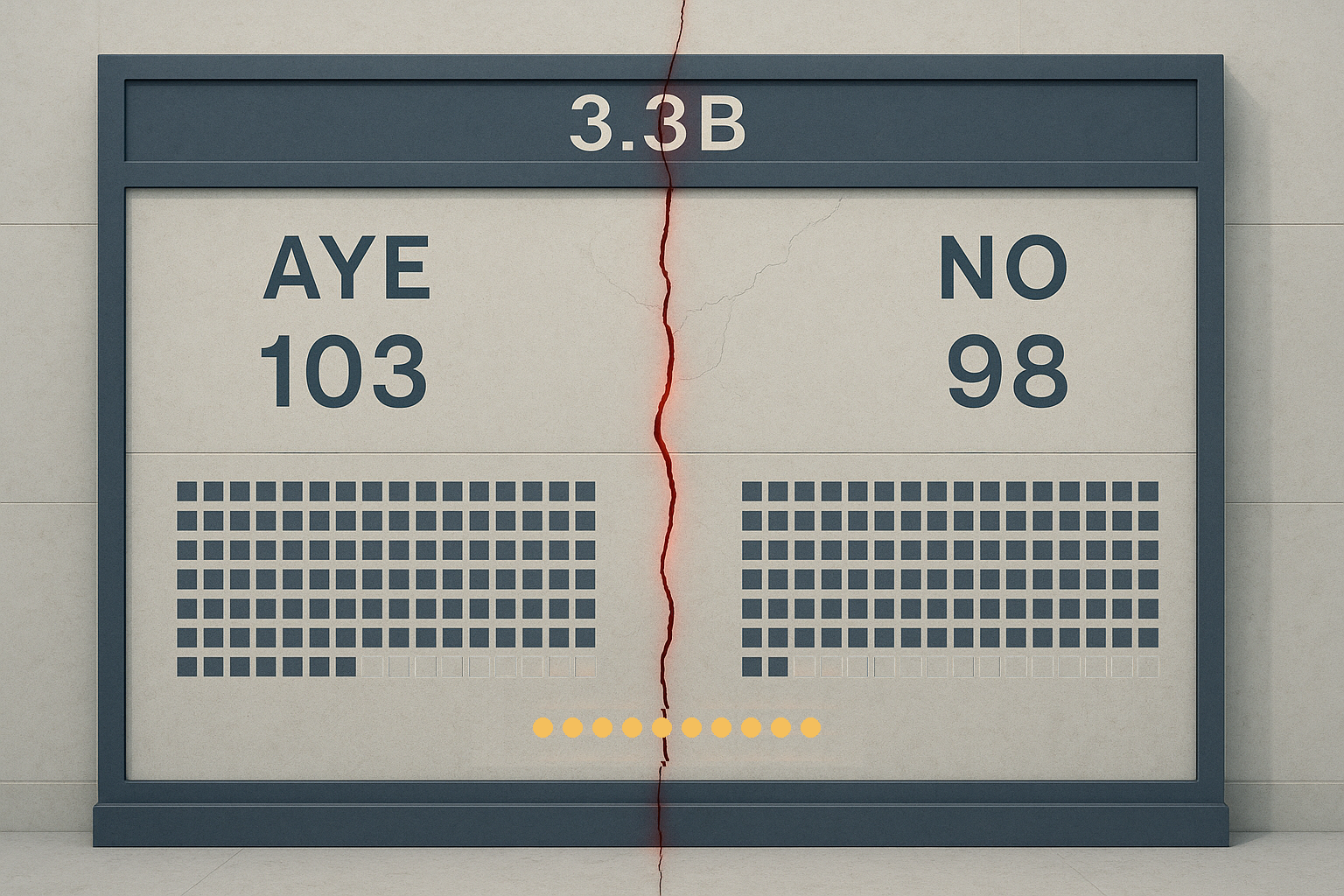
On July 15, the House voted on whether to zero out $3.3 billion in military aid to Israel.
It lost badly: 104 to 314, with 10 voting present.
That's the headline number, and it's the least interesting thing about the vote.
Look inside the Democratic caucus. 103 Democrats voted to cut the money. 98 voted to keep it. Ten voted present. That is a majority of the Democrats who took a side.
Then look at who cast them.
- Nancy Pelosi — voted to cut it
- Katherine Clark, the current Democratic whip — voted to cut it
- Hakeem Jeffries, the Democratic leader — voted to keep it
- Pete Aguilar, the caucus chair — voted to keep it
The current leadership of the House Democrats split against itself. And Nancy Pelosi — not current leadership anymore, but as close to the party's establishment as a person gets — joined the side voting to withhold the money.
One Republican voted with them: Thomas Massie of Kentucky, who wrote the amendment.
Read this part before you read anything into it
The amendment was blunt on purpose, and that matters for what the vote means.
It had no carve-out. Democrats who voted no say it would have cut more than weapons. Jeffries said he opposed it because "it is overly broad," and that it would hurt humanitarian work, refugee resettlement, and efforts against Hamas.
So a "no" vote isn't automatically a vote for the status quo. Some of it is a vote against this particular amendment.
The reverse is just as true. Katherine Clark, the whip, voted yes and said she voted for it "not because I agree with the entirety of the amendment, or the GOP's cynical motivations for its consideration, but because I believe we must change course." She also said "it is clear that the status quo is not tenable" and "we should not provide a blank check for military aid to any country that does not comply with U.S. law, interests, and values."
So the number two Democrat in the House voted for an amendment she says she doesn't fully agree with, written by people whose motives she calls cynical.
We don't know what was behind all 103 of these votes. We know what was behind one of them: not full agreement — a signal that she wants a different policy. Coming from the number two Democrat in the House, that's still worth noticing.
What actually changed
Nothing about the money. Israel's $3.3 billion is intact. The amendment lost by 210 votes.
What changed is what a Democrat can now vote for without it ending their career.
For a long time, cutting military aid to Israel was not a mainstream position in the caucus. On Tuesday, more Democrats voted for it than against it — including the whip, and including Nancy Pelosi.
The party's leader still voted no. So did nearly half the caucus. This isn't a caucus that has decided something. It's a caucus that no longer agrees.
That's a different thing from a policy change, and a bigger one. Policies get reversed. A consensus, once it breaks, is very hard to put back.
What this piece is not saying
We're not saying 103 Democrats want to end American support for Israel. Several said the opposite while voting yes. Clark said it in writing.
We're not saying the 98 who voted no are defending everything Israel's government does. Jeffries said his objection was that the amendment was too broad and would hit humanitarian and anti-Hamas work — that's his stated reason, and this piece isn't second-guessing it.
We're also not saying Congress is about to cut the money. It isn't. The vote wasn't close.
What's documented is narrower: a majority of the House Democrats who took a side voted to zero out military aid to Israel, their current leadership divided over it, and Nancy Pelosi was on the side voting to withhold. All of that is on one roll call, with every name attached.
What can I do?
Look up your own representative, by name. The official roll call is public. Don't take a press release's word for how someone voted — the vote is right there, with all 435 names.
Ask a better question than "do you support Israel." That question has one answer and it tells you nothing. Ask this instead: what conditions, if any, would you put on military aid — and why? That one can't be answered with a slogan.
If your member voted no, ask what they'd vote yes on. Jeffries' stated objection was that this amendment was too broad. That's a testable position. Ask what a narrower one would look like, and whether they'd support it.
The Receipts
- House Clerk: Roll Call 243, July 15, 2026 — the official vote
- CBS News: "House vote to end Israel aid divides Democrats, with 103 voting to cut off funding"
- The Hill: "100 House Democrats vote to cut off aid to Israel, showcasing party shift"
- Roll Call: "Dems split on Massie effort to zero out Israel security aid"
- NBC News: "Nearly half of House Democrats vote to cut off aid to Israel as public opinion shifts"
- Axios: "House Democratic leaders face rare divide over vote to cut off U.S. aid to Israel"
- CNN: "Over 100 House Democrats vote to block billions of dollars in military aid to Israel"