1. The wedge is the product
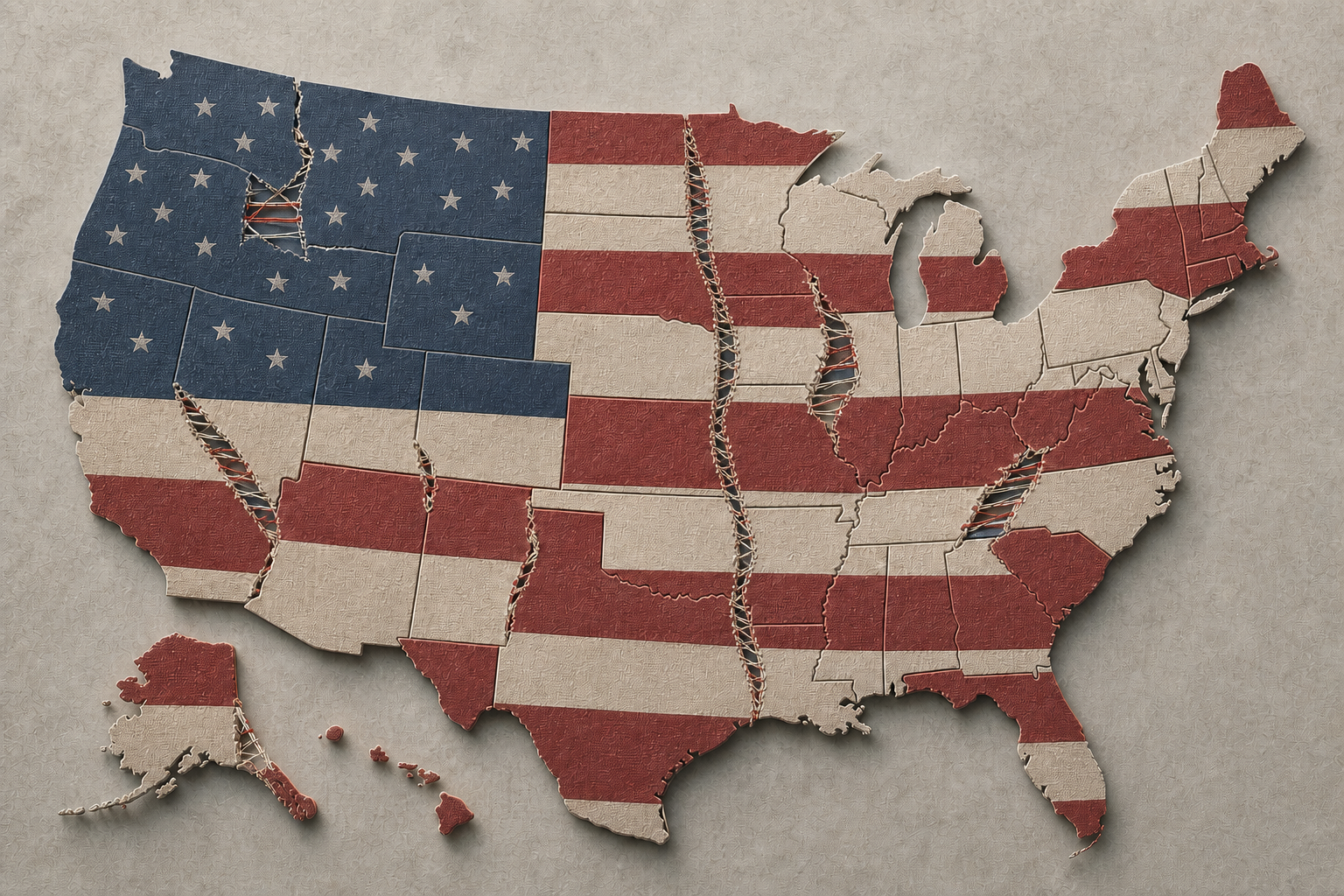
Every episode of this series has followed the same money trail: somebody downstream of your anger is getting paid. The feed sells your attention. The cable channel sells your fear. The fundraising email sells your outrage back to you at a markup. And the one belief that keeps all of it running is this — that the other half of the country is your enemy, that we are hopelessly divided, and that it's only getting worse.
That belief is not a neutral fact you arrived at on your own. It's the thing the machine most needs you to hold, because a country that thinks it's at war clicks more, watches more, and donates more than a country that thinks it can talk. So before the hope, be clear about the trick: "we're too divided to fix anything" is not the weather. It's the product. And the people selling it are wrong about it — measurably.
2. The gap you can measure
Ask a Democrat what the average Republican actually believes, and ask a Republican what the average Democrat believes. Both are badly wrong in the same direction. Researchers at More in Common call it the Perception Gap: partisans imagine almost twice as many people on the other side hold "extreme" views as actually do. We're not fighting the other side. We're fighting a cartoon of it.
The part that should stop you: the gap gets worse the more plugged in you are. People who follow the news "most of the time" were far more distorted than people who follow it "now and then." People who post about politics had a bigger gap than those who don't. The group that reads the other side most accurately is the one tuned out of the daily fight. (More in Common, The Perception Gap, June 2019) That fits the whole series: the machine's best customers — the most engaged, the most sure — are the ones it has misled most.
And the loud wings aren't the country. The same researchers found about two-thirds of Americans — 67% — are the "Exhausted Majority": a real mix of views, worn out by the shouting, convinced we have more in common than divides us. They just don't post about it. (More in Common, Hidden Tribes, October 2018)
3. Where we actually agree
Not a feeling — on the record, in named polls, on the issues that hit the kitchen table:
- Corruption. In a Brennan Center poll (fielded Apr 28–May 6, 2026), 92% of voters called government corruption a big problem — 90% of Republicans, 93% of Democrats, 93% of independents. Ending secret "dark money" drew 85%, about even across all three. (Brennan Center, June 2, 2026)
- Drug prices. In KFF's March 2026 poll, 72% said government does too little to limit prescription-drug prices — 77% of Democrats, 68% of Republicans. Letting Medicare negotiate prices drew 85% and stayed popular after hearing the counterarguments. (KFF, March 2026)
- A long, boring list. In 2024, YouGov tested 155 national policy proposals. 109 of them — 70% — had majority support from both Democrats and Republicans, heaviest in government/election reform, criminal justice, and health care. (YouGov, 2024)
Be honest about what this does and doesn't mean. It does not mean the hard fights — abortion, guns, immigration — are fake. They're real, and this series won't paper over them. And poll agreement is shallower than agreement in a law: add the trade-offs, the price tag, or a partisan messenger, and some support cracks. The point isn't that we agree on everything. It's that we agree on a lot — and almost none of it gets the airtime, the algorithm, or the fundraising email. That's a choice someone is making. It isn't yours.
4. What actually calms it down — and what backfires
Researchers have run the experiments. We're not guessing.
- Correcting the cartoon works — for a while. A 2024 Stanford-led megastudy tested 25 interventions on 32,059 people; one of the most effective was simply showing people what the other side actually believes. The honest catch: much of the effect faded within two weeks. A one-time fact isn't a cure. (Voelkel, Willer et al., Science, 2024 — pin primary DOI at gate)
- Contact works — the oldest, best-tested finding. A 2006 meta-analysis of 515 studies and 250,000+ people found real contact between groups reliably reduces hostility. Knowing someone on the other side beats any argument. (Pettigrew & Tropp, JPSP, 2006)
- Careful what counts as a win. A 2022 study found reducing animosity did not automatically make people less willing to break democratic rules. Feeling warmer is good; it isn't everything. (Voelkel et al., Nature Human Behaviour, 2022)
- Structural fixes are promising but unsettled. Ranked-choice voting and open primaries aim to reward candidates who reach the middle; Alaska's system has been linked to more moderate winners, but other research finds RCV has no clear effect on polarization. Anyone selling it as a settled miracle — or proven failure — is ahead of the evidence. (ABA, 2025)
- The one move that's yours. Braver Angels runs structured "Red/Blue" conversations modeled on couples counseling. In a randomized trial they reduced dislike of the other side, with an effect still showing six months later — and the thin versions didn't work; structure mattered. One real conversation with one real person beats a thousand posts about a cartoon. (Baron et al., Political Behavior, 2024)
The pain in this country is real — this series has never said otherwise. But the enemy was never the person across the line. It was the line, and the people who need you to believe it can never be crossed. The evidence says it can. Most of us are already on the other side of it, waiting for the noise to stop.