What's documented
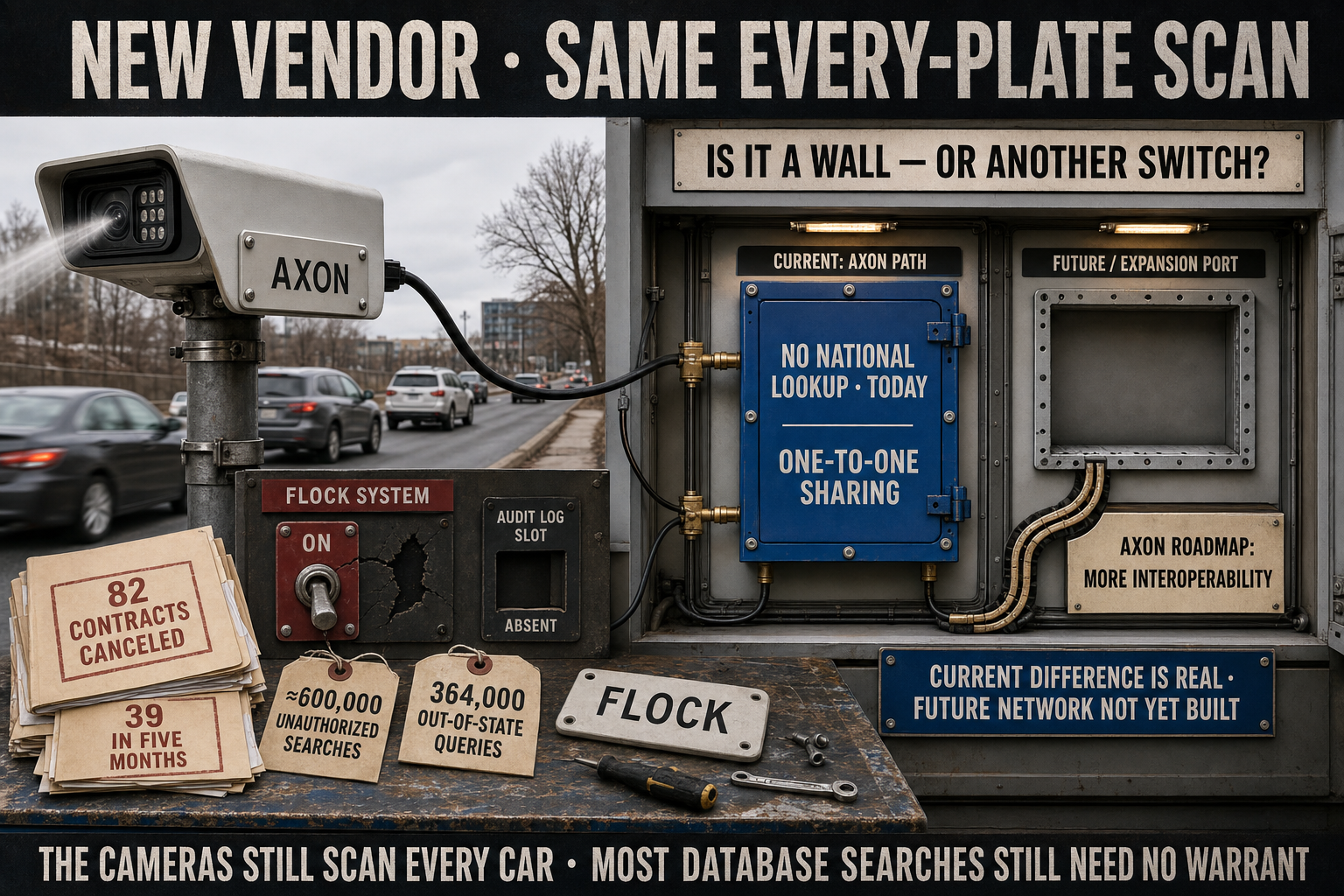
Eighty-two Flock Safety contracts have been canceled across 28 states since 2021, with 39 of those cancellations landing in just the first five months of 2026, per the tracking project Ban Flock Cameras — and most of the cities behind those cancellations aren't giving up on license-plate cameras. They're hiring a different company to install the same kind of camera.
The trigger, in the clearest case: Mountain View, California. A public-records investigation by the Mountain View Voice found that a "Statewide Lookup" setting had been active on 29 of the city's 30 Flock cameras for 17 months without the police department's knowledge, during which more than 250 agencies that had never signed a data-sharing agreement with Mountain View ran roughly 600,000 searches against the city's plate data. A second, separate setting — "National Lookup" — had also been quietly enabled on one specific camera for about four months; Flock kept no logs from that period at all, but the agencies known to have accessed it during that window include the ATF, a U.S. Air Force base, and the GSA's Office of Inspector General. The city disabled the statewide setting January 5, 2026, then shut off all 30 cameras a month later. Ventura County found the same pattern independently: an audit showed out-of-state agencies had queried its Flock data more than 364,000 times in a two-month window, 299 of those searches citing immigration enforcement by name, after the county had specifically disabled the same "National Lookup" feature back in 2023 to comply with state law. Flock's own explanation was that it couldn't determine the cause — "a Flock employee, a system bug, or someone at the Sheriff's Office" were all offered as equally possible.
Several cities that dropped Flock over this have landed on Axon — the Taser and body-camera company, now selling its own automated license-plate readers. Denver approved a contract in March 2026: 50 cameras instead of the 110 Flock ran, 21-day data retention instead of 30, and — the headline difference — no connection to a vendor-run national lookup network. Syracuse signed with Axon in February after an eight-month breakup with Flock. Douglas County, Colorado signed a $22.8 million, 100-camera Axon deal in July. Ferndale, Michigan picked Axon specifically because, in the city's own framing, it doesn't have a national lookup feature and shares data "one-to-one" instead. Stanford dropped Flock entirely on August 4, replacing it with a different vendor (Genetec) whose system is built to stay inside the university's own network rather than a shared one — the same instinct driving every other city's decision, just solved with a third company instead of a second.
What's actually different about Axon — and it's real
To be fair to what's changed: Axon's ALPR product genuinely does not ship with Flock's defining feature. Denver City Council member Kevin Flynn put the contrast plainly: "No law enforcement officer in Texas, Ohio, New York, or California can log into our system." Outside agencies can't query Denver's database directly; a records request has to go through the city, vetted against state and local law before anything is released. That's not nothing, and it's the specific failure mode that just burned two California counties.
What isn't different
Here's what a vendor swap doesn't touch: the cameras still scan every plate on every car that passes, log it, and make it available to police on request. 404 Media, reporting on the same wave of contract switches, put it directly — nothing about changing vendors "changes the basic fact of how ALPR cameras work, which constantly scan all passing vehicles regardless of which vendor runs them."
Some of the sharpest pushback on the switch itself is coming from inside the privacy community, not outside it. In Syracuse, Daniel Schwarz — senior privacy and technology strategist at the New York Civil Liberties Union, and a member of the city's own Surveillance Technology Working Group — says he requested Syracuse's ALPR policy and its Axon contract more than six months ago and received neither. His working group, the body that's supposed to review exactly this kind of deployment, hasn't met since early 2026; he was never consulted on the Axon terms, which he says mirrors how the original Flock contract went through. His broader point is that Axon may be the bigger risk, not the smaller one, because it bundles license-plate readers into the same ecosystem as body cameras, drones, and real-time crime center software — "further removed" from any single point of accountability, in his words, not less. The ACLU of Colorado, after Denver's council approved its Axon contract 7-6, called the move exactly what it looked like to them: the city "switching from one dragnet surveillance corporation to another."
The underlying abuse pattern EFF has documented in Flock's network — warrantless searches tied to abortion-related travel, immigration status, and protest activity, with less than 1% of all scans ever connecting to an actual crime — isn't a Flock-specific defect. It's what happens when every vehicle gets scanned and logged regardless of suspicion. Axon's cameras do the identical scanning. The complaint isn't really about which company's logo is on the pole.
They could build the guardrail that would actually work. They didn't.
Flock's own marketing already proves the company can build hard, code-level privacy limits when it wants to: it advertises 30-day default retention with true hard deletion, encryption at rest and in transit, and a technical block on searching camera footage for people's faces. Those are real engineering choices, not policy promises — the kind of thing that can't just get quietly switched back on by an employee, a bug, or a customer.
The exact feature that caused both scandals — whether one city's data becomes visible to hundreds of agencies it never agreed to work with — was left as a setting instead. A toggle. Something that, per Flock's own account of the Ventura incident, the company itself couldn't say for certain who flipped, or when, because the audit trail simply wasn't kept. A billion-dollar company that built AI sharp enough to read a plate at highway speed had the capacity to make cross-agency sharing require a second, logged, unforgeable authorization instead of a single switch. Whatever the reason, that's not what got built: the one setting that caused both scandals was left as a switch, not a wall.
Whether that's negligence or design isn't something this piece can settle — Flock itself says it can't determine the cause either. At the scale Mountain View and Ventura described, though, the two start to look hard to tell apart. Nothing so far suggests Axon has built that harder wall either; its current no-national-lookup posture reads like a competitive pitch aimed at Flock's angry customers, not a structural guarantee. And the company's own trajectory points toward more interoperability, not less: an April 2025 roadmap announcement laid out plans to expand "the most interoperable, intelligent public safety network integrated through Axon Fusus," with a "Works With Axon" certified-partner program already pulling third-party camera makers — Axis, Bosch, Verkada, Leonardo ELSAG — into one connected system. That is the same direction Flock's network grew from. Axon's own record on holding a line under pressure isn't reassuring either: in 2022, a majority of its AI ethics board resigned after the company announced Taser-armed drones for schools over the board's own 8-4 vote against it. Axon paused that specific drone plan — then, the following year, acquired a separate military drone maker anyway.
The gap the law hasn't closed
Even in the states with the strongest current ALPR rules, there is no general requirement that police get a warrant before searching their own plate database. Washington's new law (SB 6002, signed March 2026) — one of the toughest on the books — caps retention at 21 days and requires a warrant only when police want data held by a private vendor rather than their own system; querying data already inside the government's own database still needs no warrant at all. Oregon's law (SB 1516) caps retention at 30 days and logs inter-agency sharing but doesn't require judicial sign-off either. California caps Highway Patrol retention at 60 days, with pending legislation to bar sharing with out-of-state or federal agencies absent a warrant — not yet law.
The actual proposal that would close this gap is already written, and already being fought over: EFF, the ACLU of Virginia, and the National Association of Criminal Defense Lawyers filed a joint brief with the Virginia Court of Appeals in September 2025 arguing courts should require a warrant before any ALPR database search. The specific model researchers have proposed would require a probable-cause warrant for three things — pulling a vehicle's full movement history, identifying vehicles near a specific crime scene, and setting a real-time alert on a specific plate — while preserving exceptions for stolen vehicles, missing persons, and genuine emergencies. Two January 2026 rulings went the other way — though at different court levels. A federal district court in Virginia (Schmidt v. City of Norfolk, E.D. Va., summary judgment) and Washington's Court of Appeals (State v. Simonson) both held that a single, non-continuous plate photo on a public road isn't a Fourth Amendment search at all. Norfolk is not the final word — it's on appeal to the Fourth Circuit, fully briefed and undecided — but for now, in both places, the entire protection scheme rests on state statute and company policy, not the Constitution. Thirty-five states have roughly 100 ALPR-related bills moving in 2026. This is contested, live ground, not settled law.
What this piece is not saying
This isn't saying Denver's or Ferndale's negotiated contract terms are fake — they're real, and they're a genuine improvement over what Flock's network did to Mountain View and Ventura. It isn't saying every city that picked Axon did so purely to avoid Flock's specific scandal — cost, service quality, and other factors likely played a role too, and this piece hasn't audited every contract's full rationale. It isn't accusing Flock of deliberately engineering the sharing failures as a business strategy — the honest answer, based on what's public, is that nobody outside the company knows whether it was negligence or intent, and Flock itself has said it can't determine the cause either. And it isn't predicting Axon will definitely build a Flock-style national network — only that the company has stated ambitions toward more interoperability, not less, and that its own history doesn't inspire confidence its current restraint would survive a strong enough business case.
What can I do
There is no real way to opt out of being scanned. Flock has no consumer opt-out, federal privacy law doesn't cover this, and only a handful of individual towns let residents exclude their own plate from that town's specific system — none of that touches the networked systems this story is about.
What's real: Have I Been Flocked lets you check whether an agency has actually searched your plate, not just whether a camera photographed you. The ACLU's Get the Flock Out toolkit is built for organizing before a city council vote — and it applies just as much to an Axon contract up for a vote as a Flock one; don't assume the newer vendor gets a pass. And because this is genuinely live legislative ground right now — 35 states, roughly 100 bills in 2026 — contacting your state representative about a specific ask (a warrant requirement for database queries, not just a retention cap) is a real lever at exactly the stage where it still changes what gets voted on.
The lever that's actually moved a company fastest so far isn't a city council vote — it's consumer and investor pressure. Amazon-owned Ring cut its Flock integration entirely on February 12, 2026, after a customer revolt, and is honoring refunds for owners who say the integration violated Ring's own terms. Home Depot investors, led by Zevin Asset Management, already filed a shareholder proposal asking the company to report on the privacy and civil-rights risk of its Flock cameras; the board recommended against it and shareholders voted it down on May 21, 2026 — a loss, but proof the mechanism exists and can be refiled. A 38-organization coalition, including EFF and Fight for the Future, is running an active boycott campaign against Home Depot specifically over its Flock contract, and Lowe's — which has Flock cameras at 173 U.S. locations — is facing the same pressure. If a company's calculus is what changes deployment, that's where the leverage actually is.
If your city is currently weighing a switch from Flock to any other vendor, the one question worth asking publicly, before the vote: does the new contract's no-sharing promise live in the software itself, or just in a policy that a future settings change could quietly undo?
The Receipts
Flock sees controversial camera contracts canceled in 23 states — background on the cancellation wave (figure superseded in-text by Ban Flock Cameras' own tracker)
Ring Owners Revolt: Mass Returns Begin After Shocking Privacy Betrayal — on Ring/Amazon cutting ties with Flock
Home Depot Faces Shareholder Push On License Plate Data And Risk — Yahoo Finance
Data Privacy Concerns at Home Depot: Flock Safety and Law Enforcement Access — Zevin Asset Management, the proposal's filer
Home Depot Faces Boycott Calls Over Flock Safety Camera Ties to ICE Raids — Prism News
Home Depot and Lowe's Share Data From Hundreds of AI Cameras With Cops — 404 Media, on Lowe's 173-location figure
Cities Are Ditching Flock, Immediately Replacing It With Axon License Plate Readers — 404 Media
Flock cameras shared license plate data without permission — Malwarebytes, on the Mountain View investigation
Stanford drops Flock cameras amid national backlash — Mountain View Voice
Months after Syracuse ditched Flock, critics say switch to Axon solved nothing — CNY Central
Denver City Council Approves New Axon Contract to Replace Flock, Despite Community Concerns and Calls for a No Vote — ACLU of Colorado
Schmidt v. Norfolk — ACLU case page
Judge holds Norfolk's license plate reader use constitutional — Courthouse News Service
EFF Urges Virginia Court of Appeals to Require Search Warrants to Access ALPR Databases — Electronic Frontier Foundation
What Does Washington Senate Bill 6002 Mean for ALPR Use in Washington — Flock Safety (cited for the bill's own terms, not as a neutral source)
Axon's Ethics Board Resigned Over Taser-Armed Drones. Then the Company Bought a Military Drone Maker — The Markup
Axon Announces New Fixed ALPR Camera Solutions and Next-Gen AI Advancements to Expand Real-Time Public Safety Ecosystem — Axon, official announcement
Home Depot Is Being Sued Three Times This Year Over How It Watches You — BL:UF's prior coverage of Flock's Home Depot deployment