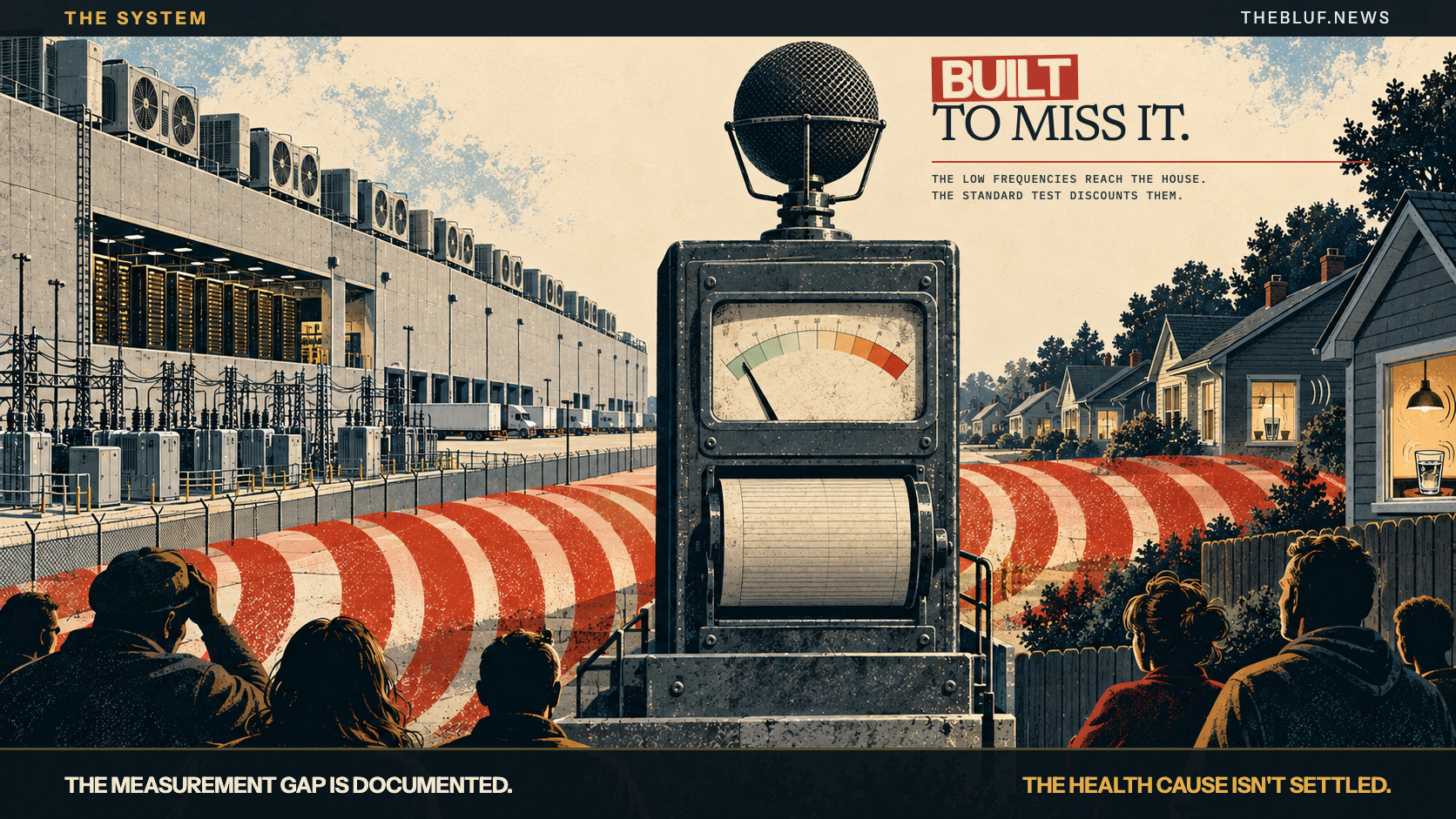
What residents are reporting
The complaints look the same from state to state, wherever these buildings are going up at scale.
In Dowagiac, Michigan, residents describe a 24/7 whine from a facility owned by a Hyperscale Data subsidiary. "The filter is clogged up, so it's a high-pitch whining, and they just left it on and walked out," one neighbor said. Others compared it to a vacuum cleaner running nonstop inside their homes. A class-action lawsuit — Valenzuela et al. v. Alliance Cloud Services, LLC — was filed May 26, 2026. It claims the noise has run for roughly two years and hurt residents' health, property values, and quality of life. None of that has been proven in court yet; the case is still pending. The city does have its own industrial noise ordinance — 65 decibels in the day, 55 at night — and, per reporting on the case, has already fined the company for breaking it, though no dollar figure for that fine is public.
In Mount Pleasant, Wisconsin, residents near Microsoft's Fairwater data center — running since June 2026 — say a steady low hum carries as far as 1.5 miles. They filed suit too: Ostergaard et al. v. Microsoft Corporation, July 1, 2026. Same as Dowagiac — this is active and unresolved. Nothing's been proven, and Microsoft hasn't been found to have done anything wrong.
It's not just those two places. Loudoun County, Virginia residents describe everything from a low-frequency hum to "propeller-like" sounds to high-pitched whining — this is the most data-center-dense part of the country, roughly 300 facilities in Northern Virginia alone, about 14% of the entire world's total. In Greenbrier, Arkansas, neighbors of a Bitcoin mining facility report round-the-clock noise along with high blood pressure and anxiety. In Granbury, Texas, people living less than 100 yards from a facility running 60,000 mining computers report vertigo, nausea, high blood pressure, migraines, fluid coming from their ears, and insomnia. In Southaven, Mississippi, neighbors of an xAI facility running 27 natural-gas turbines report trouble sleeping. And in Chandler, Arizona, years of resident complaints about a data center's constant hum got the city to rewrite its zoning code in 2022 — and in 2025, the city council unanimously turned down a new AI data center over the same noise concerns.
Why the standard noise meter can't actually catch this
Almost every city checks noise the same way: a regular decibel meter, the kind used for a loud party or a leaf blower. Those meters are built to match human hearing — and human hearing is bad at picking up low, rumbling sound.
That's the whole problem. The sound coming off a data center — cooling fans, air conditioning, backup generators, the big electrical transformers — is mostly low, rumbling sound, the kind you feel more than hear. So the meter cities use to check whether a data center is "too loud" is specifically weak at hearing the exact kind of noise these buildings make.
It's not a small gap. At the pitch a generator hums at, the meter cuts what it registers by more than 26 decibels. At the lowest, rumbling tones, it cuts more than 50 decibels. That's not a guess or one study's opinion — that's just how the meter itself is built.
Here's what that means in practice: a data center can pass its official noise test and still be putting real sound into your house — sound the test was never built to catch. None of the cases above actually shows a facility passing its test while neighbors kept complaining; that specific combination isn't documented yet. But the gap in the meter itself is real, on its own, no matter what any single case shows. Most local noise rules, as one policy analysis put it, were written for a loud block party — not for a building that runs industrial cooling equipment nonstop, all year.
What the actual science says — and doesn't
This is the part worth slowing down for, because the easy version of this story is wrong in both directions.
Nobody has actually studied this at a real data center yet. A 2026 peer-reviewed review, published in Clean Technologies, a peer-reviewed science journal from MDPI (an academic science publisher), says flatly: no study has ever measured the actual low-frequency sound coming off a working data center, and no study has looked at health outcomes in the people who work in one. The review isn't claiming harm has been proven. It's pointing out that nobody's even checked.
So what people are leaning on instead is wind turbine research — the closest thing to a comparable, well-studied case. And that research is a real, ongoing fight, not settled proof of anything. People living near turbines report headaches, dizziness, nausea, fatigue, ear pressure, ringing ears, poor sleep, and heart-related symptoms. But when scientists actually test it under controlled conditions, the picture gets messier: one study put noise-sensitive adults through 72 hours of real infrasound and 72 hours of fake infrasound, without telling them which was which, and found no real difference between the two. The World Health Organization's own 2018 guidelines only went as far as saying turbine noise causes annoyance — that's the one effect they had enough evidence to act on. For sleep problems specifically, WHO said the evidence was too weak to even make a call, and it put every other claimed effect (heart problems, ringing ears, dizziness, nausea) in that same too-weak-to-call bucket. That matters here because sleep trouble is one of the exact things data center neighbors are reporting — and the honest answer is nobody knows yet, for turbines or for data centers.
There's also something else worth naming plainly: real, published research shows that simply expecting to be harmed by something can produce real physical symptoms on its own — a documented effect called nocebo. That doesn't mean anyone's making their symptoms up. Nocebo symptoms are real and measurable. They just have a different cause than the thing people blame.
A real government investigation shows exactly how messy this gets, even without a data center involved. NIOSH (the federal agency that investigates workplace health hazards) looked into a low-frequency noise complaint at an Ohio workplace, after two loud incidents traced back to a nearby landfill's methane flare. Investigators actually measured the sound — 64 to 73 decibels, well below anything considered harmful. Some of what employees reported was, in the investigators' own words, "consistent with low-frequency noise exposure but also common and nonspecific." And 57% of the employees said they were uncomfortable even coming back to work — a sign that what people expect and fear is doing real work here too, alongside or instead of the actual sound.
Put simply: the meter problem is proven. Whether the sound is loud enough, at the right pitch, for long enough, to actually cause what residents are feeling — nobody's tested that yet, at a real data center, the right way.
The lawsuits aren't waiting for the science to catch up
No matter where the science ends up, real lawsuits are moving right now, in more than one state. Residents are suing on nuisance and falling-property-value grounds — legal claims that don't require proving a specific health mechanism, just that the noise itself is unreasonable and disruptive. A few companies aren't waiting for a verdict to respond: Hyperscale Data's Michigan subsidiary has bought the land next door as a noise buffer, and some Amazon facilities in Virginia have gotten acoustic shrouds to cut the noise at the source.
This isn't the first industry to move faster than the evidence
Data centers aren't the first industry approved on a jobs-and-tax-revenue pitch with the health question left for later. The pattern repeats, and it's worth naming plainly.
Cell towers went further than just beating the science to the punch — they got the law changed. Section 704 of the Telecommunications Act of 1996 makes it illegal for a town to reject a wireless tower based on health concerns about radio-frequency emissions, as long as the facility meets limits set by the FCC (the federal agency that regulates radio and TV signals). Not "the town chose to approve it anyway" — the town legally cannot say no on health grounds at all, no matter what residents believe or fear. If data centers ever get similar protection at the state level, that's the version of this fight worth watching for.
Factory farms show the economic pitch itself can be wrong, not just early. Towns get told to expect jobs and tax revenue. What often actually shows up: fewer jobs than promised, paying less, and in several states, property tax exemptions that cost the county money instead of bringing in more — Iowa counties have reported losing several million dollars a year to exemptions for large livestock operations, per the industry's own trade groups and rural-policy researchers, though the exact figure varies by source and year. The odor and water contamination complaints pile up years after the facility's already running.
Fracking shows almost the identical symptom list, and the identical fight over proof. Pennsylvania's own environmental regulator logged more than 9,400 complaints about drilling pollution and well problems between 2004 and late 2016 — years after wells went in, not before. The symptoms residents reported — sleep disruption, headache, nausea, fatigue, respiratory irritation — read almost like the same list data center neighbors give today. And the causation fight has the same shape: real complaints, real reported symptoms, and proof of a direct medical cause that's still genuinely unresolved.
Amazon's warehouse and delivery network — a different part of the company than the data centers named earlier in this piece — is the closest match to the actual timeline, because it's the same tech-boom-era "don't get left behind" pitch, playing out in real time instead of decades ago. In California's Inland Empire, home to a heavy concentration of Amazon logistics hubs, emergency-room visits for asthma and pneumonia in San Bernardino nearly doubled the statewide rate between 2016 and 2018, researchers found — a gap they tie to diesel truck traffic, though isolating truck traffic's exact share of that increase is its own separate, ongoing question. These facilities have also landed disproportionately in lower-income neighborhoods and communities of color — worth watching for with data centers too, since siting tends to go wherever the political resistance is weakest.
The throughline in all four: the economic case gets made with real numbers, upfront, before any vote happens. The health case only builds real numbers years later, after people are already living next to the result. By the time there's enough evidence to actually weigh, the decision that would have used it is long since made.
What this piece is not saying
This isn't saying data center infrasound has been proven to cause the symptoms residents report — the research to prove or disprove that doesn't exist yet, and even the closest comparison (wind turbines) is still an open fight, with real evidence pointing both ways. It isn't saying residents are imagining things or exaggerating — their symptoms are real no matter what's causing them, and even a nocebo effect produces real, measurable symptoms, not fake ones. It isn't saying every data center in the country is breaking noise rules — the specific violations and fines here belong to specific facilities, not the whole industry. And it isn't saying the standard noise meter is useless in general — it works fine for what it was built to measure; the problem is using it, unchanged, on a completely different kind of noise it was never designed to catch. The comparisons to cell towers, factory farms, fracking, and Amazon warehouses aren't claiming data centers will definitely follow the exact same path — they're pointing out a repeating pattern in how these decisions get made, not predicting data centers' specific future. It isn't claiming fracking, CAFOs, or diesel truck traffic have been scientifically proven to cause the specific symptoms cited for each — those causation questions have their own separate, unresolved literatures, cited here only for the pattern of complaints emerging after approval, not as settled medical fact.
What can I do
If you live near a data center and think noise is making you sick, the most useful thing you can track isn't just how you feel — it's exactly when and where. A phone app or basic consumer meter almost certainly won't pick up the frequencies that actually matter here; real low-frequency measurement takes a specialist instrument, not a general one. In practice, that means a Type 1 (Class 1) precision integrating sound level meter, built to the IEC 61672-1 standard (an international spec for precision sound meters), capable of G-weighting — a frequency weighting built specifically for infrasound, standardized under ISO 7196 — or unweighted ("linear" or Z-weighted) measurement, with octave-band or third-octave-band analysis so it reports sound level by frequency instead of collapsing everything into one number. That's the same frequency-by-frequency technique — octave-band analysis — that NIOSH used in the Ohio investigation cited above. Using the same technique doesn't mean a resident's own reading carries the same weight as a NIOSH investigation; it just means it's measuring the right thing instead of the wrong one. This is acoustic-consulting-grade equipment — real manufacturers include Brüel & Kjær, Norsonic, NTi Audio, Larson Davis, Rion, and Svantek — running well into four figures, not a phone app or a cheap consumer meter. Check whether your city's noise rule only uses a standard dBA limit — most do. Several of the towns in this piece only got their ordinance changed after residents organized and pushed together. One person complaining alone hasn't moved this anywhere; groups of neighbors pushing the same complaint have.
Why this is a BL:UF story
This story has a real, provable failure sitting right next to a real, unproven health claim — and mixing the two up does a disservice to both. The measurement gap is real, it's mechanical, and it's fixable: cities are enforcing noise limits with a tool built to miss the exact sound in question. Whether that gap is also making people sick is a genuinely open question that deserves real research — not an assumption, in either direction. And this isn't a new story shape — cell towers, factory farms, fracking, and Amazon warehouses all followed the same order of operations: the economic case gets made first, with real numbers, and the health case only catches up years later, after the decision is already made.
The Receipts
- MDPI, Clean Technologies: "Infrasound and Low-Frequency Noise in Data Center Environments: A Narrative Review Toward Health-Protective Acoustic Design Standards," Aug. 2026
- EESI: "Communities Are Raising Noise Pollution Concerns About Data Centers"
- Newsweek: "Michigan residents sue AI data center noise—they're not alone"
- Tom's Hardware: "AI data centers face increasing complaints about inaudible but 'felt' infrasound"
- NBC News: "Data center noise lawsuits: Residents sue over sounds of AI boom"
- Facilities Dive: "Noise lawsuit is latest in legal wave hitting data center operations"
- WilmerHale: "Data Centers in Court: The Emerging Wave of Nuisance, Environmental, and Land-Use Litigation," July 2026
- ScienceDirect: "Symptoms intuitively associated with wind turbine infrasound"
- PubMed: "The Health Effects of 72 Hours of Simulated Wind Turbine Infrasound: A Double-Blind Randomized Crossover Study in Noise-Sensitive, Healthy Adults"
- CDC/NIOSH: workplace low-frequency noise investigation, Ohio (methane-flare-adjacent facility)
- Cornell Law School, Legal Information Institute: 47 U.S.C. § 332(c)(7)(B)(iv) — the Telecommunications Act of 1996's preemption of local health-based denials of wireless siting
- Sierra Club / rural policy sources on CAFO tax exemptions, cited as industry/advocacy-reported figures, not an independently audited government document
- StateImpact Pennsylvania (NPR): "Data trove offers new details on complaints to DEP during shale boom," Jan. 31, 2017 — the 9,400+ PA DEP complaint figure, 2004-2016
- NBC News: "Treated Like Sacrifices" — San Bernardino asthma/pneumonia ER visit rates vs. the California statewide rate, 2016-2018
- ISO 7196:1995 — Acoustics — Frequency-weighting characteristic for infrasound measurements (the G-weighting standard)