What is known
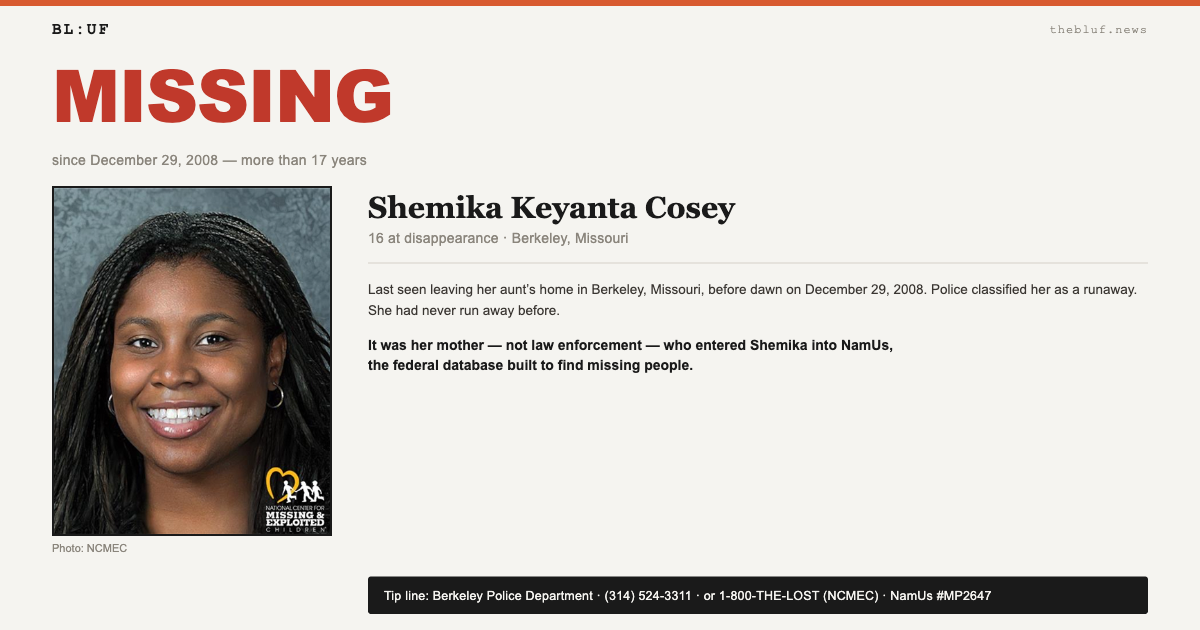
Shemika Keyanta Cosey was 16 when she disappeared from her aunt's home in the 6000 block of Napier in Berkeley, Missouri, sometime between 1:30 and 8:30 a.m. on December 29, 2008 — some agencies list December 28 or 30, but the case is tracked under the 29th. She was wearing a black long-sleeved shirt, a tan Old Navy jacket and blue jeans. She took only her purse and her jacket. Her clothes, an overnight bag and most of her other belongings stayed in the house. The front door was unlocked. There were no signs of a struggle.
She has not been seen since. She was born October 1, 1992, and would turn 34 this October.
Her mother, Paula Hill, remembers her plainly. "She was something else. She was a character. She was quiet, and she loved the kids," Hill has said.
What the police called it, and what that meant
The Berkeley Police Department classified Shemika as a runaway. Hill disputed that from the start. "For them to say she was a runaway and she had never did it before, that hurt," she has said. She has also described the response she got when she pressed for more: "As far as the police, they didn't help me with anything," and, of the explanation she says she was given, "They really just said to me in their own words, well, she probably gone with a man."
The runaway label matters beyond how it feels. It is a case classification, and it shapes how a department prioritizes a search. A missing teenager presumed to have left on her own is not resourced the same way as an abduction. Hill was the one who ultimately figured out how to enter her daughter into the National Missing and Unidentified Persons System — NamUs, the federal database meant to match missing people against unidentified remains — not law enforcement.
Why this is news again, 17 years later
In February 2026, Berkeley Police Major Steve Runge confirmed to a St. Louis television station that the case has been reopened. "I've reopened the case. I've examined the case. I think a fresh set of eyes is good," he said, adding that anyone with information is encouraged to come forward.
That is a real, on-record development, not a symbolic gesture — a named commander willing to say the file is open and being looked at again. It does not mean new evidence has surfaced, and it does not mean the runaway classification has been reversed. It means someone in the department decided a case that had gone cold for most of two decades deserved another look. Hill's response to that renewed attention was less about her own daughter than about everyone else's: "So take every case serious, please, as if it's your family member."
The coverage math
Shemika Cosey's disappearance is not a fluke of statistics — it is inside a documented pattern. Of the more than 533,000 missing-person entries the FBI's National Crime Information Center recorded in 2024, roughly one-third involved Black people, in a country where Black Americans are about 14% of the population.
Saint Louis University criminologist Kenya Brumfield-Young describes the mechanism behind that gap, and it runs through the exact language Berkeley police used about Shemika: "Unfortunately, Black and Brown women, when we go missing, the idea is that we have engaged ourselves; it's a lifestyle issue. We're engaged in something nefarious or with a partner or things like that." She traces the gap to the start of a case, not just its media afterlife: "It's not even strictly media. It's who takes the report at the first end." And on why a name draws national attention at all: "If a woman is considered to be attractive, by societal standards, she's more likely to garner attention."
The point isn't that Shemika's case was ignored because of one officer's judgment in 2008. It's that the same conditions — an early classification that lowers the case's priority, and a national attention economy that has to be told a story is worth telling — apply to thousands of cases like hers at once, and only a small number ever get a "fresh set of eyes."
What is unknown
Whether Shemika Cosey is alive. What happened after she left that house before dawn on December 29, 2008. Whether the reopened case has turned up anything since February. No remains have been identified as hers, and nothing here should be read as settling that question — she is a missing person, still, and her mother is still asking people to call.
What could actually change this
Missouri does not require local police departments to enter missing-adult or missing-child cases into NamUs — that's still a department-by-department choice in most of the country, which is exactly why it fell to Hill to do it herself in this case. In 2025, Missouri created a Missing and Murdered African American Women and Girls Task Force, a state-level response to the same pattern this case sits inside. Whether that task force produces a NamUs mandate, dedicated investigative resources, or nothing measurable at all is still an open question — it's new enough that there isn't yet a track record to judge.
A reader who wants to do something with this does it upstream: ask whether your own state has a mandatory NamUs-entry law, whether your state has (or needs) a task force like Missouri's, and press your legislators on it if it doesn't. That's a lever that outlasts any one case.
Anyone with information about Shemika Cosey is encouraged to contact the Berkeley Police Department at (314) 524-3311, or submit a tip through the National Center for Missing & Exploited Children at 1-800-THE-LOST. Missing-person and unidentified-remains cases can be submitted directly at NamUs.gov.
The Receipts
- PBS NewsHour: "When a Black person goes missing, families say their cases get left behind" (June 3, 2024)
- First Alert 4 (KMOV): "Missing and overlooked: Black women and girls disappear at disproportionate rates — Shemika Cosey's family still searching 17 years later" (Feb. 27, 2026)
- The Charley Project: Shemika Keyanta Cosey
- NamUs: Missing Person #MP2647
- National Center for Missing & Exploited Children: Shemika Keyanta Cosey