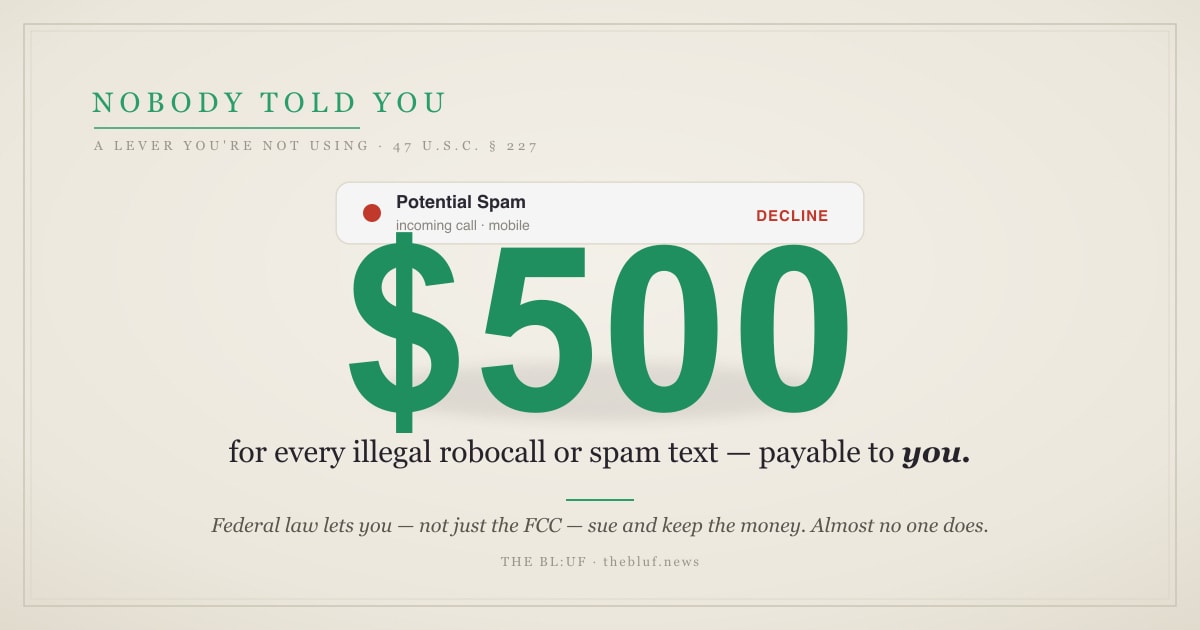
Here's something the recorded voice on the other end will never mention: that illegal call might owe you money. Not the phone company. Not the government. You.
Journalism, not legal advice. This explains what a federal statute says in general terms — whether you have a valid claim, what it's worth, and where to file depend on your state, your consent history, and the specific facts. Talk to a lawyer (many TCPA attorneys offer a free consult) before you file anything.
The lever. The Telephone Consumer Protection Act — 47 U.S.C. § 227, on the books since 1991 — doesn't just let the FCC chase illegal robocalls. It gives you a private right to sue the caller and keep the money. For an autodialed or prerecorded call, or a marketing text, sent to your cell phone without your consent, the law lets you recover "$500 in damages for each such violation" — that's per call, per text. If a court finds the caller acted "willfully or knowingly," it can triple that, up to $1,500 apiece. A separate part of the law covers the Do Not Call list: if the same company calls you more than once in a 12-month period in violation of the rules, that's also up to $500 a call.
The receipt. This isn't a loophole or a lawsuit-ad promise — it's the text of the statute. Section 227(b)(3) lets a person "recover for actual monetary loss... or to receive $500 in damages for each such violation, whichever is greater," with treble damages for willful violations; §227(c)(5) does the same for repeated Do Not Call violations. Texts count too: the FCC has confirmed that a text sent by an autodialer is a "call" under the TCPA, so spam texts sit on the same footing as robocalls. And you don't need a federal courthouse — the law says you can "bring [the action] in an appropriate court of that State," which in practice usually means small-claims court, where you file the paperwork yourself for a modest fee. Small-claims dollar limits vary by state — some cap claims well below what a multi-call or treble-damages claim could be worth, which can push a bigger claim into regular civil court instead.
Who it's really for — and the catch. This lever bites real, nameable businesses that got sloppy — the dealership, the timeshare, the debt collector, the marketing firm that kept texting after you said stop. It is far weaker against the anonymous "your car warranty is expiring" fraud, because to collect you have to identify and legally serve the caller — and an overseas scam operation you can't name is one you can't sue. The company's best defense is consent: if you gave a number when you signed up for something, they may argue you agreed to be contacted — so revoking that consent matters. As of an FCC rule effective April 2025, a caller has to honor your opt-out by any reasonable means — replying "STOP," "CANCEL," or "UNSUBSCRIBE" to a text all count — and must stop within 10 business days, so a clear "stop" is enough; you don't have to use their exact script. There's also a deadline — most courts apply the general federal four-year catch-all statute of limitations (28 U.S.C. § 1658) to TCPA claims, though the exact deadline can depend on your state and court, so don't wait to find out.
The scam version — because there's always one. Fraudsters have turned this very topic into bait. Registering on the Do Not Call list is free and never expires — so anyone who calls, texts, or emails saying your registration is "about to expire" and asks for a payment or your information is running a scam, often impersonating the FTC. The FTC will never demand money or a fee to keep you on the list. Be equally wary of outfits that cold-call promising to get you "robocall settlement money" for an up-front fee. The lever here is something you can pursue yourself for free, or with a lawyer who takes TCPA cases on contingency — you shouldn't be paying anyone in advance to claim it.
The penalty for illegal calls was written to be collected by the people who get them. Almost no one collects it.
✅ Do It Now
- Keep the evidence. For every unwanted call or text, note the date, time, the number, and what it was pushing. Save voicemails and screenshots — that record is what turns "annoying" into a claim.
- Register free — and never pay to. Add your cell and home numbers at donotcall.gov or 1-888-382-1222. It's free, it never expires, and anyone charging you to "register" or "renew" is the scam.
- Report the illegal ones. File with the FCC at consumercomplaints.fcc.gov and the FTC at donotcall.gov/report.html. This drives enforcement — but note it won't, by itself, put a check in your hand.
- To actually collect the $500+, that's the private route: a small-claims filing against a company you can name, or a free consult with a TCPA attorney (many work on contingency, so no up-front cost).
Journalism, not legal advice. Damages, consent rules, and filing deadlines turn on the specific facts and your state — confirm before you file, and consider talking to a lawyer for anything beyond small claims.