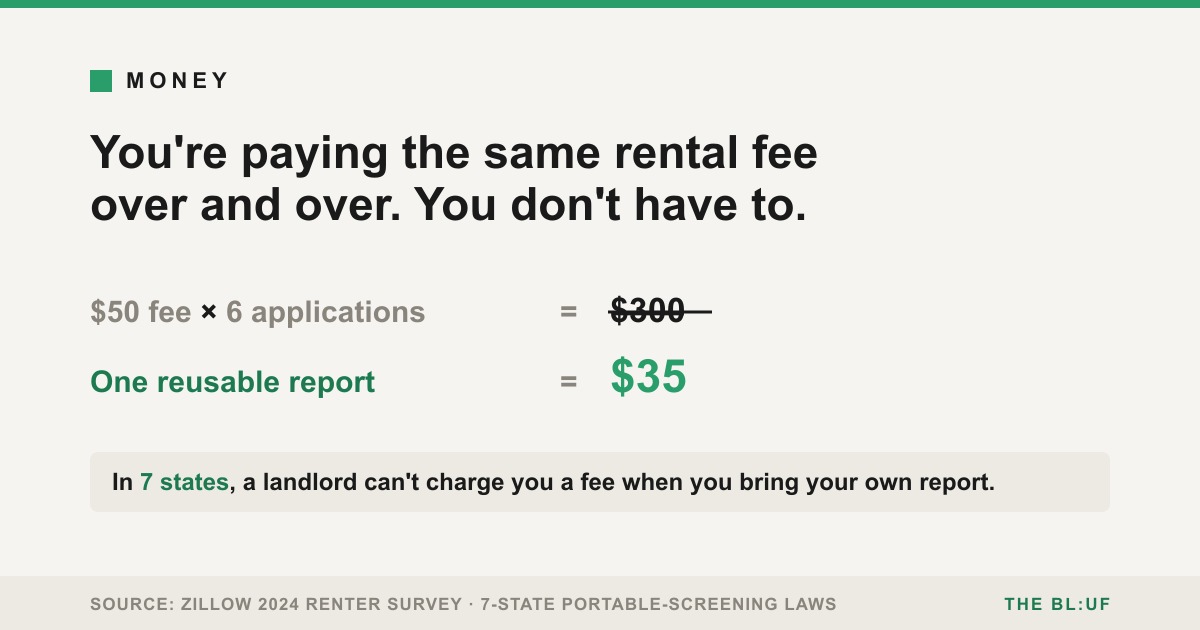
In a tight market you apply to five, six, ten places before one says yes. At ~$50 a pop — the typical fee by the rental industry's own surveys — a six-application search costs $300 before a dime of rent or deposit.
Here's the part that should make you angry: most of that money buys the same product over and over. An application fee mostly covers a credit-and-background check. Yours doesn't change between Tuesday's application and Thursday's. You're buying the identical report five times because each landlord orders their own copy — and bills you for it.
The fix that already exists (and stayed quiet)
A portable (reusable) tenant screening report flips that. You pay once — Zillow's is $35, good for 30 days — and apply to unlimited participating rentals on one report that includes your credit and background check. Landlords review it for free. Avail, SingleKey, and LeaseRunner sell similar reports.
So why do 79% of recent renters still pay a per-application fee, typically $50 (Zillow's own 2024 survey), years after the fix existed? Three reasons: it only works at properties that opt in; it's buried (no campaign, no name renters repeat); and the real one — a conflict of interest. Listing platforms earn revenue from landlords and property managers. A loud "never pay an application fee again" push attacks their paying customers' income. So the feature exists, legally and quietly, like a coupon kept behind the counter.
Meanwhile, the law moved — in seven states
Seven states now have portable-screening-report laws on the books (as of 2026): Washington, California, Colorado, Illinois, Maryland, New York, and Rhode Island. The strongest:
- New York — a landlord can't charge an application fee at all to an applicant who provides a valid reusable report (fees are otherwise capped at $20). A real screening costs a landlord more than $20 to run — so a renter who brings their own report is saving the landlord money. (Real Property Law § 238-a.)
- Colorado — landlords must accept a valid report you bring yourself, and can't charge an application or screening fee on top. That must-accept rule has existed since 2023 (HB23-1099); as of Jan 1, 2026, HB25-1236 strengthened it — landlords can no longer dictate that the report be routed through a specific agency or website. (Colo. Rev. Stat. § 38-12-903.)
- Illinois — since Jan 1, 2025 (Public Act 103-0840, 765 ILCS 705/25), when you provide a qualifying reusable report, the landlord can't charge a screening or access fee.
- Rhode Island — your reusable report stays valid 90 days, fee-free. (R.I. Gen. Laws § 34-18-59.)
A valid portable report generally means: a credit report under 30 days old (90 in RI), plus criminal, eviction, employment, and rental history, produced by a licensed consumer-reporting agency at your direction.
What to actually do
- Before your next search, buy one portable report (~$35) instead of paying per application.
- In NY, CO, IL (and the other four): present it and don't pay an application fee. In Colorado, a landlord who refuses a valid report is out of step with the law.
- Everywhere else: ask every landlord, "Do you accept a portable screening report?" Some will. Every yes is ~$50 back in your pocket — and every ask normalizes the question.
- Know the limit: in non-mandate states a landlord can still decline your report, and most can verify details independently. The law is moving — more states have bills pending.
The Receipts
BL:UF doesn't ask you to trust us. Check our work:
- 79% paid a fee, typically $50; the $35 / 30-day reusable report — Zillow 2024 renter survey + Zillow rentals: zillow.com/learn/how-much-are-apartment-application-fees
- Seven states with portable-screening-report laws (2026) — WA (RCW 59.18.257), CA (Civil Code § 1950.1 / AB 2559), CO (§ 38-12-903), IL (Public Act 103-0840 / 765 ILCS 705/25, eff. Jan 1 2025), MD (Real Property § 8-218), NY (RPL § 238-a), RI (§ 34-18-59).
- Colorado must-accept origin HB23-1099 (2023); Jan 1 2026 HB25-1236 strengthening — Colo. Rev. Stat. § 38-12-903.
- Illinois as the 7th state — Public Act 103-0840, effective Jan 1, 2025 (sourced independently, not via the Upturn report, which pre-dates it).