If you remember QVC — the TV channel where a host sells you a blender at 2 a.m. — you already understand live shopping. It just moved to your phone, and it's growing fast.
What it actually is
A seller goes live on video, shows products, takes questions, and you buy in the moment. QVC itself made the jump: its parent company (now called QVC Group) started selling on TikTok Shop in 2024 and launched a 24/7 live stream there in 2025, plus free QVC+ apps. Worth knowing, though: that pivot hasn't saved the business — QVC Group filed for a prepackaged Chapter 11 in April 2026 — a debt restructuring meant to keep it operating, not shut it down, but a long way from a victory lap. The format is hot; that doesn't make every player a winner.
The $140,000 number
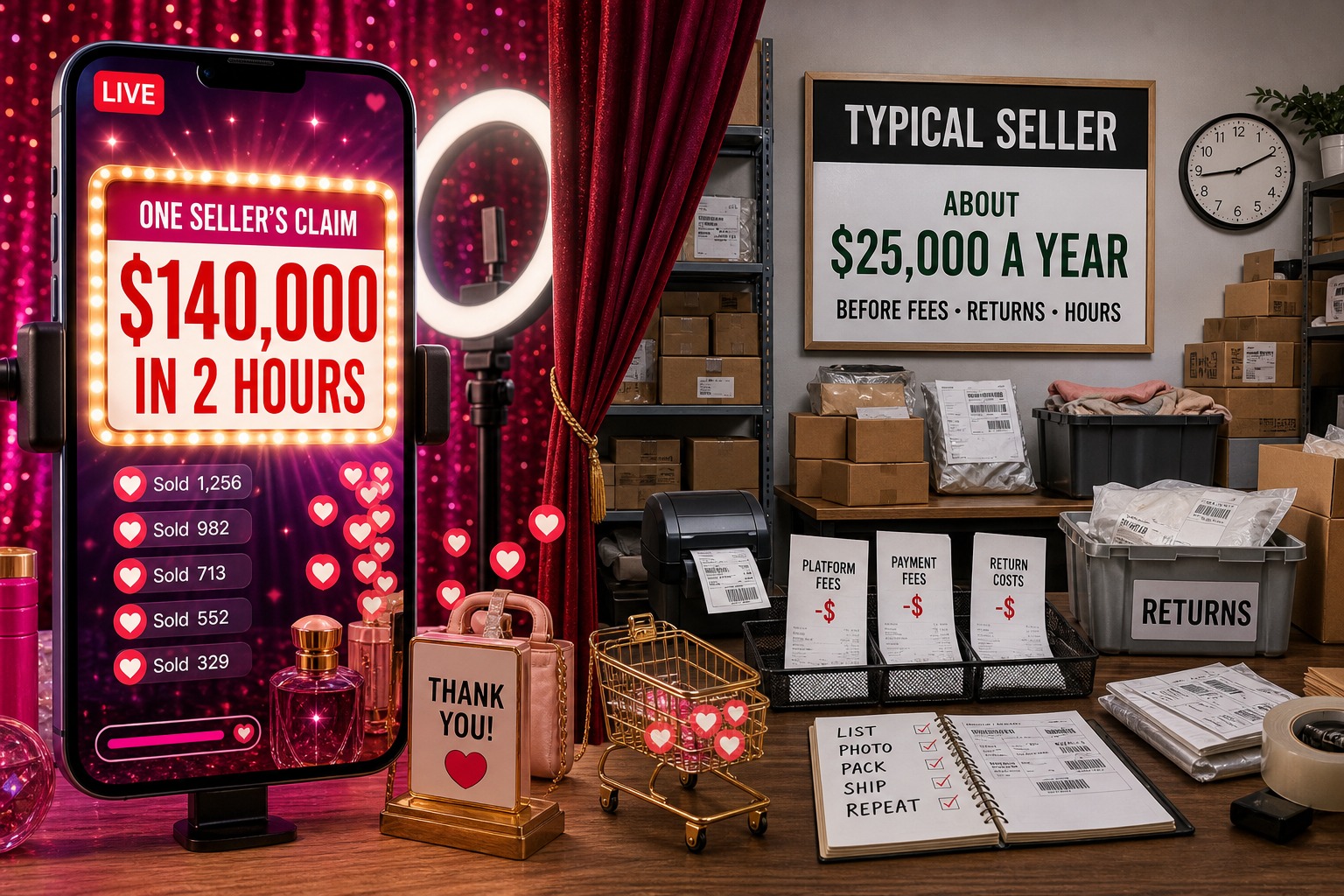
Entrepreneur Gary Vaynerchuk ("Gary Vee") says he went live on Whatnot for two hours and "did $140,000 in revenue" — and that the same product, sold the best way through ads to a web page, would've done about $7,000. That quote is real; he said it publicly in 2025.
Here's what to hold onto: that's gross sales, self-reported, by a celebrity with tens of millions of followers and an established channel. It's a headline, not a baseline.
The number he didn't lead with
Whatnot's own page says the average seller earns about $25,000 a year — and notes that average is pulled up by a handful of people selling over $1 million. Independent reporting adds the part nobody puts on a flyer: after fees, giveaways, and shipping, sellers of cheap items can end up making less than minimum wage. Live selling can work. It is not a slot machine.
Where it's really happening
- Whatnot — collectibles, cards, sneakers, coins, apparel. Now valued around $11.5 billion, with roughly $8 billion in sales in 2025.
- TikTok Shop — the big general-audience mover; about $15 billion in total US sales in 2025 — though only a slice (~$2 billion) is live selling; the rest is regular shop and short-video orders.
- Amazon Live and YouTube Shopping — best if you already sell on Amazon or already have an audience.
- Skip Instagram and Facebook for this — Meta shut down its live shopping features in 2022–2023. Don't build a plan on a button that's gone.
For scale: China's live-shopping market — counting all sellers, not one platform — was worth roughly $800 billion in 2024. The US is far behind — researchers project it climbing toward $68 billion by 2026 (today it’s a fraction of that) — which is exactly why people call it an opening.
How not to get left behind
- Pick the platform by what you sell — collectibles to Whatnot; broad consumer goods or beauty to TikTok Shop; already on Amazon, use Amazon Live.
- Gear up cheap — a recent phone, a ring light, a tripod, clear audio, and reliable internet. That's the whole studio.
- Set up the boring stuff — a seller account, identity verification, and your bank/payout details, before you go live.
- Have a format, not just stuff — a run of show, a reason to watch now (drops, deals, Q&A), and inventory ready to ship.
- Start small and date your homework — fees and rules change often; check each platform's current terms before you lean in.
The opportunity is real. The $140K-in-two-hours version is one famous person's best night — not the price of admission.
Receipts: Gary Vaynerchuk via Brand Innovators (June 2025: his "$140,000 in two hours" Whatnot claim + ~$7,000 comparison); Whatnot.com/seller (avg ~$25k/yr, pulled up by top sellers) & Value Added Resource (below-minimum-wage caveat); Digital Commerce 360 / QVC Group (TikTok Shop 24/7 stream; Qurate→QVC Group rebrand; Chapter 11 April 2026); Business of Fashion / eMarketer (Whatnot ~$11.5B valuation, ~$8B GMV); DealStreetAsia (TikTok Shop US ~$15B GMV 2025); TechCrunch (Facebook live shopping ended Oct 2022, Instagram March 2023); Coresight (US live-commerce projected ~$68B by 2026; China ~$800B in 2024, whole-market).