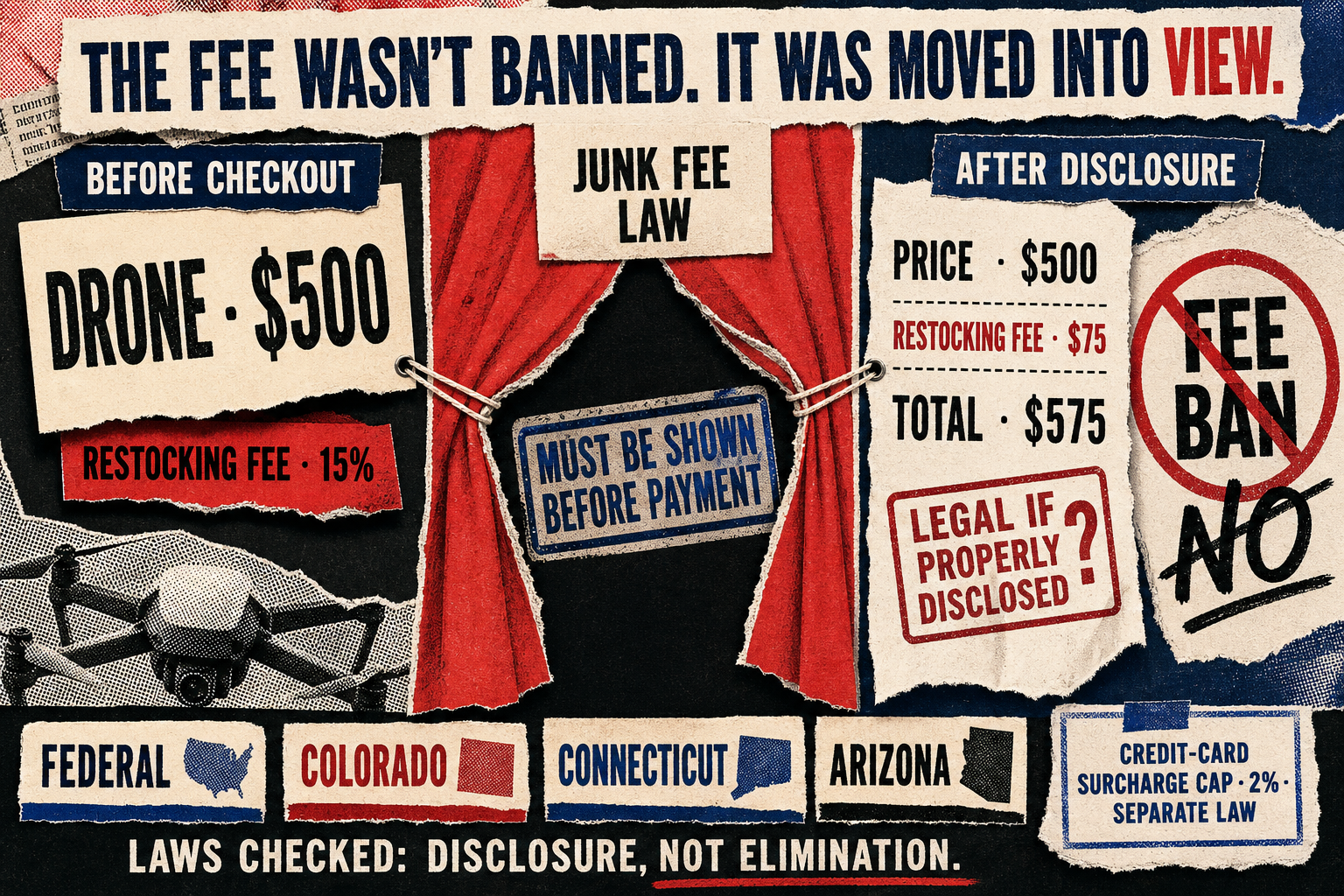
A wave of state laws and a federal rule landed within about a year of each other, all branded around stopping "junk fees" — the surprise charges added at checkout. It reads like regulators finally said no to convenience fees, restocking fees, resort fees, service charges. That's not what any of these laws actually do. Every one checked for this piece — federal, Colorado, Connecticut, Arizona — requires a business to show you the fee before you pay. None of them stop the fee itself.
Who's actually doing it, in current numbers
Best Buy, according to its published return policy as of this writing, charges a 15% restocking fee on drones, digital cameras, camera lenses, camcorders, electric bikes, electric mopeds, premium and mobility scooters, electric wheelchairs, projectors and projector screens, and special-order products — plus a flat $45 fee on activated devices (non-prepaid phones). My Best Buy+ and Total members are exempt. So is any unopened item.
The National Retail Federation's own 2025 Retail Returns Landscape report, with Happy Returns, surveyed retailers directly on why they've added return and restocking fees. Their own top reasons: increased cost of processing returns (40%), increased carrier shipping costs (40%), and economic uncertainty tied to tariffs (33%). That's their claim, not independently verified here — but it's their own stated reasoning, not a guess.
It isn't cost-free for them either. The same report found real blowback: 47% of merchants that started charging report more customer complaints, 37% lost customers specifically over the fee, 34% saw average order value drop, and 24% saw sales fall outright. Retailers are choosing this anyway — a real signal that, in their own calculation, the savings outweigh the customer loss. Restocking fees are getting more common, not less: 72% of retailers now charge some return fee, up from 66% the year before.
"Restocking"? "Convenience"? What the names actually claim
Restocking fee — what's actually in it. Industry return-logistics estimates — no named study behind the number, worth reading with that caveat — put the real components at roughly 15 to 30 minutes of labor to inspect a returned item, $2 to $5 in repackaging materials, and updating inventory records. On a low-cost item, that roughly tracks a modest flat fee. It does not obviously track a 15% cut of a $500 camera or a $2,000 e-bike. The gap between "someone spent half an hour checking this box" and "you owe us $75 to $375" is covered by a second, different justification bundled under the same name: diminished resale value. The same loosely-sourced industry consensus holds that opened electronics can lose 10% to 30% of resale value the moment the box is opened, regardless of condition — plausible as a real economic pressure on the retailer, but not a "restocking" cost in the literal sense of the word. It's closer to a used-goods discount, charged to the customer instead of absorbed by the seller. Nothing found in this research requires the fee amount to actually match either cost component — only that it be disclosed. A retailer can charge 25% on an item that costs $15 to actually process, and nothing checked here stops that as long as it's posted before you pay.
Convenience fee — convenient for whom, on the record. At a January 2023 Senate Judiciary Committee hearing on Ticketmaster, called after the Taylor Swift Eras Tour presale collapse, Live Nation president Joe Berchtold testified that fees are generally set by venues and said on the record: "The Live Nation venues have fees that are consistent with other venues in the marketplace, and cover the cost of the operation of those venues." Musician Clyde Lawrence testified at the same hearing that when his own band asks venues directly what the fee is and why, the answer is: "Not only do we not choose what it is, we don't even know what it is, we can't even tell you what it's going to be." Lawrence testified that fees on his own shows have run as high as 82% on top of the ticket price, with his band having, in his words, "absolutely zero say or visibility in how much these fees will be." That's a direct, on-record contradiction between what Live Nation's own president says the fee is for and what the people actually running the venues say they know about it — not a media characterization, sworn testimony from the same hearing. (That 2023 hearing is a separate episode from the active FTC lawsuit described below — different conduct, different year.)
What the new laws actually require: disclosure, not elimination
Colorado, effective January 1, 2026, has one of the most sweeping state fee laws in the country. The Colorado Sun's own reporting on it, after it took effect, put it plainly: "It wasn't a law to get rid of fees, only to bring attention to them before the bill arrives." Restaurant service charges and "appreciation fees" — the Sun's own example was a "Dumpling Chef Appreciation Fee" — are still completely legal. So are convenience fees on movie tickets, delivery fees, hotel resort fees, and Airbnb cleaning fees. They just have to be posted on the menu, the website, and the receipt.
One real cap does exist in Colorado, but it's a separate, older law, not part of the 2026 disclosure statute. SB21-091, effective July 1, 2022, repealed the state's old ban on credit card surcharges and replaced it with a hard cap: 2% of the transaction or the merchant's actual card-processing cost, whichever is less. That's a real, enforceable dollar limit — the only one found anywhere in this research — but it predates the 2026 fee-transparency wave by four years; don't credit it to the same law.
Connecticut's SB 3, effective October 2025, requires landlords to disclose recurring fees in advertised rent — but the law explicitly excludes payment processing fees from even having to be disclosed, on top of pet fees, utilities, and damage charges.
Arizona has a specific restocking-fee statute, A.R.S. § 44-1377. Read directly, it requires a business to disclose in print advertising that a restocking fee may apply, post a notice before purchase, and disclose it on receipts "in type at least as large as the majority of the printed text." It does not cap the fee amount. It does not ban it under any circumstance. It requires you be told.
The "8 states ban restocking fees" claim, checked all eight
Best Buy's own policy exempts purchases in Alabama, Colorado, Hawaii, Iowa, Mississippi, Ohio, Oklahoma, and South Carolina from its restocking fee. That list gets repeated across consumer-advice sites as "these states ban restocking fees." Checked all eight directly, and it's a genuine mixed bag, not one category:
Hawaii is the real thing. Hawaii Revised Statutes § 481B-5.5 actually bans deducting a restocking fee from a refund, exchange, or store credit, with narrow exceptions for custom orders and disclosed repack or pickup charges. Violating it is an unfair or deceptive trade practice. It's the only genuine consumer right found anywhere in this research that goes further than disclosure.
Ohio and South Carolina are the same trick, not a ban. Ohio Administrative Code 5703-9-11 and South Carolina Code of Regulations § 117-318.8 are both sales-tax rules: a retailer can still charge the fee, it just can't also claim the sale as a tax-deductible "return" if it does. That's a real financial disincentive — likely why Best Buy skips the fee in both states — but it is not a legal right consumers have, and it's not enforceable the way Hawaii's law is.
Alabama, Iowa, Mississippi, and Oklahoma have no traceable legal basis at all. No statute, regulation, or tax rule was found in any of the four that specifically restricts restocking fees. Best Buy's exemption in these states doesn't appear to trace to any discoverable law — it may be an internal business decision, but "the law requires it" doesn't hold up here the way it does for the other four.
So: one real consumer-protection ban (Hawaii), two tax-accounting workarounds that only look like bans (Ohio, South Carolina), and four states where a national retailer's own policy is more protective than any law on the books (Alabama, Iowa, Mississippi, Oklahoma). Hawaii consumers really do have a right the other 42 states don't.
The fees still completely unregulated
There is no federal law that bans or caps restocking fees, full stop. The FTC Act's general "unfair or deceptive practices" standard applies to how a fee is disclosed, not whether it can exist. Consumer Reports puts restocking fees at 15% to 20% of the purchase price, "but can go much higher" — a 2014 figure, still the most current on-record number found for this piece, worth reading with its age in mind. Separately, industry-aggregator sites put the general range wider, 10% to 25%, with furniture and custom orders running 30% to 50% — those figures aren't attributed to any named research source and should be treated as a rough industry estimate, not a verified number. Clothing returned unworn with tags usually escapes fees entirely.
What is broadly true, sourced to general state unfair-practices law rather than one specific statute: charging a restocking fee on a defective item, the wrong item, or an item the seller failed to deliver on time is treated as illegal in most states that address it at all — because at that point it isn't a restocking cost, it's a penalty for the seller's own error.
The federal rule has real teeth. It's just narrow.
The FTC's Junk Fees Rule took effect May 12, 2025, and covers exactly two things: hotels and short-term lodging, and live-event ticketing. Within that narrow lane, it's being enforced for real — the FTC settled with StubHub for $10 million in April 2026 over advertising ticket prices without the mandatory fees included. The FTC and seven states are separately suing Live Nation and Ticketmaster over what the FTC alleges is the same kind of "drip pricing"; that case is still active and unresolved, with Live Nation's motion to dismiss opposed by the FTC as of early 2026. Retail convenience fees, restocking fees, and nearly everything outside hotels and ticketing sit entirely outside this rule.
In March 2026, the FTC opened a public comment process on whether to write a new rule specifically for rental-housing fees — application fees, administrative fees, convenience charges, amenity fees. That window closed April 13, 2026, and the FTC hasn't announced whether it will move to an actual proposed rule or drop it. It's the one place where next year's fee rules are genuinely still being decided.
What can I do
An undisclosed fee is your strongest lever, in every state checked here. If a convenience fee, resort fee, or restocking fee wasn't shown to you clearly before you paid, that's the one thing every law above actually prohibits — dispute the charge on that basis first, in writing, citing the specific law: Arizona's A.R.S. § 44-1377, Colorado's 2026 statute, or your own state's posted-return-policy requirement.
Defective, wrong, or late merchandise puts a restocking fee on much shakier ground almost everywhere — say so explicitly when you dispute it.
Buying something on Best Buy's restocking-fee list? Keep it unopened until you're sure, or check whether you're in one of the eight exempted states — but know the actual reason before assuming it's a legal ban.
Credit card surcharges: if you're in Colorado, the cap is 2% under SB21-091 — name the bill if you need to dispute an overcharge. Elsewhere, ask your state attorney general's consumer-protection office directly; there's no single reliable national source for this, state by state.
And know there's no federal restocking-fee cap or ban to point to. Don't cite one that doesn't exist — cite the specific disclosure failure instead. That's the part of the law that's real.
The Receipts
- Colorado Sun: "What's Working: The fees Colorado consumers still face after 'junk fee' law has taken effect" (Jan. 17, 2026)
- Colorado SB21-091, credit card surcharge cap, effective July 1, 2022
- Arizona Revised Statutes § 44-1377
- Ohio Administrative Code 5703-9-11
- Hawaii Revised Statutes § 481B-5.5
- South Carolina Code of Regulations § 117-318.8
- FTC Rule on Unfair or Deceptive Fees, effective May 12, 2025
- FTC v. Live Nation Entertainment / Ticketmaster (filed Sept. 2025)
- FTC / StubHub settlement, $10 million, April 9, 2026
- FTC Advance Notice of Proposed Rulemaking, Rental Housing Fee Practices, published March 13, 2026
- Connecticut SB 3 / Public Act 25-44, effective Oct. 1, 2025
- National Retail Federation + Happy Returns, "2025 Retail Returns Landscape"
- Consumer Reports, restocking-fee percentage figures (2014)
- Senate Judiciary Committee hearing, "Ticketmaster's Market Power," Jan. 24, 2023