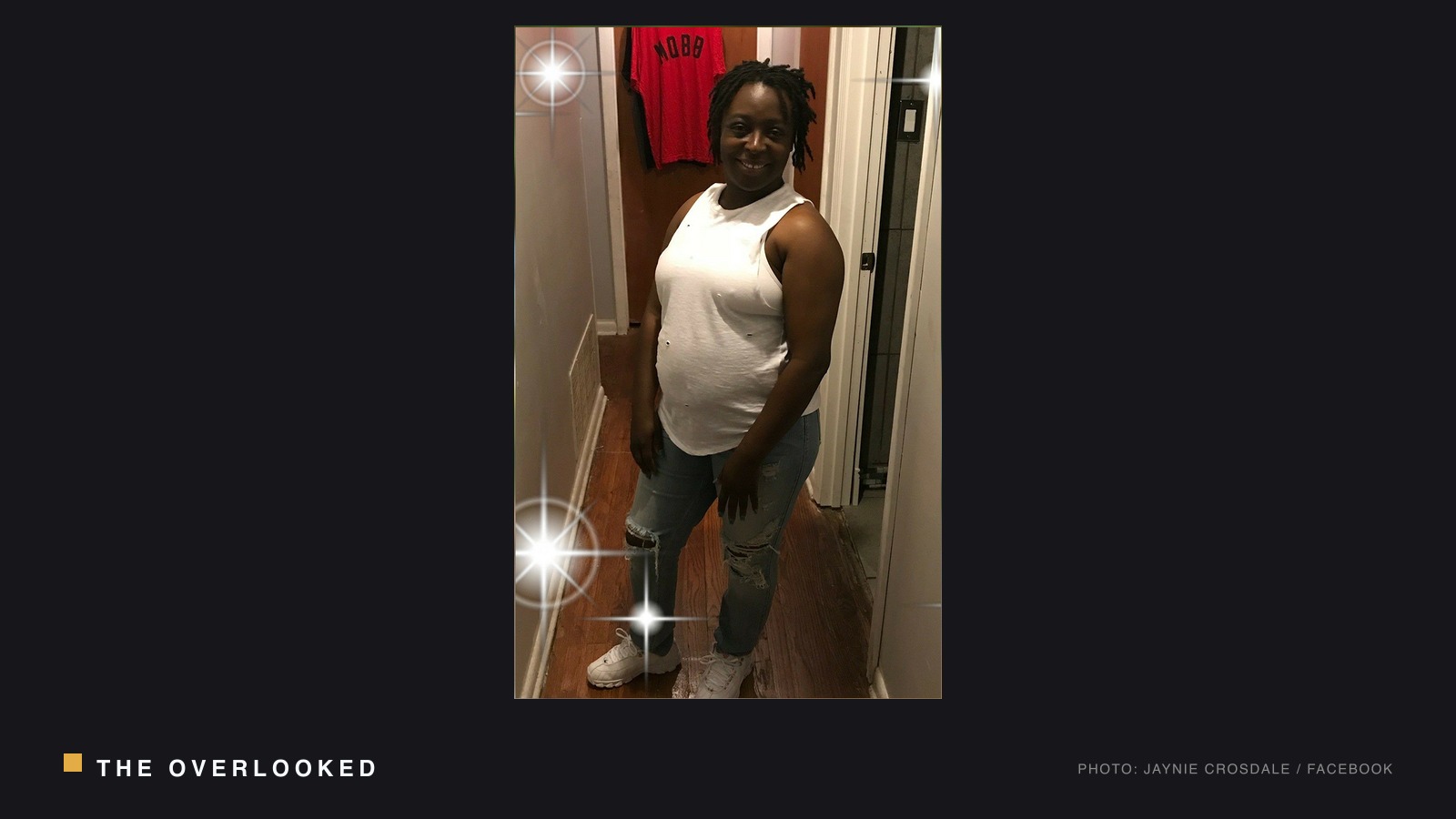
The kid who could talk to anybody
Before she was a name in a court file, Jaynie Crosdale was the fastest runner at Swinney/Volker Elementary in Kansas City.
Her cousin, Nikiyah Crosdale, told KCUR she was "just full of energy and life. She could talk to anybody. She was very charismatic." The popular one. Her family called her J-Bird.
Somewhere in her late teens or early twenties, that life moved to the street. She struggled with her mental health and used crack cocaine for years. Kris Wade of The Justice Project KC, who knew her for about two decades, told KCUR that Jaynie "was very independent and it was very difficult to offer her help of any kind."
Wade also said the thing that ought to sit at the center of any account of her: "She wasn't a bad girl. She was a sick girl."
She was known along Prospect and Independence Avenues. She received services from Relentless Pursuit Outreach & Recovery on Independence Avenue, an organization that works with women on the street — women who have been trafficked, women who trade sex to survive, women who are using. Michelle Newton, the group's outreach coordinator, told KSHB that when she knew Jaynie sober, she was "gregarious," "very headstrong," "smart, bright, and witty."
Her family has been clear about what those years did not change. "Even when she was in the streets," they said, "we never stopped loving her. We prayed for her."
The absence that generated no paperwork
At some point, Jaynie stopped coming around.
Newton told KSHB that her organization only put it together later: "When the news came out about what was going on down here, we started inquiring and no one had seen her."
The first official record that Jaynie Crosdale was missing was created on January 12, 2023. Not by a detective. By a relative — and not an immediate family member.
KCPD Sgt. Jake Becchina described that report to KCUR in an email: "In this report a relative (not immediate family) responded to the East Patrol Division police station to pass along information that they had not seen her in an amount of time and they thought she could be missing."
It came one day after Excelsior Springs police released her photograph and named her a possible witness in the case against Timothy Haslett Jr.
Prosecutors would later allege that Jaynie was killed sometime between June 6 and October 7, 2022 — months before that first report was ever filed.
What the department said, and why it matters
In September 2022, Bishop Tony Caldwell of Eternal Life Church posted a video saying women were being killed near 85th and Prospect and that nobody was looking for them. The Kansas City Defender, a Black-owned news outlet, carried it. A separate post on Twitter repeating those claims — four killed, three missing — drew more than 200,000 likes before it was removed.
Those specific numbers were never confirmed. Police disputed them directly.
On September 27, 2022, Newsweek published the Kansas City Police Department's response:
"We want to make the public aware this claim is completely unfounded. There is no basis to support this rumor. Furthermore, we notify the media any time we respond to a homicide… There has been 1 female homicide victim in the last six weeks."
Ten days later, on October 7, 2022, a 22-year-old woman escaped a basement in Excelsior Springs. She told police she had been held there for a month, beaten and raped. She said she had been taken off Prospect Avenue — the same street named in the warnings. Timothy Haslett Jr. was arrested that day and has pleaded not guilty to every count.
The department gave a second answer that October, to ABC News, and it is the more important one:
"In order to begin a missing person's investigation, someone would need to file a report with our department identifying the missing party."
That statement is true. It is also the entire story.
A police department can only look for the people it has been told to look for. Jaynie Crosdale's name was not on that list. It would not be on it for months — and by the time it was, prosecutors say she had already been dead for the better part of a year.
The unit that wasn't there
There is one more piece of context, and it cuts for the department as much as against it.
During the months Jaynie Crosdale disappeared, the Kansas City Police Department did not have a missing persons unit.
Its Missing Persons Section had been broken up in the spring of 2022 amid staffing shortages — KCPD's own word for what happened is "reconfigured"; local reporting described it as disbanded. Prosecutors allege Jaynie was killed sometime between June 6 and October 7 of that year.
On April 11, 2023, Chief Stacey Graves announced the Section was coming back, effective that April 16, with seven detectives and one sergeant assigned solely to finding missing people. The department's own announcement said Graves revived it "after listening to the community's concerns."
By then, Jaynie had been in the system as a missing person for three months. Her remains were found that June.
What this piece is not saying
The dates matter here, and they cut against the easy version of this story.
Prosecutors allege Jaynie was killed between June 6 and October 7, 2022. Bishop Caldwell's warning came in September. So the argument about whether anyone should have been looking arrived, at best, in the middle of that window — and more likely after it had closed.
Nobody has established that a different police response would have saved her. The record does not show that, and this piece does not claim it.
What the record shows is narrower and, honestly, worse: Jaynie Crosdale could be gone for months and generate no official trace of any kind. When the police were asked about missing women, they answered — accurately — that no reports had been filed. Nobody had filed one on her.
"Possible witness"
When Jaynie finally entered the official record, it was not as a missing woman. It was as a possible witness.
"Possible witness" is a category police use for someone who might know something. It is not a category for someone who is missing.
Crime Stoppers put up a billboard in Kansas City. It carried her photograph and read: HAVE YOU SEEN JAYNIE CROSDALE — WITNESS IN EXCELSIOR SPRINGS KIDNAPPING.
Her family saw the language for what it was. Nikiyah Crosdale told KCUR: "It's a slap in our face, as our family knows the kind of person (Jaynie) was. She'd never jeopardize anyone else. The language could have been different."
Jaynie was, in the state's telling, useful. She had not been worth looking for on her own account for months — but she was worth a billboard once she might help someone else's case.
What happened next
On June 24, 2023, two kayakers found her remains in a blue barrel in the Missouri River.
Timothy Haslett Jr. had already been charged in February 2023 with nine felonies — rape, kidnapping, sodomy and assault — in connection with the woman who escaped. He has pleaded not guilty.
The first time his case and Jaynie's name were publicly connected, his defense was not that she had never been in his house. At a bond hearing in August 2023 — eleven months before any murder charge existed — his public defender, Tiffany Leuty Winningham, told reporters outside the courtroom: "We've never said that Jaynie Crosdale wasn't in Mr. Haslett's home. They have video of her at his house. I think they had consensual sex."
On July 9, 2024, prosecutors charged Haslett with first-degree murder in Jaynie Crosdale's death. His bond was raised to $5 million. He has pleaded not guilty to that count as well. His attorney declined to comment when the charge was announced.
No court has decided any of it. His trial is currently set for October 26, 2026, in Clay County Circuit Court before Judge David Chamberlain, with a pretrial conference on October 9. The date has already moved more than once.
It is worth being precise about what is actually known. At a news conference announcing the murder charge on July 9, 2024, Clay County Prosecutor Zachary Thompson said an autopsy of Jaynie Crosdale found wounds consistent with a gunshot at or near the time of her death, and that she was killed "by an act of homicidal violence."
Those are the prosecution's findings, presented on the day it brought a charge. Thompson said the rest himself, in the same news conference: "The charge of an offense is not evidence of guilt, and defendants are presumed innocent until found guilty in a court of law."
The part that is fixable
There is nothing anyone can do now about the six months in which nobody told the police that Jaynie Crosdale was gone.
But the reason those months were possible is not a mystery, and it is not unique to her. A missing adult in America generates a police record only when a specific human being walks into a station and files one. If the people around you are themselves on the street, or wary of police, or simply assume you have gone quiet for a while — as people had reason to assume about Jaynie — that report may never get filed at all.
Missouri law is clear that the report itself should be easy. Under RSMo 43.401, no agency may impose a waiting period: "No law enforcement agency shall prevent an immediate active investigation on the basis of an agency rule which specifies an automatic time limitation." Once a report is filed, it goes into two systems — Missouri's own MULES network and the FBI's National Crime Information Center.
What Missouri does not require is entry into NamUs, the national database built to match missing people against unidentified remains. The statute does not mention it. A bill to require it has been introduced in Jefferson City more than once and has not become law.
In Jaynie's case the databases were never the failure — the report was. But the two failures are the same shape: a system that only works once somebody puts a name into it, and no requirement that anybody ever does.
The receipts
- KCUR 89.3, Aug. 28, 2023 (Peggy Lowe) — Jaynie's life and family; Nikiyah Crosdale and Kris Wade interviews; KCPD Sgt. Jake Becchina's email on the January 12, 2023 report; the family's objection to "possible witness."
- KSHB 41 — Michelle Newton of Relentless Pursuit Outreach & Recovery on Jaynie sober, and on her absence going unnoticed.
- Newsweek, Sept. 27, 2022 — KCPD's "completely unfounded" statement in full, including its six-week homicide count.
- ABC News, Aug. 2023 — KCPD: "In order to begin a missing person's investigation, someone would need to file a report with our department identifying the missing party."
- Excelsior Citizen, July 9, 2024 — Clay County Prosecutor Zachary Thompson's charging news conference: the autopsy findings, "an act of homicidal violence," the June 6–Oct. 7, 2022 window, and his own statement that a charge is not evidence of guilt.
- Clay County Sheriff's Office, July 2024 — first-degree murder charge announced; bond raised to $5 million.
- Excelsior Citizen, Sept. 14 and Oct. 14, 2025 — trial rescheduled to Oct. 26, 2026 before Judge David Chamberlain, per the court docket; pretrial conference Oct. 9, 2026.
- Kansas City Police Department, "Missing Persons Section Returns," April 11, 2023 — the Section, "reconfigured a year ago," returning April 16 with seven detectives and one sergeant, revived by Chief Stacey Graves "after listening to the community's concerns."
- Missouri Revised Statutes § 43.401 — MULES and NCIC entry required; NamUs not mentioned; no agency may impose an automatic waiting period.
- Democracy Now! and Capital B News, Oct. 2022 — Bishop Tony Caldwell's September video and the dismissal that followed.