What happened
Macklemore opened for Sheeran at MetLife Stadium in New Jersey on September 4 and 5. He wore a keffiyeh, showed footage of destruction in Gaza, performed his 2024 protest song "Hind's Hall," and led the crowd in "Free Palestine" chants.
Macklemore says New England Patriots owner Robert Kraft — whose Gillette Stadium was booked to host Sheeran on September 25 and 26 — rallied other stadium owners into a collective ultimatum: if Macklemore stayed on the tour, none of their venues would host Sheeran's shows. That account comes from Macklemore, relaying what he says Sheeran told him; Kraft's own public statement addresses only Gillette Stadium's own policy and doesn't confirm he organized anyone else. Wikipedia's summary of the episode notes several venues "independently notified" the tour, and reporting on other owners "backing" Kraft's position is attributed to the Wall Street Journal and explicitly caveated as alleged — none of those other owners have commented publicly. Kraft's public justification: "Gillette Stadium has a longstanding commitment to providing a welcoming environment for all guests and ensuring that events held at our venue do not provide a platform for hate speech," citing what he called "a broader history of antisemitic rhetoric and imagery" from Macklemore. He also said he'd "welcome the opportunity to sit down with Macklemore" to discuss it directly. Macklemore has directly disputed the antisemitism characterization: "To all of my Jewish brothers and sisters: criticism of Israel, criticism of apartheid, being against genocide in no way is a criticism of you."
On September 14, Messina Touring Group — the tour's US promoter — announced Macklemore was off the remaining dates, saying venues had told them they'd cancel the shows otherwise, which "would result in the cancellation of the tour and impact hundreds of thousands of fans."
By September 15, every other remaining opening act — Finneas, Lukas Graham, Beoga, and Aaron Rowe — had withdrawn from the tour, each publicly voicing support for Macklemore.
Who actually made the call — the part that's genuinely unresolved
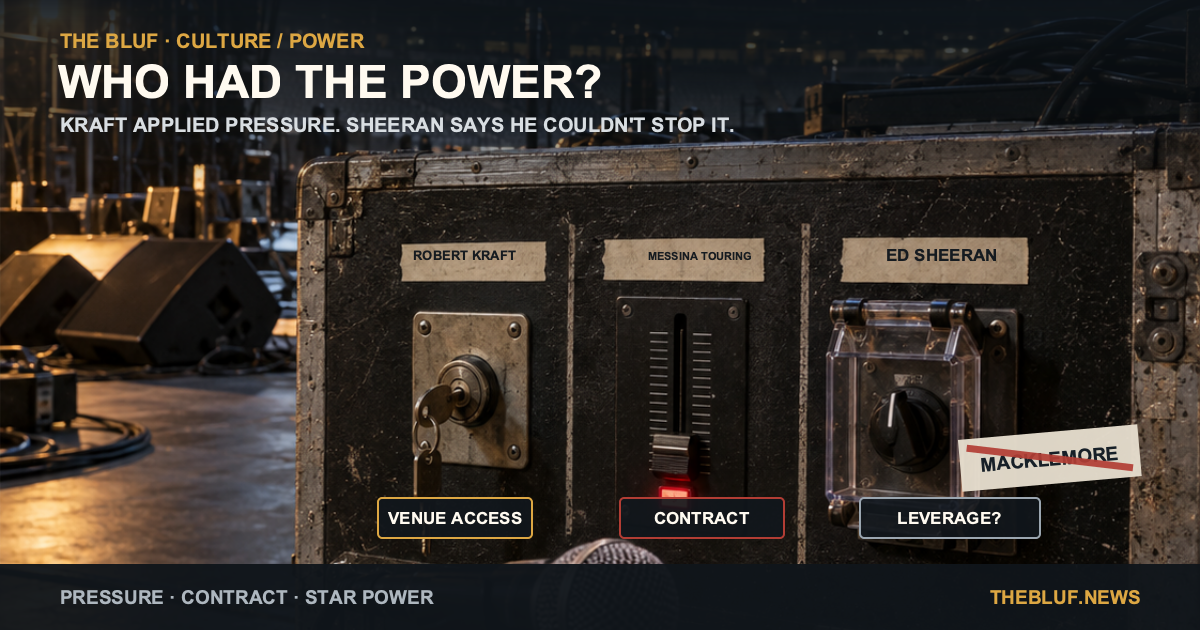
Three different kinds of power were in play here, and they don't line up cleanly.
Formal control: Messina Touring Group held Macklemore's contract for the tour, not Sheeran personally. Messina made the announcement. That part isn't disputed.
Venue veto power: Kraft and the other stadium owners weren't disagreeing with a creative choice — they were threatening to simply not open their doors. That's closer to landlord power than a booking dispute. Even an artist with full approval over his own lineup can't force a privately owned stadium to physically host a show it's refusing to hold.
Industry-norm authority — where the real tension sits. Entertainment lawyer Dean Sheldon Serwin, quoted by the AP on this exact story, put it plainly: "At the end of the day that superstar headliner is going to have approval over everything." Concert-industry analyst Ray Waddell, same reporting: "The promoter puts up the money, pays all of the acts, deals with the venue" — but "almost without exception the promoter wants to do what the artists want." Two people with no stake in the outcome are describing an industry where a stadium-filling headliner like Sheeran normally drives what his own promoter does — promoters don't usually override the artist, they execute what the artist wants.
Sheeran's own account is the exception to that norm: he said on Instagram that "Macklemore coming off tour was the promoter's decision; it was not mine," that "Macklemore's contract for the tour was with the promoter, not me," and that "the venue's and promoter's decision was final."
It's also worth knowing Messina and Sheeran aren't an arm's-length pairing hired for one tour. Sheeran first worked with promoter Louis Messina in 2013, opening for Taylor Swift, and that relationship is publicly credited with shaping his touring career since — a 13-year business partnership, not a stranger he brought on for this run. Messina's own statement said the removal came "after discussions with stakeholders" — language that doesn't specify whether Sheeran's camp was consulted and agreed, or simply informed after the fact.
What's actually settled: Kraft created the pressure. Messina executed the removal. Whether Sheeran was genuinely boxed out, or had real leverage and chose not to spend it, is the one load-bearing fact nobody involved has proven either way.
The jobs argument — real, and worth weighing fairly
Sheeran has a legitimate, verified reason for not fighting harder — regardless of how much leverage he actually had. In his own statement: "I would never let down the fans who had made plans, nor would I abandon the touring crew and the other support acts and musicians who rely on me for work and to make a living."
That's not a deflection to dismiss. A canceled stadium tour doesn't just cost Sheeran — it costs every crew member, driver, tech, and local vendor tied to those dates, and the fans who'd already made plans around it. That's a real, sympathetic cost.
It's also, honestly, the same logic that favors compliance whenever someone applies pressure like this. Nobody who goes along with an ultimatum frames it as caving — they frame it as protecting the people downstream. Both things can be true: the jobs argument is real, and it's also functionally the explanation people reach for whenever they go along with an ultimatum instead of testing it — whether or not they actually had the power to push back.
"I don't do politics" runs into his own record
Sheeran's defense for not pushing harder rests partly on a consistent, personal rule: "There is a reason I do not use my professional platform for politics." He's said versions of this before — "People buy my records to put on while they make out. I'm not Mr Political."
His own history doesn't back that up. Sheeran played Concert for Ukraine in 2022. He's campaigned against Brexit and against far-right racism. He publicly supported Jeremy Corbyn. Ukraine specifically isn't a small or safe issue to weigh in on — it's a live war, the same category of conflict as Gaza.
That's the real tension, and it's not just BL:UF making the connection — Newsweek, The Conversation, and writer Jason Okundaye have all argued the same thing since this broke: that Sheeran isn't apolitical so much as selective about which causes he'll put his name behind, and that Gaza is where he drew the line this time.
What this actually comes down to
Kraft used venue access — leverage that had nothing to do with a creative decision by Sheeran or his own team — to force Macklemore off the stage over content Kraft characterized as hate speech. That Kraft, not Sheeran, wielded that leverage isn't in dispute, and it's the part that should worry anyone who thinks performers should be able to say what they think from their own microphone. Whether Sheeran is a bystander who got run over by that pressure, or a headliner who had more power than he's admitting and chose not to spend it, isn't settled — and it won't be until either Sheeran, Messina, or someone inside that negotiation says more than they have so far.
The Receipts
- Macklemore–Ed Sheeran tour controversy | Wikipedia
- Robert Kraft Defends Banning Macklemore From Ed Sheeran Tour | Variety
- Macklemore Says Robert Kraft, NFL Owners Blacklisted Him | TMZ
- Ed Sheeran Breaks Silence on Macklemore's Tour Exit | Rolling Stone
- Ed Sheeran's Cousin Unloads on Him: 'He's a Coward' | Complex
- Ed Sheeran Addresses Macklemore Controversy On Stage | Variety
- The Macklemore And Ed Sheeran Situation Explained | Forbes
- Who Is The Promoter Ed Sheeran Says Is Responsible? | Newsweek
- Artists, promoters and venues have their own kind of power | ABC News
- Ed Sheeran Macklemore Tour: Who Really Controls the Stage? | KMOB
- Ed Sheeran speaks out after Macklemore dropped from tour | ABC News
- Does Ed Sheeran Avoid Political Statements? | Newsweek
- When does being 'apolitical' become a political act? | The Conversation
- Ed Sheeran thought fans didn't want artists to be politically engaged | Politixia
- Macklemore Says 'Free Palestine' Is Not a 'Criticism' of Jewish People | Variety
- Macklemore Says Robert Kraft, NFL Owners Blacklisted Him | TMZ — source for the Kraft-organizing claim; note it's Macklemore's account, not independently confirmed.